Archive of Australian Alternative Comics: INTERNATIONAL EXHIBITION OF DRAWINGS-COMICS

Archive of Australian Alternative Comics, Art, Comics January 12, 2012

Thirteen years ago the 14th International Exhibition of Drawings opened at the Museum of Modern Art in Rijeka, Croatia. It ran from 17th December 1998-20th March 1999. It was devoted to comics. I had been invited to contribute to the curation of the show…based on the research into comics art that I was undertaking at the time… following a referral from Professor Joan Kerr of Australian National University…I selected and sent 13 works by 14 creators…I also wrote an essay The Australian Underground. It was published in the exhibition catalogue in both Croatian and English…here is a short extract:..”In its own small way the underground comics community not only contributes to the visual cultural life of Australia but also to an understanding of it. It adds to the ongoing critique of Australian culture and provides a healthy and relatively unregulated creative outlet. From its position on the margins its critical viewpoint is expressed with great humour. ‘Taking the piss out of things’ would seem an appropriate and very Australian way of describing it.” (extract) Dr. Michael Hill

Cover of the exhibition catalogue. Design by Mirko Ilić, drawing by Davor Vrankić
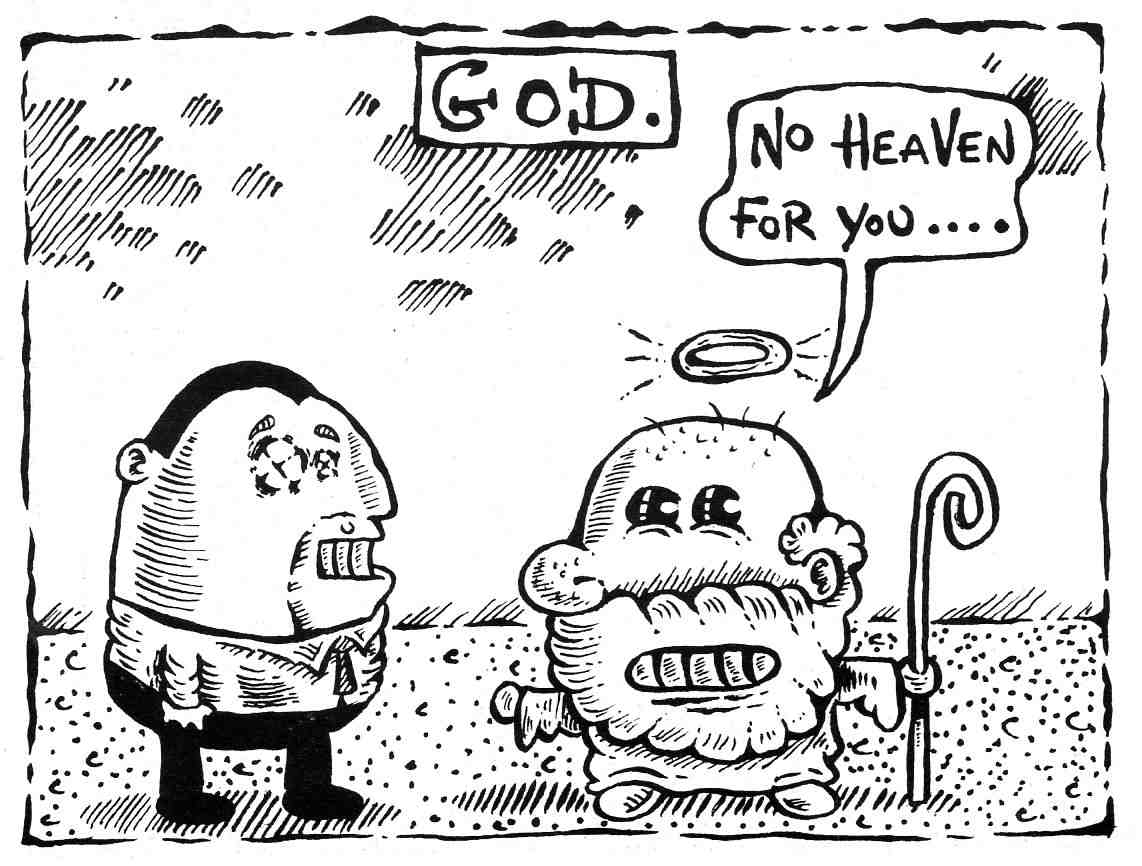
The Comic Messiah by Q-Ray (Clint Cure), 1998, ink on paper.

Other artists in this exhibition included: Max Andersson, Enki Bilal, Guido Crepax, Will Eisner, Jason(John Arne Sæterøy), Henry “Hank” Ketcham, Brant Parker, Hugo Pratt, Quino, Bryan Talbot, Mort Walker and Song Qing Zhu (Gao Diao). It was wonderful to see the work of emerging Australian creators displayed alongside these established international comics art creators. I’d love to hear your comments and comparisons of their graphic styles.

Black Light Angels by Louise Graber, 1998, ink on paper.
Blackie’s last day by Tony Single, 1994, pencil, felt pen, ink on paper.
Upward + Onward by Damien Woods, technical pen and felt pen on photocopy paper.
Lightning Strike by Mandy Ord, 1998, ink on paper.
Radiation Sickness by Ross Tesoriero, 1997, ink on paper.
Ah-choo by Neale Blanden, 1997, combined technique on paper.
Jean and Rolly by Timothy John Danko, 1995, collage on paper.
Kurt Hurt’s Reasons to Draw Comix by Stuart Stratu, 1997, ink and whiteout on paper.
Francis Bear by Gregory Mackay, 1998, ink on paper.
Stranger Danger by Ryan Vella, 1997, ink on paper.
Bernard Caleo and Tolley-The False Impressionists, 1997-combined technique on paper.
The False Impressionists by Bernard Caleo and Tolley, 1997, combined techniques on paper.
The Killer Foetus by Ben Hutchings, 1997, combined technique on paper.

It was most significant for my research into Australian comics art to be included in this international exhibition of drawings. In the meantime, I’m endeavouring to establish a minimum three week gap between posts. Perhaps I was a little too enthusiastic in my first year of blogging but I am working on improved scheduling. As always, I would love to hear your response to my posts. This post is the fifth in the series Archives of Australian Comics History…that document moments in the recent history of Australian comics… particularly alternative comics and the Australian Small Press. I started researching this subject in the late 1990s and it eventually led to my PhD thesis: Ph.D. Macquarie University, Division of Society, Culture, Media and Philosophy… A Study Of Contemporary Australian Alternative Comics 1992-2000 With Particular Reference To The Work Of Naylor, Smith, Danko And Ord, 2003. On completion of the research I donated the research materials and comics I had collected to the National Library of Australia, titled the Michael Hill Collection of Australian Comics

(All text-©2012 Dr. Michael Hill a.k.a. Doctor Comics).

FLYING THE ANIME FLAG ON TREASURE ISLAND

Art, Comics, Film, Japanning November 14, 2011

Last month I spent a wonderfully productive week in Fiji…on behalf of the Japanese Embassy and the Japan Foundation in Sydney…to present a lecture and workshop at the School of Arts, Language and Media, University of the South Pacific. I also introduced films at an Anime festival held there. It was part of Japan Culture Week 2011 in Suva, the capital city on the largest of the 300 islands. It seemed like an act of cultural colonisation…with the raising of the Anime and Manga flags and the flying of their colours on Treasure Island…creating a little Anime and Manga paradise in the Pacific Ocean.

Lecturing on the global spread of Japanese pop culture in the 1980s. (Photo by Louise Graber)
Dr. Michael Hill at the University of the South Pacific in Fiji…presenting a slide lecture for the Japan Foundation on the global spread of Japanese pop culture in the 1980s. (Photo by Louise Graber)

My lecture titled Up In The Air: Anime’s Journey To The Stars described the global success of Japanese animation…and its rise to prominence both in the film world and in popular culture. It covered the work of Osamu Tezuka and its international success. It also referred to Rintaro’s involvement with him as an animation director on Astro Boy…prior to his subsequent productions that included his Tezuka homage film Metropolis…his adaption of Leiji Matsumoto’s manga Galaxy Express 999, and of Sanpei Shirato’s manga The Dagger of Kamui. Describing Shirato’s beginnings as a kamishibai artist…before moving to manga and the alternative publication GARO…the lecture included anecdotes from my time as a lecturer at Sydney College of the Arts…and the University of Technology, Sydney where I observed the growing interest of students in Japanese popular culture. They became fascinated with manga, Anime, cosplay, fashion,…J-Pop, scanlations, computer games…cameras, turntables, TV game shows,…food and fashion, not to mention learning Japanese and visiting Tokyo. The lecture concluded with an analysis of the productions…and the rise to prominence of Hayao Miyazaki and Studio Ghibli…who, like Tezuka, found both both an international audience and critical acclaim.

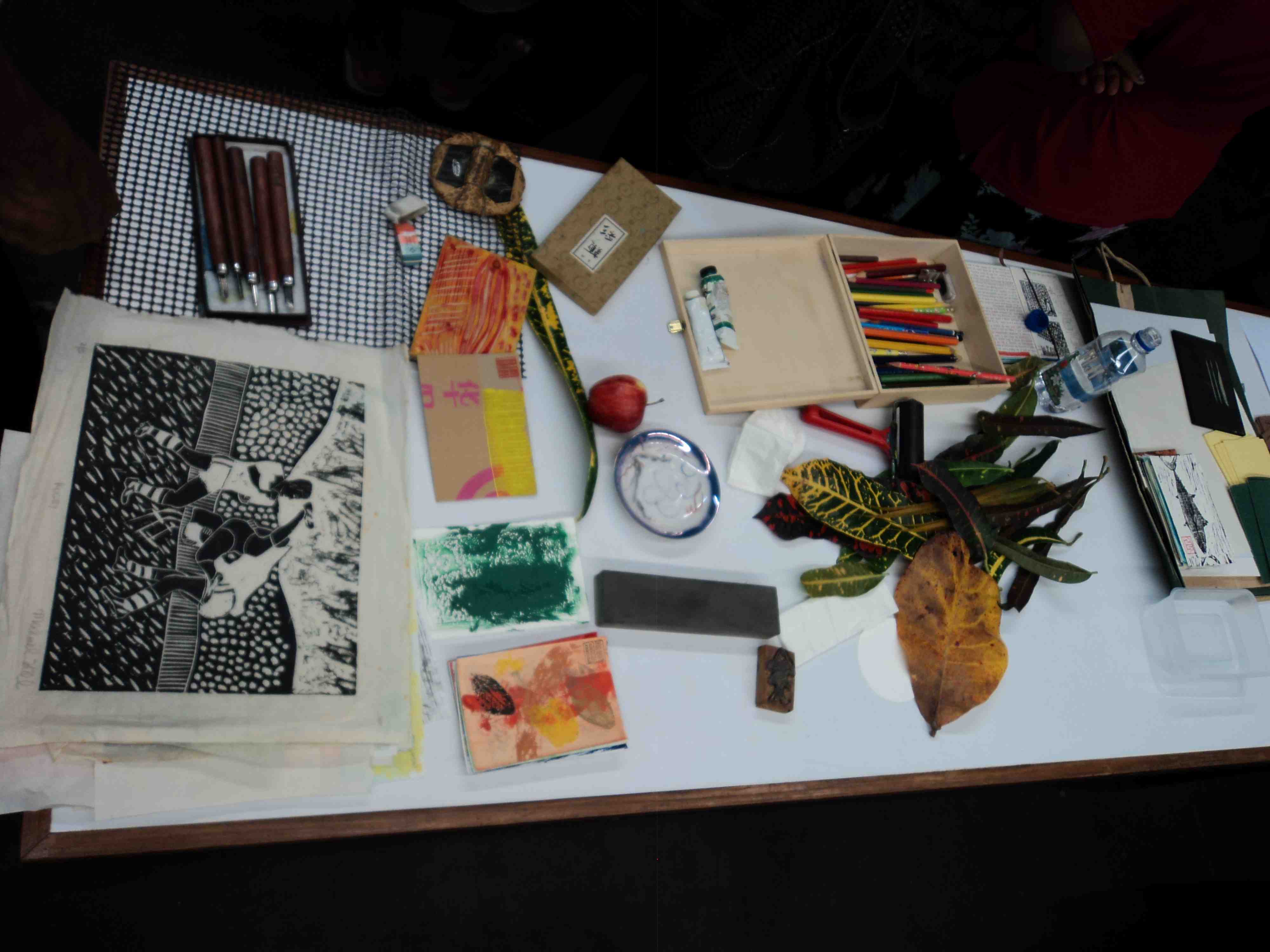
The tools and materials for the printmaking workshop. My Rugby woodblock print is on the table alongside some of my art postcards and printmaking tools. (Photo by Louise Graber)

In addition to the theory lecture I presented a practical arts workshop…demonstrating the printmaking technique I had developed as part of my artistic practice. Based on the Japanese creative print movement Sosaku Hanga,…and the work of Koshiro Onchi and Shiko Munakata  in particular. I showed examples of my work that had been made using this approach and methodology…and applied to my prints, postcards, T-shirts and comics.

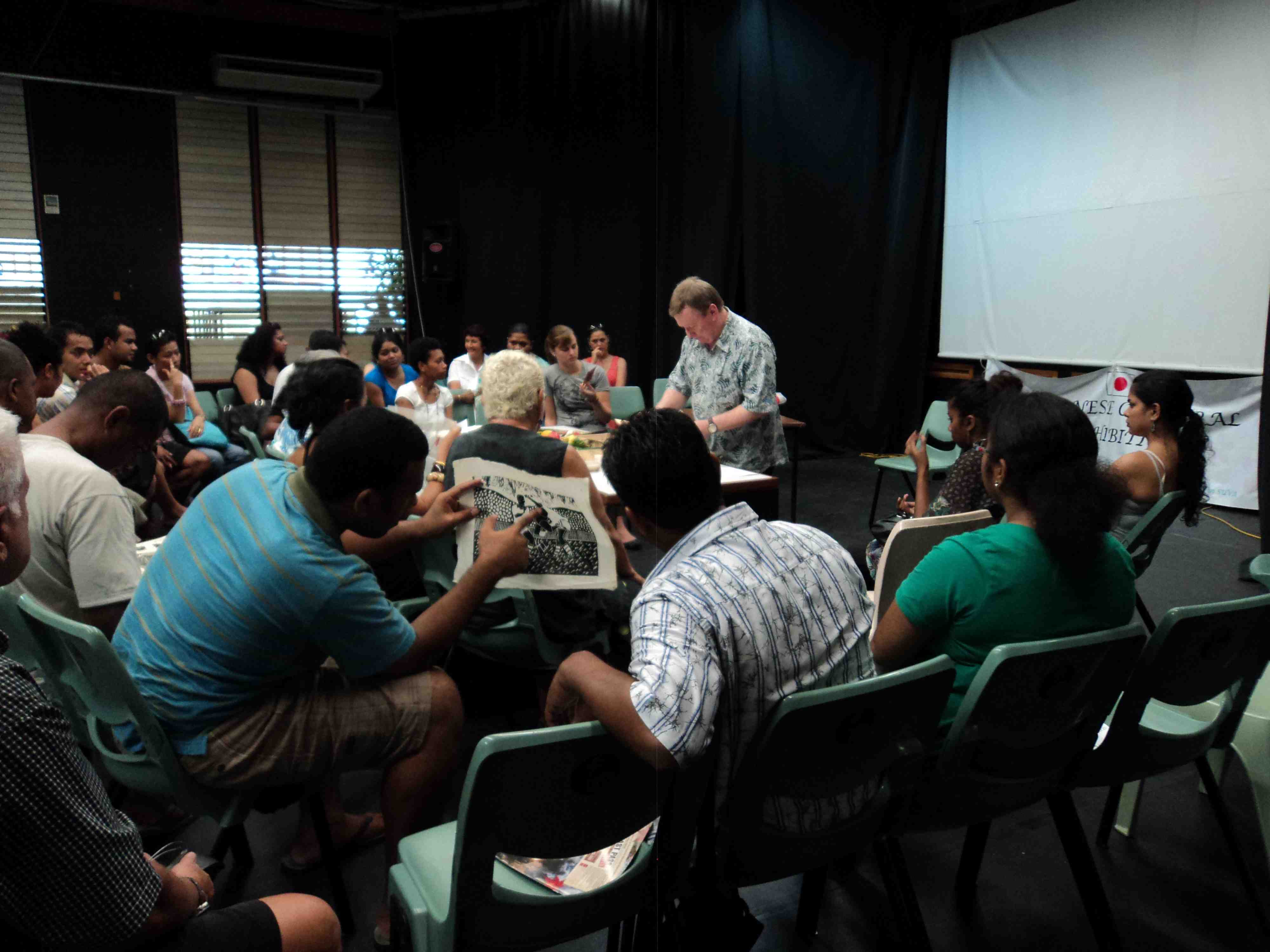
Dr. Michael Hill teaching printmaking techniques to students of the University of the South Pacific. In the foreground his Rugby themed woodblock print is being studied. (Photo by Louise Graber)

After the demonstration the students had the opportunity to make their own prints. By chance, the cultural activities took place in the same week as the Rugby World Cup finals…and the only paint colours to hand were those of the Wallabies, yellow and green. My own rugby woodblock print (being passed around the class, in the photos above) provided some amusement and interest.

The ‘sosaku hanga’ creative printmaking workshop. (Photo by Louise Graber)

Downtown, on the roof of the Village Cinema complex Batman and Spiderman look down…intrigued at the sight of people going in to see the Ninja super hero Kamui. It was here that the Anime Film Festival was held each evening. Films screened included Galaxy Express 999…The Dagger of Kamui…Laputa: Castle in the Sky and The Girl Who Leapt Through Time. Anime is now a fixed part of the Japanese cultural coat of arms…emblematic of the country’s long history of graphic arts which feeds into and nurtures both Anime and manga. The week long festival of Anime films and supporting cultural events was an alternative offering to American movies…and helped spread Japanese popular culture in the South Pacific.

Village Cinema Centre, Suva, with superhero cinema on the screens. (Photo by Louise Graber)


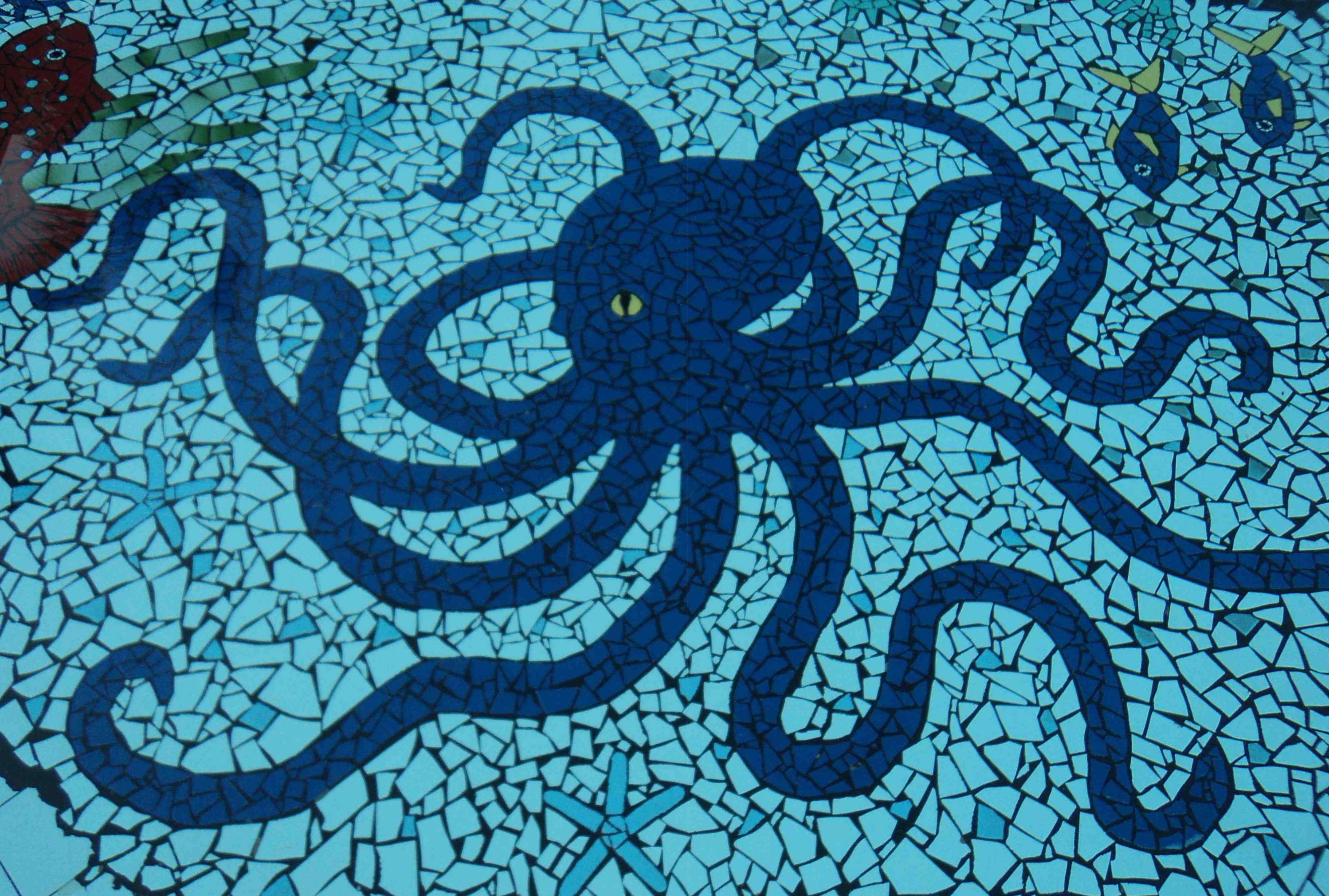
In the hotel pool in Nadi, my friend the octopus. (Photo by Louise Graber)
At the bottom of the hotel pool in Nadi, the elegant octopus tile design. (Photo by Louise Graber)


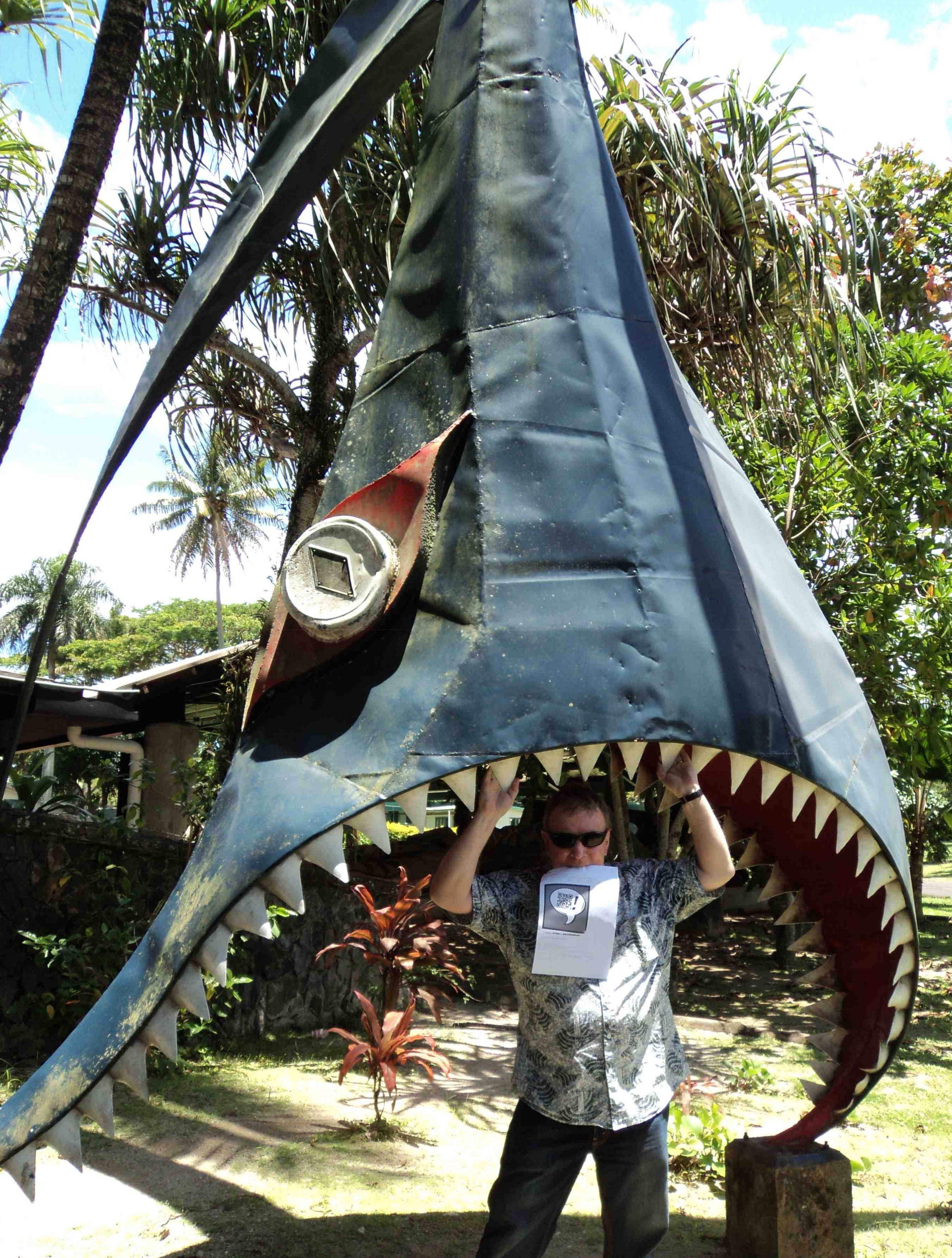
Doctor Comics in  shark jaws at the University of the South Pacific. (Photo by Louise Graber)
Dr. Michael Hill a.k.a. Doctor Comics playfully poses in shark jaws at the University of the South Pacific in 2011. (Photo by Louise Graber)


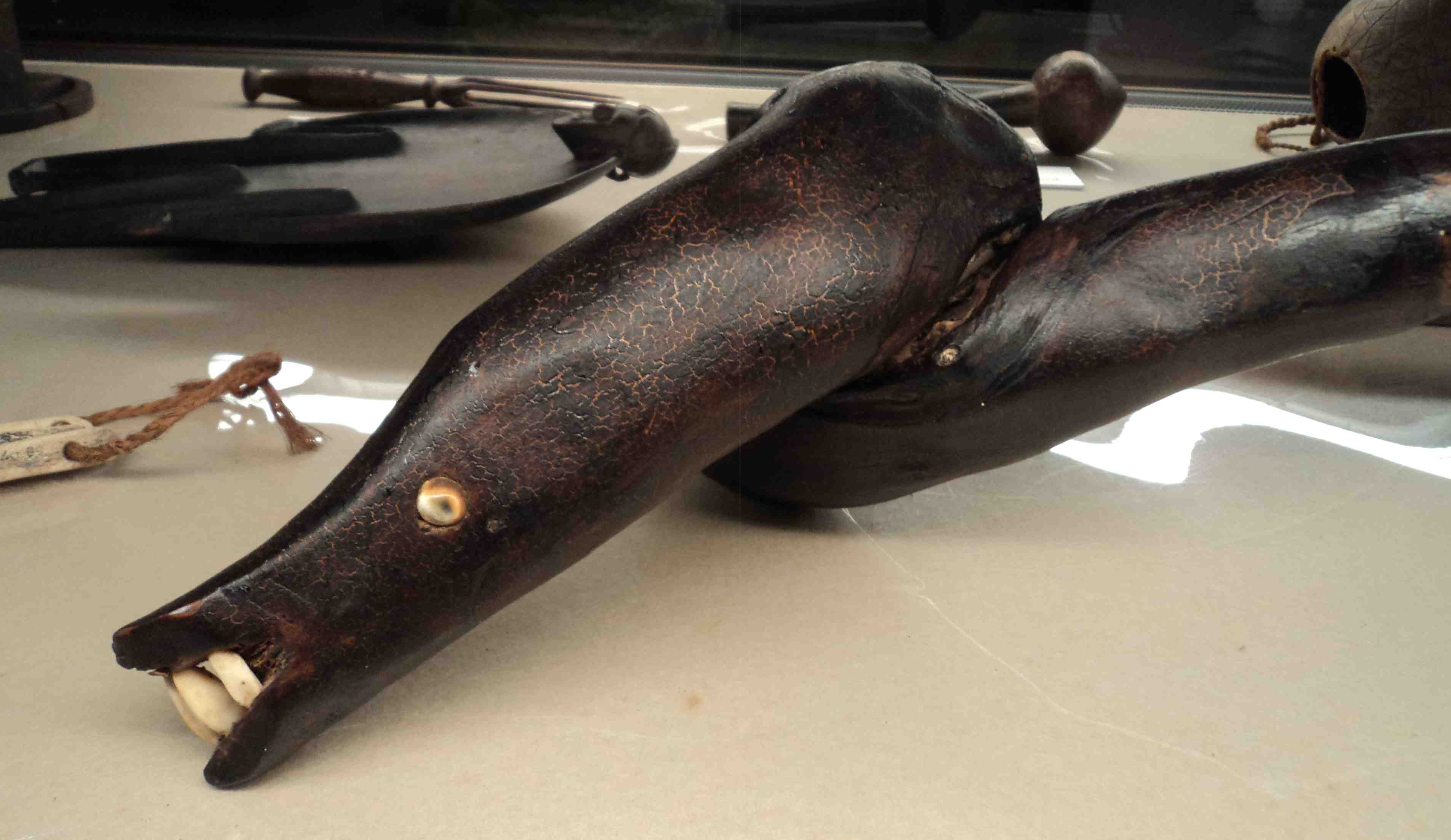
In the Fiji Museum in Suva, the Eel God sacred club. (Photo by Louise Graber)

In addition to my admiration of the octopus and various fish I am also a fan of the eel. During my Fiji visit I was pleased to find that the eel had acquired the status of a deity…and a creative one at that…in Melanesian mythology. Below is an artwork I had created, featuring eels once found in the Parramatta River near Blacktown in Sydney.

My own eel art work(print, painting and collage-© 2009 Michael Hill).
My impression of the freshwater eels once found and fished in the Parramatta River near Blacktown, Sydney…a mixture of printmaking, painting and collage-© 2009 Dr. Michael Hill a.k.a. Doctor Comics.

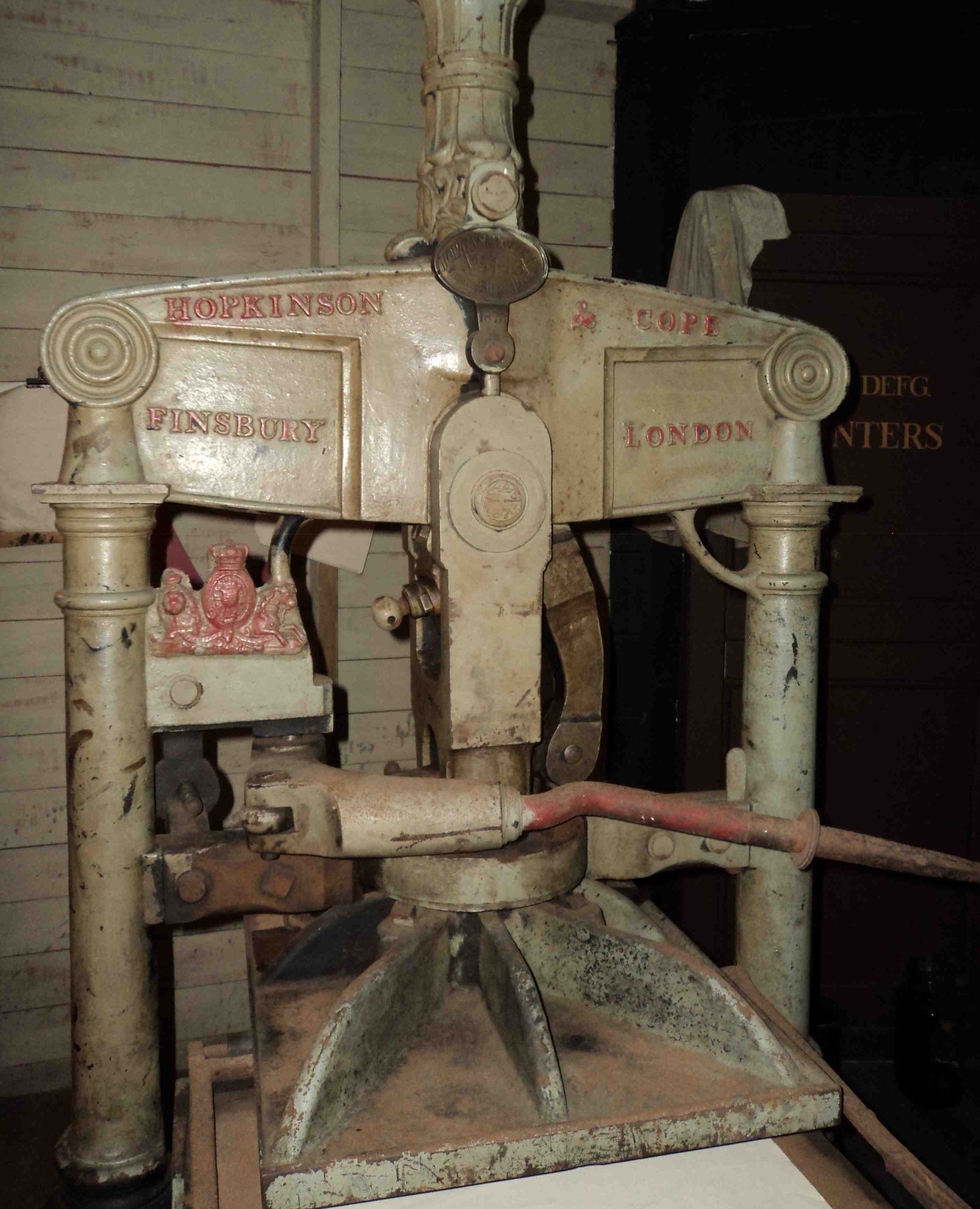
Another treasure inside the Fiji Museum was this old metal Hopkinson & Cope printing press…imported from England in earlier days. At my printmaking workshop in Suva I demonstrated an alternative, Japanese method…that employs one’s body weight as a press instead of a device such as this.

Old metal, pre-digital printing press. (Photo by Louise Graber)

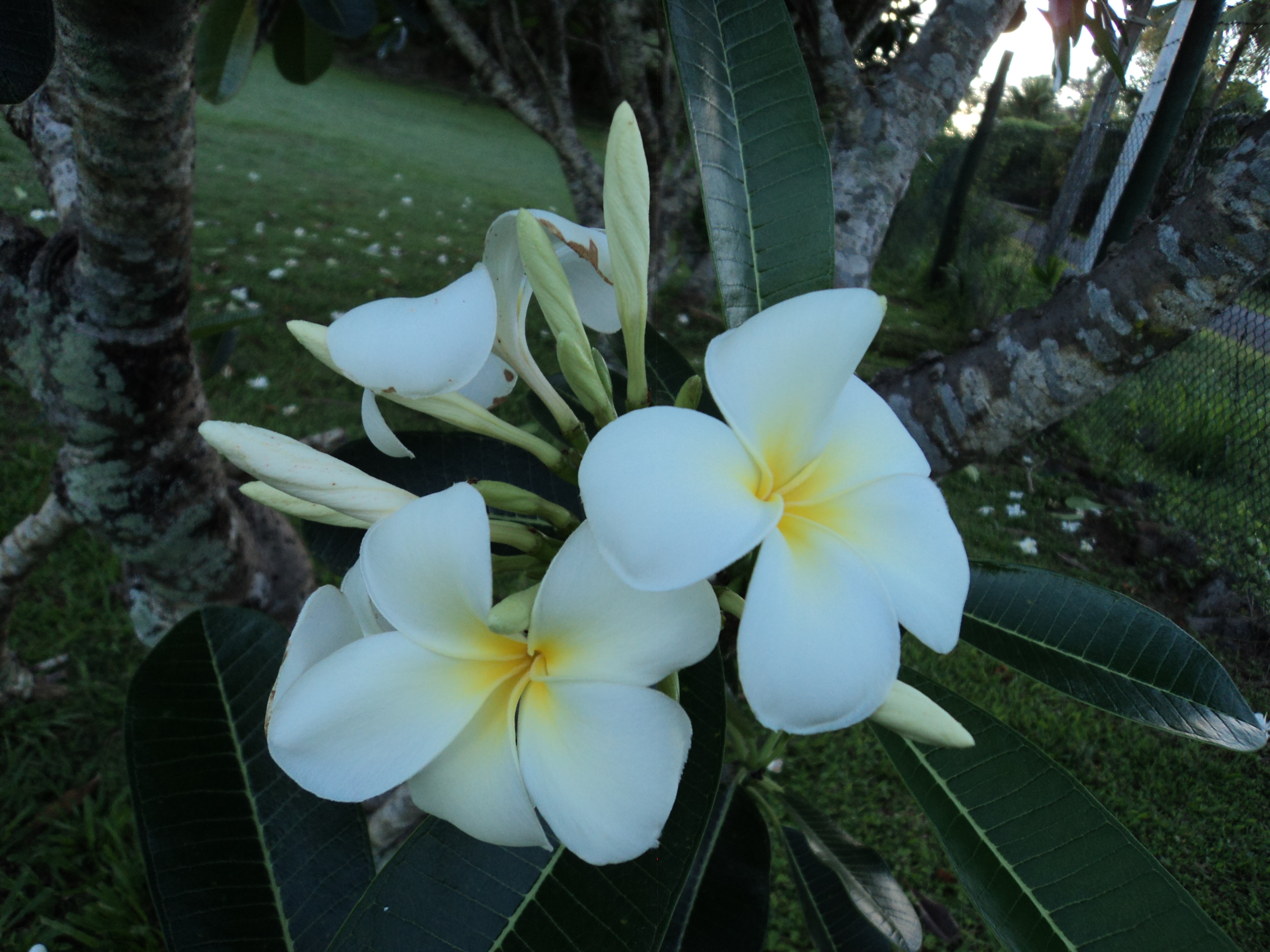
On this “Treasure Island”…in addition to the art and marine life…there were collections of coconuts, palm trees and flowers including red hibiscus and white frangipani.

Big frangipani presence on the island. (Photo by Louise Graber)
An example of the abundant frangipani presence on the island. (Photo by Louise Graber)

Many thanks to Sayuri Tokuman and Susan Yamaguchi of the Japanese Studies & Intellectual Exchange Department…and Tokiko Kiyota, Director of the Japan Foundation in Sydney…and to Nobuko Iwatani, Mako Nakauchi and Mele of the Embassy of Japan in Fiji..and His Excellency Yutaka Yoshizawa, Ambassador of Japan, for their ideas, assistance and support with this project.

INVITATION: Please respond to this post if you would like to make a comment…or suggest topics for future posting. Being new to blogging I would love to hear any feedback about my posts. Are they too long?…have too many images?…or too much text?…or there are too many of them?…or not enough? Michael.

Dr. Michael Hill aka Doctor Comics.

(All text-©2011 Dr. Michael Hill a.k.a. Doctor Comics).

BLOTTING PAPER The Comic: Production Report No.4

Art, Blotting Paper, Comics November 2, 2011

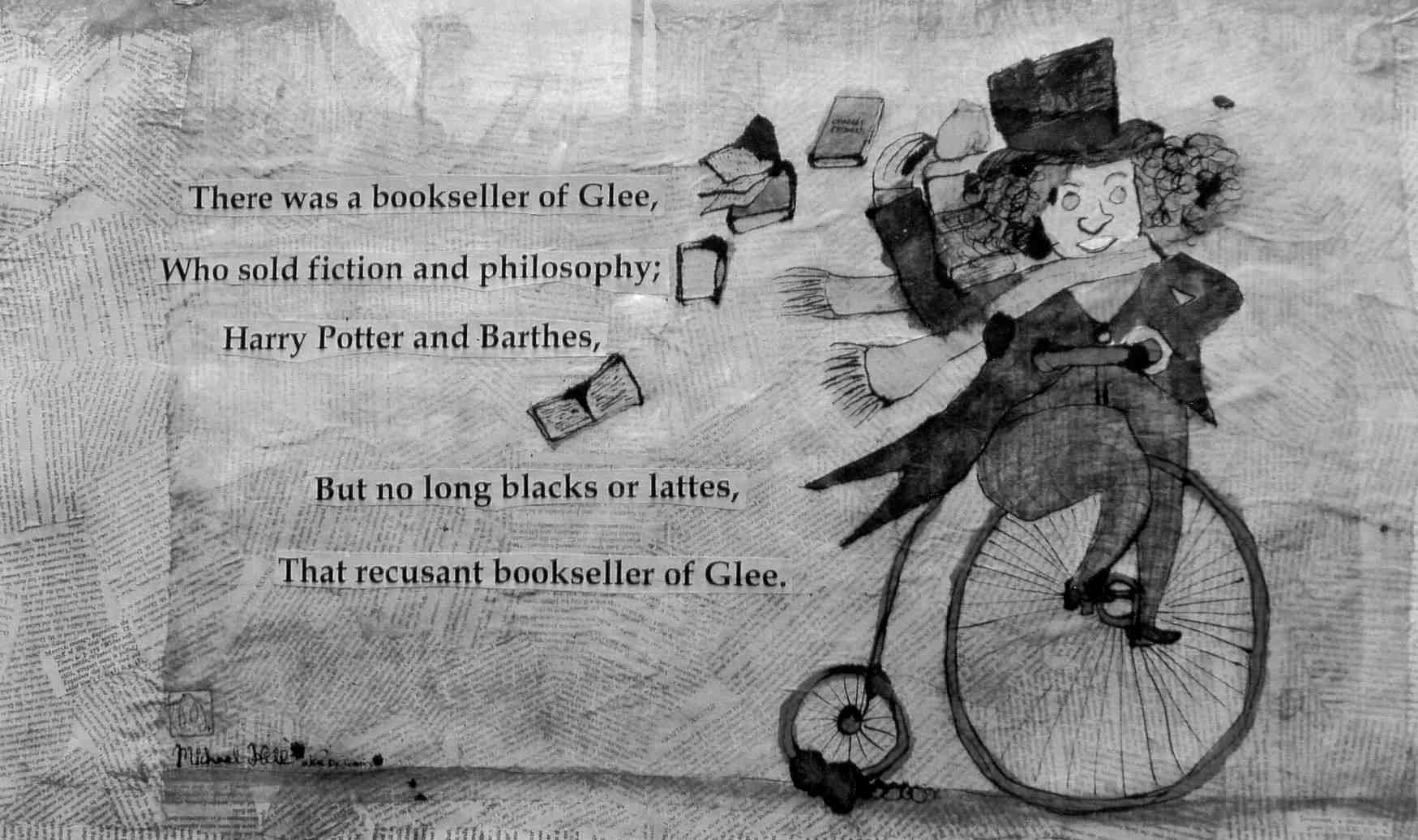
There are books, cats, fish and the occasional bicycle that appear in my comic…the one which I am currently in the process of creating. The title is BLOTTING PAPER. The principal character, Doctor Comics, is an alias of mine…an avid reader and collector of comics. He has two pet talking cats who also read comics, preferably graphic novels, and who regularly eat fish…sometimes these two activities are combined…despite the good doctor’s distaste of stains on his comics fish is a favourite dish of the Doctor’s, too,…but not whilst reading comics! The first chapter refers to books and comics, including graphic novels, both cats and one fish. The location, Glee, is a fantasy label for Glebe, the suburb of Sydney in which I live. It is a bookish suburb near the academic precinct…Sydney University, the University of Notre Dame and the University of Technology, where I work. Being tertiary education territory it has several bookshops, cafes, restaurants and pubs…and is within walking distance of the Sydney Fish Market…which is of special interest to the Doctor Comics character and his cats. I go there often, myself but leave the cats at home. The Bookseller of Glee (below) is a portrait of Roger Mackell, the proprietor of one such bookshop, Gleebooks…and a good friend of mine. Doctor Comics shops at and occasionally writes reviews of graphic novels for this bookstore. The proprietor refuses to sell coffee and cakes! With the emerging trend of cafes in bookshops, I wonder how long he will manage to hold out?

The Boookseller of Glee. (Pen and ink, drawing and collage-© 2009 Dr. Michael Hill a.k.a. Doctor Comics). This is the original colour art work. A Black & White print of it will appear in the comic (below).
The Boookseller of Glee. (B&W print of pen and ink, drawing and collage-© 2009 Dr. Michael Hill a.k.a. Doctor Comics)
Two of the fish featured in the story. (Digital scan of woodblock prints-© 1998 Dr. Michael Hill a.k.a. Doctor Comics)

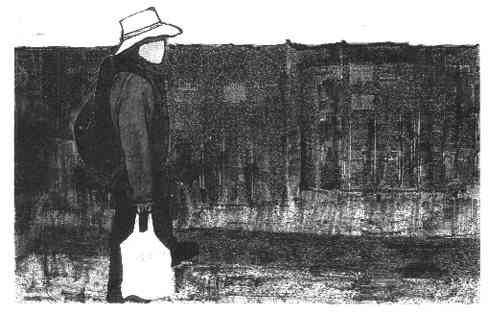
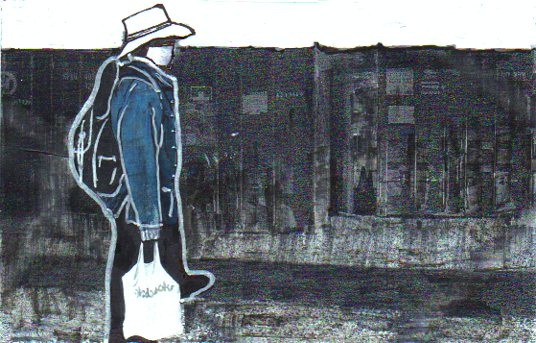
In addition to drawing, cartooning and printmaking, photography is being incorporated as a graphic tool. Below are two photographs from the Sydney Fish Market that have been graphically manipulated and merged…one of stacks of shipping containers…the other of me shopping with a bag of fish that I have purchased. The photographs were subjected to a graphic treatment then collaged together…to show Doctor Comics returning from his shopping expedition. He is carrying a bag of fish and wearing a backpack which is full of books and comics .

Doctor Comics has been shopping. (Photo by Louise Graber overlaid with my graphic treatment-© 2011 Dr. Michael Hill a.k.a. Doctor Comics)
Hand coloured version. (Photo by Louise Graber overlaid with my graphic treatment-© 2011 Dr. Michael Hill a.k.a. Doctor Comics)

Despite the intention and the progress made…it is now looking likely that the first issue of my comic won’t be published this year after all. It is nearing completion, however, and I feel certain that I shall have something to show in early 2012. In the meantime there are these blogged progress reports. The shape of the comic continues to move in an “artist book” direction. It retains some semblances of an art comic, and an Australian one at that, despite some Japanese influences. The figure in the overlaid drawings below, is the older Doctor Comics character, doing some printmaking in his studio. It goes on!

The comics art scholar turns his hand to making comics. (Felt-tipped pen drawing-© 2011 Dr. Michael Hill a.k.a. Doctor Comics)
Trying out letter type. (Photo by Louise Graber)

There has also been some script editing. This has resulted in both extensions and deletions. I found that I needed more space to convey some sequences which weren’t working…and other parts were either too difficult or time-consuming for me to draw!

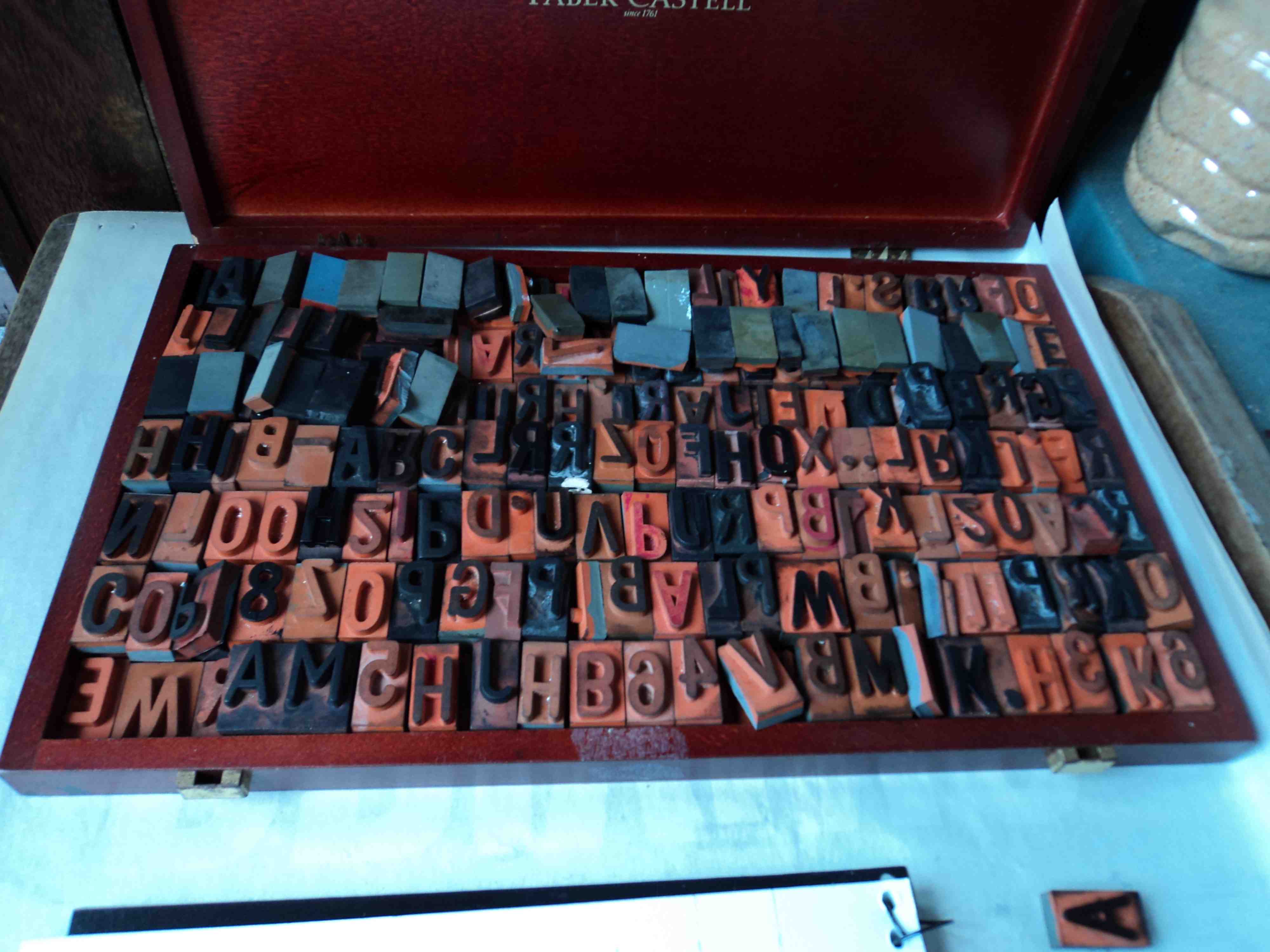
My box of uppercase rubber type. (Photo by Louise Graber)
The type in rubber-stamped, printed form prior to editing, cutting and pasting.

The other interesting development has been the photographic aspect of the project. Initially employed as a reference device for locations, objects and figures, photography has now become more prominent. Some pages are starting to look a little like sequences from a Mexican foto-novela or picto grafia comic. This was not my original intention. There remains, however, the anticipated drawn and printed elements along with the traditional rubber-stamped text (see the photos above). I hope to confirm the completion of the first issue and announce its publication date, shortly…but I won’t hold my breath, Michael.

(All text, photos and artwork-©2011 Dr. Michael Hill aka Doctor Comics).

Archive of Australian Alternative Comics: OZCON

Archive of Australian Alternative Comics, Art, Comics October 16, 2011

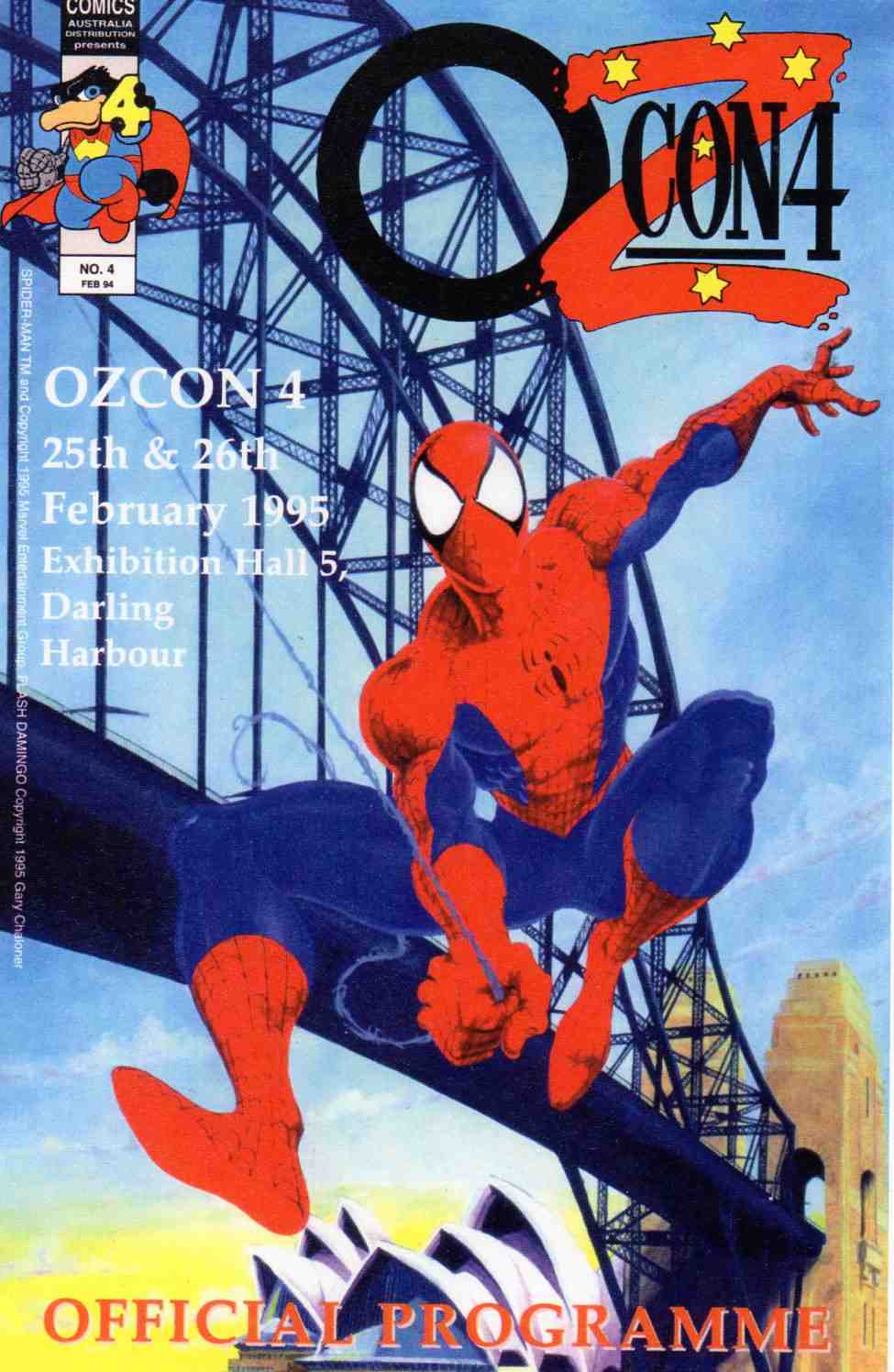
In terms of the large comics conventions in Australia prior to the current events Supanova,  Animania,  SMASH!,  Armageddon and the earlier Comic-Fest, there was OZCON. Before that there was one event called ComicCon back in 1979. OZCON was the big, annual comics convention at the time I began researching Australian alternative comics in the late 1990s. The promotion of the more mainstream imported comics seemed to be the raison d’être for the event…although there was some minor presence by independent creators and their publications despite the cost of their participation. Some comics discussion panels also took place. I recall one between Eddie Campbell and Dave Sim about the distribution of independent comics. That was both informative and entertaining. Campbell was most amusing. This event provided a sense of community for local creators to meet…discuss their self-published comics…and compare their work to the imported product.

Spidey seen swinging from the Sydney Harbour Bridge.
(Poster design by Ant Larcombe)

The poster for OZCON in 1995. Australian comics creators and fans back then had the spectre of the US super-hero genre hanging over them. It was a wonderful poster! It was designed by local comics creator and former student of mine Ant Larcombe…a graduate of Sydney College of the Arts. I had worked there as an academic staff member of the Visual Communication Design Department. The cover had an inset of the super-hero dressed avatar and character Flash Domingo by another Australian creator, Gary Chaloner.

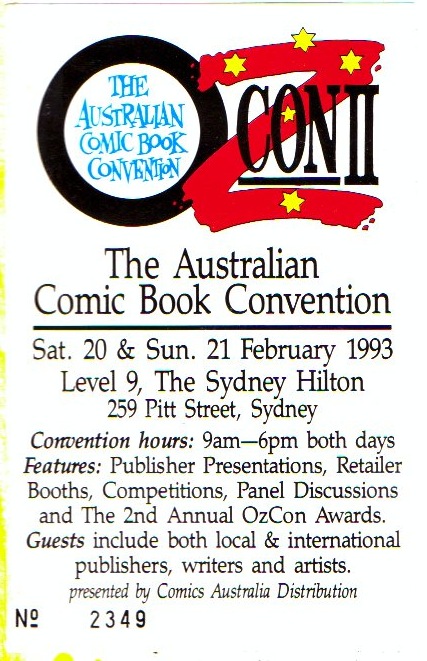
Ticket to an earlier staging of the OZcon event.
(above) Ticket to an earlier staging of the OZcon event.
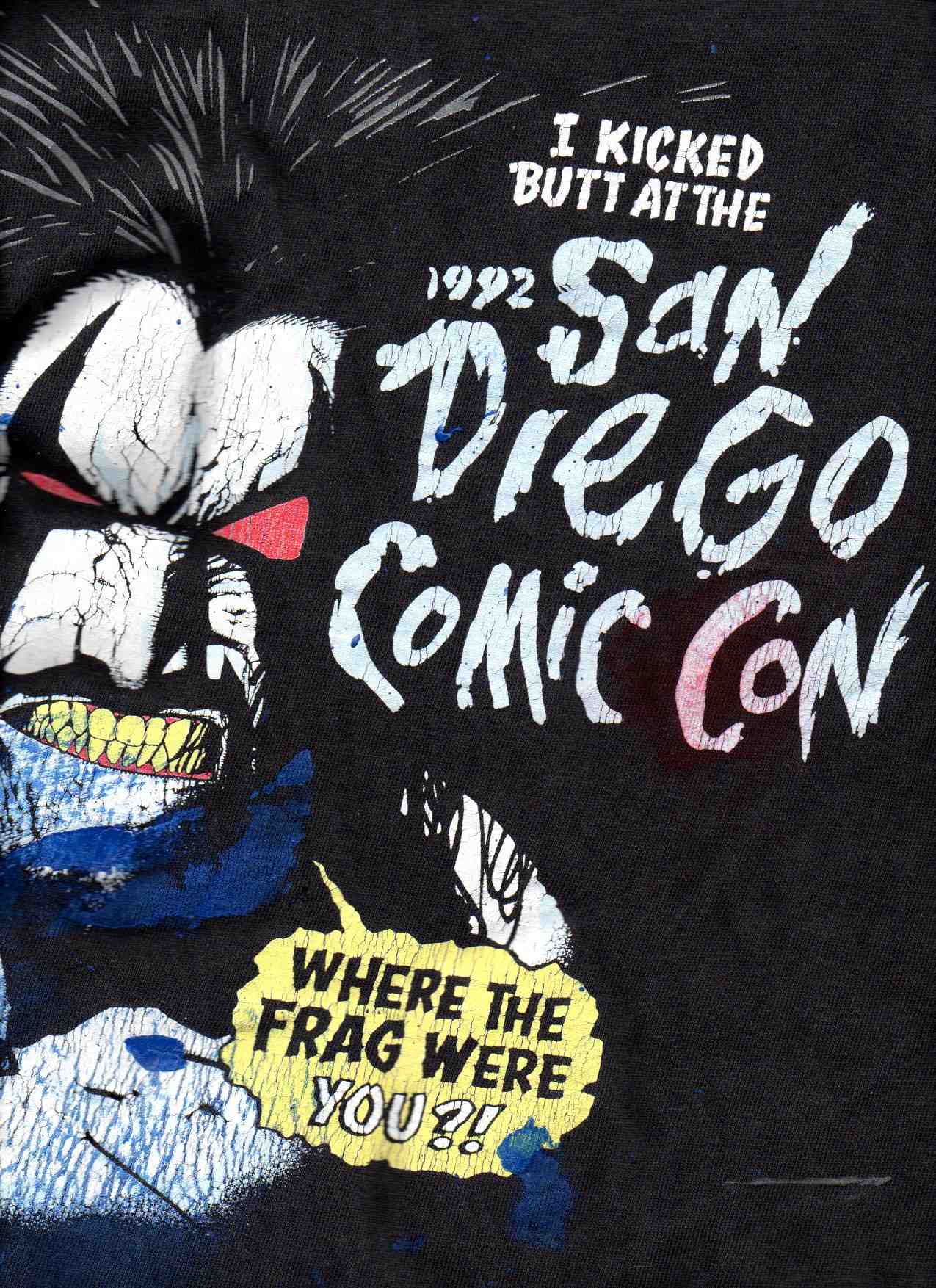
San Diego Comic Con T-shirt design. (artist unknown)

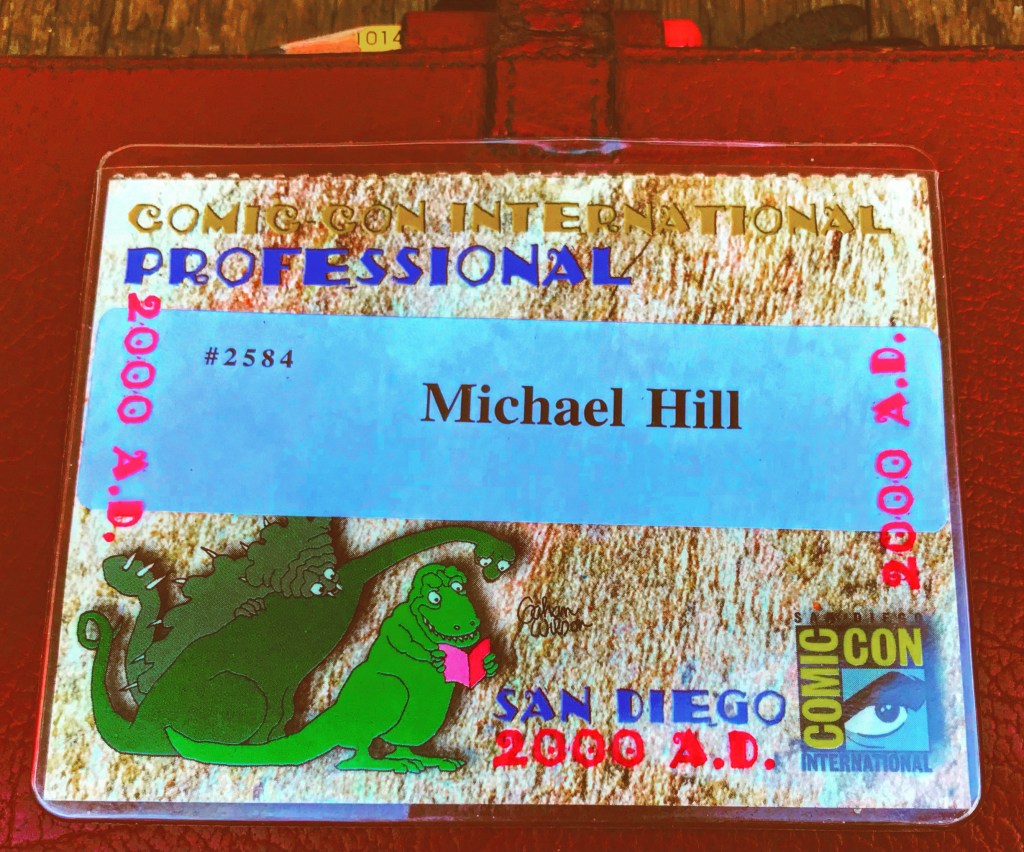
Reflecting on OZCON made me think of an American comics convention that I attended. “BIG” is a key descriptor. Above is a scan of the T-shirt I bought at what is considered the largest comics convention in the USA…San Diego Comic Con. It was from an earlier staging of that event, had been discounted as a remainder but caught my eye. The in-your-face aggression, confidence, swagger and speech balloon seemed to say what that convention was all about. The blue paint stains are a subsequent addition from my having worn it whilst doing one of my printmaking sessions. There were fewer than 50,000 attendees at the San Diego Con back in 2000. Over the past decade, however, this convention has grown in size to around three times that number. It remains considerably less than the 500,000 that go to Comiket in Tokyo, twice a year!…which makes a million of them, anually! Anyway, I was very impressed by the U.S.A. event. On the research front, in addition to presenting a paper on “Australian Gothic comics” at the conference…(shout out to my U.S.colleagues Randy Duncan and Peter Coogan)…I got to meet and chat with comics art figures: Will Eisner…Scott McCloud…Gahan Wilson…James Kochalka…Roman Dirge…Jhonen Vasquez…Los Bros Hernandez…Rumiko Takahashi and Jim Woodring. Oh joy! That was a very special and memorable experience for me.

Have you ever been to comics conventions? Which one? If you would like to post a comment about your experience, I would be happy to respond, Michael.

My ComicCon pass designed by Gahan Wilson whom I got to meet at this event.

MIND ROT AND OTHER COMICS ART SEMINARS AND WORKSHOPS AT UTS.

Besides the big comics conventions in Australia and overseas there were smaller Sydney based seminars and workshops. I organised for students of the Visual Communication Design Program at the University of Technology, Sydney. These included MIND ROT, a seminar and accompanying workshop in 1998, poster design by Neil Heymann…plus BIO-HAZARD, and BASICK-INKSTINCT both held in 1996(see posters  and post following below). 

Whist researching my collection of comics art research materials for my PhD thesis I came across this poster (below). It was for an event that I had conceived and organised at the University of Technology, Sydney, back in 1998. As a lecturer in the Visual Communication Department I was endeavoring to incorporate comics based projects into the course curriculum. It seemed to be an ideal medium in which to apply techniques of visual communication design. I found that students undertaking Word & Image projects were generally enthusiastic about comics. They enjoyed the combination of writing and drawing. To increase the students’ understanding of the professional practice of making comics I decided to involve some practitioners. The event poster(below) was designed by one of my students, Neil Heymann. His modestly carved signature can be discerned on the neck of the shouting head in the poster (below).

The MIND ROT comics seminar and workshop, Sydney, 1998. Poster design by Neil Heymann.

With funding from the student group Stop Motion Sickness I enlisted a trio of professional Australian comics creators. These were Mandy Ord from Canberra, Dillon Naylor from Melbourne and Glenn Smith from Sydney. They visited and displayed their comics art work to my Visual Communication Design students. They also described how they went about researching and designing their comics. Mindful of possible regional differences I selected these creators from three different Australian cities. Each comics creator made a 45-60 minute presentation of their work…showing visual examples to the whole class of students. This was followed by a Q&A session. Naylor profiled his comic about Melbourne share-household shenanigans Pop Culture & 2 Minute Noodles. Ord spoke about her intensely inky, autobiographical tales of life in Canberra, Wilnot. Smith described making his painstakingly, linear drawn, slice-of-life The Sydney Morning Hell. Each guest also led a practical, comics art workshop with a small group of students. Experienced comics creator Gerard Ashworth, also from Sydney, attended the seminar and kindly assisted with the workshop proceedings. The event was a small but significant moment in terms of the formal study of the medium.

The seminar’s title? Attempted irony with little bit of cheek, perhaps? I think I was put in a defensive position by the dim view of the medium in the community. There were one or two doubts from some of my colleagues. This was in relation to the presumption that comics be considered a valid form of design. Most of the academic staff supported the study of comics, especially the staff of the Visual Communication Design Department. Back in those days, thirteen years ago, photography was the most popular subject. This was followed by graphic design and illustration. Comics, animation and video were perceived as lesser, although emerging, forms…especially video with the then growing interest in music video. I was taking the study of comics seriously by undertaking academic research into comics art for my PhD degree. I saw this event as a stepping stone to the staging of a conference on comics for researchers and students. The poster was designed by one of students, Neil Heymann, who is now a New York based advertising designer. The notion of comics being a suitable medium of scholarly study and research had already been accepted. The teaching of comics as professional practice, however, remained a hurdle.

An earlier event: the Bio-Hazard comics workshop, Sydney, 1996. Poster design by Xander Black

An even earlier event: the Basick Inkstinct comics workshop, also held at UTS in Sydney, 1996. Flyer design by Neil Heymann

These posts form part of the series of posts titled Archives of Australian Comics that document events in the recent history of Australian comics, particularly alternative comics and the Australian Small Press. I started researching this subject in the late 1990s and it eventually led to my PhD thesis: Ph.D. Macquarie University, Division of Society, Culture, Media and Philosophy,  A Study Of Contemporary Australian Alternative Comics 1992-2000 With Particular Reference To The Work Of Naylor, Smith, Danko And Ord, 2003. On completion of the research I donated the materials and comics I had collected to the National Library of Australia: Michael Hill Collection of Australian Comics.

All comments welcome, Michael.

(All text-©2011 Dr. Michael Hill a.k.a. Doctor Comics).

CATS IN COMICS: Krazy Kat by Gene Kannenberg, Jr.

Art, Cats in Comics, Comics September 23, 2011

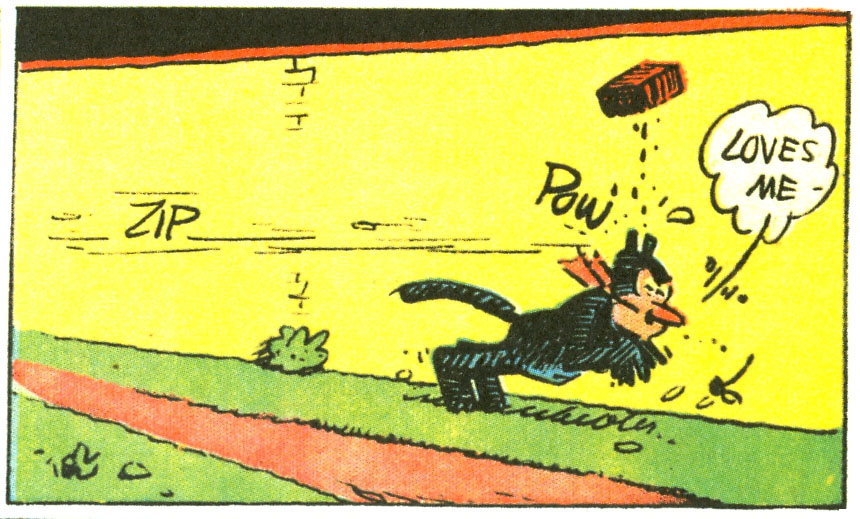
Panel from Krazy Kat comic strip October 17th, 1937.

Krazy Kat, created by cartoonist George “Garge” Herriman (1880-1944) initially as a family pet in his comic strip “The Dingbat Family” in 1910 before graduating to an eponymous strip in 1913, is without a doubt The Greatest of All Cartoon Cats – if only because “Krazy Kat” is the greatest comic strip of all time. (I don’t write those words lightly, but to me they’re true enough.)

As ever, the strip’s conceit: Ignatz Mouse, the antagonist, has it in for Kazy Kat, the sometimes-he, sometimes-she protagonist; Ignatz expresses his disdain usually in the form of a brick hurled at Krazy’s head. Krazy, in love with Ignatz, sees the brick as a sign of affection. Offissa Pupp, the local constabulary, is in love with Krazy and despises Ignatz. Many strips end with Pupp putting Ignatz in jail for his crime. It’s all that simple, and that complex – variations on a theme for four glorious decades.

It’s almost a cliche to say that the strip is “poetic,” but really, honestly, I don’t know of a better word. Herriman’s use of language, pulsing with puns and patois, is lyrical in and of itself. But look at the strip as a whole: each installment, especially each Sunday page, is a perfect little gem of an object, with visuals that are as malleable, marvelous, and magnificent as any sonnet. Form and meaning walk hand in hand in Krazy’s hometown of Coconino County.

Panel from Krazy Kat comic strip October 8th, 1920.

I’ve seen it said at times that Krazy is delusional, or that she doesn’t understand Ignatz’s intentions. But I think that such ideas miss the point. Like a “real” cat*, Krazy creates hir own reality. Anyone who’s lived with an actual feline knows that, try as you might, you cannot control, cannot master a cat. Cats are subject to their own internal wants, needs, and whims; sometimes, rarely, these impulses correspond to what we want, and we then find this behavior charming and “cute.” But really, it’s the cat who’s calling the shots. So, too, does Krazy call the shots – literally: she calls the shooting bricks love tokens. So what if Ignatz doesn’t mean them that way? Ultimately, and to our benefit, it’s what Krazy desires that kounts.

* I use the “scare quotes” hesitantly as, to me, Krazy is as real a creation as is possible. Nothing fake; all genuine. All Art.

Many thanks to our guest blogger, the awesome “big guy” of comics art studies, Gene Kannenberg, Jr. for contributing to my CATS IN COMICS series with this wonderful post. Please let me know what you thought of Gene’s post and my BLOG in general. I would love to hear your feedback and suggestions. (Dr. Michael Hill a.k.a. Doctor Comics).

BIO: Gene Kannenberg, Jr. is the director of ComicsResearch.org. Formerly the Chair of the International Comic Arts Festival and the Comic Art & Comics Area of the Popular Culture Association he has written widely on comics art. His book “500 Essential Graphic Novels” was published in 2008.

NOTE! I am adding the two following posts on cartoon cats that I wrote…on this topic…to the one above by  guest poster Gene Kannenberg, Jr.,…to make this a 3 Cartoon Cat Post! Read on for Doraemon followed by The Rabbi’s Cat, Michael.

CATS IN COMICS: DORAEMON by Michael Hill aka Doctor Comics

Art, Cats in Comics, Comics, Japanning, originally posted September 10, 2011

Cover of Doraemon manga, issue 1.

This post is on Doraemon, the creation of Fujio Fujiki, the alias of two creators (mangaka) Motoo Akibo and Hiroshi Fujimoto, working in collaboration. Doraemon is a blue, earless, male, magical, back from the future, robot cat that lost his ears to a hungry rat. And like most cats he is very good to his owner, the little boy Nobita. This cat has been designed in a seriously super-deformed style with a large round head that takes up practically half its body length. First published in Japan in 1970 it was so successful it was developed into an animation series and franchise with an accompanying massive amount of merchandise including postage stamps! Doraemon has the distinction of being the first Anime Ambassador of Japan. Most recently a museum of Doraemon has opened in Kawasaki. This character is more than 40 years old although, as it is a cat that is back from the future, it has not yet been born, his birthday being just over a century away on 3rd September 2112. His popularity and merchandising goes on and on…such as this guitar I saw in a music shop in Ochanomizu, Tokyo, near Meiji University.

Doraemon guitar in Tokyo music shop. (Photo-© 2009 by Dr. Michael Hill a.k.a. Doctor Comics)

See who is front and centre on this Anime character post card!

Doraemon in centre on this Anime character post card!

UPDATE 3 SEPTEMBER 2112: On September 3rd 2012  this character received an official residency certificate from Kawasaki city-100 years before his birth on September 3rd 2112.

Doraemon’s official residency certificate.

Doraemon on rails!

UPDATE 21 NOVEMBER 2016: On a trip to Tokyo last month I found these two sets of Doraemon stamps on sale at a Japan Post shop…
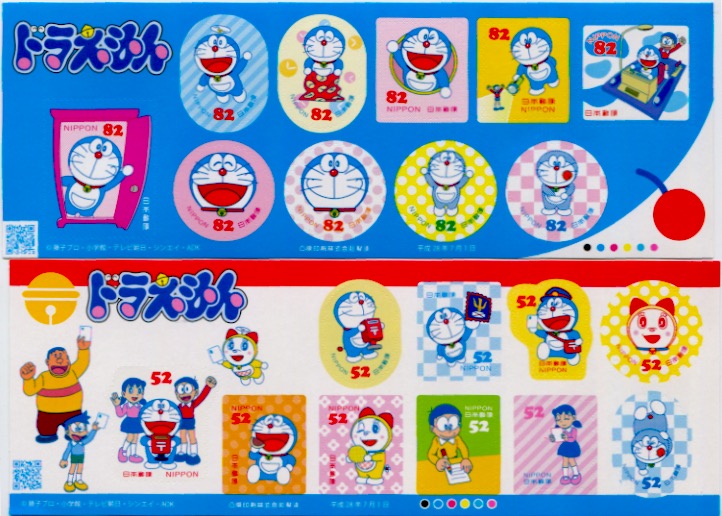
2 sets of Doraemon stamps on sale in Japan.

2 sets of Doraemon stamps on sale in Japan.

…and an old copy of the Doraemon magazine at a bookshop in the Jimbocho area of Tokyo…
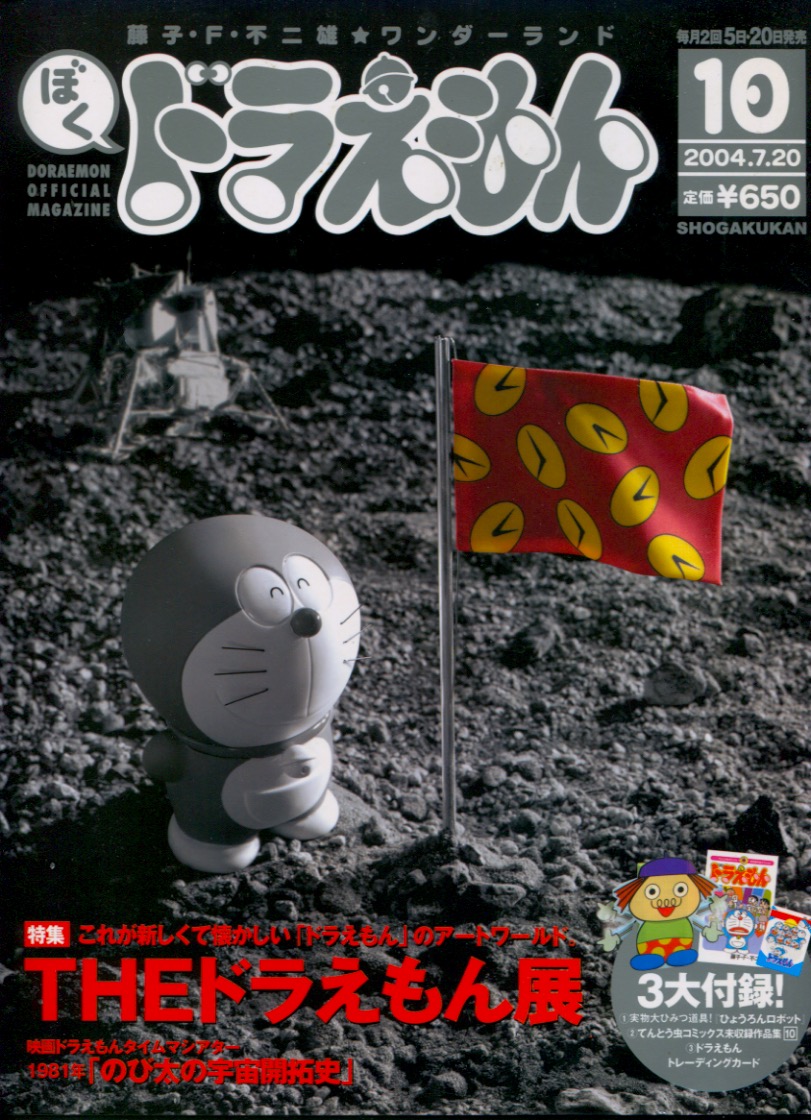
Copy of Doraemon Official Magazine 2004.7.20

Copy of Doraemon Official Magazine 2004.7.20

…and a toy figure in a food shop in Kappabashi, Tokyo.
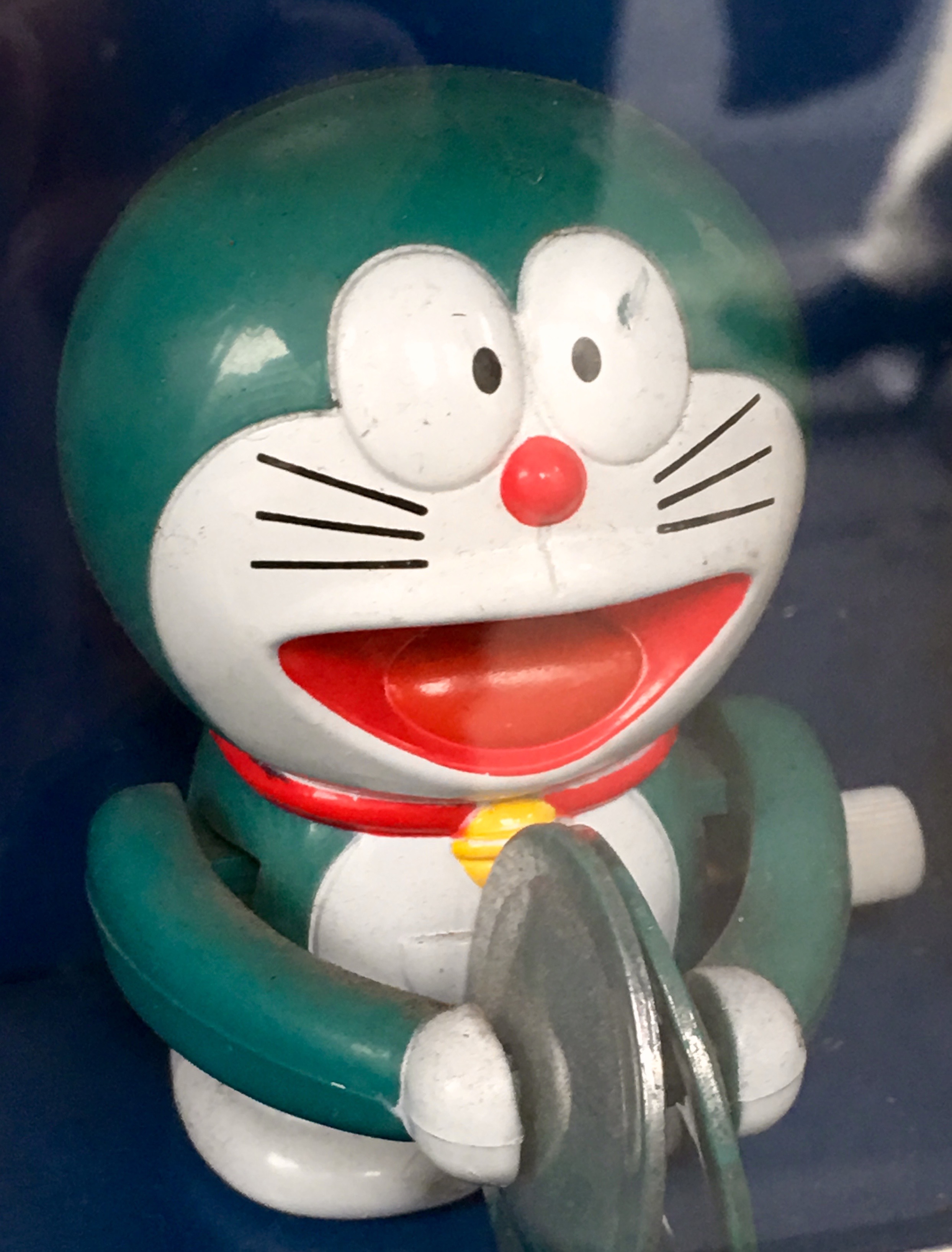
Doraemon toy in food store in Kappabashi-(Photo-© 2016 Louise Graber).

Doraemon toy in food store in Kappabashi-(Photo-© 2016 Louise Graber).

UPDATE 19 APRIL 2017: On a trip to New York last month I found this Doraemon doll dressed as Captain America in a shop window in Chinatown, along with a group of smaller Doraemons and a large ornate Japanese cat! How’s that for a cultural, comics crossover!

Doraeman as Cap, in shop window, Chinatown, New York. (Photo-© 2017 by Dr. Michael Hill a.k.a. Doctor Comics)

Comments

  1. ragingyoghurt says on September 12, 2011 , Edit

    oh doraemon! when i was growing up in malaysia and singapore he was known by his chinese name: xiao ding dang, and i was really more familiar with him as the packaging mascot for a brand of spherical puffed rice crackers coated in compound chocolate. the crackers were always stale. yum.

    do you know komaneko? http://youtu.be/fbhs5P-xa4U

    Like

  2. Doctor Comics says on September 13, 2011 , Edit

    Name changes! I know Mickey Mouse was known as Topolino in Italy. Xiao ding dang eh? That one’s had an interesting cultural and phonetic shift. Glad you enjoyed the crackers. Why were they stale? Were they imported from Japan or was the character licensed to another country’s brand?

    Thanks for introducing me to Komaneko. I was impressed by the slow moving tempo and subdued soundtrack. Don’t often experience that in childrens animation. There were some nice touches there like when the cat’s eyes widen at the sight of having threaded the needle. Very careful and controlled animation.

CATS IN COMICS: The Rabbi’s Cat by Michael Hill aka Doctor Comics

Art, Cats in Comics, Comics, Film … originally posted October 4, 2011 , Edit

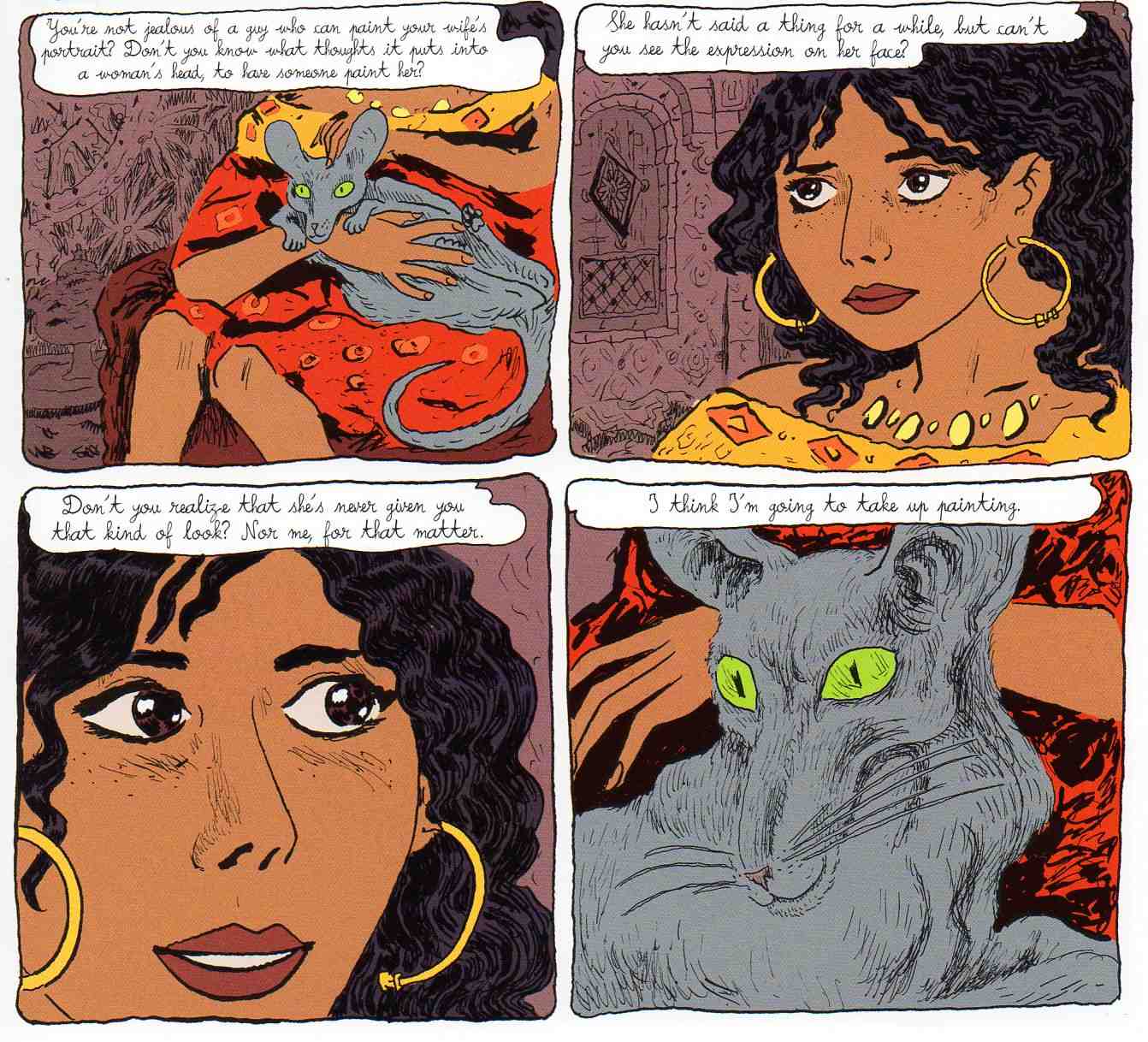
This cat can talk! The Rabbi’s Cat by Joann Sfar.

This is a story about a talking cat from Algeria that lives with a rabbi and occasionally visits Paris. One day it ate the rabbi’s parrot and in so doing, gained the gift of speech. Being a clever cat it denied eating the bird and instead demanded conversion to Judaism. The design of the cat appears loose and improvised. Whilst it is rather thin and scrawny in physique it is big in terms of personality, intelligence and cheek. This richness of character and determination affords the cat the capability of comprehending foreign languages(he speaks Arabic, French, Latino and a bit of Spanish) and of learning the Torah. This rabbi’s cat is a marvellous, witty and charming cat that pleases itself, as cats do. It has appeared in several comics and most recently in an animated feature film of the same name. It is the creation of Joann Sfar, a jury prize winner at Angoulême for The Rabbi’s Cat graphic novel. The cat likes to hang out with the rabbi’s daughter and snuggle up close to her. It even tells her that it loves her. She tells it to shut up as she prefers it when it’s quiet or not around. It’s also inconvenient for both of them when her boyfriend visits. The cat loves a bit of a scratch, preferably on the ear by a female foot with painted toenails. Resilient, resourceful, stubborn, smart, curious and decidedly nocturnal, this cat is difficult to ignore.

This cat considers taking up painting to impress his love.

The Rabbi’s Cat (Le Chat Du Rabbin) film is a charming animated adaption of the graphic novels by Joann Sfar who also co-directed the film thus ensuring an authentic visual adaption of the bande dessinee. I saw the film at the 2012 French Film Festival in Sydney and I have been reading the graphic novels for a couple of years. Sfar is a prolific and award winning comics creator with awesome talent who is now transferring his talents to filmmaking. Sfar had previously directed the highly stylised live-action film Gainsbourg (vie héroïque) based on the life of the famous 1960’s French pop singer Gainsbourg (that’s Serge Gainsbourg, Charlotte’s dad). The film won the French Oscar, César Award, for Best First Film. The Rabbi’s Cat (Le Chat Du Rabbin) film also won a César for Best Animated Feature and the similar prize at the 2011 Annecy International Animated Film Festival. It is a traveller’s tale in more ways than one dealing with the cat’s progress from ordinary cat to talking cat, its enforced separation from its beloved mistress, the rabbi’s daughter, and its struggles with the rabbi in its attempts to convert to the Jewish religion. Then there is the overland journey in an antique Citroën half-track, all terrain vehicle from France to Africa with the rabbi, a Russian artist and others in search of African Jews in Ethiopia. The film is ambitious covering material from three of the graphic novels although some characters and sequences have been altered or omitted. Its visual design has also been modified into a more simplified cartoon look suitable for animation production from Sfar’s sumptious illustrative style but the images remain rich and varied. It contains plenty of satire including a few barbs aimed at Tintin and his dog Snowy whom the travellers meet in Africa and whom the cat finds somewhat obnoxious.
Poster of the film.

Poster of the film.

For a more formal analysis of The Rabbi’s Cat graphic novel see my post Gridlocking Joann Sfar’s Talking Cat on The Comics Grid. You can also watch an extract from a new documentary by Sam Ball called Joann Sfar Draws From Memory that shows Sfar cheerfully drawing in a restaurant with his pen and water-colours whilst dining and commenting on his cross-cultural background and port city upbringing.

I would love to hear your response to these cat posts and to my blog in general, Michael.

Doctor Comictopus alias for Michael Hill Ph.D (a.k.a. Doctor Comics) designed by Michelle Park.

Doctor Comictopus alias for Michael Hill Ph.D (a.k.a. Doctor Comics) designed by Michelle Park.

Comments 2

(All text-©2011 Dr. Michael Hill a.k.a. Doctor Comics).


READING COMICS IN PUBLIC

Art, Comics August 28, 2011

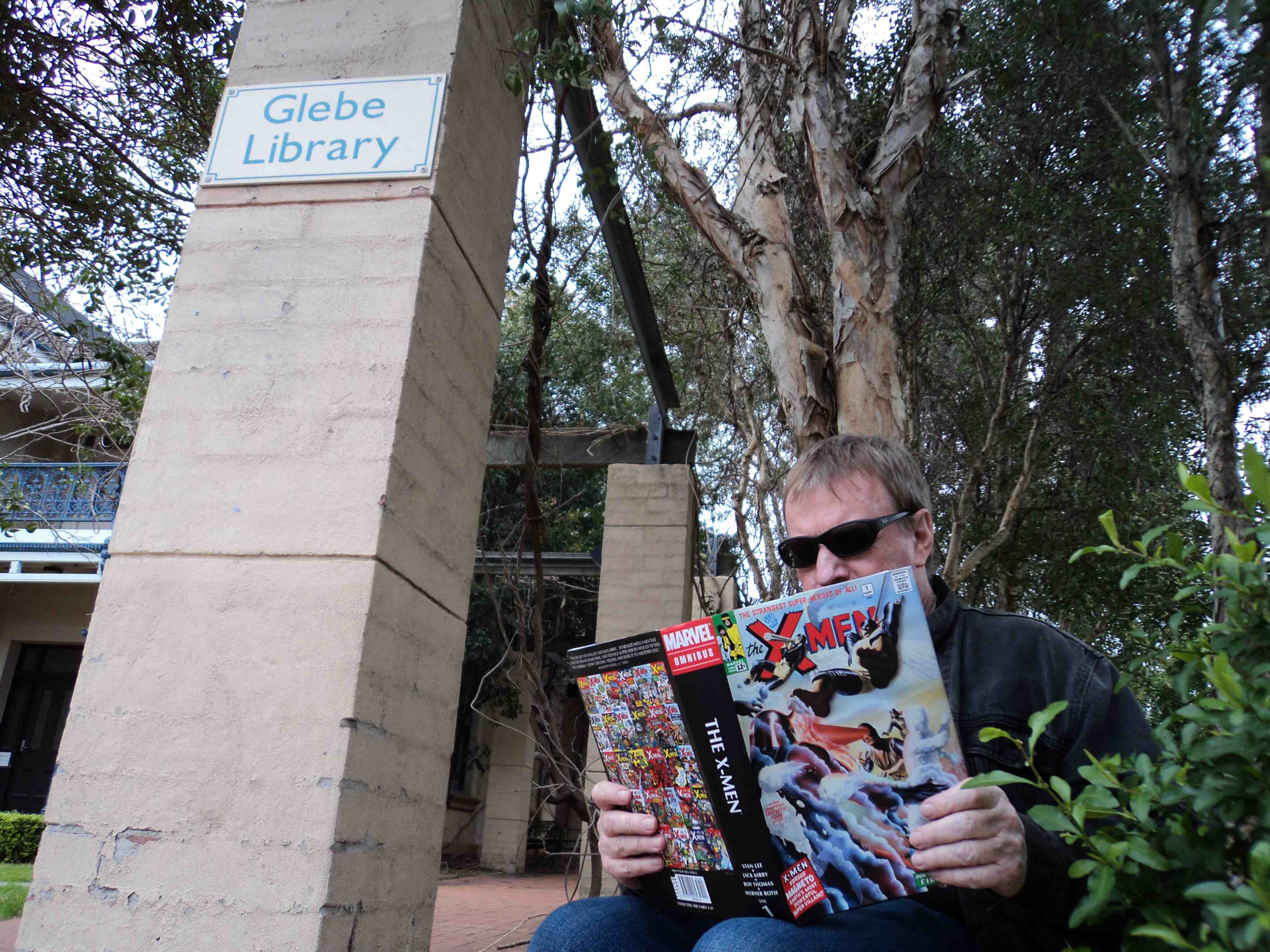
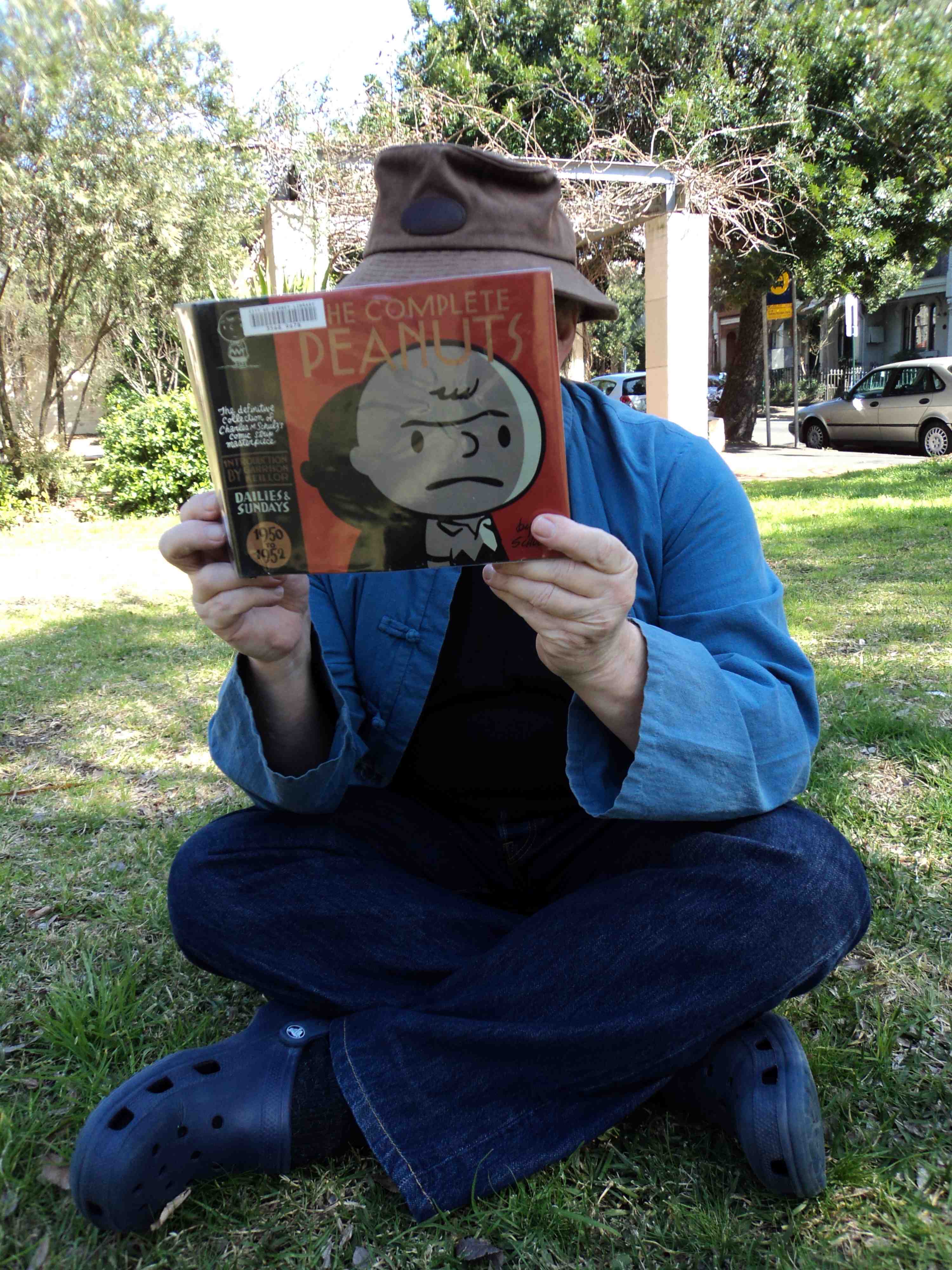
Today, 28 August 2011, is International Read Comics in Public Day! This celebratory, public reading of comics is being staged for the second time. It began last year and was created, sponsored and promoted by The Daily Cross Hatch. I take pride in participating in this event and have done so on both occasions (see photos below). I chose the location outside my local library in Sydney. The City of Sydney Library branches carry an increasing range of comics and graphic novel titles including some manga. Being comics artist Jack Kirby’s birthday I read the giant X-Men Omnibus that he created with writer Stan Lee. Last year I read early issues of Peanuts by Charles Schulz. I love reading comics in public!

Dr. Michael Hill a.k.a. Doctor Comics seen reading comics in public, Glebe 2011. (Photo by Louise Graber)
Dr. Michael Hill a.k.a. Doctor Comics participating in the inaugural Reading Comics In Public 2010 event. (Photo by Louise Graber)

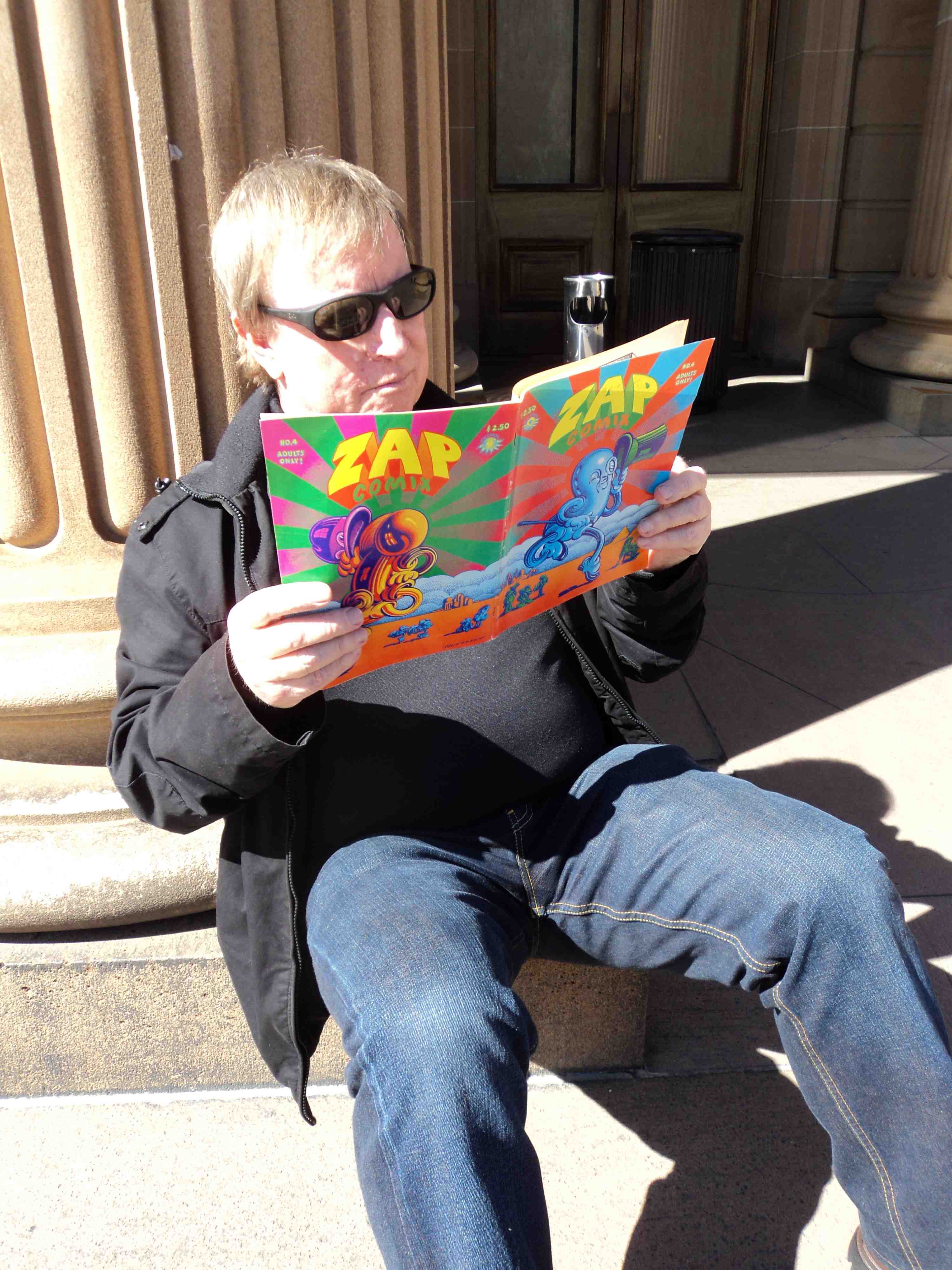
UPDATE 2012. I participated in this event for the third time in 2012 when I read ZAP Comix No.4 on front the front steps of the Art Gallery of NSW in Sydney (photo below). In the full sunshine what a perfect place it was to enjoy comics art! This particular comic features a dazzling psychedelic cover design by Victor Moscoso which the morning sunlight illuminated. I often read comics in pubs and cafes, on public transport and in parks and gardens. I love reading comics…always have…thanks to my Dad!(see my first blog post).

Dr. Michael Hill a.k.a. Doctor Comics can sometimes be seen Reading Comics In Public, even on the steps of the Art Gallery of NSW. (Photo by Louise Graber)

UPDATE 2013: At the beach!

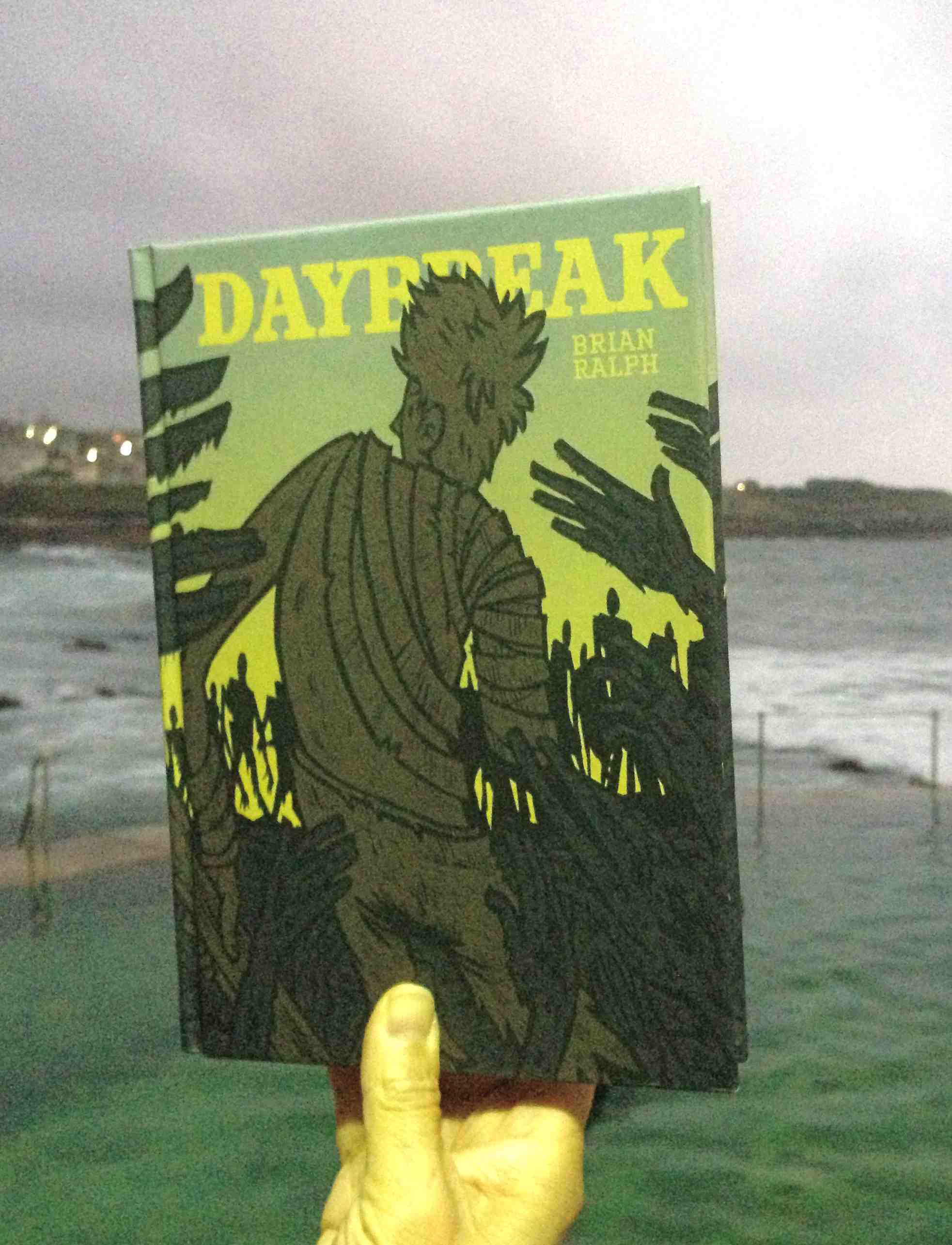
Reading Brian Ralph's Daybreak at the beach at dawn.
Reading Brian Ralph’s comic Daybreak in public near the pool on the beach at dawn. (Photo-© 2011 by Dr. Michael Hill a.k.a. Doctor Comics)

UPDATE 2016: VIVID Festival, Sydney Harbour Bridge

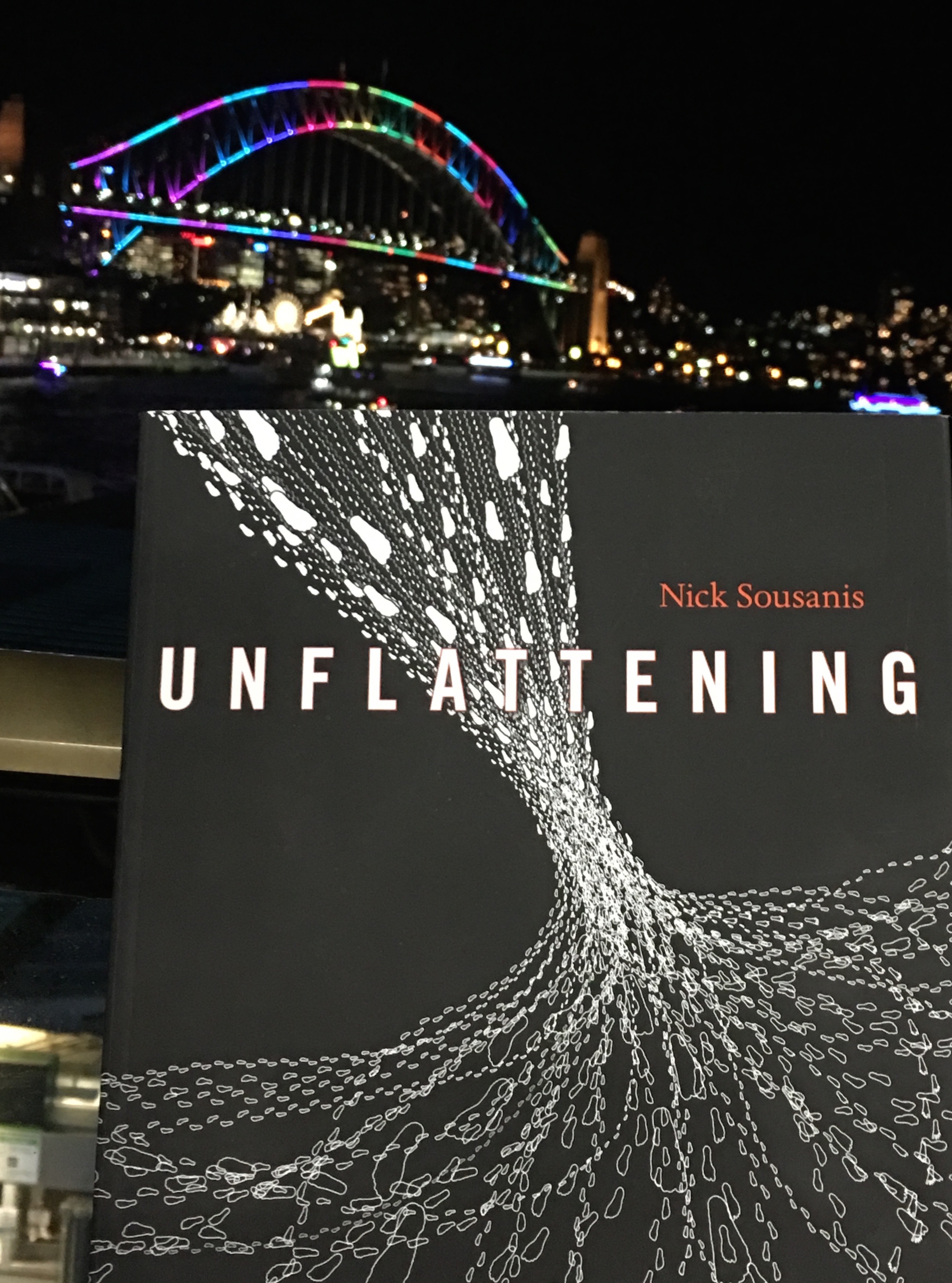
Reading Comics-Unflattening
Reading the graphic novel Unflattening by Nick Sousanis in public under lights with the Sydney Harbour Bridge in the background. (Photo-© 2011 by Dr. Michael Hill a.k.a. Doctor Comics)

Have you ever read comics in public…on a bus, train, plane, outside a gallery whilst waiting for a friend, or in a waiting room? How did it feel? Not that it is much of an issue these days…but back in my Primary and Secondary School days, my teachers the Dominican Nuns and Christian Brothers respectively…both banned comics from the classroom and the reading of them by their students…let alone the public reading of them! I would love to hear of your experiences. What was your choice of title and the location for your reading? Did you get any public response? And, if it was at school, did you ever have the comic you were reading confiscated and never returned? What happened to it? Was it burnt, or shredded, or torn? Let me know. In the meantime enjoy your comics reading wherever you are…in the park, on the bus, in the waiting room, at the opera or home in bed. Till next post, Michael.

(All text-©2011 Dr. Michael Hill a.k.a. Doctor Comics).

BLOTTING PAPER The Comic: Production Report No.3

Art, Blotting Paper, Comics August 9, 2011

Production of the first issue of my comic Blotting Paper continues despite delays from my ongoing academic commitments. However, my intention of having the first chapter finished by the end of the year remains. Comparing research to production I have discovered the enormous amount of time it takes to design and create artwork. I can write a thousand word critique of a comic in just over an hour…but creating one page of comics art will take me several times that. Many of the comics creators that I have interviewed say their rate was “a day per page”. I wish!…but I don’t really mind as I love the feeling of being deep in creative space. At the moment, besides printmaking, I am also doing some drawing. I love it and the mental space it takes me into. I like the feeling of getting lost in there.

My ink sketch of the Sydney Harbour Bridge for the first chapter of my comic…it could use a little more detail, perhaps? (Pen and ink drawing-© 2011 Dr. Michael Hill a.k.a. Doctor Comics)

The bridge and Doctor Comics, pen and ink drawing collage #1(© 2011 Michael Hill)
Rough collage of Doctor Comics out walking and contemplating near the Sydney Harbour Bridge…a rough draft design, including corrections, in pen and ink.
(© 2011 Dr. Michael Hill a.k.a. Doctor Comics)

I am experimenting with a range of image-making media to produce the artwork and text. Below are some of the images that have been generated through printmaking at Studio Buljan, in Sydney. (My thanks to Katharine Buljan for the access to her studio). These prints appear in the first chapter of my comic The Ingurgitator. The chapter begins in sunshine in Sydney then things take a dark turn into the subconscious terrain. There is also the evening ritual wherein Doctor Comics cooks dinner…then drinks wine whilst reading his recent comics purchases. During this time he converses with his feline friends. The evening often ends in a dream state that is a melange of art, thought, taste and reflection.

Doctor Comics has his evening proverbial swim in a sea of sumi ink.
(Monotype print-© 2011 Dr. Michael Hill a.k.a. Doctor Comics)
Losing one’s footing and feeling out-of-depth and the fear of ‘going under’.
(Monotype print-© 2011 Dr. Michael Hill a.k.a. Doctor Comics)
Struggling for breath and sinking into the blackness.
(Monotype print-© 2011 Dr. Michael Hill a.k.a. Doctor Comics)

These images are monoprints, so called for their singularity…only one of each is made. However, by re-inking the block and marginally alterating the images, a degree of continuity is maintained. This enables a sequential element to come into play. I have learned this approach in creating the artwork for animation projects. For me, working in printmaking, comics and animation is both labour saving and exhaustive. The images come up quickly but the act of re-inking and printing the block destroys the originals. There is no going back. I enjoy working with the inky element of printmaking. It is so graphic! Any thoughts? Comments about this and my posts are welcome, Michael.

(All text, photos and artwork-©2011 Dr. Michael Hill a.k.a. Doctor Comics).

DOMO ARIGATO MR. ROBOTO: Toy Porn 2 Exhibition Review

Art, Comics, Film, Japanning July 26, 2011

Domo Arigato Mr. Roboto! Earlier this evening I went to the opening of a comics art related exhibition in Chippendale. This area of inner Sydney is becoming something of an arts hub. In recent weeks I have visited galleries located within a stone’s throw of each other: MOP, NG and White Rabbit. This exhibition, titled Toy Porn 2, showcased the work of established artist Nick Stathopoulos. Nick recently made a portrait of the comics creator Shaun Tan for the Archibald Prize competition. It was on display in the restaurant downstairs. The portraits here, however, were of cartoon character creations from animation, comics and films. Titles selected included Astro Boy, Tintin, Batman, Thunderbirds, Robby the Robot, The Beatles in their Yellow Submarine, and assorted others.

Title: He always comes between us – Acrylic and oil glaze on canvas-2011-60 x 60 cm

Stathopoulos paints in a hyper-realistic style on a flat canvas but manages to deliver a convincing three dimensional effect. He does intensely detailed, fine painting with no visible trace of brush strokes. His rendering of plastic surfaces is extraordinary. It is a labour of love. There is tension evident in the work. He always comes between us portrays a moment of drama between the cartoon characters Snowy, Tintin and Captain Haddock. A painting of the package containing the Yellow Submarine toy is a delight. Collectors and toy hunters will enjoy its scratches and dents pointing to its less than mint condition.

Michael Hill a.k.a. Doctor Comics with the artist at the opening. (Photo by Louise Graber)
Dr. Michael Hill a.k.a. Doctor Comics with the artist Nick Stathopoulos at the opening. (Photo by Louise Graber)

The show was enthusiastically opened by Claudia Chan Shaw, of ABC-TV’s Collectors program and a former student of mine. She admitted to being something of a collector herself. She has a weakness for plastic and vinyl. She even brought one of her toys along to the event. Her speech was both erudite and amusing. She demonstrated a fine understanding of the business and motivation for collecting. In this instance, the need for re-connection with the playthings of one’s childhood. Discussing her own collecting habits Claudia mentioned the therapeutic value of going public and sharing stories with other collectors. From this she gained empathy in a form of collaborative complicity. She was the perfect choice to launch this exhibition. I am familiar with the term ‘shelf porn’ referring to the display of treasured collections. There are photos by comics collectors of their bookshelves with the spines of all the graphic novels they own. The notion of display, or as Claudia Chan Shaw described it, “one’s habit”, is an element of this behaviour. You look at these images of someone’s collection and envy the items and titles that they have and you don’t…a love for the object in question and the desire to add it to one’s own collection.

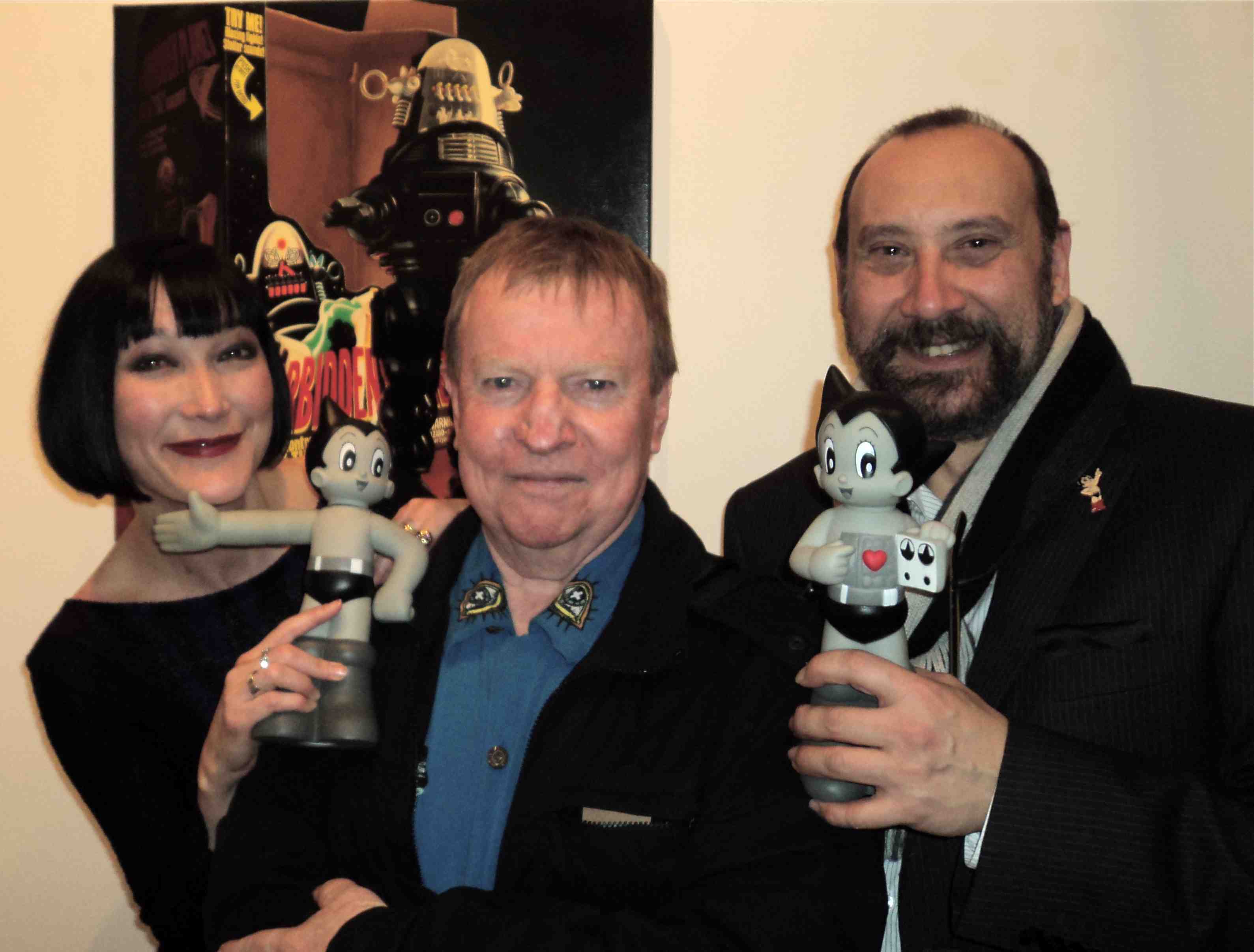
"Domo arigato, Mr. Roboto!" Claudia Chan Shaw, Doctor Comics and the artist Nick Stathopoulos. (Photo by Louise Graber)
“Domo arigato, Mr. Roboto!” Claudia Chan Shaw, Doctor Comics and the artist Nick Stathopoulos posing with Astro Boy dolls. (Photo by Louise Graber)

To the music of Domo arigato Mr. Roboto by Japanese band Polysics…and with robots, rockets, plastic and vinyl around…this exhibition is an affectionate tribute to toys, their collection and preservation. Well done Nick!  Good show. Comics lovers should definitely see it. Toy Porn 2 is on in Sydney at NG Art Gallery Little Queen Street, Chippendale, 26 July-13 August 2011, Michael.

(All text-©2011 Dr. Michael Hill a.k.a. Doctor Comics).

Archive of Australian Alternative Comics: GETTING SMASH(ed)!

Archive of Australian Alternative Comics, Art, Comics, Film, Japanning July 18, 2011

Saturday July 16, 2011 was a day of comics and anime amusement at SMASH! (Sydney Manga And Anime Show). Over the past few years the local interest in manga and anime has been increasing. Initially ignored by existing comics conventions the manga fans went out and created their own event. Some even began learning Japanese so that they could translate the manga that they loved! The new conventions provided opportunities for fans to meet and enjoy these two media. Some local female creators even began making their own versions of shōjo manga. Interest continued to grow, as did the events. Within Australia, Sydney had Animania, Melbourne had Manifest...then along came SMASH! also in Sydney.

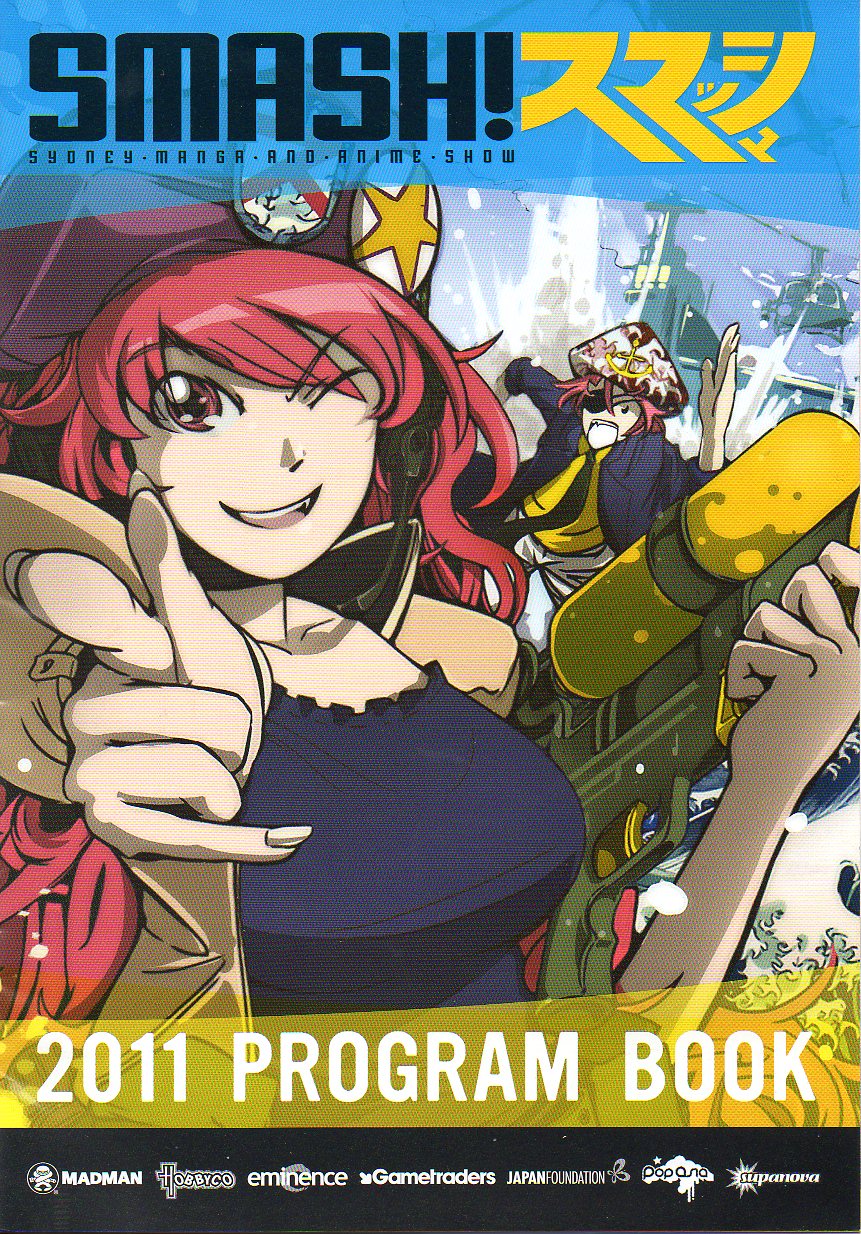
The SMASH! 2011 program.

In 2011 it was located, for the first time in its short 5 year history, at the Sydney Convention Centre. It had outgrown its previous smaller venues at the Roundhouse, University of New South Wales and the Sydney Town Hall.

Welcome from Box Man. (Photo by Louise Graber)

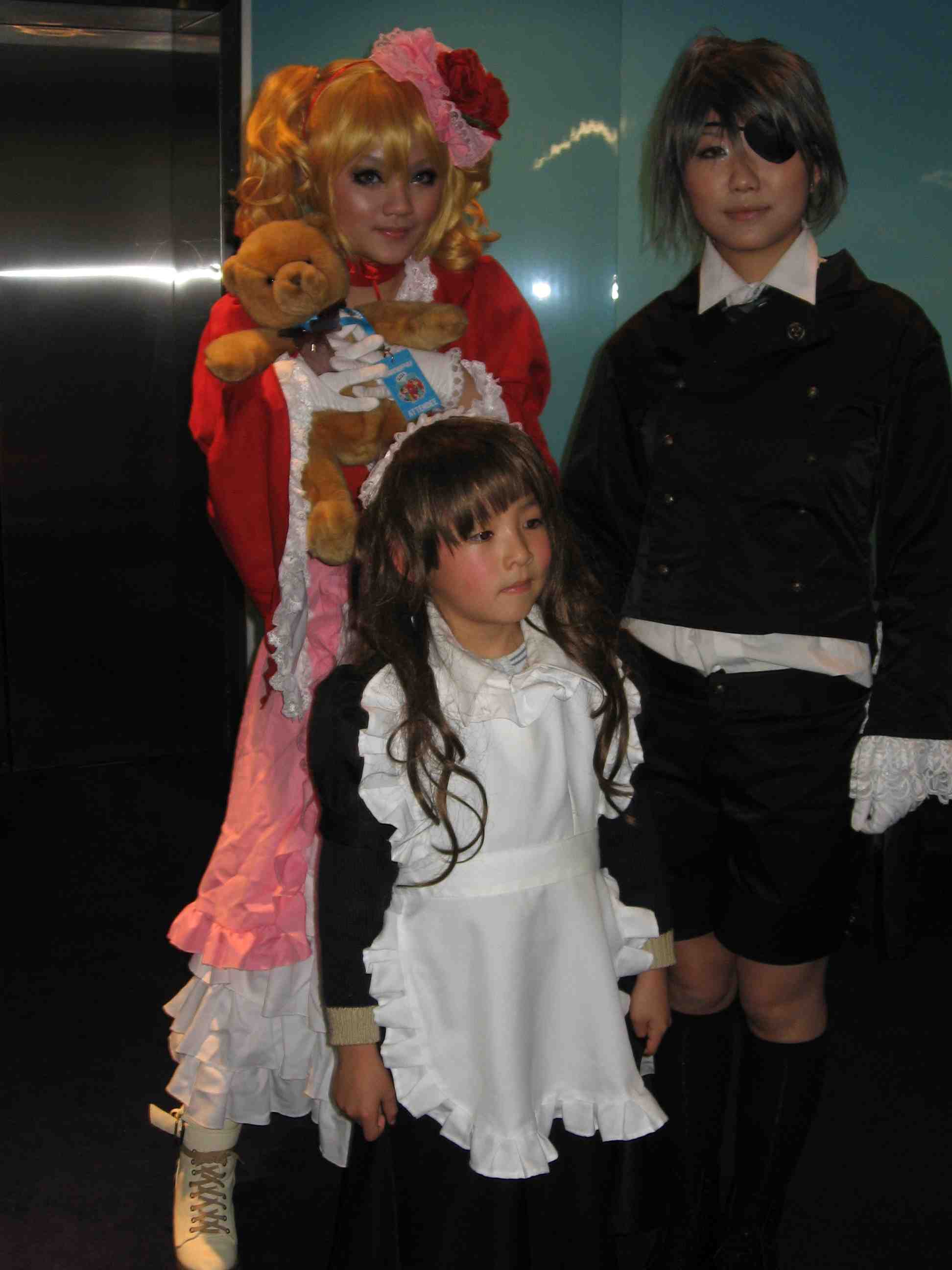
A suitable event for Cosplay, there were some costumes featuring sewing, beading, feathering and functioning. These were paraded both inside and outside the venue and on the cosplay stage.

A tutu moment…(Photo-© 2011 Dr. Michael Hill a.k.a. Doctor Comics)
A posing trio. (Photo by Louise Graber)

In addition to university and high school students, many young children attended, some with their parents or older siblings.

Young cosplay fans. (Photo-© 2011 Dr. Michael Hill a.k.a. Doctor Comics)

There were Hobby Rooms for the construction and display of dolls and robots.

Some Dolfie dolls. (Photo-© 2011 Dr. Michael Hill a.k.a. Doctor Comics)

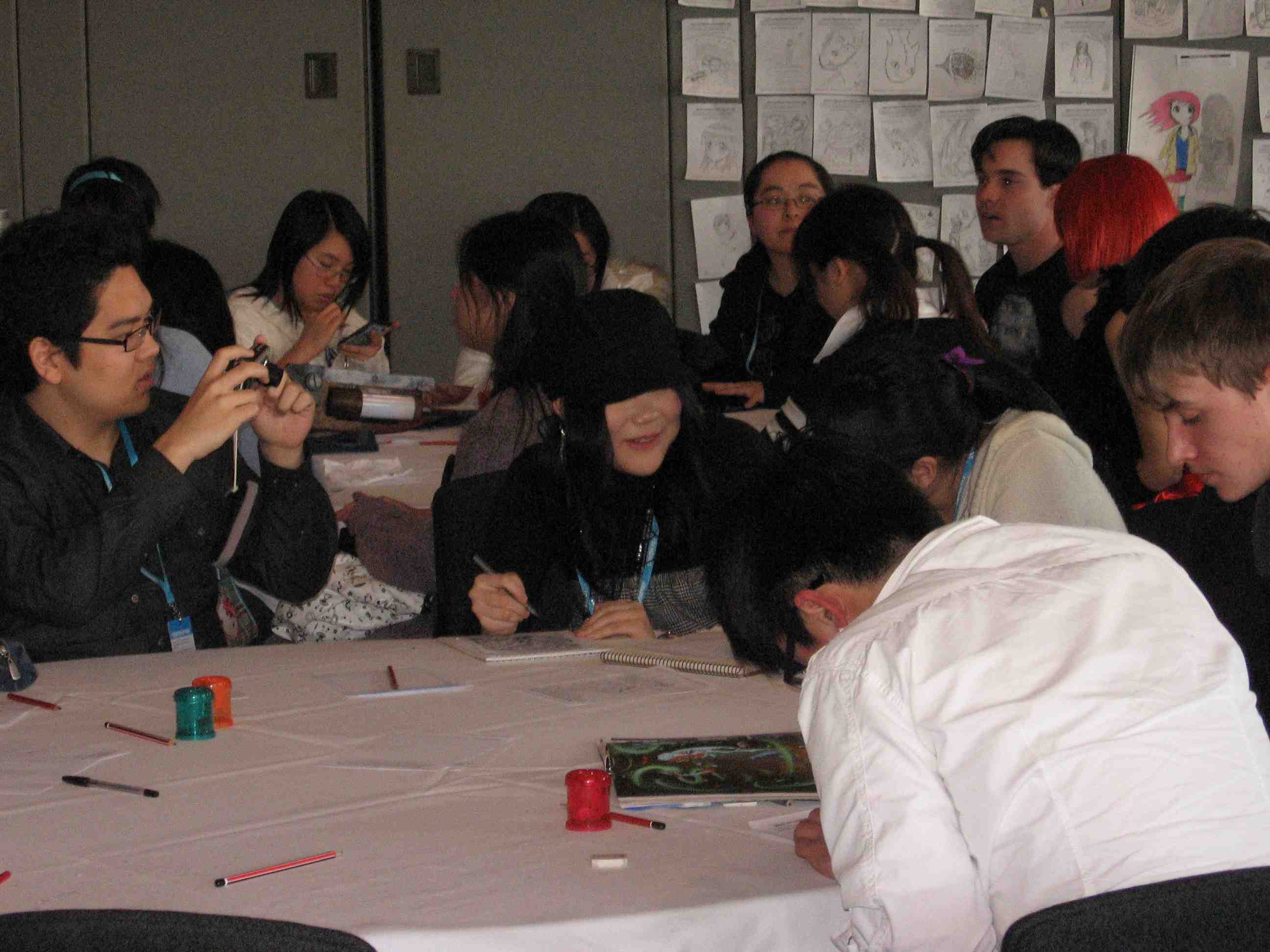
There were Art and Doodle Rooms…for art and doodling…and also manga making…and an epic Cosplay Competition in the main theatre. (Photo-© 2011 Dr. Michael Hill a.k.a. Doctor Comics)

Other events included a Gundam workshop, Karaoke session, videogames and a screening of the anime Summer Wars. There were also sewing, pattern and armour making workshops…plus the huge trading floor full of vendors, artists and fan clubs. It all flourished in the presence of the patronage of the Japan Foundation. Japanese popular culture thrived at this event and made it a wonderful day!

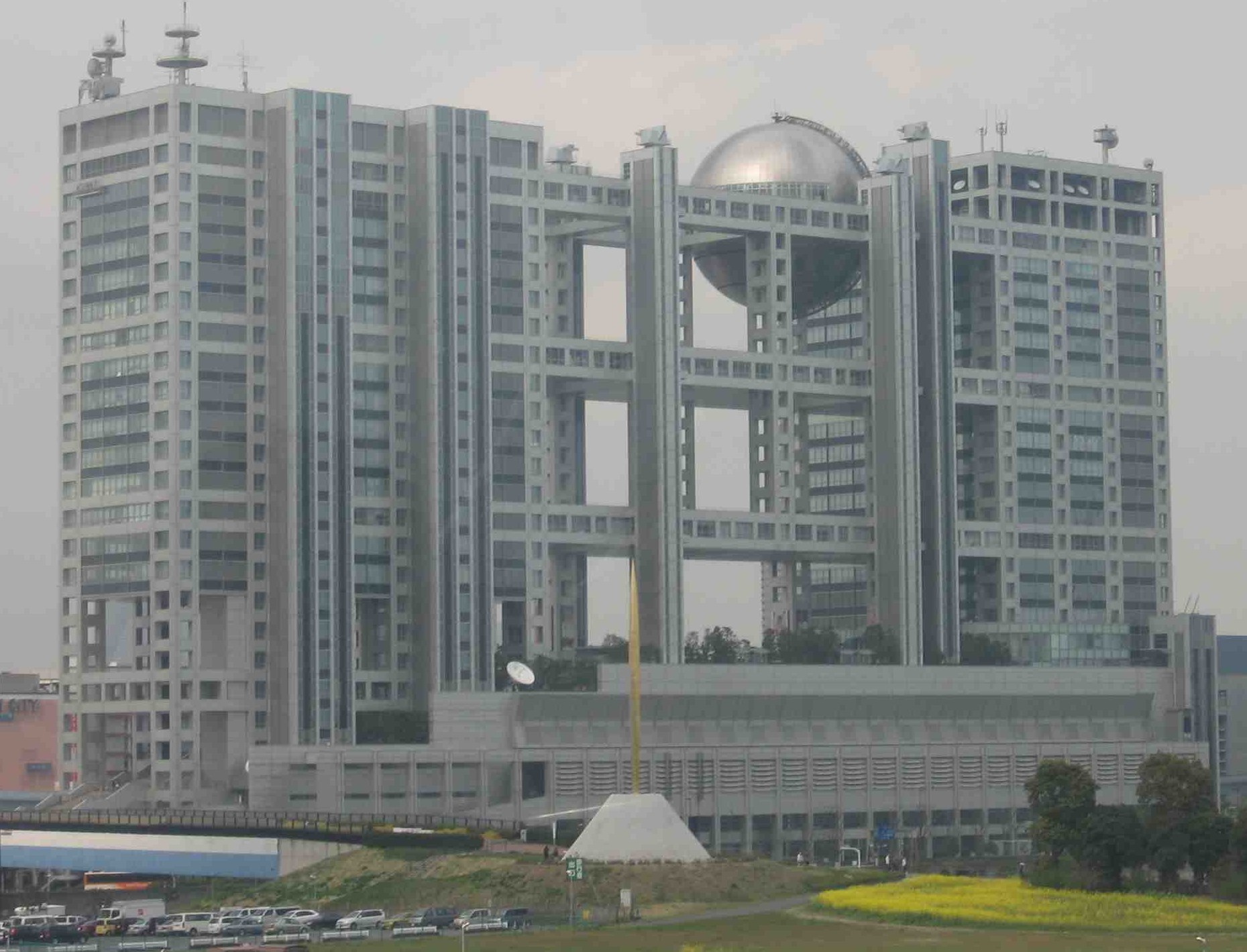
FOOTNOTE: I SAW A BIG SAW AT BIG SIGHT!  As an addendum to this convention report I wish to mention an event I attended in Tokyo last year. I travelled by monorail to Odaiba Island, an artificial island built in Tokyo Bay…to attend the Tokyo Anime Fair at a venue called Tokyo Big Sight (pronounced Biggu Saito in Japanese). Big Sight? I thought that must be a misspelling along Japlish lines for the name of a large exhibition space. There were definitely some big architectural sights to behold as it was a very large exhibition space. No sign of Godzilla though! I thought of Thor as the monorail travelled over the Rainbow Bridge…but instead saw the high tech buildings of Fuji TV headquarters.

The headquarters of Fuji TV(building designed by Japanese architect Kenzo Tange) and the Joyopolis Arcade. (Photo by Michael Hill)
The headquarters of Fuji TV(with the building designed by Japanese architect Kenzo Tange) and the Joyopolis Arcade. (Photo-© 2010 Dr. Michael Hill a.k.a. Doctor Comics)

 On arrival at the Big Sight location things started to look a little unusual. There was an open space beneath a series of inverted pyramids sitting on glass covered, cantilevered legs(see photo below). This giant entrance had the effect of considerably reducing the scale of the people passing beneath it. Then I understood the ‘big’ aspect implied in the name of the site.

Tokyo Big Sight-entrance. (Photo by Michael Hill)
Tokyo Big Sight-massive scale entrance. (Photo-© 2011 Dr. Michael Hill a.k.a. Doctor Comics)

The walk from the monorail station to the Big Sight exhibition also had an epic feel to it. It looked a lot closer than the long walk it took to get there. It was during this walk that I experienced a visual surprise…the sight of a large object embedded in the grass on the level below. It was a sculpture, an art installation of a large saw…unmistakably something by the Swedish/American Pop artist Claes Oldenburg. It also was a “big sight” to see at this big site.

Saw, Sawing by Claes Oldenburg. (Photo by Michael Hill)
Saw, Sawing by Claes Oldenburg. (Photo-© 2011 Dr. Michael Hill a.k.a. Doctor Comics)

This is the third in my series of posts on the theme of comics art…that document moments in the recent history of Australian comics, particularly alternative comics and the Australian Small Press..and related overseas comics events that I attended as part of my research. I had started researching this subject in the late 1990s and it eventually led to my PhD thesis. Details: Ph.D. Macquarie University, Division of Society, Culture, Media and Philosophy…A Study Of Contemporary Australian Alternative Comics 1992-2000…With Particular Reference To The Work Of Naylor, Smith, Danko And Ord, 2003. On completion of this research I donated my large collection of comics to the National Library of Australia…for listing as the Michael Hill Collection of Australian Comics.

NOTE: I wish to acknowledge the shorter gap between my posts in this instance…this was influenced by the attendance and timing of the anime and manga event in Sydney. BTW please let me know what you think about the content and frequency of my blog posts. With this post there’s an opportunity to compare the two events…Sydney and Tokyo…comics and anime…small scale and grand. I welcome any comparative comments, Michael.

(All text, photos and artwork-©2011 Dr. Michael Hill a.k.a. Doctor Comics).
  

BLOTTING PAPER The Comic: Production Report No.2

Art, Blotting Paper, Comics July 10, 2011
Title page from the first issue of my comic using experimental printmaking techniques with rubber stamp letter stamps and smudges.-© 2011 Dr. Michael Hill a.k.a. Doctor Comics

The above image is an experimental graphic impression of the typographic design of the title of my emerging first comic. Keen to experiment graphically with rubber stamping I have moved the letters during printing to create a smudged effect. I have also used some askew registration and mixed the fonts. How postmodern! My comic is based on my experiences…both practical and metaphorical…that I have had in a career in higher education. This involved teaching and research at an art and design college…followed by a university, in the disciplines of film, video, animation and visual communication design. The subject of comics often arose and I actively endorsed that. Initially considered as an effective method of teaching storyboarding it then became a medium in its own right. I also began to research the comics medium. This ultimately led to my doctoral research in comics studies and the gaining of my Ph.D in that field. The Art and Design schools of Sydney College of the Arts were virtually neighbours. As mentioned in my previous post, I became involved in printmaking when I temporarily swapped classes with a colleague…my graphics students with her printmaking students for a couple of sessions, and her students learning animation with me. I became very interested in the printmaking studio and its graphic methods…and began to learn printmaking techniques myself. The printmaking lecturer and I taught each other the rudiments of our respective skills. It was a good exchange. I enjoyed it both as a technical medium and as a form of artistic expression. Consequently, printmaking became an adopted part of my artistic practice. In my own comic production I have employed printmaking to generate titles and visual expressions. These have been edited and combined in my developing graphic novel project Blotting Paper.

My printmaking design of the title page of the comic…an attempt at animated typography but a bit on the blurry side!
© 2011 Dr. Michael Hill a.k.a. Doctor Comics.

I experimented with the visual communication design elements of the work and found this approach both exciting and productive. I also began to think of my project extending beyond a single issue…possibly even becoming a graphic novel?

Another example of expressive and experimental typography-© 2011 Dr. Michael Hill a.k.a. Doctor Comics.

The ‘graphical impressions’ are drawings and prints of graphic memories. These were generated and printed in ink from rubber, wood, lino and other surfaces. The titles were made with rubber type and my name credit from a linocut.  Besides printmaking as a method of image-making I also did some drawing…using traditional metal dip pens, pencils, felt-tipped pens and brushes plus a range of inks.

Title page for Chapter 1 of my comic/graphic novel Blotting Paper titled The Ingurgitator. (collage, sketch and printmaking assemblage- © 2011 Dr. Michael Hill a.k.a. Doctor Comics)

PRODUCTION UPDATE: Recently the production progress of my comic has experienced a few interruptions. On the plus side of this I have been working on interesting studies projects during the delays. One project involves the works of Tezuka, Rintaro, Matsumoto and Miyazaki, and their films. These include Galaxy Express 999, The Dagger of Kamui, Laputa-Castle in the Sky, and The Girl Who Leapt Through Time. Another project involves workshops in the sosaku hanga technique of creative Japanese printmaking. Both of these activities will form part of a Japanese Cultural Festival in Suva in the South Pacific. I shall be participating in and teaching at this event. In terms of my comic’s progress, I have pulled some pieces of completed work together. I have also been modifying other work that I had considered completed. That’s the title page design(above) for the first chapter The Ingurgitator, as it currently stands. Although created in colour a black and white version may appear in the comic. It consists of a combination of image-making techniques including drawing, painting, inking, printmaking and collage. The original collage/sketch, below, was made during a trip to Shanghai to attend the Animation Expo in Hangzhou in 2007.

Original image and early draft of The Ingurgitator  final image, above, from my Shanghai sketchbook. (Collage and rough sketch- © 2007 Dr. Michael Hill a.k.a. Doctor Comics)

So there is my third post on this blog…a month since my previous post…which seems to be a better and more manageable gap…and the second post on my comics project. I would love to hear any comments and suggestions about my blog…including the frequency of my postings, Michael.

(All text, photos and artwork-©2011 Dr. Michael Hill a.k.a. Doctor Comics).