Tag: comics studies

DRAWING WAR: Arrayed in Erlangen

Art, Comics, Germania July 29, 2014

An awesome aspect of the recent Internationaler Comic-Salon Erlangen that I attended…in the old university town of Erlangen, Germany, near Nuremberg…was the staging of two contrastingly presented and equally impressive exhibitions of comics art on World War I…by Joe Sacco and Jacques Tardi.

COMIC SALON exhibition signboard in the city (Photo-© 2014 Michael Hill).
COMIC SALON exhibition signboard, with Tardi image, in the city (Photo-©2014  Dr. Michael Hill a.k.a. Doctor Comics).

Joe Sacco’s The Great War was displayed as an open-air exhibit in Schlossplatz. It was enlarged on display boards arranged in a long series of folds. Seeing it spread across the square magnified the herculean task that Sacco undertook in drawing this epic, concertina work. It represented one day of the Battle of the Somme fitted into one panel.

Open air exhibition in the city at Schlossplatz of Sacco's The Great War (Photo-© 2014 Michael Hill).
Open air exhibition at Schlossplatz of Sacco’s The Great War (Photo-©2014  Dr. Michael Hill a.k.a. Doctor Comics).

His wordless comic is structured around this single seemingly endless panel. It had been folded into 24 segments that unfolds to form a single piece. It depicts events in a continuous, cinema-pan like take. That is spread across time and space with soldiers assembling, attacking, engaging in crossfire and then returning to their lines. The unfolded published comic is too long for a table. Consequently, for exhibition, it has to be spread across the floor of two adjoining rooms or a long corridor. In Schlossplatz it ran right across the square necessitating a reading whilst walking approach. With so much detail it required several passes to take it all in.

Fold-out art work of Sacco's The Great War (Photo-© 2014 Michael Hill).
Fold-out art work of Sacco’s The Great War (Photo-©2014  Dr. Michael Hill a.k.a. Doctor Comics).
Closer view of fold-out art work of Sacco's The Great War (Photo-© 2014 Michael Hill).
Closer view of fold-out display of Sacco’s The Great War (Photo-©2014  Dr. Michael Hill a.k.a. Doctor Comics).

The panels above show the trenches and the movement of the soldiers into the hostilities of ‘No Man’s Land’. This includes their exposure to artillery attacks and its associated schrapnel, plus machine gun and rifle fire.

Sacco being interviewed on site of The Great War exhibition. (Photo-© 2014 Michael Hill).
Sacco being interviewed on site of The Great War exhibition. (Photo-©2014  Dr. Michael Hill a.k.a. Doctor Comics).

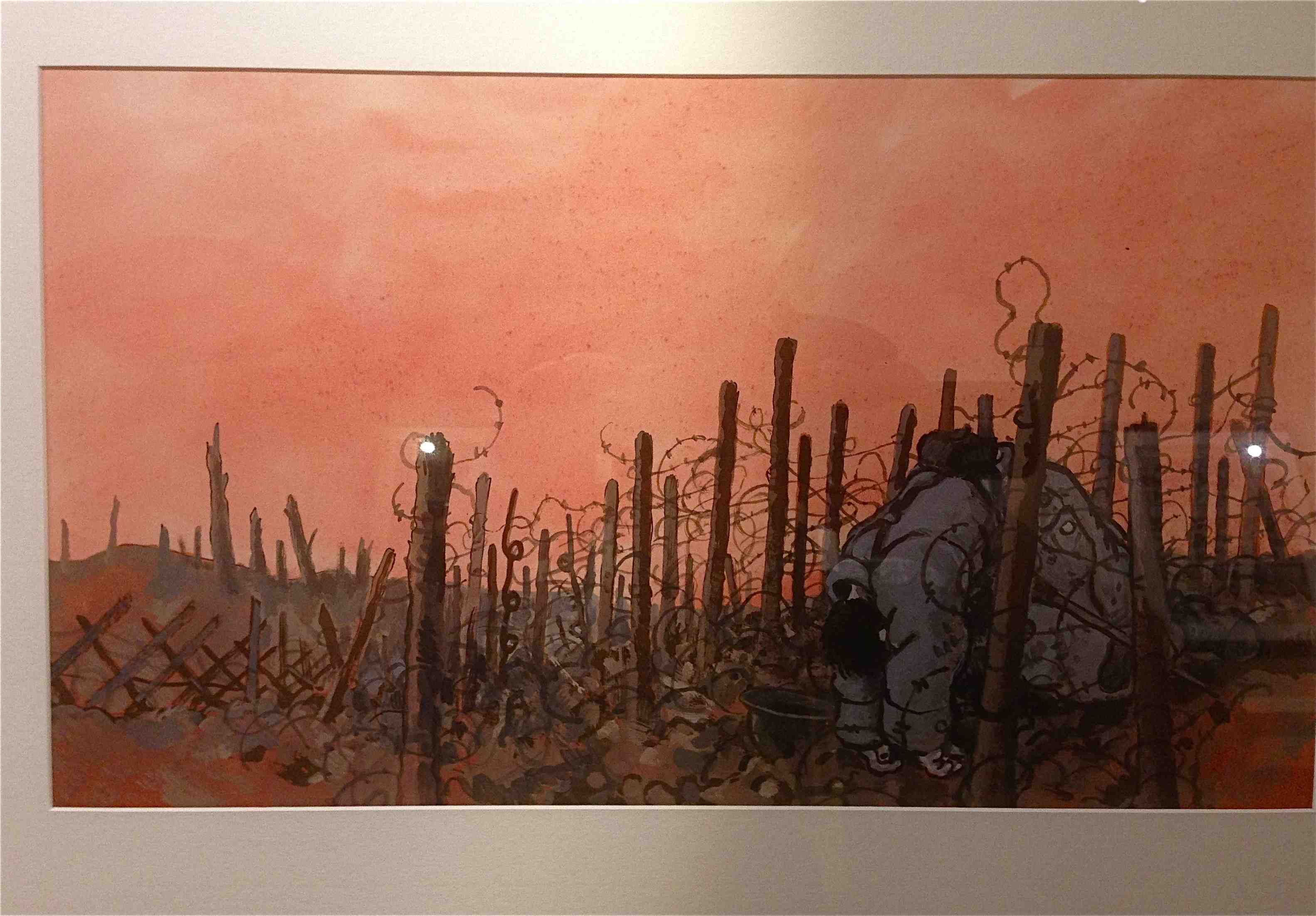
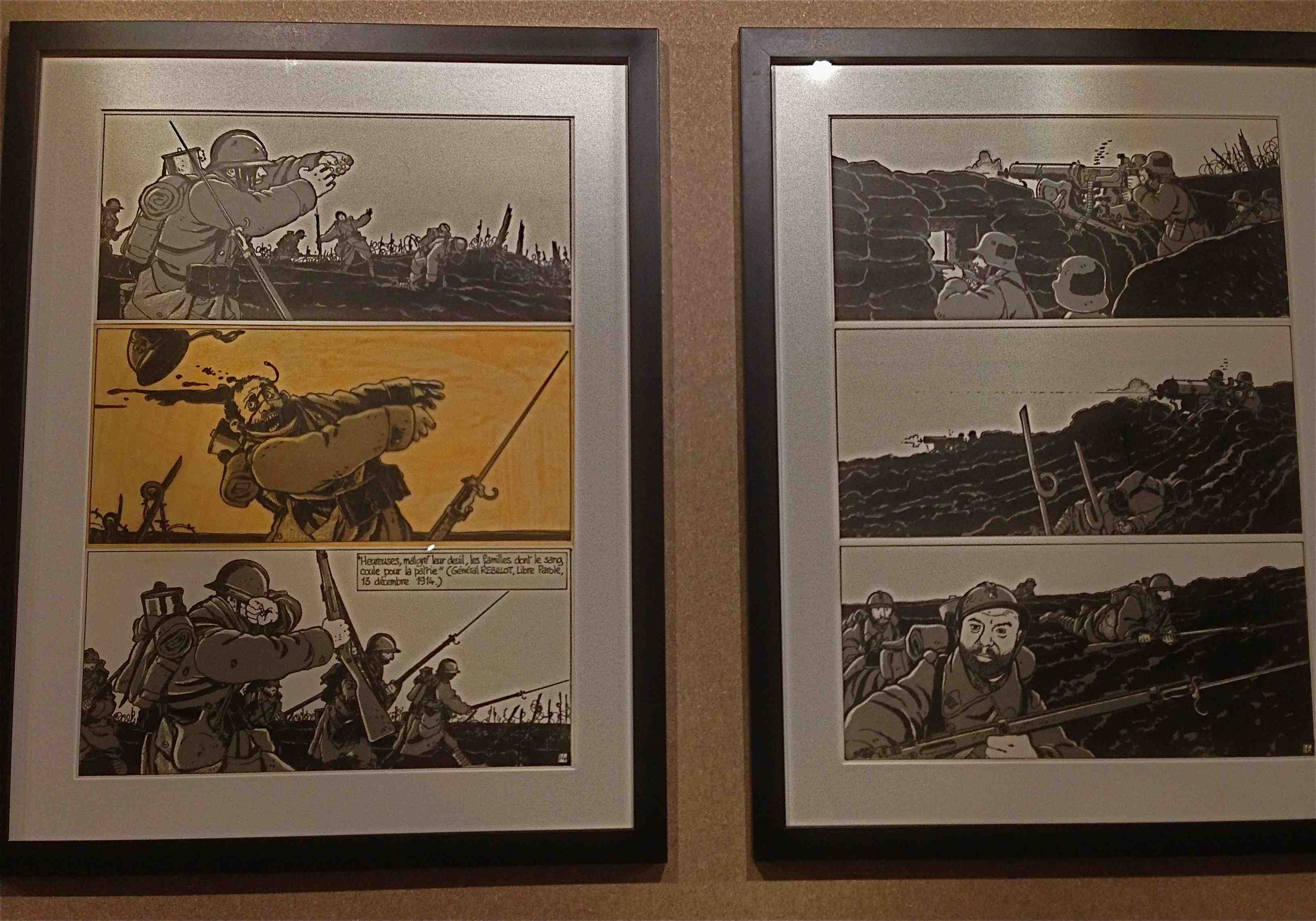
By comparison, the war comics art of Jacques Tardi were exhibited indoors. Low level lighting created a sombre mood appropriate to the theme. It also perhaps protected the original art work from exposure. Corrections such as the whiting-out of errant black border lines and some alignment and registration marks were visible. This was the original art on display! It was not it’s cleaned up and reduced size reproduction as seen in the published comics.

Landscape of Death: Jacques Tardi and the First World War exhibition (Photo-© 2014 Michael Hill).
Landscape of Death: Jacques Tardi and the First World War exhibition (Photo-©2014  Dr. Michael Hill a.k.a. Doctor Comics).
Image from Landscape of Death: Jacques Tardi and the First World War exhibition (Photo-© 2014 Michael Hill).
Image from Landscape of Death: Jacques Tardi and the First World War exhibition (Photo-©2014  Dr. Michael Hill a.k.a. Doctor Comics).

The work, titled Landscape of Death, was bleak, expressing the agony of those who fought in World War I. Many of the images were painful to view. These included soldiers’ bodies torn apart by flying pieces of shredded metal. They were lacerated, disfigured or rendered limbless, with some surviving in this state.

Image from Landscape of Death: Jacques Tardi and the First World War exhibition (Photo-© 2014 Michael Hill).
Image from Landscape of Death: Jacques Tardi and the First World War exhibition (Photo-©2014  Dr. Michael Hill a.k.a. Doctor Comics).
Image from Landscape of Death: Jacques Tardi and the First World War exhibition (Photo-© 2014 Michael Hill).
Images from Landscape of Death: Jacques Tardi and the First World War exhibition (Photo-©2014  Dr. Michael Hill a.k.a. Doctor Comics).

Exhibited in a darkened theatre, the low level of the light created a reverent atmosphere for the images. It also acted as a canopy of protection, from fading, for the original art work. The work was housed in a series of narrow wooden walled and roofed walk-throughs. Some shapes were cut into the walls so that one could see out to lessen the confined effect. Tardi’s use of colour was impressive. His delicate watercolour brushwork added a poignant hue to his poppies, pools of blood and rising smoke.

Image from Landscape of Death: Jacques Tardi and the First World War exhibition (Photo-© 2014 Michael Hill).
Image from Landscape of Death: Jacques Tardi and the First World War exhibition (Photo-©2014  Dr. Michael Hill a.k.a. Doctor Comics).

These two exhibitions, Sacco and Tardi respectively, had contrasting presentations:…open-air/indoor; …spacious/confined;…sunlight/low level artificial illumination;…expansive/confined;…complete/edited; …served to express and communicate aspects of the texts/open…the vulnerability of soldiers both out of the trenches and restricted by the narrow confines of the trenches;…time-one day or six years of living with gas masks, flame throwers, helmets, barbed wire…and the dampness, misery, the stench of rotting bodies, despair and the ongoing expectation of death. This all made a memorable imprint on me, Michael.

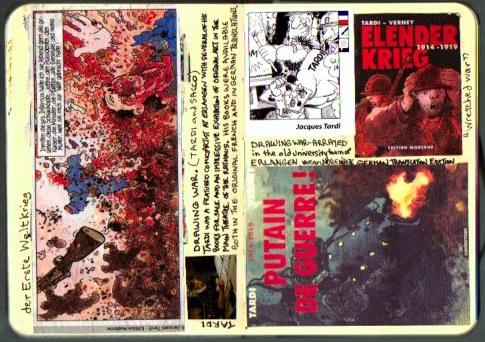
Pages from my Germany journal with Tardi press clippings and sticker (© 2014 Michael Hill).
Pages from my Germany journal with Tardi press clippings and sticker (©2014  Dr. Michael Hill a.k.a. Doctor Comics).

UPDATE 2017: I found this discarded Jacques Tardi sticker (below) from the set that the Erlangen organisers were disseminating…and decided to add it to this post, Michael.

(All text, photos and artwork-©2014 Dr. Michael Hill a.k.a. Doctor Comics).

Archive of Australian Alternative Comics: 2ND SEQUENTIAL ART STUDIES CONFERENCE

Archive of Australian Alternative Comics, Comics, Japanning May 1, 2013

It was ten years ago that the second Sequential Art Studies Conference took place at the University of Technology, Sydney. At the time, minicomics, having blossomed throughout the 1990s, were making an impression on the local alternative comics scene.  The event was billed as A Mini Conference on Minicomics and featured presentations by comics creators as well as scholars. The conference was convened by Spiros Tsaousis (now Spiros Xenos) and I. It was a sequel to our previous and first Sequential Art Studies conference held in Sydney in 2002. That was the first comics conference held in Australia. It was also staged in association with Supanova Pop Culture Expo again. Included in the event was a minicomics market.

CALL FOR PAPERS: 2nd Sequential Art Studies Conference May 23, 2003, Sydney. The Interdisciplinary Studies Unit of the Faculty of Design at UTS (University of Technology, Sydney) http://www.uts.edu.au will again host this new scholarly conference that will be held during the same week as the Sydney Writers’ Festival. The inaugural event in 2002 attracted a small but stimulating range of papers from local academics and students. It is hoped that this year’s event will build on that. Scholars are invited to submit 250 word proposals which address alternative approaches to comics, whether local or global, recent or historical, online or offline, artistic or commercial. The conference will adopt an interdisciplinary approach and so welcomes papers from a broad range of areas. Send proposals by email to either of the conference convenors and coordinators by February 28, 2003: Michael.Hill@uts.edu.au  Spiros.Tsaousis@bigpond.com 
CONFERENCE PROGRAM: Scholarly Papers

4.00pm                Opening of Conference and Welcome by Assoc. Professor Steve Harfield Assoc. Dean of Research Faculty of Design, Architecture and Building  University of Technology, Sydney

4.05pm                 The Sydney Morning Hell of Glenn Smith, Dr. Michael Hill, Interdisciplinary Studies Unit, Faculty of Design, Architecture and Building University of Technology, Sydney

4.30pm                 Fear and yearning of “manga Japan” in Australia, Craig Norris, School of Communication, Design and Media, University of Western Sydney

4.55pm                 Taming the ‘Superhuman’ Shrew: Identification with Superheroes in Comics and the Popularisation of the Human Potential Ethic, Adam Possamaï, School of Applied Social Sciences, University of Western Sydney

5.20pm                The Problem of The Yellow Kid: From Single Panels to Sequential Images, Spiros Tsaousis, La Trobe University

Craig Norris, University of Western Sydney.
Adam Possamaï, University of Western Sydney
CONFERENCE PROGRAM: Artist Presentations 

6.00pm             Alex Major (Naomi and Poggie)

6.20pm             Komala Singh (Moshi Moshi)

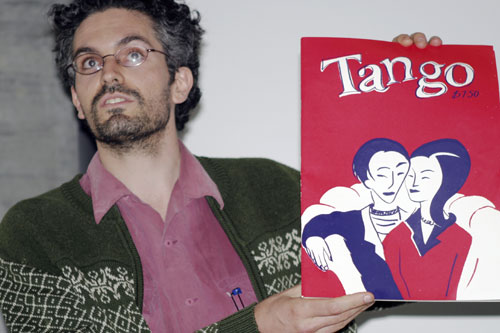
6.40pm             Bernard Caleo (Big Cardigan Comics)

7.00pm             Katarina Knebel (Cult Fiction Comics)

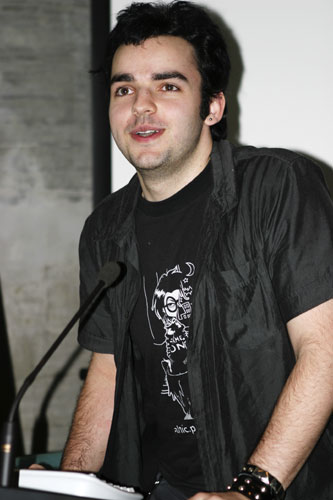
7.20pm             Ben Hutchings (Geeen Comix)

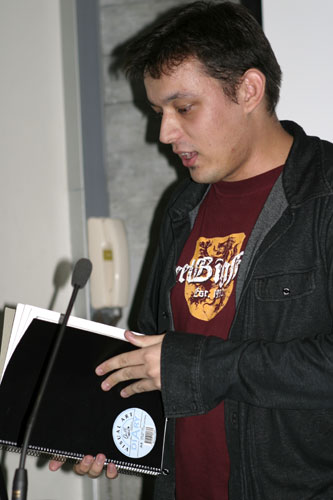
7.40pm             David McDermott (Glitter Shy)

Bernard Caleo proclaimed his comics manifesto and promoted Tango.
Bernard Caleo ‘performed’ his comics manifesto…brilliantly!..and promoted his own comic Tango.
Komala Singh talking about Moshi Moshi.
Komala Singh talked about her minicomic Moshi Moshi.
David McDermott goes Glitter Shy.
David McDermott goes Glitter Shy and playfully ‘performed’ some of his pages live to projected images of the panels.
Chloe Lyttle introducing David Maccad.
Ben Hutchings going Geeen!
Ben Hutchings had fun going Geeen!
Katarina Knebel talks Cult Fiction Comics.
Alex Major describes Naomi and Poggie.
Alex Major describes his minicomic Naomi and Poggie.
Minicomics market at the conferece.
Minicomics market at the conference.

This conference about MINICOMICS as a form of sequential art was a sequel to the first comics conference in 2002…the first comics conference held in Australia I think! Did you attend? If so would you like to add a comment about the proceedings? Please do! I would love to hear, Michael.

This is the tenth in a series of posts called Archives of Australian Comics History. These document moments in the recent history of Australian comics, particularly alternative comics and the Australian Small Press. I started researching this subject in the late 1990s and it eventually led to my PhD thesis. That degree was awarded to me as follows: Ph.D. Macquarie University, Division of Society, Culture, Media and Philosophy…A Study Of Contemporary Australian Alternative Comics 1992-2000 With Particular Reference To The Work Of Naylor, Smith, Danko And Ord, 2003.

On completion of my research I donated the materials and comics I had collected to the National Library of Australia, as: Michael Hill Collection of Australian Comics.

(All text, photos and artwork-©2013 Dr. Michael Hill a.k.a. Doctor Comics).

BLOTTING PAPER The Comic: Production Report No.8

Art, Blotting Paper, Comics, Japanning June 28, 2012

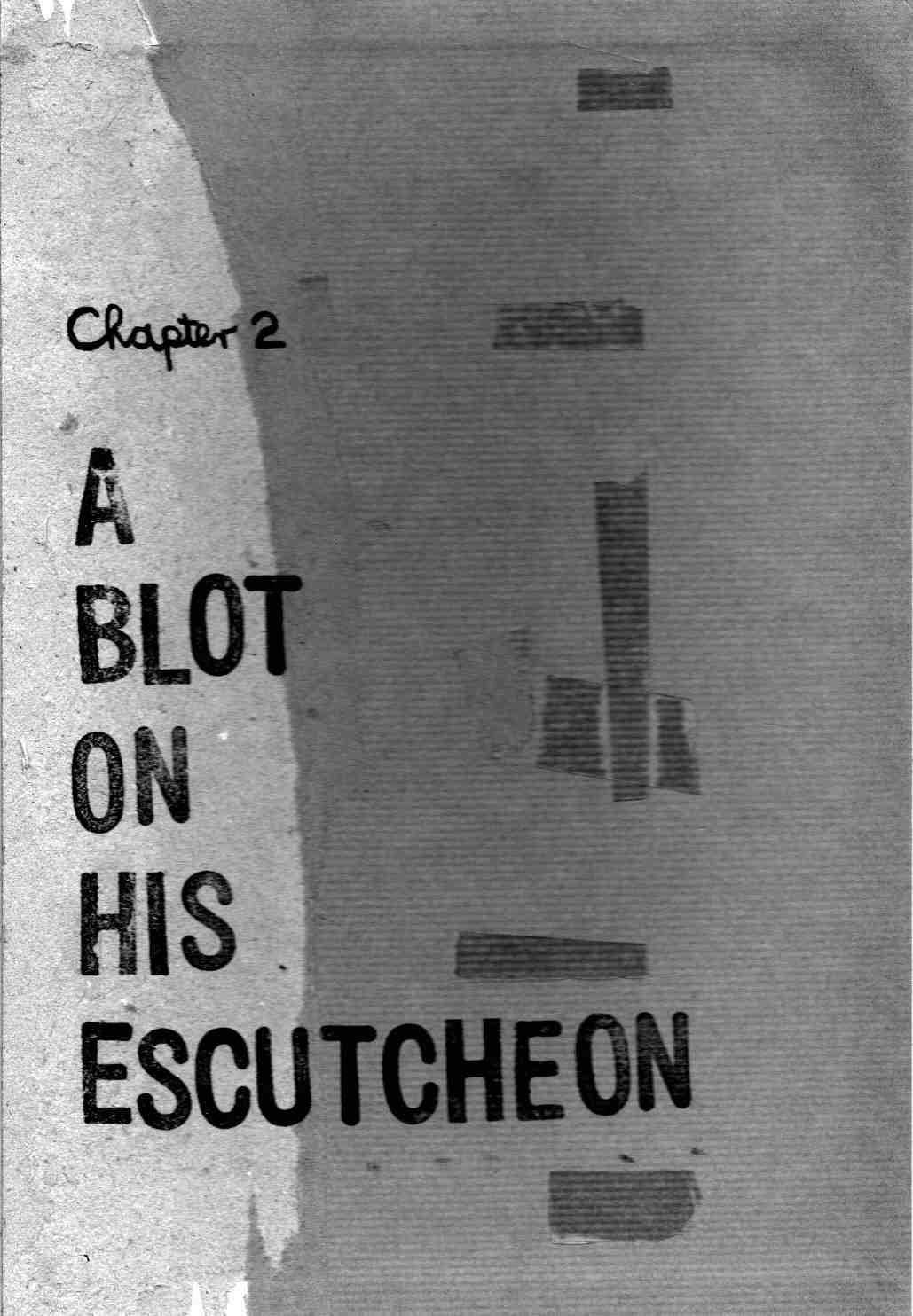
This is the first report documenting the production of the second issue of my artist book/comic…Blotting Paper: The Recollected Graphical Impressions Of Doctor Comics. The new chapter is titled A Blot on His Escutcheon. It delves deeper into the character of Doctor Comics, the environment in which he lives and his life in comics. I am making progress with this and hope to self-publish it next year. The book is partly based on my career in art and design education in Sydney. I worked within these disciplines and their application within the areas of film, video, animation and visual communication. I have employed aspects of comics art in my teaching. Storyboarding, word and image projects and as a medium in itself are examples. I have also employed it in my study and research…the presentation of lectures and conference papers…the staging of conferences, symposiums and exhibitions and the writing of a doctoral thesis. My own comic has fictive passages as well as auto-biographical elements. Printmaking is being utilised as an image-making medium. This includes the Japanese sosaku hanga method, along with pen and ink drawing, collage and found materials.

Proposed title page for issue #2(Pen and ink drawing and collage-© 2012 Dr. Michael Hill a.k.a. Doctor Comics)

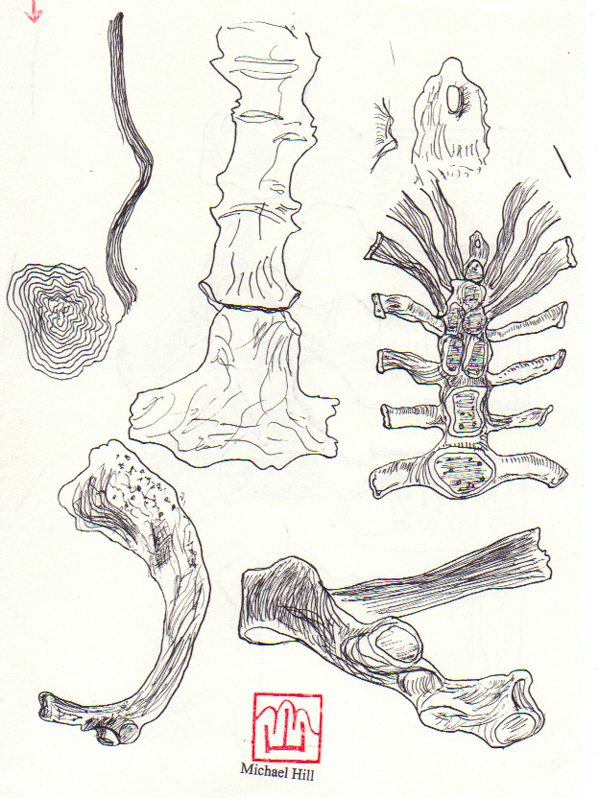
I’m currently learning to draw bones by reading the osteology chapters in anatomy books and studying the illustrations really carefully. In Chapter 1 I used fish bones as an image and as a printmaking substrate for the sosaku hanga technique. In Chapter 2 there will be drawings of human bones of the hand and foot. I have had the opportunity to study some broken bones incurred in falls from bicycles. Speaking of cyclists I also make reference to the Bookseller of Glee character.

Bones of the hand and foot. (Pen and ink drawing-© 2012 Dr. Michael Hill a.k.a. Doctor Comics)

This bookseller rides a penny farthing type of bicycle and will play a part in this issue. I had my portrait of this fine gentleman in the Glebe Sesquicentenary Art Exhibition(see below). It was also a finalist in the 2010 Bald Archy Prize. Titled The Bookseller of Glee (mixed media-drawing, painting and collage on paper)…it is a postmodern portrait of Roger Mackell, co-owner of Gleebooks (4 times Australian Bookseller of the Year). He is a generous character gleefully disseminating books and promoting the joy of reading. The portrait caricatures him and his store’s contribution to the intellectual life of Glee Village and its nearby universities. In my portrait the main street is constructed from the writings of French literary critics and philosophers…whose work the bookshop stocked in the 1980s.

The artist…Dr. Michael Hill a.k.a. Doctor Comics and his portrait of a particular Glebe bookseller. (Photo by Louise Graber)
More bones (pen and ink drawing-© 2012 Michael Hill)
More bones (pen and ink drawing-© 2012 Dr. Michael Hill. a.k.a. Doctor Comics)

I have been drawing more bones. In the meantime I am putting a call out for feedback on this post. I would really love to hear what you think of what I am doing with my blog and bones.

Bones of the hand, heel and hips. (Pen and ink drawing-©2012 Dr. Michael Hill a.k.a. Doctor Comics)

(All text, photos and artwork-©2012 Dr. Michael Hill).

Archive of Australian Alternative Comics: 2002 SEQUENTIAL ART STUDIES CONFERENCE

Archive of Australian Alternative Comics, Art, Comics, Japanning April 7, 2012

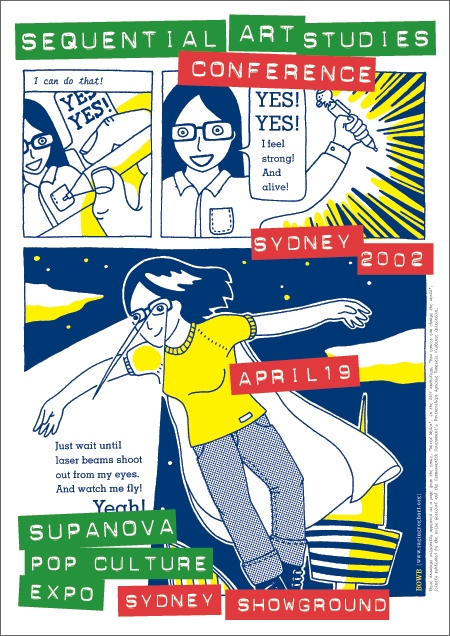
Conference poster designed by BOWB.

Ten years ago this event, the first Sequential Art Studies Conference took place on April 19 2002 in Sydney at the University of Technology, and by my reckoning, was the first scholarly conference on comics studies to be held in Australia, more than 3 years prior to the “Men In Tights” conference at Melbourne University in 2005 that also makes this claim! The conference was named after the descriptive term for comics, sequential art, introduced by Will Eisner in 1985. Thank you Will! Convened by Jeremy Allen and myself, with panels chaired by Jeremy, Spiros Tsaousis and I, the conference was held in association with Supanova Pop Culture Expo with support from Daniel Zachariou. The conference poster was designed by BOWB.

CALL FOR PAPERS

SEQUENTIAL ART STUDIES CONFERENCE, Sydney, Australia, April 19 2002 SUPANOVA POP CULTURE EXPO Sydney Showground, April 20-21 2002. This inaugural scholarly conference on comics will take place on the day preceding Australia’s largest comics convention and will be associated with that event. Scholars are invited to submit 250 word proposals which address alternative approaches to comics, whether local or global, recent or historical, online or offline, artistic or commercial. The conference will adopt a multidisciplinary approach and welcomes papers from a broad range of disciplines. Send enquiries and proposals, by email only, to either of the conference coordinators: Jeremy Allen: Jeremy.S.Allen@uts.edu.au  or  Michael Hill: Michael.Hill@uts.edu.au Interdisciplinary Studies, Faculty of Design, University of Technology, Sydney.

DEADLINE: Friday December 21 2001

PROGRAM

Michael Hill-Bite of the Mongrel Breed: A Study of Satire in Contemporary Australian Alternative Comics 

Abstract: This paper involves an examination of the contemporary Australian alternative comics scene as a lively form of lampooning and derision in the late 20th Century. In contrast to the mainstream print media, many of the artists, creators and cartoonists involved antagonise, irritate and ridicule with their graphic humour and horror, provoking irreverent laughter as well as an element of fear and amazement within their limited audience. In so doing, they take advantage of what is a relatively unregulated outlet of creativity and visual communication. As a wide-ranging group of artists, their repertoire houses a mix of graphic styles and comic art genres and their attitude has strains of ‘larrikin’ and ‘ratbag’ humour.

Bio: Michael Hill is Senior Lecturer in Visual Communication and Director of the Interdisciplinary Studies Unit at UTS, and partner in Graber Hill, publisher of the alternative comic B.L.A.CK.

Craig Norris-Manga in Australia: erasing and re-animating Japan   

Abstract: The export of manga (Japanese comics) from Japan to Australia is a journey from erasing race and culture to redrawing ideal bodies and communities. Using my two years of field research in Tokyo I argue that the export agenda of Japanese animation distributors is based on the erasure of Japanese racial characteristics and life-style to allow for easier localisation of animation and comics such as Astro Boy, Poke-Mon and Dragonball Z (Iwabuchi, 1998). I compare these producer-dominated ‘erased’ manga with the ‘redrawn’ manga of fan artists throughout Australia. I focus on the work of a number of manga fan-artists based in Sydney whose work appears in fan-zines, online, and on more unusual surfaces such as car-body art work.

Bio: Craig Norris is a PhD candidate at the University of Western Sydney. His research interests include cultural globalisation, audience-studies, and Asian/Australian popular culture flows.

Jeremy Allen-OZ.COM: Australian Comic Creators and the Web  

Abstract: Over the last seven years the web has emerged as a focal point for comicsculture. It is a place for fans to connect, for the purchase of latest titles and back issues, for comic news to be broadcast, for upcoming comics to be ‘spoiled’, and for established comic companies to advertise. Significantly, it has also given a mass media voice to aspiring comiccreators. In this respect, the web has become a gallery of online comics to be appreciated by potentially millions of people across the world. It is through this new method of distribution and new form of comics that the Internet has perhaps had its most revolutionary impact on comics, by producing a true alternative to the ‘offline’ comics industry.  

Bio: Jeremy Allen is currently researching his Ph.D. on Online Comics on an Australian Postgraduate Award Scholarship in the Faculty of Design, Architecture and Building at the University of Technology, Sydney.  

Zeldz Magnoonis-The sequential art of the skateboard sequence   

Abstract: Skateboarding is an activity full of dynamic action and motion.  Inevitably, attempts to capture this phenomenon require communication of this movement.  Representing movement in print has obvious limitations and the most obvious solution is that of the photographic sequence.  In this paper, it will be argued that these sequences can be read much like a comic strip.  It will be demonstrated that they not only share characteristics of comic strips, but have developed alternative processes that could be of use to the comic creator.

Bio: After falling into the cauldron of magic comics as a baby, monsieur Magnoonis has been addicted to the medium ever since, currently studying visual communication and creating the mini comic Pepe’s Quest.

Kurt Brereton-From Paper to Pixels: Animating Drawings and Paintings   

Abstract: Many artists and new animators work with desktop Mac and PCs at home or in schools and colleges. Great ideas can be well expressed using alternative approaches without resorting to high tech wiz bang special effects. New media and interactive multimedia technical restrictions have forced alternative animators to think big and work small.  This talk will focus on practical and conceptual issues at play in working in multimedia.

Bio: Kurt Brereton is Adjunct Professor in Computer Based Art & Design at the University of the Sunshine Coast and the University of Technology, Sydney, Managing Director of Spark Interactive and an internationally represented visual artist, photographer and film maker.

Spiros Tsaousis- The Spatial Logic of Krazy Kat   

Abstract: Modernist spatiality evidenced two strains – one orderly, mechanistic, logical and gridbased; the other fluid, dynamic, a transvaluation. However the rational and orderly exhibits the symptoms of anxiety, containing within its formulation the seeds of its unconscious propensity toward disorder and fluidity. Broadly tracing the spatial development of the comic strip from, say, Hogan’s Alley to Little Nemo to Krazy Kat evidences the movement of the medium between the two poles. In this paper I assert that the ‘logic’ of Krazy Kat is made coherent, legible and thematically consistent with appeal to its representation of space and place; and that its spatial presentation – its design and rearrangement of the comics page – is a significant departure from the relatively uniform and stable arrangements of comic strips such as Hogan’s Alley and Little Nemo.

Bio: Spiros Tsaousis has recently completed his thesis, “Disturbance of Distance: Postmodern Spatiality and the Comic Strip, Comic Book and Graphic Novel”. He has presented and published a number of papers on comics.

Adam Possamai-The Social Construction of Comic Books as a (Non) Recognised Form of Art in Australia 

Abstract: Even if since the 1990s there is an emergent community of comic book artists, Comic Books in Australia appear to be negatively stigmatised as immature literature in everyday life and in academic spheres. Even if comics started in newspapers as a way to attract working class adults to buy newspapers, and later became a literature form aimed at young readers, this medium has reached its Lettres de Noblesses and has been recognised as an art form since the 1970s in Europe, Japan, and the USA, but NOT – as it appears – in Australia. The aim of this paper is to describe the social construction of comic books as an immature literature in Australia since WW II.

Bio: Adam Possamai lectures in sociology at the University of Western Sydney. His doctoral thesis won the Jean Martin Award for the best PhD in Sociology submitted in Australia during 1998-9.

Note: Jeremy Allen is now known as Jeremy Kerr and Spiros Tsaousis is now Spiros Xenos.

Well this post came up a bit sooner than I preferred but I had to report on the event asap. Whether you attended  this event or have just read this blog post I would love to hear your impressions of either. Please post. It is the seventh in a series of posts called Archives of Australian Comics History that document moments in the recent history of Australian comics, particularly alternative comics and the Australian Small Press. I started researching this subject in the late 1990s and it eventually led to my PhD thesis: Ph.D. Macquarie University, Division of Society, Culture, Media and Philosophy,  A Study Of Contemporary Australian Alternative Comics 1992-2000 With Particular Reference To The Work Of Naylor, Smith, Danko And Ord, 2003. On completion of the research I donated the materials and comics I had collected to the National Library of Australia: Michael Hill Collection of Australian Comics.

(All text-©2012 Dr. Michael Hill a.k.a. Doctor Comics).

BLOTTING PAPER The Comic: Production Report No.3

Art, Blotting Paper, Comics August 9, 2011

Production of the first issue of my comic Blotting Paper continues despite delays from my ongoing academic commitments. However, my intention of having the first chapter finished by the end of the year remains. Comparing research to production I have discovered the enormous amount of time it takes to design and create artwork. I can write a thousand word critique of a comic in just over an hour…but creating one page of comics art will take me several times that. Many of the comics creators that I have interviewed say their rate was “a day per page”. I wish!…but I don’t really mind as I love the feeling of being deep in creative space. At the moment, besides printmaking, I am also doing some drawing. I love it and the mental space it takes me into. I like the feeling of getting lost in there.

My ink sketch of the Sydney Harbour Bridge for the first chapter of my comic…it could use a little more detail, perhaps? (Pen and ink drawing-© 2011 Dr. Michael Hill a.k.a. Doctor Comics)

The bridge and Doctor Comics, pen and ink drawing collage #1(© 2011 Michael Hill)
Rough collage of Doctor Comics out walking and contemplating near the Sydney Harbour Bridge…a rough draft design, including corrections, in pen and ink.
(© 2011 Dr. Michael Hill a.k.a. Doctor Comics)

I am experimenting with a range of image-making media to produce the artwork and text. Below are some of the images that have been generated through printmaking at Studio Buljan, in Sydney. (My thanks to Katharine Buljan for the access to her studio). These prints appear in the first chapter of my comic The Ingurgitator. The chapter begins in sunshine in Sydney then things take a dark turn into the subconscious terrain. There is also the evening ritual wherein Doctor Comics cooks dinner…then drinks wine whilst reading his recent comics purchases. During this time he converses with his feline friends. The evening often ends in a dream state that is a melange of art, thought, taste and reflection.

Doctor Comics has his evening proverbial swim in a sea of sumi ink.
(Monotype print-© 2011 Dr. Michael Hill a.k.a. Doctor Comics)
Losing one’s footing and feeling out-of-depth and the fear of ‘going under’.
(Monotype print-© 2011 Dr. Michael Hill a.k.a. Doctor Comics)
Struggling for breath and sinking into the blackness.
(Monotype print-© 2011 Dr. Michael Hill a.k.a. Doctor Comics)

These images are monoprints, so called for their singularity…only one of each is made. However, by re-inking the block and marginally alterating the images, a degree of continuity is maintained. This enables a sequential element to come into play. I have learned this approach in creating the artwork for animation projects. For me, working in printmaking, comics and animation is both labour saving and exhaustive. The images come up quickly but the act of re-inking and printing the block destroys the originals. There is no going back. I enjoy working with the inky element of printmaking. It is so graphic! Any thoughts? Comments about this and my posts are welcome, Michael.

(All text, photos and artwork-©2011 Dr. Michael Hill a.k.a. Doctor Comics).

BLOTTING PAPER The Comic: Production Report No.1

Art, Blotting Paper, Comics, Japanning June 12, 2011

This is the first post documenting the production and progress of my own creative comics project. After studying and researching comics for the past few years…and reading them since I was seven…I have now decided to have a go at making my own. I have more experience of researching comics than producing them. In fact I gained a Ph.D. for my research into comics. That is where I picked up the “Doctor Comics” tag. Then I decided to write some blog posts on the topic…and that led to the decision to create my own comic. The title of my comic is Blotting Paper: The Recollected Graphical Impressions Of Doctor Comics. My research into comics art is now being followed by the creation of it…in a self-reflective approach. I like the juxtaposition of research and production although it may prove difficult to balance. We will see. Please let me know what you think of my efforts. I expect that my comic will be partly autobiographical and partly fictive. It will include comics art related events from my academic career…and my attempts to carry the comics flag in art and design tertiary education. There will be anecdotes relating to my Doctor Comics’s adventures and to my own longstanding interest in comics art studies.

Following a few false starts the first chapter has been written, the design roughed out and the artwork constructed. My experience in printmaking was employed in the generation of some of the graphic work. Techniques included woodblock, linocut and Japanese sosaku hanga techniques along with the use of rubber stamps and seals. Printmaking has also shaped the title of the comic, namely Blotting Paper. It suggests the sometimes messy outcome of shaping words and images in ink on paper…and the latter’s absorption and rejection of it. It is a process where things can get messy at times…but I enjoy the appearance of inkblots and stains and attempts to resolve graphic issues arising from it. Drawing, photography, typography, collage and handwriting have all been utilised as image-making techniques. My intention is to construct a free form, creative comic in an artist’s book format. I really enjoy the process of printmaking…including its potential to produce variations on a theme e.g. unexpected blots, streaks and stains. I would also like to acknowledge of how I first learned it. That was at Sydney College of the Arts whilst working in the Film and Video department of the Design School. I was approached by a fellow academic from the Art School who wanted to learn animation. So we arranged a swap deal. If I taught her basic animation techniques she would introduce me to the art of printmaking. That sounded interesting and it worked like a charm. I fell under the printmaking spell. In fact, I’m still under it!

Typographic design with rubber type assemblage of title of my comic.(Photo-© 2011 Dr. Michael Hill a.k.a. Doctor Comics)

I am how much more time it takes to create a comic than to read or review one…but I am enjoying the creative and technical challenges. I now expect I shall be spending more time creating and less time critiquing comics art in the future. I have since altered the order of emphasis in my social media profile…from ‘critiquing and creating’ to ‘creating and critiquing!’

Some of the stamps, chops and seals. (Photo by Michael Hill)
Some of the stamps, chops and seals I have accrued and assembled for this project are from my printmaking days. (Photo-© 2011 Dr. Michael Hill a.k.a. Doctor Comics)

My basic set of woodblock printmaking chisels purchased in Tokyo. (Photo-© 2011 Dr. Michael Hill a.k.a. Doctor Comics)

Red cat (pencil and ink drawing-© 2010 Michael Hill)

My experimental character design of possible feline character, Red Cat (© 2010 Dr. Michael Hill a.k.a. Doctor Comics)

Accompanying the Doctor Comics character in the comic are his cats, Busch and Cohl. They not only live with him and keep him company but they also read his comics and critique them! Being talking cats they also give him feedback, advising him in a critical manner, of his skills, shortcomings and selections. These comics reading cats are a seeming contrast to him…although their characters are still being designed. One possible design is the Red Cat above. Future posts will document the graphic resolution of this matter.

My animated ink sketch of Doctor Comics rushing to buy cat food at feeding time. He had run out of it and his cats are unpleasantly difficult to deal with when hungry! I have used an animation technique approach of juxtaposed sequential stages of the action for this one…to emphasize Doc’s movement. (© 2010 Dr. Michael Hill a.k.a. Doctor Comics)

Well that’s the third post on my blog…three weeks since the last one…smaller in size…and the first one dealing with my own developing creative project. I think I’m starting to get the hang of it. Thanks for the feedback I have received…I welcome any comments about my blog and my comics project. Here’s to comics art, Michael.

(All text, photos and artwork-©2011 Dr. Michael Hill a.k.a. Doctor Comics).

Archive of Australian Alternative Comics: MCA ZINE FAIR

Archive of Australian Alternative Comics, Art, Comics May 22, 2011

Wow!…that was quick! I’m already publishing the second post on my blog only ten days after the debut post…a bit soon, perhaps? As a new blogger I am wondering how often I should post? Suggestions welcome! Anyway, having just attended this event I wanted to go straight home and blog about it! And that’s what have done!

Opposite the Sydney Opera House... (Photo by Michael Hill a.k.a Doctor Comics)
Sydney Opera House…just across the Sydney Harbour and opposite the MCA (Museum of Contemporary Art). (Photo-© 2011 by Dr. Michael Hill a.k.a. Doctor Comics)
...at the MCA (Museum of Contemporary Art)... (Photo by Michael Hill a.k.a Doctor Comics)
MCA(Museum of Contemporary Art…with comics and zines on display in an art gallery. (Photo-© 2011 by Dr. Michael Hill a.k.a. Doctor Comics)
The MCA Zine Fair 2011 program! (Photo-© 2011 by Dr. Michael Hill a.k.a. Doctor Comics)

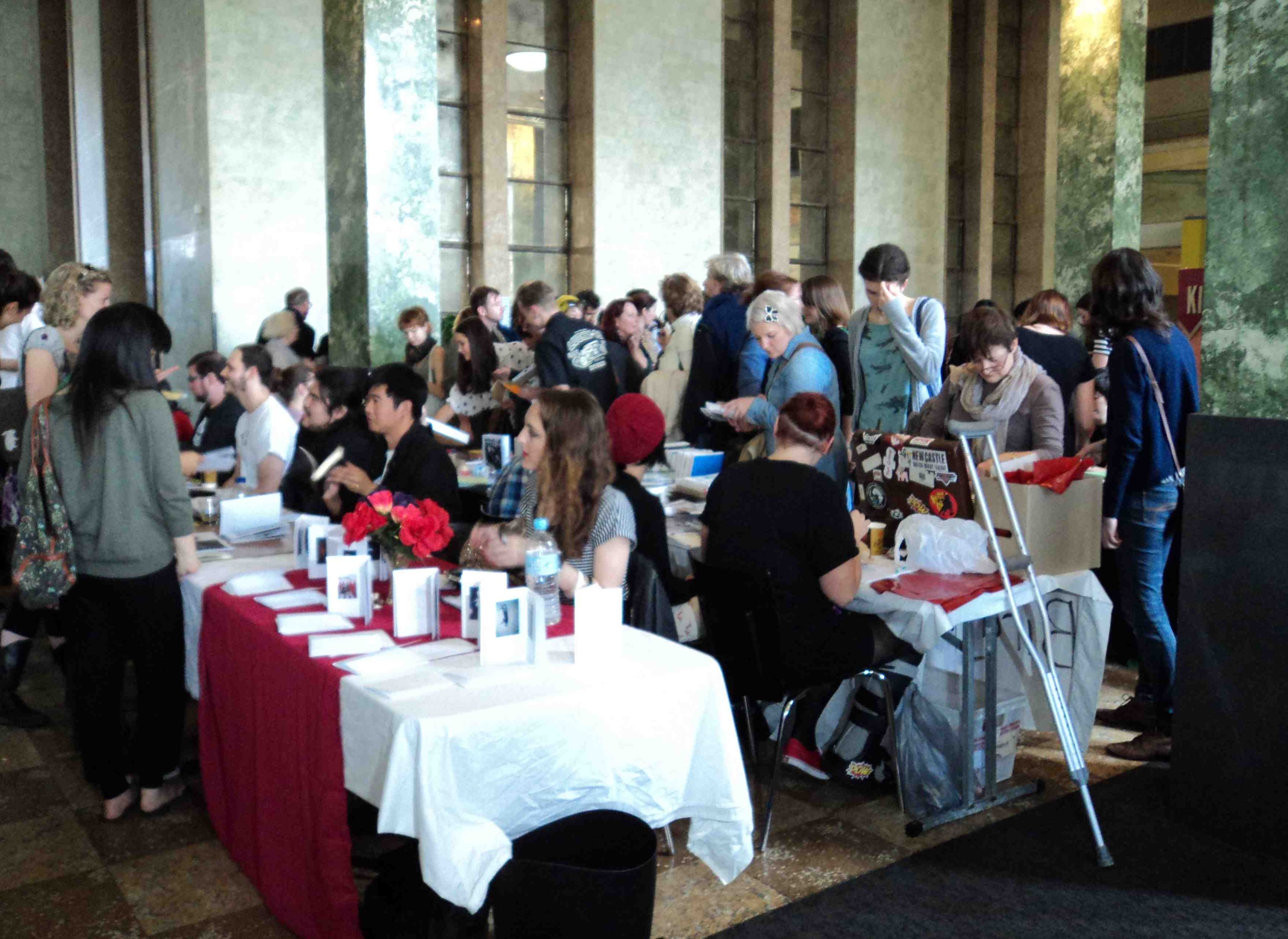
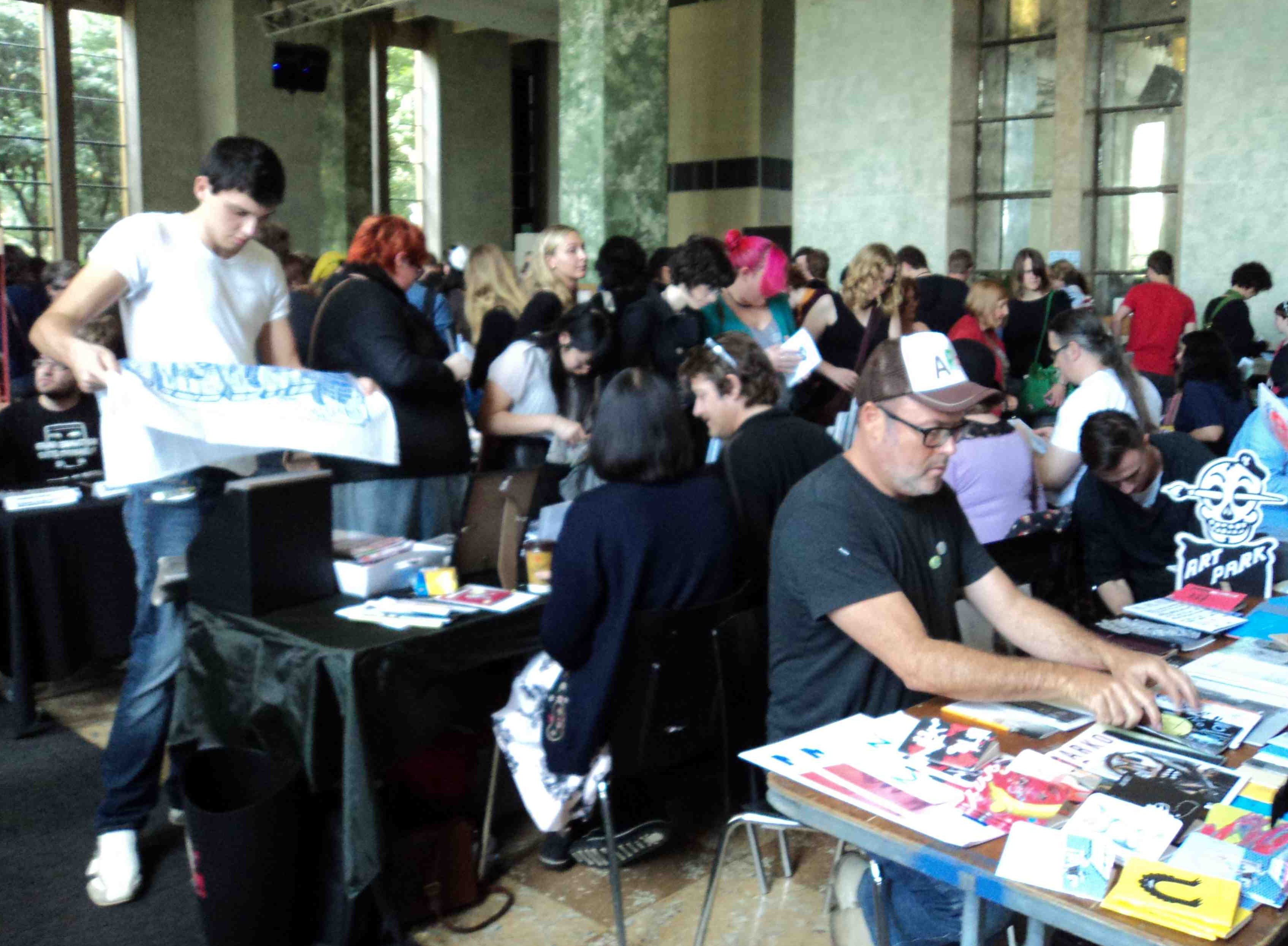
So there was this Zine Fair in Sydney in 2011…at the Museum of Contemporary Art at Circular Quay on Sydney Harbour, just across from the Sydney Opera House. Were comics and zines moving up in the art and culture world? I could hear the comics art bell ringing even if it was primarily a zine affair. Some of the comics crew that I knew were attending…some even trading amongst the 50 tables to a busy crowd of attendees on the gallery floor. An odd presence of craft makers selling jewellery and accessories seemed curious…after all it was a zine fair! This led to queries about the selection process…as some comics creators had apparently been unable to acquire a table due to the limited trading space available? Despite the presence of the jewellery artists there was hectic selling of comics and zines. It seemed to be a “happening” event that had a “certain buzz” about it! It also provided a networking opportunity for the creators.

...2011 Sydney Writers' Festival-MCA Zine Fair. (Photo by Louise Graber)
Comics and zine creators at work on the trading floor. (Photo by Louise Graber)
L to R: Tim McEwen, Doctor Comics(wearing Sick Puppy Comix T-shirt), Cefn Ridout. (Photo by Louise Graber)
L to R: Tim McEwen, Doctor Comics a.k.a. Dr. Michael Hill (wearing a Sick Puppy Comix T-shirt designed by Australian cartoonist and comics creator Neale Blanden) and Cefn Ridout. We were delighted to see comics displayed and sold in an art gallery! What a hoot! (Photo by Louise Graber)
Busy trading on the floor of Foundation Hall. (Photo by Louise Graber)
Some very busy zines and comics trading took place in the Foundation Hall…along with the meeting and mingling and jewellery jingling. (Photo by Louise Graber)

Stuart Stratu, the creator of Sick Puppy Comix approved my wearing of a T-shirt featuring his comic. It had a Neale Blanden cartoon design(see photos above and below). Sick Puppy is a radical anthology of short pieces by Australian and overseas creators. Stratu has edited and self-published this comic having been motivated to commence small press publishing after visiting a comics convention. He said: “It was going to OZCON, one of the comics conventions…seeing the small press booth- that’s when I got the idea to make my own mini-comics. I had never done any comics or cartoons myself, just little drawings and things. So what I did was run an ad for contributors in the personals column of Drum Media. So all the people in the first issue…none of them had published their own comics at all. So that was basically how Sick Puppy No.1 came to be. That was April 96. Number two came out four months later. It was very primitive.”  A total of 13 issues off his comic have now been published! It features a range of graphic styles from alternative comics contributors and the content is both provocative and entertaining!

Sick Puppy Comix T-shirt with graphic logo by Neale Blanden. (Photo-© 2011 by Dr. Michael Hill a.k.a. Doctor Comics)

A common feature of the alternative comics scene is the practice of creators contributing to each other’s publications. Sick Puppy Comix is a prime example of this providing that comic with a variety of graphic styles. By contrast there was some commonality of content. Much of the material dealt with aspects of sex and/or violence. Whilst emphasising humour, it adopted a somewhat avant-garde attitude… encouraging its contributors to test both their own and their readers’ personal boundaries of taste and creativity. The print and presentation quality of the publication improved with each issue. This seemed to inspire contributing creators to produce better quality work. Contributors included Gerard Ashworth…Neale Blanden…Tim Danko…Anton Emdin…Michael Fikaris…Louise Graber…Maccad…Kieran Mangan…Chris Mikul…Mandy Ord…Pox Girls(Susan Butcher and Carol Wood)…David Puckeridge…Q-Ray…SCAR(named from the initials of its collaborators Steve Carter and Antoinette Rydyr)…Glenn Smith…Ross Tesoriero and Ryan Vella as well as Stratu himself.

Sick Puppy Comic creator Stuart Stratu. (Photo by Louise Graber)
Stuart Stratu, creator of Sick Puppy Comix at the Zine Fair. (Photo by Louise Graber)
David Puckeridge with his publication
David Puckeridge selling his comic BOX. (Photo-© 2011 by Dr. Michael Hill a.k.a. Doctor Comics)
Doctor Comics with Antoinette Rydyr of SCAR. (Photo by Louise Graber)
Dr. Michael Hill a.k.a Doctor Comics with comics creator Antoinette Rydyr at her table with a selection of alternative comics for sale. (Photo by Louise Graber)

This post is from my new, developing series Archive of Australian Alternative Comics. It was created as a result of my research into comics art conducted for my doctoral degree. Details: Macquarie University, Division of Society, Culture, Media and Philosophy, PhD awarded by virtue of the thesis…A Study Of Contemporary Australian Alternative Comics 1992-2000…With Particular Reference To The Work Of Naylor, Smith, Danko And Ord, 2003. On completion of my doctorate I donated most of my Australian small press comics collection(approximately 500 items)…that I had used in my comics art research…along with a copy of my thesis, to the National Library of Australia.

So there is the second post on my new blog. I think I’m beginning to get the hang of it…but that makes two posts in ten days! Should I have a longer gap between posts? Should I use fewer images and more text? I welcome any suggestions from readers on these matters, Michael.

(All text, photos and artwork-©2011 Dr. Michael Hill a.k.a. Doctor Comics unless otherwise noted).

BEGINNING MY BLOG: Creating and Critiquing Comics Art

Art, Blotting Paper, Comics May 12, 2011

Since retiring from work, having concluded my full-time academic career, I have enjoyed a lot more free time….especially time to read and draw comics, watch films and go for walks. It has been simply wonderful! I have also found more time to work on my art projects…printmaking, creating comics…and doing the odd bit of blogging. I had previously enjoyed doing some guest blogging. Subsequently, I decided to start my own blog, posting reports on my research and comics creation. I initially thought of having two blogs: one formal and critical, as in my academic research work…and the other more playful and creative, about the making of comics. Ultimately, I decided to merge these two approaches into a single interwoven blog that would be both informative and entertaining. So here is my first post…on the new, one and only, Doctor Comics blog. It will include posts critiquing comics art as well as documenting the creation of my own comic. Many thanks to my excellent agent, Andrew Hawkins, for obtaining the Doctor Comics label, website and email…and for his arrangement of media interviews for me. It’s now time to get my website and blog up and running.

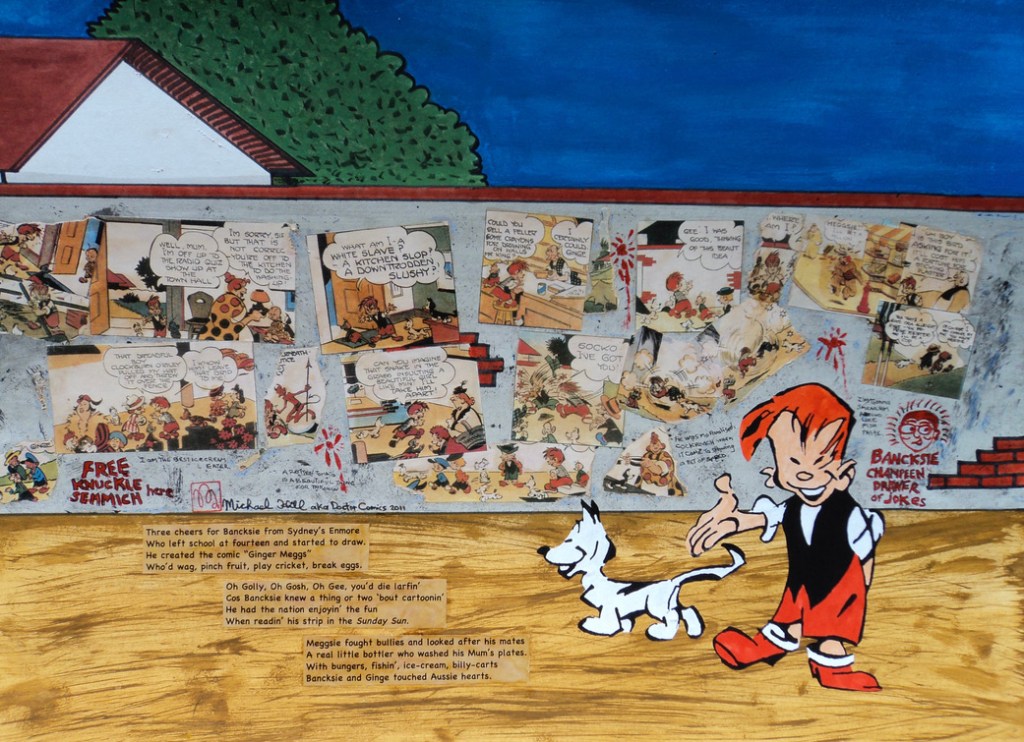
I want to begin my blog by declaring that I absolutely love both reading and creating comics. I have read, collected and studied comics since I was a child. Every Sunday morning after church, I would wait for the opportunity to read the comics section of the Sunday newspaper. My father had first reading rights. He began with the comics section before moving on to the sports pages. He didn’t like to separate the paper into sections, preferring to keep it all together…so the family had to wait till he had finished his complete reading of it. It was good to hear him laughing at the comics. He particularly loved The Potts by Jim Russell, whom I would meet years later at a comics convention in Sydney. He also loved Australian cartoonist Jimmy Bancks’s strip Adventures of Ginger Meggs. It was printed in glorious four tone colour (see my art tribute collage Bancksie Champion Drawer of Jokes, below). He also liked action comics, especially English war tales and American Wild West adventures. He had served as an Australian soldier in the Second World War. Whilst reading the war and western comic strips he would make the sounds of bombing raids and gunfights.

My art and poetry collage of my father’s favourite comic strip, James Bancks’s Adventures of Ginger Meggs…part of my solo exhibition at Gauge Gallery, Sydney. (Art-© 2011 by Dr. Michael Hill a.k.a. Doctor Comics).

Once he finished his reading he left the newspaper for the rest of the family. That was when it got separated into sections. I was usually the first to follow his reading and, like him, I started with the comics section. Unlike him, I didn’t proceed to the Sports pages but stopped reading there. For me the comics were the highlight of the Sunday paper. News of the world, sporting results and weather reports did not match the joy of reading the comics for me. My mother would buy me a comic when I was ill and absent from school…especially when I was hospitalised to have my tonsils out. It was usually a Donald Duck or Mickey Mouse…sometimes a Denis The Menace. The graphic humour would soothe my illness. I got to know comics by their titles and characters and gradually learned the names of the creators e.g. comics artists Carl Barks and Hank Ketcham. So I can claim that my parents contributed to my developing love of comics.

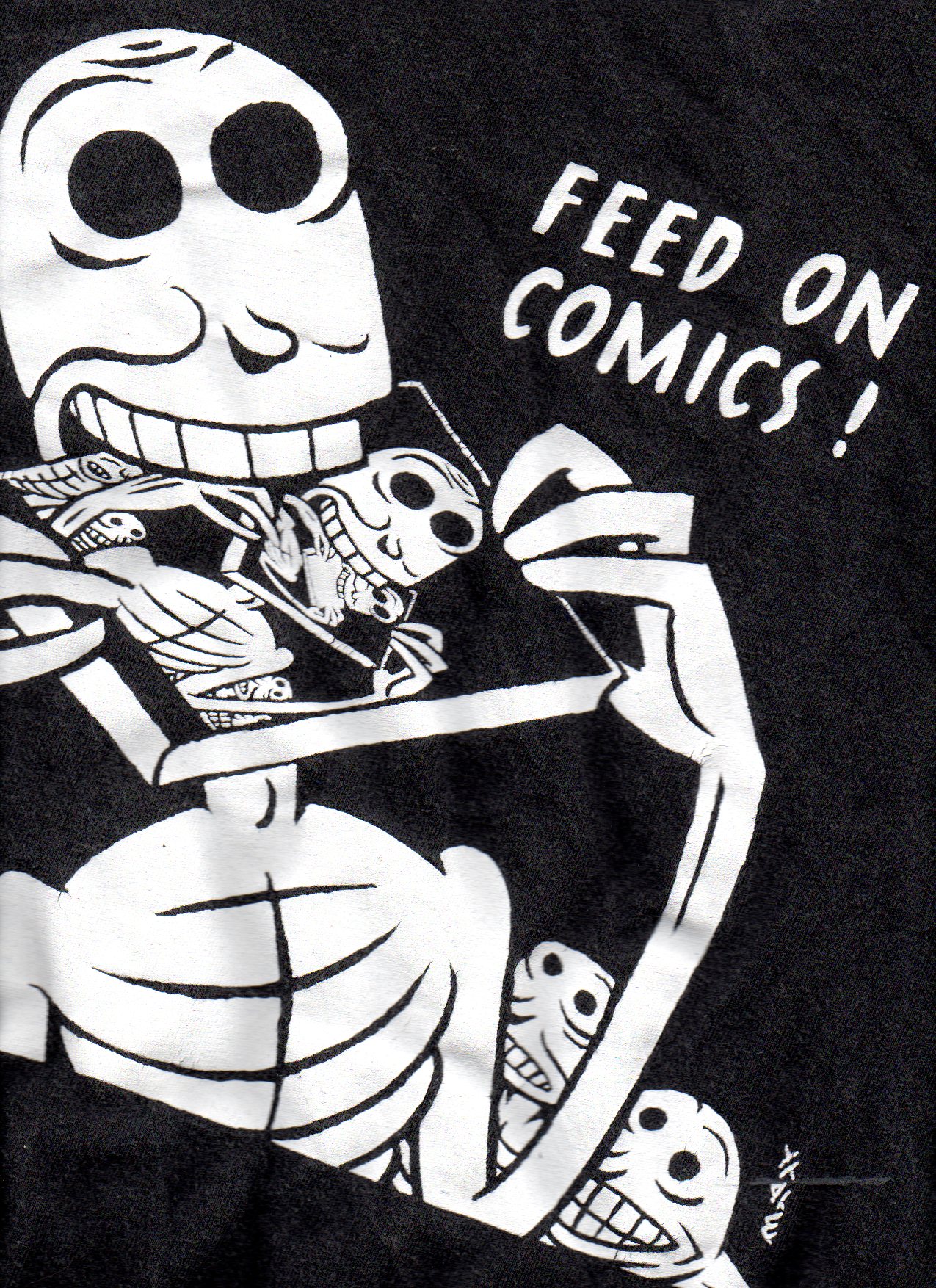
The T-shirt design by Max
The FEED ON COMICS! T-shirt design by Max. Doctor Comics intends to follow this call on his Blog.

I also had two kind aunties who would regularly buy me comics weeklies in the 1960s…titles like BEANO or EAGLE. These were shipped to Australia from England and arrived approximately three months after their U.K. publication date. I suspect my interest in space travel, English football and cartoon animals arose from reading and collecting these “boys papers”. Throughout my teenage years I continued to read and collect comics. This continued in adulthood. Some of my friends thought it somewhat childish and that I should grow up and stop reading comics. No way! Never! Eventually I was no longer limited to reading comics after church, after homework or during periods of illness. I had left school, found a job, and left home. This enabled me to stop going to church, buy my own comics and read them in bed!

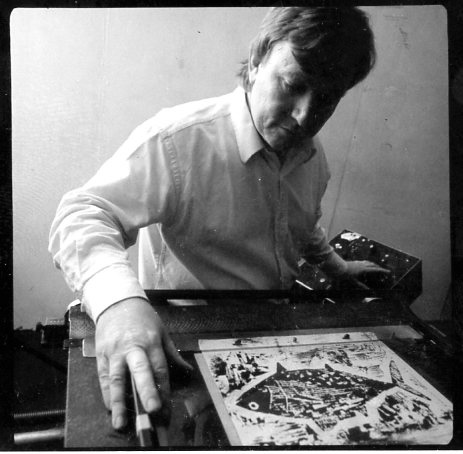
Animating my woodblock prints on the Oxberry animation stand at Sydney College of the Arts.

My interest in and enthusiasm for comics continued and reached another level at Sydney College of the Arts. As an academic in the Visual Communication Design program…I developed a more formal interest in studying and researching comics and animation. I also learned the technique of printmaking from a colleague…(see photo above…more details to come in future posts). I had always loved to draw and often received colour pencil and paint sets as Birthday and Xmas presents. I had had no art tuition in my primary and secondary schooling…but one year I was awarded the Religious Prize in Primary School that was probably attributed to my artistic skills. My teachers were Nuns. It was for a drawing I did of The Little Flower (Saint Teresa) floating up to Heaven on her death. I drew her literally as a flower. It was my unknowing introduction to visual metaphor. My drawing made the nuns cry! At the time I thought I had done something wrong, upsetting them, but the tears were apparently joyous! I wish I still had that drawing but the nuns ran off with it. In fact they never returned it! I never saw it again and my parents never ever saw it! Those nuns did seemingly compensate me, however, by awarding me the Religious Prize that year! The top student in my class and his parents complained to them on Speech Night (the Prize giving event)…saying “Unfair!..he only got a Credit in the subject but he won the prize!” They just didn’t know about that drawing…and the magic of art. Despite this so-called “injustice” I managed to keep my prize…although I did lose my art! My parents were very proud of my award. They had taught me to never challenge a teacher, especially a Nun. So I had to forget about asking them for the return of my drawing. This proved to be sound advice in the long term.

After Primary School with the Dominican Nuns I came up against the much tougher Christian Brothers in my Secondary education. Their chosen instrument of punishment and persuasion was “the strap!” This consisted of layers of leather strips, stitched together, with which they vigorously struck the student’s open palm. Each Brother had his own particular “strap” and technique of administration. Some preferred fast, repeated strokes from a short distance…whilst others preferred the delayed but vigorous downward stroke from a higher level. It proved more painful than the nuns’ short but hard cane tap. These were rigid disciplinarians with seemingly little interest in art. Any mathematics or science drawing or doodle on the edge of a page was met with a disapproving frown. No extra marks were awarded if you added an illustration to an essay…you might get away with a map in History but not a landscape in Geography…and definitely no art in a composition in English! These were considered an unnecessary waste of word space! Years later, however, I was to experience the joy of visual expression in art and design schools. They absolutely loved it there!

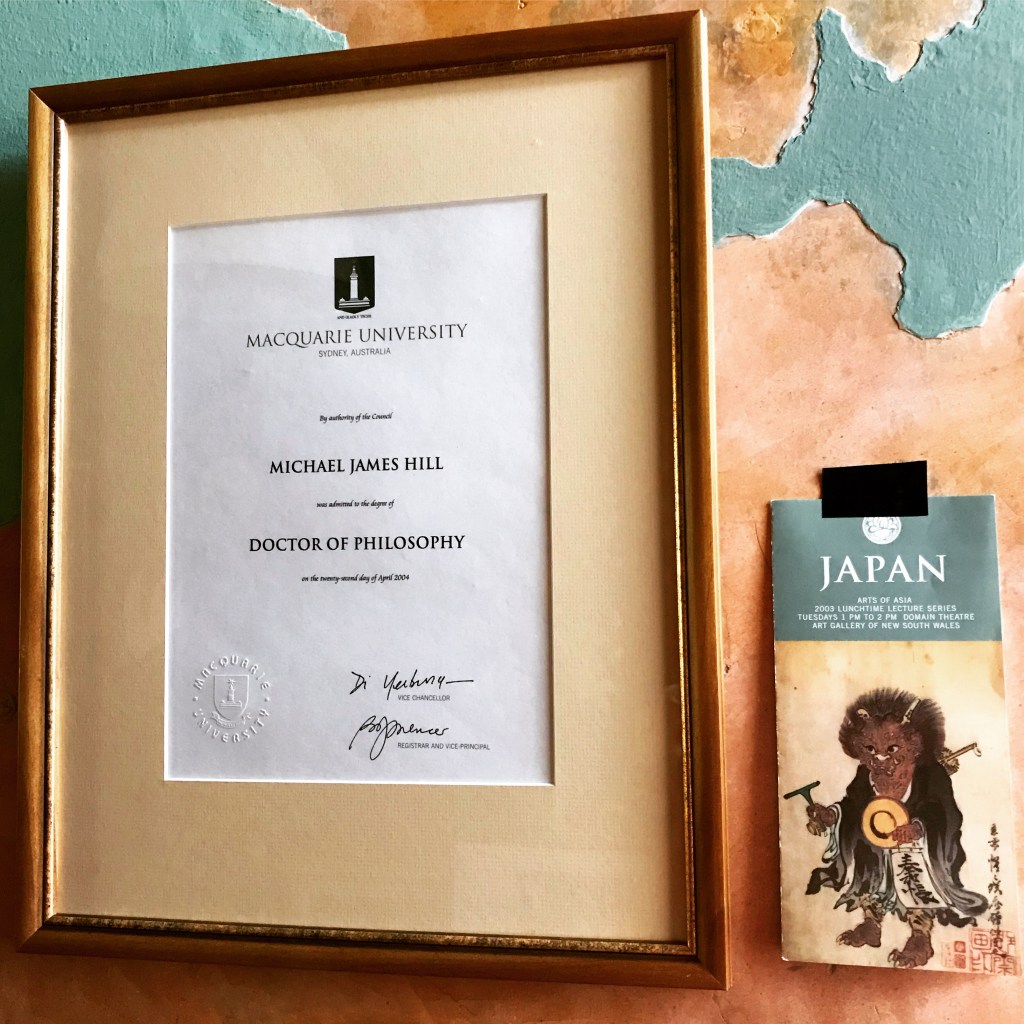
My PhD was awarded for my original research into Australian comics art and production. The accompanying brochure refers to my interest in Japanese art.

Since early adolescence I have been involved in comics art studies and research. First, through leisurely reading of the English comic strips from my aunties…followed by compulsive collecting…some review writing…all leading to the creation of my own comics. Later, working at an Art College I found that comics were considered a valid field of study and research. Oh joy! This ultimately led to my PhD for research into Australian ‘small press’ comics. That is where my alias arose. I’m known as Michael Hill, PhD (a.k.a Doctor Comics). I completed the doctorate in 2003 and acquired the alias in 2006. It was on a radio chat show that my agent, Andrew Hawkins, arranged for me to be interviewed. One caller said he wanted to talk to “that Doctor Comics guy!” To the amusement of listeners the announcer informed them that I actually had a PhD in “comics”! So instead of “Doctor in comics”…or “Doctor of comics”…it was strategically shortened and sharpened in focus to Doctor Comics. My agent formalised this with the registration of my doctorcomics@gmail.com email account and the doctorcomics.com website. This caught on in the local media and led to a chain of interviews.

Conventioneer card for the 99 Expo in Maryland with Brian Ralph illo.
My entry card to U.S.A. comics event THE EXPO 99…with the Brian Ralph illustration.

My intention with this blog is to document my reading, researching, critiquing, creation and celebration of comics art. This is expressed by the Feed On Comics! T-shirt by the artist MAX (see illustration above). I acquired it at the  ICAF (International Comic Arts Festival) at Bethesda, Maryland, USA in 1999. I could not believe there was an academic conference on comics! Not only that…it was followed by a comics convention, the Small Press Expo! It turned out to be an inspiring event being both a conference and a convention. The academic conference was chaired by Gene Kannenberg, Jr., the “big guy” who enthusiastically led proceedings, to a gathering of like-minded souls, i.e. academics researching comics art. Gene made me feel very welcome. Amongst those who attended was Dr. John A. Lent who was selling the first issue of IJOCA, the International Journal of Comic Art Vol. 1, No. 1 Spring/Summer 1999, that he had produced and published as Editor-in-Chief. I became a member of the International Editorial Board of that journal, representing Australia. Other new comics colleagues I met at that event were Michael Rhode, Randy Duncan, Charles Hatfield…and Mike Kidson whose paper “William Hogarth: Printing Techniques and Comics” inspired my later graphic research into Hogarth and printmaking. That introduction to printmaking eventually led to my adoption of it as an artistic practice. Also in attendance were other comics art researchers…Pete Coogan, Pascal Lefèvre, Jeff Miller, Ana Merino, Jeff Williams, Mark Nevins, Guy Spielmann, and Joseph “Rusty” Witek. They were pleased to have another Australian attend (Spiros Tsaousis had attended the previous year). They even let me, as guest, choose the restaurant on the first day…I suggested “Mexican?” a novel choice for me, not familiar with the cuisine. They all smiled and took me to one of the many local Mexican restaurants. I have since, somewhat subliminally, associated dining on Mexican food with researching comics art!

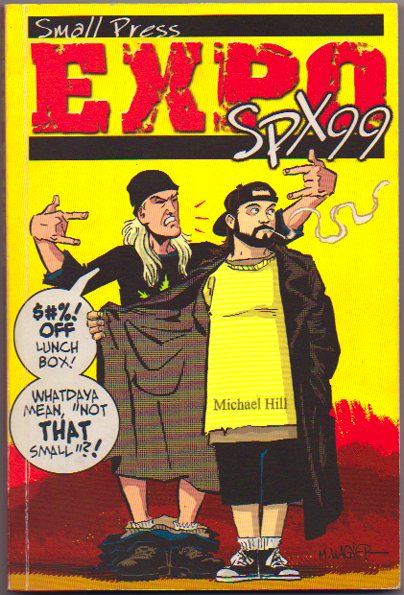
The Small Press Expo Comic at ICAF where I also bought the Max T-shirt
SPX99, my copy of the Small Press Expo program in Bethesda, Maryland, U.S.A., the first comics art conference I attended.

This conference gave me the reassurance to undertake the academic study and research of comics art. It also connected me with other academics from around the world who studied and researched comics art. This ultimately led me to the gaining of my PhD in comics studies. At that Bethesda conference, I made a presentation on Australian indie comics based on the research I had been doing. As the conference concluded the comics expo kicked off downstairs. This convention, known as the Small Press Expo, honoured indie comics (see my 99 EXPO card above). I bought several comics and even sold some I had brought with me from Australian small press creators. I also met Gary Groth, “wow!” the guy who runs The Comics Journal…he seemed to be on the look out for “comics stuff”…and Neil Gaiman, “yes, him!”, in the lift, speaking in his dulcet English tone that was wonderful to hear! They, and many others that I had only read about, were in attendance, wandering around at the event. Comics art was what they studied, created, promoted, traded or researched! In the evening there was an award ceremony at which comics artist James Kochalka performed, surprisingly, absolutely naked! Amazing! Each category winner was awarded a brick,  just like the one Ignatz threw at Krazy. I was most impressed and inspired by the level of comics art interest and the emerging philosophy surrounding it! The event celebrated both the study and creation of comics art. This has had ongoing resonance for me as I start this blog. I also intend continuing my reading, researching and writing about comics art.

Doctor Comictopus alias for Michael Hill Ph.D (a.k.a. Doctor Comics) designed by Michelle Park.
Doctor Comictopus alias for Michael Hill a.k.a. Doctor Comics, designed by Michelle Park.

So there is my first post….a little lengthy perhaps…but I am off and running along the blogging trail and feeling very excited about it…and I welcome any comments and suggestions from readers of my blog, Michael.

(All text, photos and artwork-©2011 Dr. Michael Hill a.k.a. Doctor Comics except where otherwise credited).