Tag: comics art

RESEARCHING COMICS ART: Seventh Reading

Art, Comics, comics art May 5, 2024

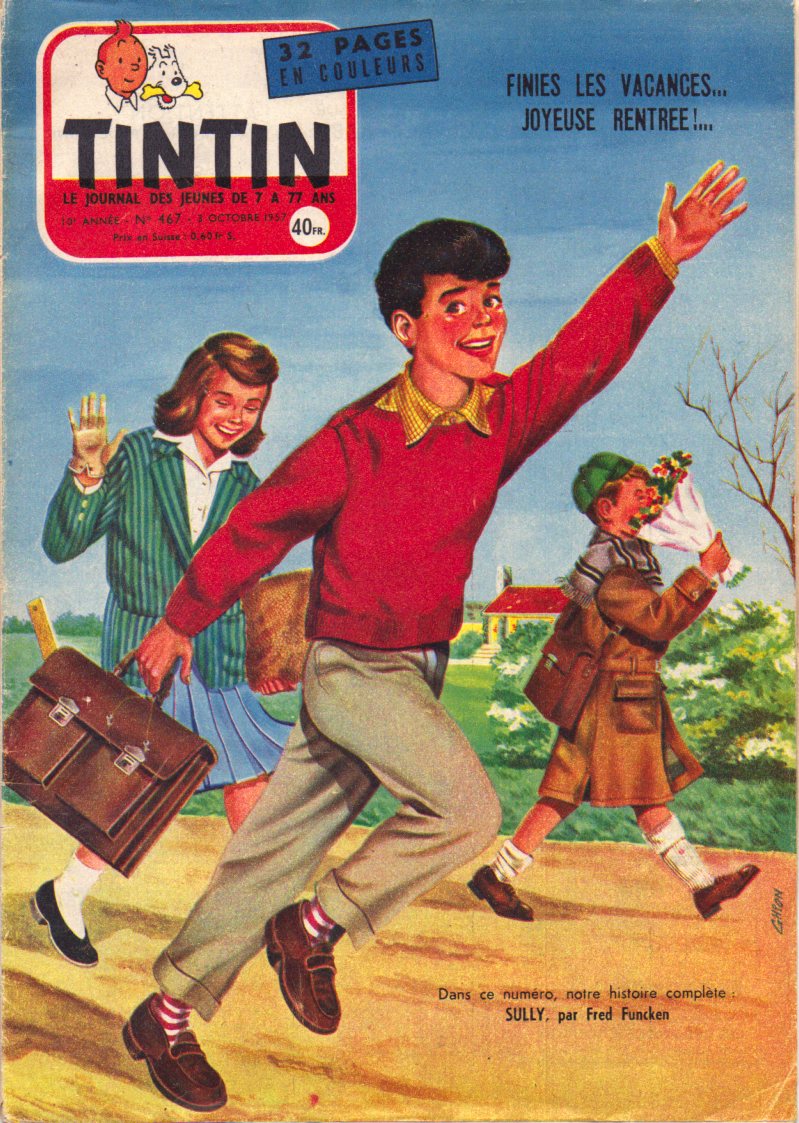
This previously published post has been re-edited and transferred to this newly added RESEARCHING COMICS ART series. It documents articles and items from my comics art library research collection. This particular post focuses on Hergé and his creation Tintin. I have collected and read a complete edition of the albums, including the unfinished final one. I also have a copy of the Tintin magazine Le Journal Des Jeunes De 7 A 77 Ans. I have viewed the complete Adventures of TINTIN DVD set. My bande dessinée franco-belge exhibition review has been included in this post (see below). I have also acquired a few items of clothing related to the character. In my experience as a researcher, it is always useful to approach one’s subject with an open, playful attitude. 
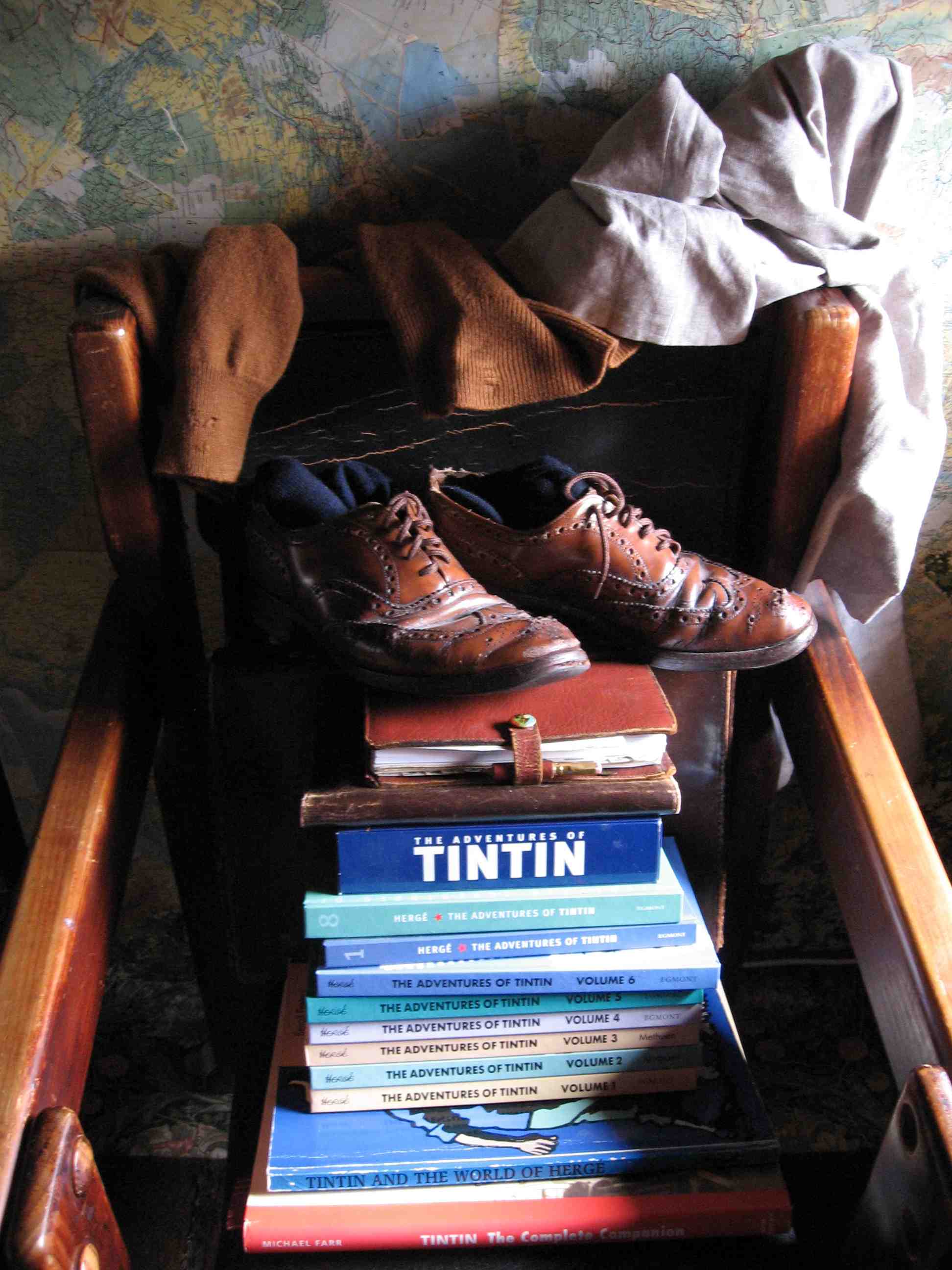
Tintin stuff (Art direction and photography-© 2013 Louise Graber)
Part of my essential collection of assorted Tintin related materials, from albums, appraisals, films, clothes and studies. (Art direction and photography-© 2013 Louise Graber)
Tintin magazine, No. 467, October 1957.
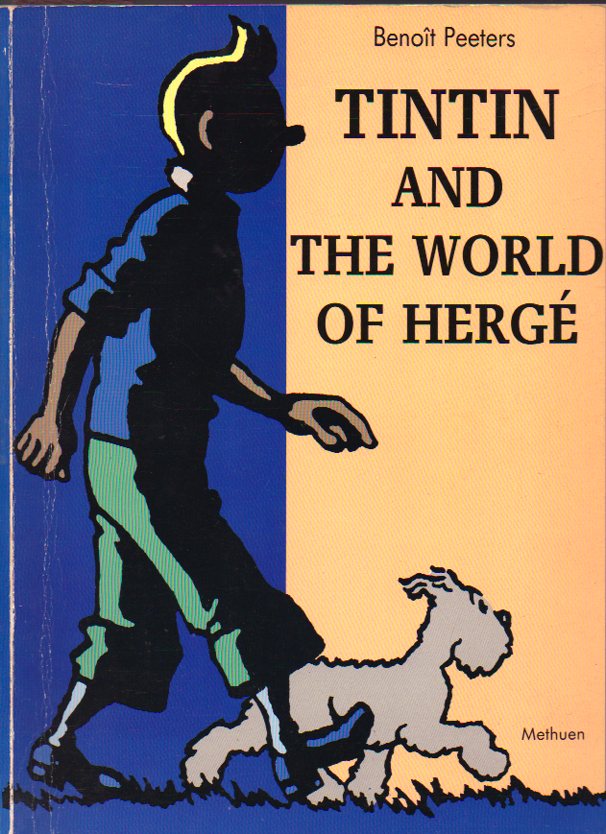
The Benoît Peeters study of Tintin and Hergé.
The Michael Farr Tintin companion book
Michael Farr’s Tintin companion book.

The Adventures of Tintin albums…24 in all including the unfinished final one, were executed in the ligne clair (clear line) drawing style. This was developed by Hergé and his colleague and collaborator Edgar Pierre Jacobs. I missed the opportunity to read these as a child. Two kind aunties occasionaly bought me American comics by Carl Barks and Hank Ketcham and “boys papers” from England. These included The Eagle with a Dan Dare feature story on the cover that inspired my interest in Space travel…plus a The Adventures Of Tintin episode in the centre-spread. Another weekly they bought me, TIGER and Hurricane, with a Roy of the Rovers episode, started my love of football. My father read the occasional war and western comics and the comics lift-out section of the Sunday Mail newspaper. That was when my interest in comics really began to develop. I found it a fascinating form of storytelling, combining writing and drawing.

My English lessons at Primary School and later in Secondary college prioritised words in reading rather than accompanying illustrations…although maps always seemed to be given at least a cursory glance. Consequently, when I started reading comics I automatically read and prioritised the captions and word balloons…before proceeding to look at the drawings. Sometimes I even skipped from panel to panel following the text and only cursorily scanning the images. It took me a years to unlearn this ‘upside down’ approach…and alter the balance of attention between words and images! Ultimately I learned to look at a comics page and individual panels holistically…one that included both image and text, sometimes even obtaining a degree of simultaneity. As a result my English language skills dropped a little, however, my art skills blossomed. Neither the Dominican nuns nor the Christian Brothers who taught me offered Art as a subject in their curriculums…so I was largely left to learn it by myself.

I had an uncle who read Western comics. He could also draw horses, hats and guns…and he taught me basic sketching, done quickly with a pencil. Once I started I practiced a lot. I made nuns cry in Primary School with my art…a sketch of Saint Therese rising up to Heaven as “the little flower.” It was for an essay and not expected to have any accompanying illustrations. My submission was 95% art with an accompanying paragraph. This response gave me some odd feeling of encouragement about my art…to think that I could make nuns cry! It also occurred to me that art was valued as the nuns took my drawing and never returned it! Somewhat surprisingly, I was awarded the Religious Studies prize that year…much to the dismay of the dux of the class who topped every other subject! 

I didn’t actually discover Tintin until adolescence. That was when the English translations had been published. I also began to find the odd volume in libraries. They were actually the first comics that I found in libraries. That sounds surprising but in the 1960s librarians seemed reluctant to have comics in library collections…although they seemed to made an exception in the case of Tintin. They didn’t admit that they were actually comics. Instead these were referred to as European narrative, pictorial albums. They were foreign and published in hardcover editions rather than the soft, pamphlet form of North American comics…so they seemed more like books than comics…and so were suitable for library collections.

And they were really popular! Students read and borrowed them to the extent that it was often difficult to find them on the library shelves. Following tertiary study and research and I collected and read all of the Tintin comics…admiring their beautifully printed colour drawings…their adventures in unfamiliar geography…the amusing babble from Captain Haddock…and the entertainment provided by the surprising amount of slapstick. These elements combined to further my appreciation of bande dessinée and the Ninth Art. That was consolidated and extended in subsequent years as I admired Hergé’s comics art skill…and finally found myself looking at the illustrations before reading the word balloons. The adoption of my Doctor Comics persona followed. It was later that I became aware of unresolved, racist allegations against Hergé that possibly impacted on his creative work. Some of my Tintin related acquisitions are displayed in this post…along with a copy of the published review that I wrote of a Tintin themed art exhibition in Sydney.
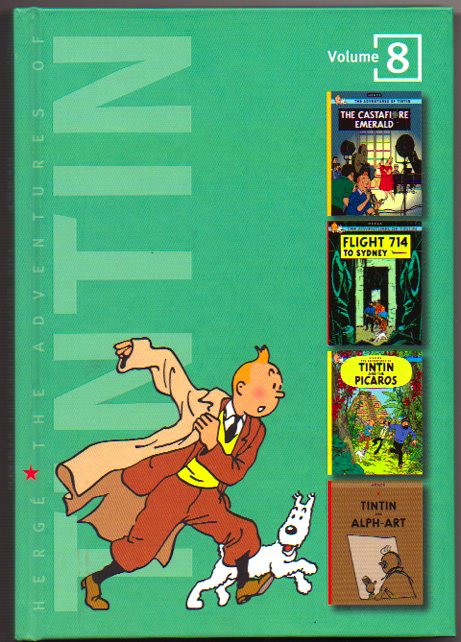
A volume of the collected works in the reduced size format.
                      Volume 8 of the TINTIN series.

Another Tintin study book-this one by Harry Thompson (no relation).
            Harry Thompson’s Tintin profile book.
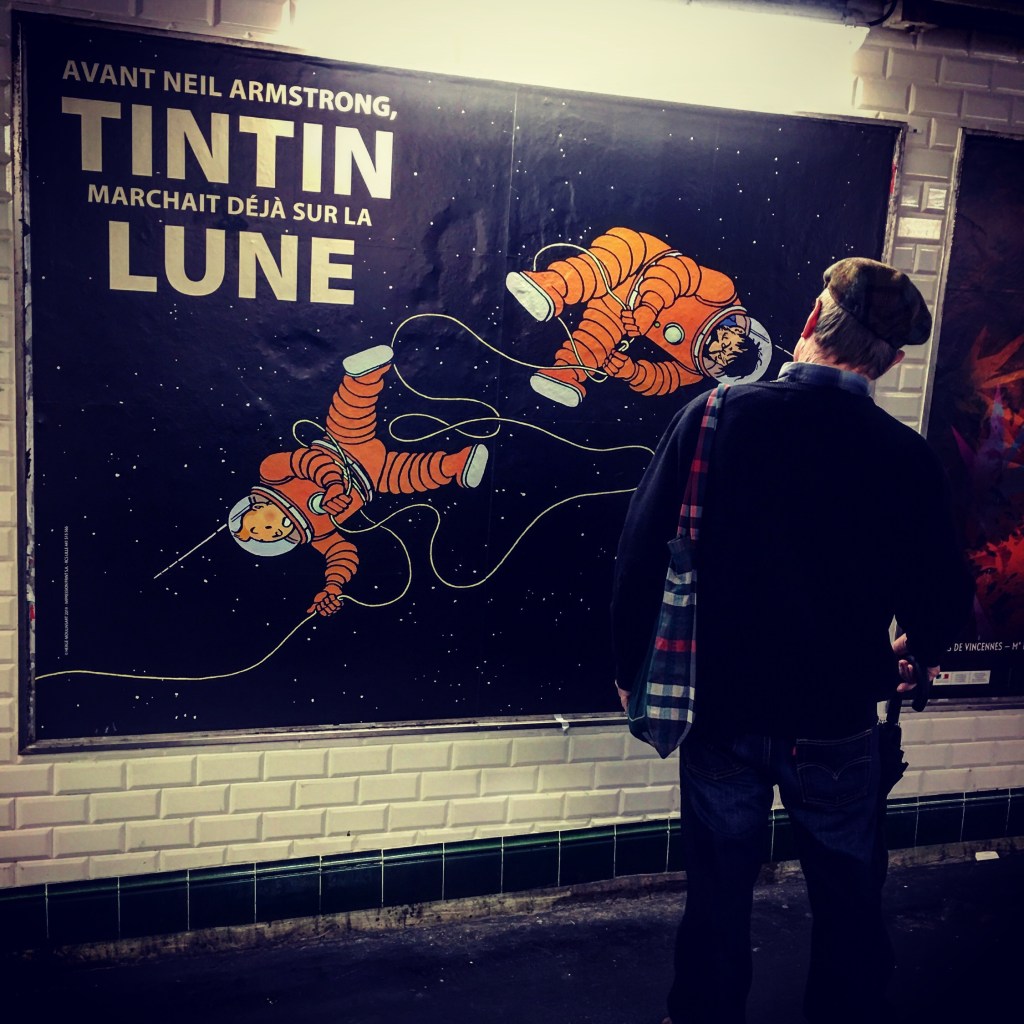
Doctor Comics finds cartoon character friends in the Paris Metro. (Photo by Louise Graber).


EXHIBITION REVIEW: Comic Strip, Passion’s Trip, Sydney, Alliance Francais de Sydney, November 18-December 20, 2002, review by Dr. Michael Hill (a.k.a. Doctor Comics), first published in International Journal of Comic Art, Vol.5 No.1 Spring/Summer 2003

The “Tintin” Qantas Flight 714 finally touched down in Sydney in November 2002. Originally carrying Tintin and associates to a scientific symposium in in 1968 his party left the plane in Jakarta. They then went off on a private jet and another adventure. Now, 34 years later, the Tintin entourage has arrived in Sydney in the shape of a cargo of beer, chocolates and comics, three of Belgium’s significant export commodities, accompanied by members of the Royal family and an exhibition of French language Belgian comics titled Comic Strip, Passion’s Trip,

Belgium exports considerable quantities of comics (approximately 65% of publication exports). It refers to comics as the Ninth Art. It also has a museum devoted to them. So it was no surprise that the exhibition was opened by members of the Belgian monarchy. Prince Philippe and Princess Mathilde attended, giving the exercise the Royal seal of approval. (see invitations to both the exhibition opening and the following Royal reception event, below). The exhibition formed part of an economic mission organised by the Wallonia-Brussels Sydney Trade Office. 300 different comics titles in French plus a further 70 in English were shipped to Sydney. These were put on sale in Dymocks, one of Sydney’s larger bookstores. This created a mini-venue for Euro comics in the local retail market…and competition for Japanese manga and Hong Kong comics.

A page from my graphic novel BLOTTING PAPER: The Recollected Graphical Impressions of Doctor Comics. It shows the invitations to the events referred to in the above text.

The exhibition was staged at Alliance Francais de Sydney, a combination gallery, café and French language teaching centre. It was a noisy location next to a city bus stop. Passengers could admire the window display of old comics whilst waiting for the bus. There were also staged acrobatics of a large model by the Belgian cartoonist André Franquin of his character Marsupilami. The exhibition had undergone a serious design process by the curator Jean-Marie Derscheid. It had a multi-strand focus that included comic books, comics art and rough process comics art. There was a display revealing the workings of the comics artist’s studio. There was a child’s bedroom decorated with comics art merchandise. There were also videos, and an oversized mock-up comics album, 82cm(heigth) x 56 cm(width). These were beautifully bound and designed. They contextualised Belgium comics and featured brief biographies and examples of the work of 20 significant artists. These included Didier Comes, André Franquin, Greg, Hergé, Hermann Huppen,…Edgar Pierre Jacobs, Jijie, Lambil, Raymond Macherot, Morris,…Peyo, Francois Schuiten, Jean-Claude Servais, Tibet, Maurice Tillieux, Tome and Janry, Will, and Yslaire. References were made to Spirou magazine and to two emergent schools of comics: the Brussels School and the Marcinelle School.

The bed in the child’s room had a printed Tintin doona cover and bed sheets. There was also a Gaston Lagaffe reading lamp by the Belgian cartoonist André Franquin and a Marsupilami alarm clock. Various posters and a cupboard containing Lucky Luke figurines were present. Interestingly there was not a Smurf in sight! The room also had a small television and video player with a collection of Belgian animated cartoon series. Amusingly, by the end of the opening night, the child’s room was littered with empty beer bottles. These had been deposited by the noisy and appreciative guests viewing the exhibition. This gave the installation a bizarre visual association between beer and comics in the nursery. If only I had taken a photograph of that! In any case, my character Doctor Comics would have approved of the pairing of beer and comics. He may even have shouted his occasional cry of “beer, chocolate and comics!”  He holds this to be an excellent combination in which to indulge…the reading of comics whilst eating chocolate and drinking beer.

Another section of the exhibition consisted of individual displays of the work of particular artists.These included Hermann, Geerts, Midam, Yslaire, Morris, Jacobs,…Herge, Francois and Luc Schuiten, Francqu and Van Hamme, Dufaux and Marini,…Lambil, Marc Bnoyninx, Tome and Janry, Constant and Vandamme. There were even examples of original artwork and a copies of comics albums that were accessible for visitors to read. Some of thee appeared quite soiled near the end of the exhibition, let alone the opening night.

Upstairs in a small seminar room there was a mock-up setting called  ‘the artist’s studio.’ Large blow-up photographs on the walls showed the interiors of various comic book creators’ work spaces. A working drawing table had been set up with pencils and other equipment. There was a video corner screening a documentary on one of the featured artists, Frank. It showed him at work on illustrations for his comic book The Source about Australia. This had been specially commissioned for the exhibition and scheduled for release with it. His watercolour sketches of Australian animals were impressive. Despite never having been  to Australia prior to the exhibition…Frank did come to Sydney for the opening…his story showed the desert. Although his use of colour was accurate some of his conceptual content was neither sensitive nor politically correct. What he refers to as Ayers Rock, a giant natural rock formation, is now known as Uluru. having had its ownership and management reverted to the control of the indigenous owners. Consequently it is regarded as a sacred place. In his comic Frank freely plays with Aboriginal art and icons. This practice is respected by local artists as the cultural domain and ownership of the indigenous people. Conscious of the lack of local knowledge and in tongue-in-cheek fashion, perhaps?…the exhibition points to “our delightfully cliched images of Australia: kangaroos, boomerangs, mythical Aborigines and smouldering red deserts.” This exhibition was about culture in any case…the culture of a country whose comics have been elevated to the level of art…and treasured and collected by libraries and museums. I praise the high profiling of comics art in Belgium!

The exhibition brochure with Illustration by Frank.The Sydney exhibition brochure with an illustration by Frank showing part of Sydney Harbour juxtaposed with outback terrain.
(Original text, photos, artwork and scans-©2024 Dr. Michael Hill a.k.a. Doctor Comics).

BLOTTING PAPER The Comic: Production Report No.26

Art, Blotting Paper, Cats in Comics, Comics, Germania, Japanning February 28, 2016

I have completed production and commenced publication of the fifth issue of my artist book/comic…BLOTTING PAPER: The Recollected Graphic Impressions Of Doctor Comics. The pages are being printed, collated, trimmed, bound and covered. Copies will soon be mailed to readers. Each copy will have an original postcard size print on the cover.

Original print on cover of new issue-© 2013 Michael Hill
Example of original print on cover of new issue-©2013
Dr. Michael Hill (a.k.a. Doctor Comics)

It has now been four years since publication of the first issue. That was launched at Hondarake-Full of Books in Sydney in February 2012 (see earlier post about the launch). A further four issues have been produced and published. I am now considering collecting these issues into graphic novel form. This will allow me the opportunity to make revisions to the story and artwork. The five issues have generated 200 pages of material. This may be altered following editing and development of the existing material. There also remains the possibility of a further new chapter! We’ll see about that!

Woodblock ink print and painting-© 2014 Michael Hill
Woodblock ink print of sea-©2014 Dr. Michael Hill (a.k.a. Doctor Comics)
Location photograph, Germany-© 2014 Michael Hill
Photograph of road design in Germany-©2014 Dr. Michael Hill (a.k.a. Doctor Comics)
Rough scan of artwork, Germany-© 2016 Michael Hill
Rough scan of artwork collage-©2016 Dr. Michael Hill (a.k.a. Doctor Comics)
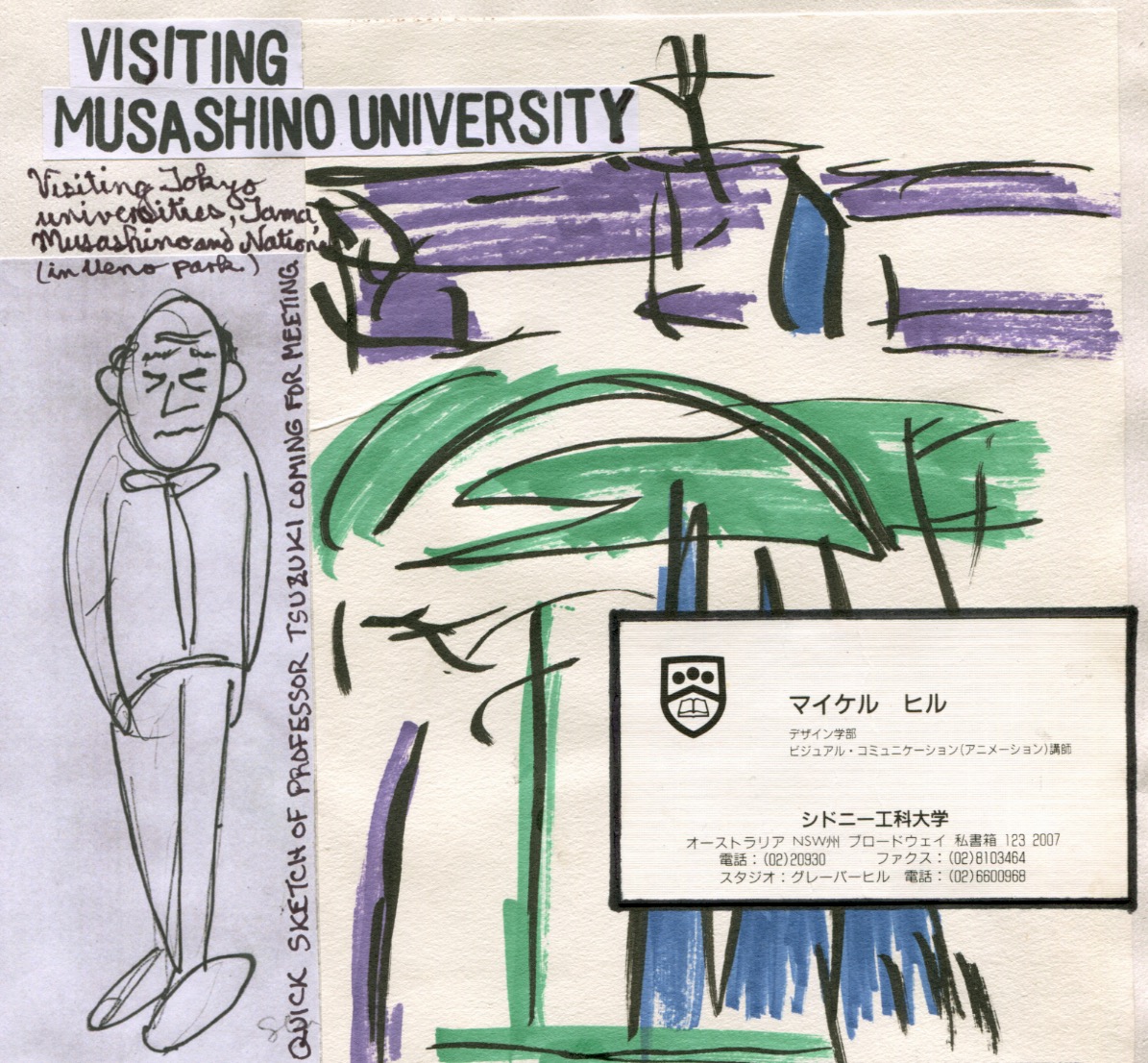
Rough scan of artwork, woodblock prints, handwriting, cartooning Tokyo-© 2016 Michael Hill
Rough scan of artwork compilation from woodblock prints, handwriting and cartooning-©2016 Dr. Michael Hill (a.k.a. Doctor Comics).
Rough scan of artwork, illustration, sketching, cartooning, Tokyo-© 2016 Michael Hill
Rough scan of artwork, illustration, sketching, cartooning-©2016 Dr. Michael Hill (a.k.a. Doctor Comics)
Rough scan of artwork, Photography, character design, Tokyo-© 2016 Michael Hill
Rough scan of artwork compilation from photography, drawing, handwriting and character design-©2016 Dr. Michael Hill (a.k.a. Doctor Comics)
Rough scan of artwork of a cat scanning artwork, Germany-© 2015 Michael Hill
Rough scan of artwork compilation from inking, drawing and printmaking-©2015 Dr. Michael Hill (a.k.a. Doctor Comics)

For details of the production of all five issues and a visual history of the project read previous reports.

(All text, photos and artwork-©2016 Dr. Michael Hill a.k.a. Doctor Comics).

DRAWING WAR: Arrayed in Erlangen

Art, Comics, Germania July 29, 2014

An awesome aspect of the recent Internationaler Comic-Salon Erlangen that I attended…in the old university town of Erlangen, Germany, near Nuremberg…was the staging of two contrastingly presented and equally impressive exhibitions of comics art on World War I…by Joe Sacco and Jacques Tardi.

COMIC SALON exhibition signboard in the city (Photo-© 2014 Michael Hill).
COMIC SALON exhibition signboard, with Tardi image, in the city (Photo-©2014  Dr. Michael Hill a.k.a. Doctor Comics).

Joe Sacco’s The Great War was displayed as an open-air exhibit in Schlossplatz. It was enlarged on display boards arranged in a long series of folds. Seeing it spread across the square magnified the herculean task that Sacco undertook in drawing this epic, concertina work. It represented one day of the Battle of the Somme fitted into one panel.

Open air exhibition in the city at Schlossplatz of Sacco's The Great War (Photo-© 2014 Michael Hill).
Open air exhibition at Schlossplatz of Sacco’s The Great War (Photo-©2014  Dr. Michael Hill a.k.a. Doctor Comics).

His wordless comic is structured around this single seemingly endless panel. It had been folded into 24 segments that unfolds to form a single piece. It depicts events in a continuous, cinema-pan like take. That is spread across time and space with soldiers assembling, attacking, engaging in crossfire and then returning to their lines. The unfolded published comic is too long for a table. Consequently, for exhibition, it has to be spread across the floor of two adjoining rooms or a long corridor. In Schlossplatz it ran right across the square necessitating a reading whilst walking approach. With so much detail it required several passes to take it all in.

Fold-out art work of Sacco's The Great War (Photo-© 2014 Michael Hill).
Fold-out art work of Sacco’s The Great War (Photo-©2014  Dr. Michael Hill a.k.a. Doctor Comics).
Closer view of fold-out art work of Sacco's The Great War (Photo-© 2014 Michael Hill).
Closer view of fold-out display of Sacco’s The Great War (Photo-©2014  Dr. Michael Hill a.k.a. Doctor Comics).

The panels above show the trenches and the movement of the soldiers into the hostilities of ‘No Man’s Land’. This includes their exposure to artillery attacks and its associated schrapnel, plus machine gun and rifle fire.

Sacco being interviewed on site of The Great War exhibition. (Photo-© 2014 Michael Hill).
Sacco being interviewed on site of The Great War exhibition. (Photo-©2014  Dr. Michael Hill a.k.a. Doctor Comics).

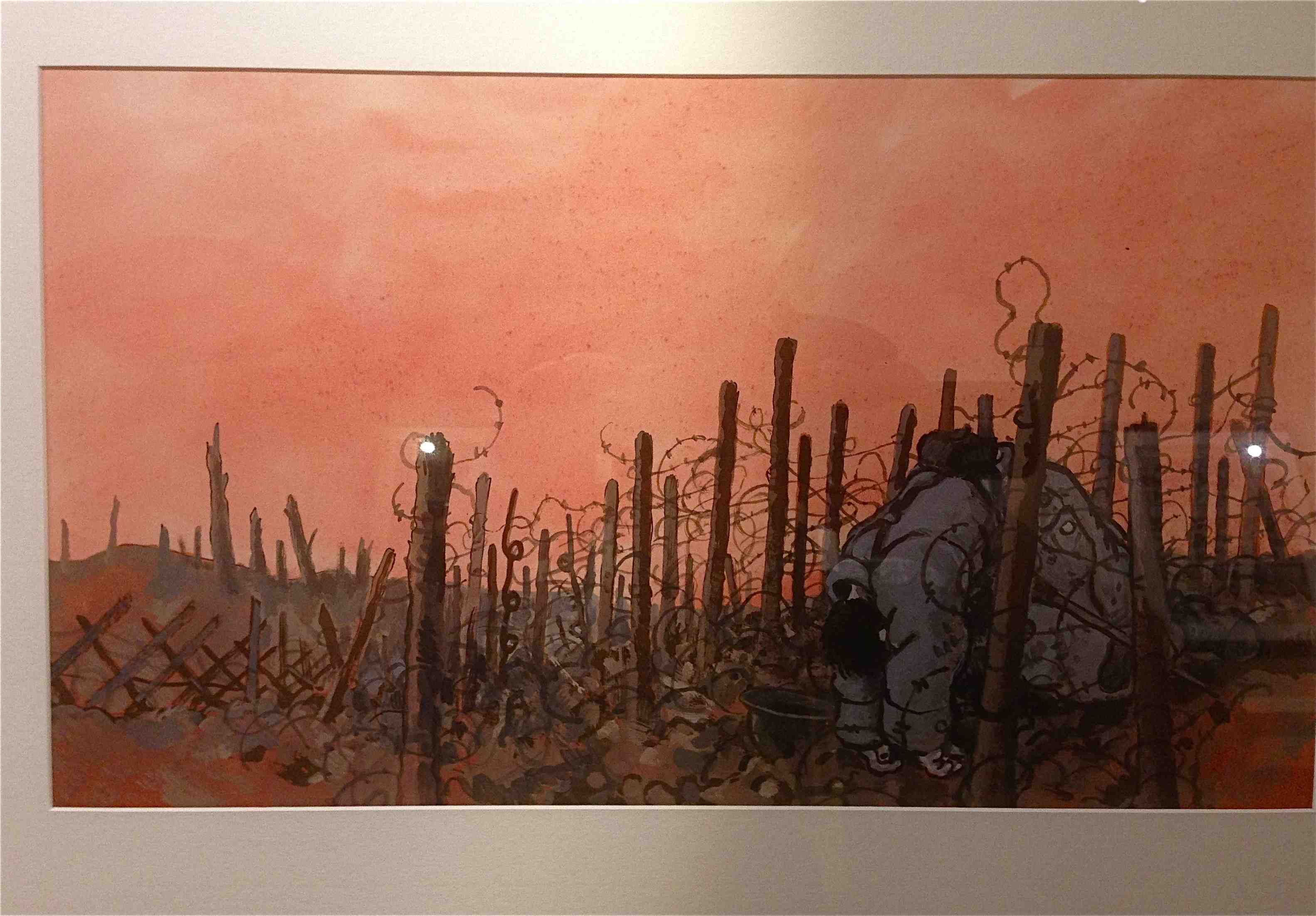
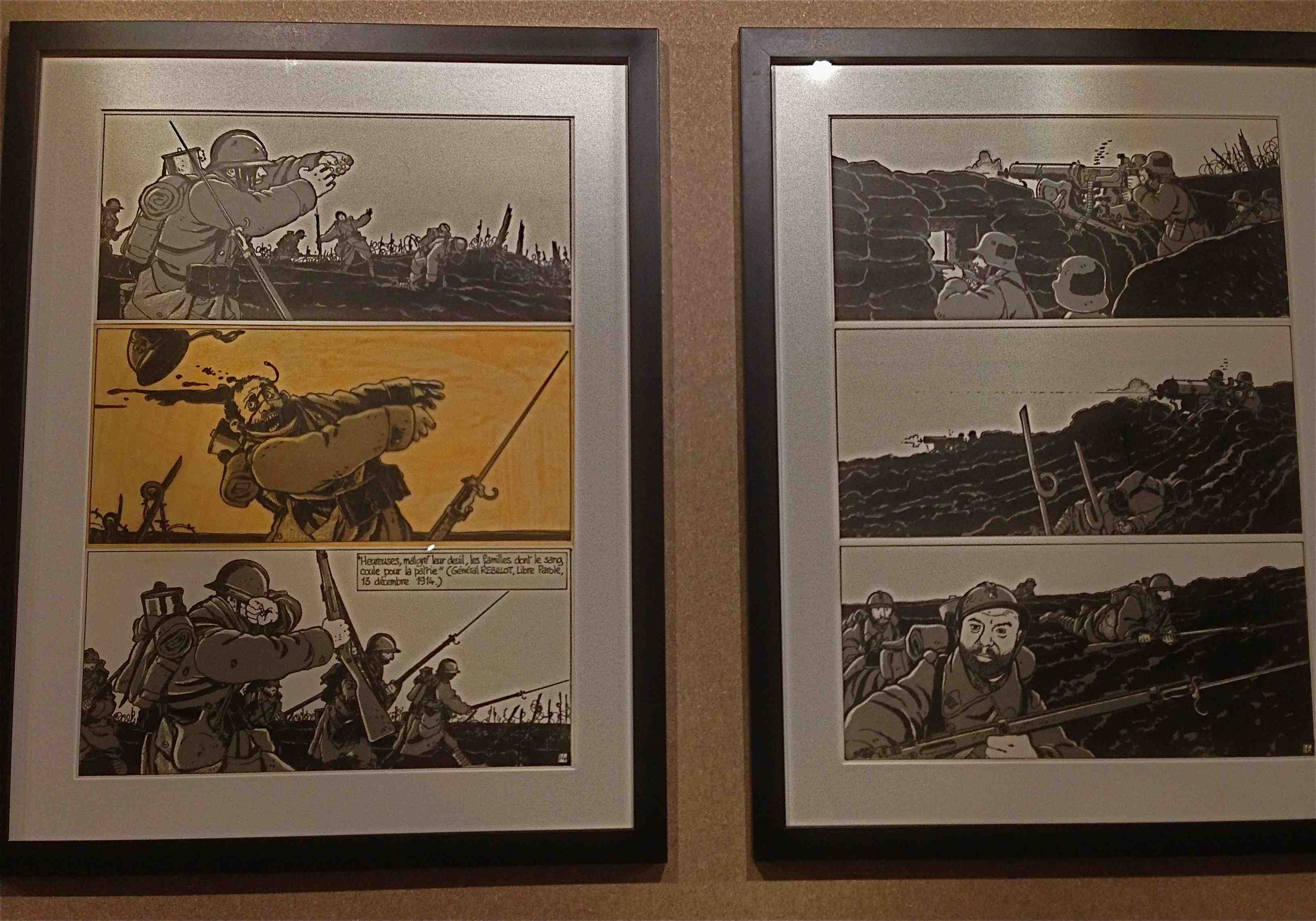
By comparison, the war comics art of Jacques Tardi were exhibited indoors. Low level lighting created a sombre mood appropriate to the theme. It also perhaps protected the original art work from exposure. Corrections such as the whiting-out of errant black border lines and some alignment and registration marks were visible. This was the original art on display! It was not it’s cleaned up and reduced size reproduction as seen in the published comics.

Landscape of Death: Jacques Tardi and the First World War exhibition (Photo-© 2014 Michael Hill).
Landscape of Death: Jacques Tardi and the First World War exhibition (Photo-©2014  Dr. Michael Hill a.k.a. Doctor Comics).
Image from Landscape of Death: Jacques Tardi and the First World War exhibition (Photo-© 2014 Michael Hill).
Image from Landscape of Death: Jacques Tardi and the First World War exhibition (Photo-©2014  Dr. Michael Hill a.k.a. Doctor Comics).

The work, titled Landscape of Death, was bleak, expressing the agony of those who fought in World War I. Many of the images were painful to view. These included soldiers’ bodies torn apart by flying pieces of shredded metal. They were lacerated, disfigured or rendered limbless, with some surviving in this state.

Image from Landscape of Death: Jacques Tardi and the First World War exhibition (Photo-© 2014 Michael Hill).
Image from Landscape of Death: Jacques Tardi and the First World War exhibition (Photo-©2014  Dr. Michael Hill a.k.a. Doctor Comics).
Image from Landscape of Death: Jacques Tardi and the First World War exhibition (Photo-© 2014 Michael Hill).
Images from Landscape of Death: Jacques Tardi and the First World War exhibition (Photo-©2014  Dr. Michael Hill a.k.a. Doctor Comics).

Exhibited in a darkened theatre, the low level of the light created a reverent atmosphere for the images. It also acted as a canopy of protection, from fading, for the original art work. The work was housed in a series of narrow wooden walled and roofed walk-throughs. Some shapes were cut into the walls so that one could see out to lessen the confined effect. Tardi’s use of colour was impressive. His delicate watercolour brushwork added a poignant hue to his poppies, pools of blood and rising smoke.

Image from Landscape of Death: Jacques Tardi and the First World War exhibition (Photo-© 2014 Michael Hill).
Image from Landscape of Death: Jacques Tardi and the First World War exhibition (Photo-©2014  Dr. Michael Hill a.k.a. Doctor Comics).

These two exhibitions, Sacco and Tardi respectively, had contrasting presentations:…open-air/indoor; …spacious/confined;…sunlight/low level artificial illumination;…expansive/confined;…complete/edited; …served to express and communicate aspects of the texts/open…the vulnerability of soldiers both out of the trenches and restricted by the narrow confines of the trenches;…time-one day or six years of living with gas masks, flame throwers, helmets, barbed wire…and the dampness, misery, the stench of rotting bodies, despair and the ongoing expectation of death. This all made a memorable imprint on me, Michael.

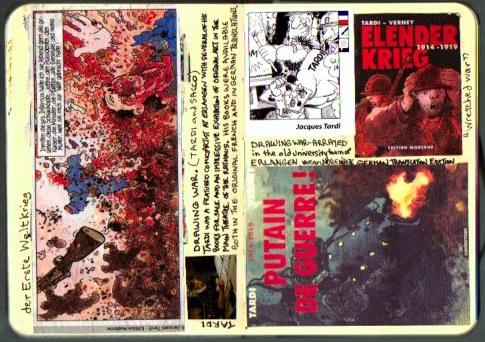
Pages from my Germany journal with Tardi press clippings and sticker (© 2014 Michael Hill).
Pages from my Germany journal with Tardi press clippings and sticker (©2014  Dr. Michael Hill a.k.a. Doctor Comics).

UPDATE 2017: I found this discarded Jacques Tardi sticker (below) from the set that the Erlangen organisers were disseminating…and decided to add it to this post, Michael.

(All text, photos and artwork-©2014 Dr. Michael Hill a.k.a. Doctor Comics).

BLOTTING PAPER The Comic: Production Report No.17

Art, Blotting Paper, Comics March 29, 2014

This is the first in a series of regular reports documenting the production of the third issue of my artist book/comic…Blotting Paper: The Recollected Graphical Impressions Of Doctor Comics. It continues on from my previous posts on the first chapter/issue The Ingurgitator…and the second chapter/issue A Blot On His Escutcheon. The new chapter, The Chthonian Turn: The Cats’ Revenge…deals with the feline characters’ reaction to the demise of Doctor Comics…and that gentleman’s adventures in another dimension to which he has travelled. I hope to self-publish it before the end of the year.

Title page for Chapter 3 The Chthonian Turn–© 2013 Michael Hill
Title page for Chapter 3–© 2013 Dr. Michael Hill a.k.a. Doctor Comics.

As with the two previous issues printmaking is involved in the generation of images…via woodblock, linocut, Japanese sosaku hanga technique, rubber stamps and wooden seals.  In addition other visual communication techniques…such as drawing, painting, collage, cartooning and photography…with the intention of producing a limited edition artist’s book comic.

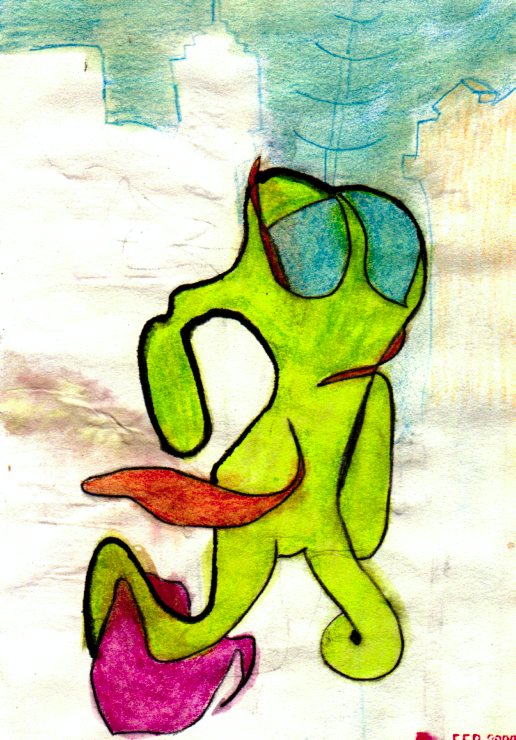
One of the spirits in the underground sky–© 2013 Michael Hill
Design of one of the spirits in the underground sky–© 2013 Dr. Michael Hill a.k.a. Doctor Comics.

I also intend having more colour pages in this issue…following the use of sporadic spot colour in Issue #1 and the 8 full colour pages in Issue #2. The colour will assist in the graphic representation of both the real and imaginary worlds featured in the comic.

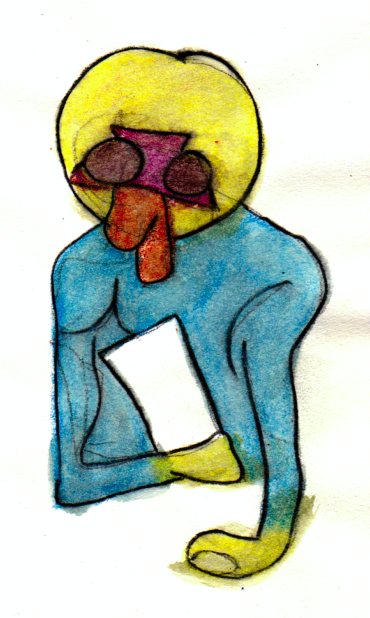
Another of the spirits in the underground sky–© 2013 Michael Hill
Design of another of the spirits–© 2013 Dr. Michael Hill a.k.a. Doctor Comics.

I am continuing to edit the script, refine ideas, and develop others. There has been some unscripted image-making and printmaking activity…with the intention of using this as a loose but parallel means of creating vaguely conceived and experimental visual content. Examples produced through this printmaking strategy are featured below.

Red face print #1–© 2013 Michael Hill
Visage of first red shade–(©2013 Dr. Michael Hill a.k.a. Doctor Comics).

In the present chapter the two feline characters deliberate over the decision of what to do following the sudden departure of Doctor Comics. Meanwhile the latter character continues his travels in the chthonian world…confronting various vaporous forms and ghostly figures…including a trio of roaming red shades (see the three red shade illustrations). The raw state of these printmaking images will most likely be subject to further graphic manipulation.

Red face print #2–© 2013 Michael Hill
Visage of second red shade–©2013 Dr. Michael Hill a.k.a. Doctor Comics.
Red face print #3–© 2013 Michael Hill
Visage of third red shade–©2013 Dr. Michael Hill a.k.a. Doctor Comics.

Within a few weeks the design and creation of the planned pages began to fall into place.

The production schedule is up!
The production schedule for Issue #3 up on the studio wall! (Photo ©2014 Dr. Michael Hill a.k.a. Doctor Comics)

The target date for completion of the five 8-page signatures have been approximated…and with a good run the comic could possibly be ready for binding as early as June.

The art table has been established.
The art table has been established… (Photo ©2014 Dr. Michael Hill a.k.a. Doctor Comics)

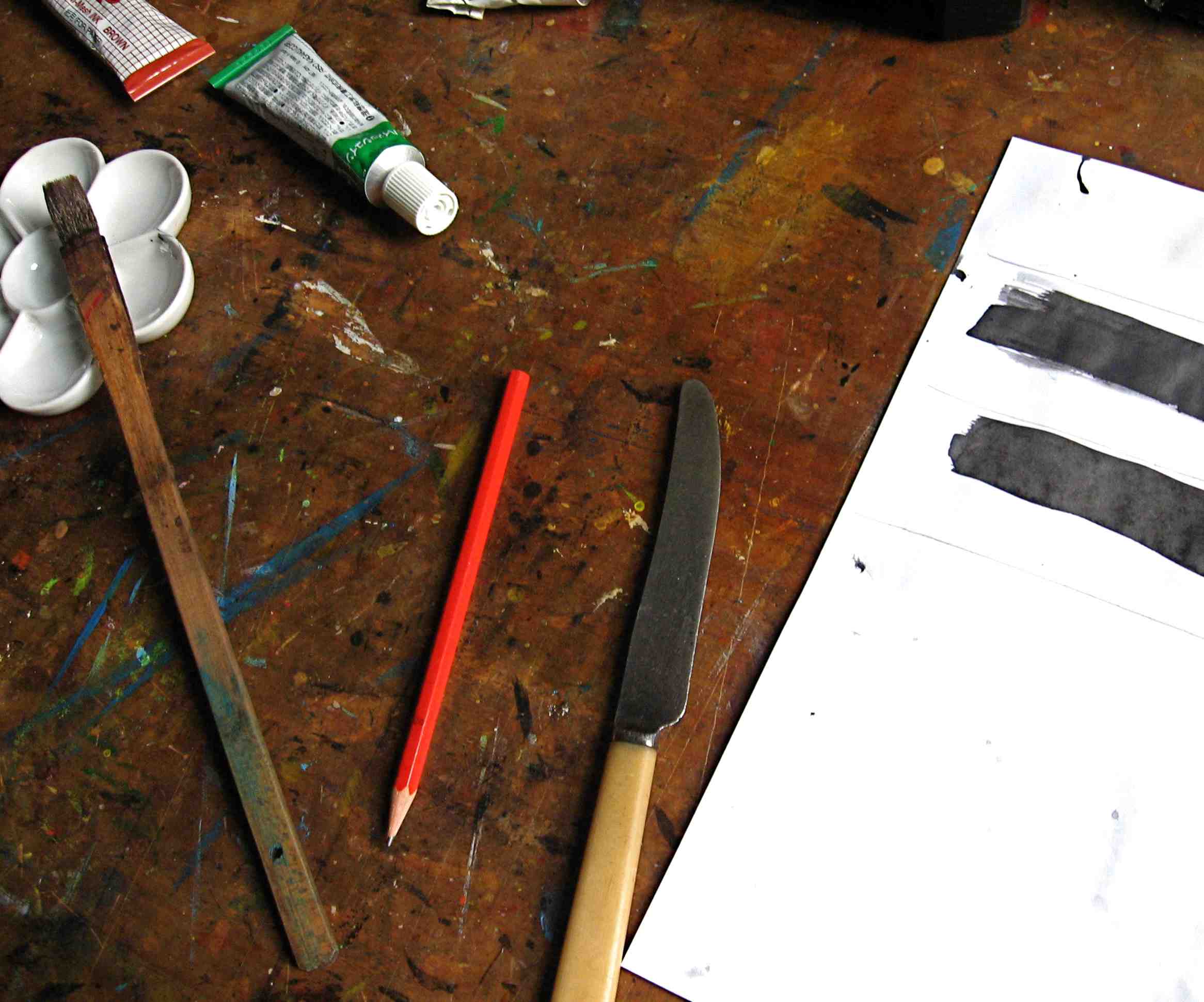
Ink, more so than paint, appears to be the dominant graphic ingredient in the production…with dip pens, drawing pens and brush calligraphy involved…although some of the inking will be made onto previously painted paper.

...and particular tools selected.
…and particular tools selected. (Photo ©2014 Dr. Michael Hill a.k.a. Doctor Comics)

There are some pencils in there too…as well as the pens,…with drawing and handwriting components plus my regular use of printmaking for image generation.

Ink tests are underway...
Ink tests are underway… (Photo ©2014 Dr. Michael Hill a.k.a. Doctor Comics)

The messy ink tests and mark making has begun.

...and drying on display.
…and on display whilst drying. (Photo ©2014 Dr. Michael Hill a.k.a. Doctor Comics)

Having gotten deeper into production mode I am now approaching completion of the artwork …having advanced from scripting to page layout…however, I am keeping things open in terms of the resolution of the story.

A spread of artwork on the studio floor.A spread of artwork on the studio floor. (Photo ©2014 Dr. Michael Hill a.k.a. Doctor Comics)

I find the creation of the images…and the entire image-making process…including the resultant generation of the artwork…to be the most pleasurable part of the production process. Culling, selecting and editing the artwork is a tougher task.

A more detailed glimpse of the spread of artwork.A more detailed glimpse of the spread of artwork. (Photo ©2014 Dr. Michael Hill a.k.a. Doctor Comics)

Printmaking has again been employed in the image-making…a little more than photography…but about the same proportion as drawing. In terms of style, abstraction is making an impression. The notion of developing this project into graphic novel form continues to firm.

Another glimpse of the spread of artwork.Another more detailed glimpse of the spread of artwork. (Photo ©2014 Dr. Michael Hill a.k.a. Doctor Comics)
 
 
(All text, photos and artwork-©2014 Dr. Michael Hill a.k.a. Doctor Comics).

Q: A PROJECT FOR THE PRESERVATION OF COMICS

Comics February 23, 2014

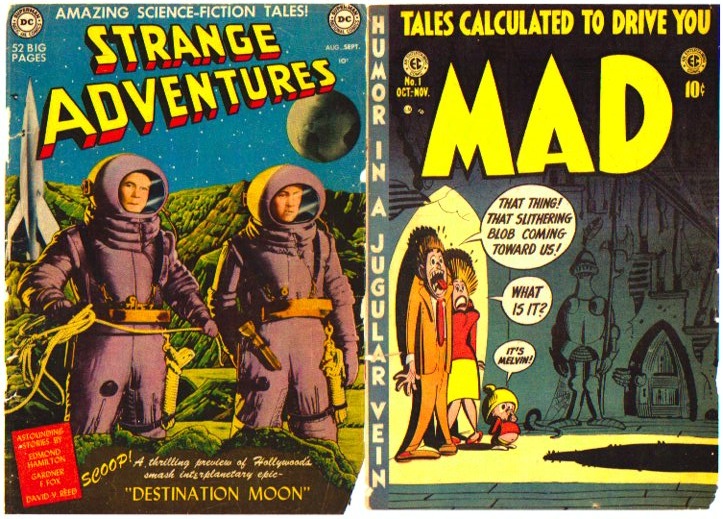
I have been involved with this project as an academic advisor for the past three years. It’s formal title is Q-COLLECTION COMIC BOOK PRESERVATION PROJECT, an initiative to preserve a particular collection of comics. I like to refer to it as Q, the “Q” standing for the city of Quincy, Massachusetts. The city’s shield was presented to the project’s founder Dr. John Offerman Sindall for use on the project. Sindall, a member of Mensa, has collected around 200 key American comic books from the period 1930s-1960s. This was an era of printing comics on low grade paper that will eventually crumble into powdery form when handled. The Q project is a strategy to prevent this by cutting up the comics, coating them with Mylar and mounting them in wooden binders that will provide an estimated life of 10,000 years. Hearing this part of the process, that the comics will have to be destroyed in order to be saved, is disturbing for some collectors. Librarians understand the beneficial outcome, however. It means the comics will be able to be read. In terms of financial investment this collection is not about unopened first issues in sealed plastic bags.

Two of the comics in the collection, both No.1's, Strange Adventures (1950) and MAD (1952).

Two of the comics in the collection, both No.1’s, Strange Adventures (1950) and MAD (1952).

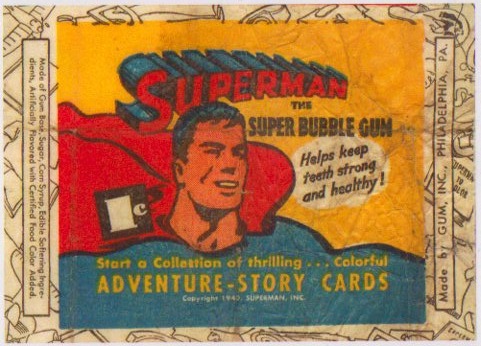
In addition to the comics, the collection contains associated artifacts such as trading cards, bubble gum wrappers, photographs, ads, membership cards etc. These items will be subject to the preservation process.

Superman bubblegum wrapper.

Superman bubble gum wrapper.

Sindall has put together a wide-ranging international advisory committee for the project. Here is my statement of support: In a world in which comic books have been treated for far too long as consumables and ephemera the Q-Collection Comic Book Preservation Project represents a significant plan to preserve key items of these as popular culture artifacts. This project also provides physical protection against the transitory status of comic books by means of coating, wrapping and encasement in protective materials that will ensure defense against their decay. The selection and acquisition of these rare comic books that have become classics of popular culture, their preservation treatment, deposit and safekeeping and subsequent availability for reading and research by future generations has my support and deserves backing by business benefactors, patrons of popular culture and by an appropriate public collection institution.

The collection is destined for the Library of Congress.

UPDATE: FEBRUARY 2016: An article about the project’s founder has been published: Comic Book Heroics: Mensan Leads Efforts To Preserve Aged Comics by Michael Hill, Ph.D., The Mensa Bulletin, February 2016, No. 592.

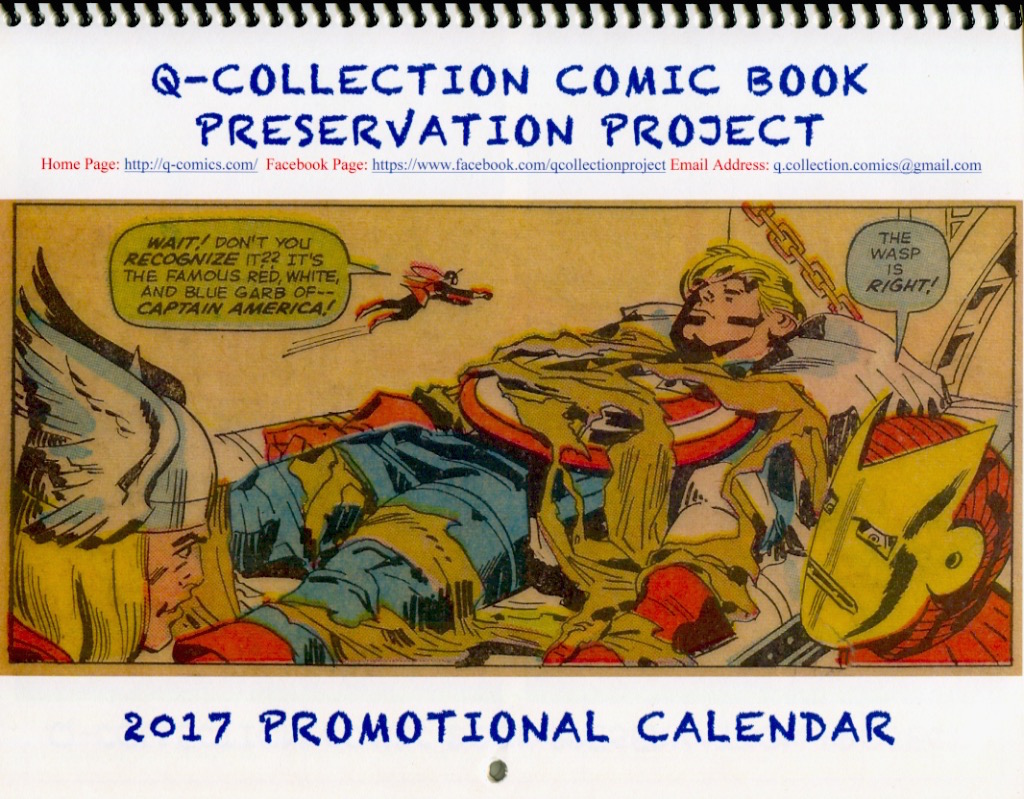
UPDATE: DECEMBER 2016: The Q-Collection Comic Book Preservation Project’s 2017 promotional calendar-strictly limited edition gifted to committee members. Thank you John!

2017-q-project-calendar

(All text, photos and artwork-©2014 Dr. Michael Hill a.k.a. Doctor Comics).

BLOTTING PAPER The Comic: Production Report No.5

Art, Blotting Paper, Comics, Japanning February 4, 2012

Good news for me! The first issue of my comic Blotting Paper: The Recollected Graphical Impressions Of Doctor Comics is to be published…in a signed, limited edition. Scheduled for 11 February 2012 at HONDARAKE Full of Books in Sydney (details in the poster below). The comic will be launched by my friend and colleague Gene Kannenberg, Jr. via a Skype link from the U.S.A.  Kannenberg, a noted comics historian, is the director of ComicsResearch.org. He is former Chair of the International Comic Arts Festival…and the Comic Art & Comics Area of the Popular Culture Association…and he has written widely on comics art including the book “500 Essential Graphic Novels.”

Poster designed by Louise Graber incorporating original print by Dr. Michael Hill a.k.a. Doctor Comics.

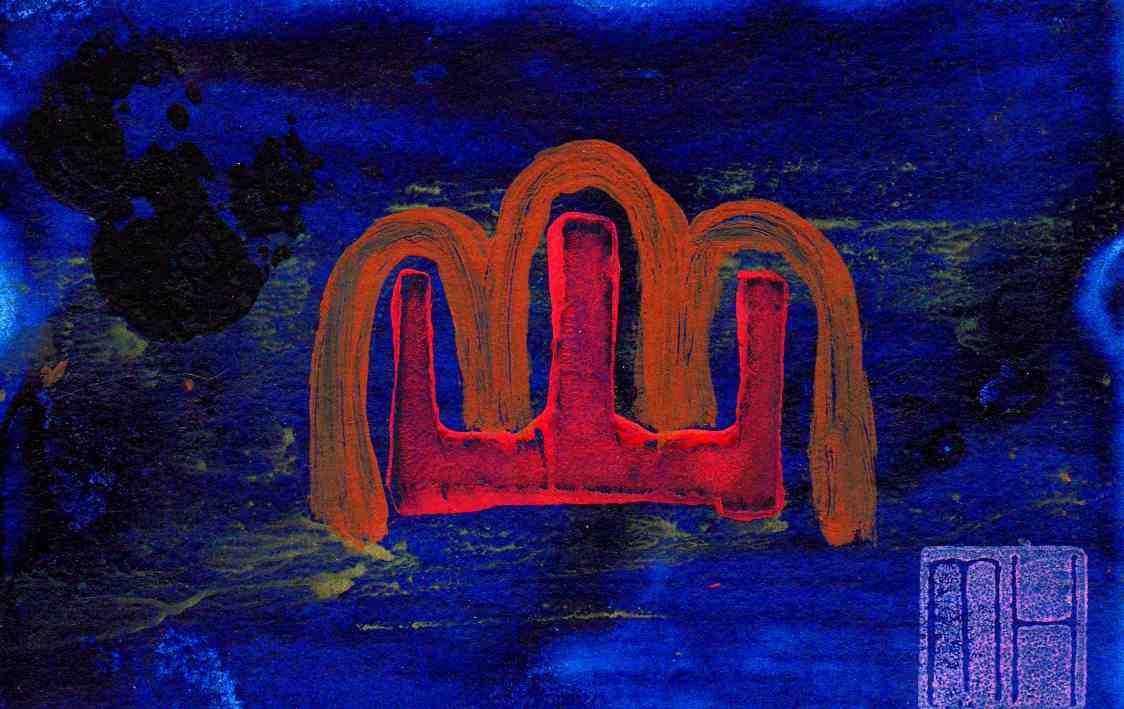
The launch will be accompanied by an exhibition of 33 of my handmade art postcards. These have been produced following the sosaku hanga ‘creative print’ style. This method originated in a movement that emerged just over a century ago in Tokyo. Creative prints became the voice of a group of artists who went under the name Pan. They met for sake parties by the Sumida River. It was the centre of the Floating World of old Edo and site of the classic Ukiyo-e print movement. James Michener wrote: “…in contrast to the classical system in which the artist merely designed the print, leaving the carving of the blocks to one technician and the printing to another, the newer print artists preached that the artist himself must do the designing, carving and printing. A new term was devised to describe such a print-sosaku hanga, meaning “creative print.” ” (Michener, 1968: The Modern Japanese Print p.11). I follow this method in my printmaking.

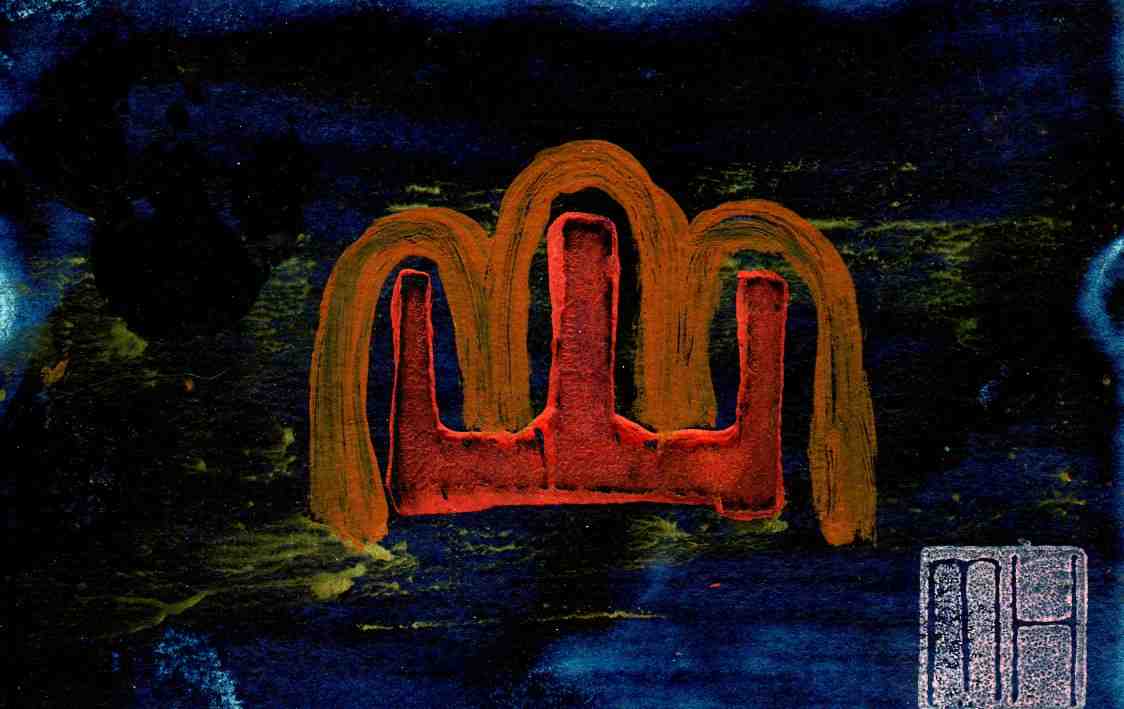
One of my art postcards in the associated exhibition–© 2010 Dr. Michael Hill a.k.a. Doctor Comics.
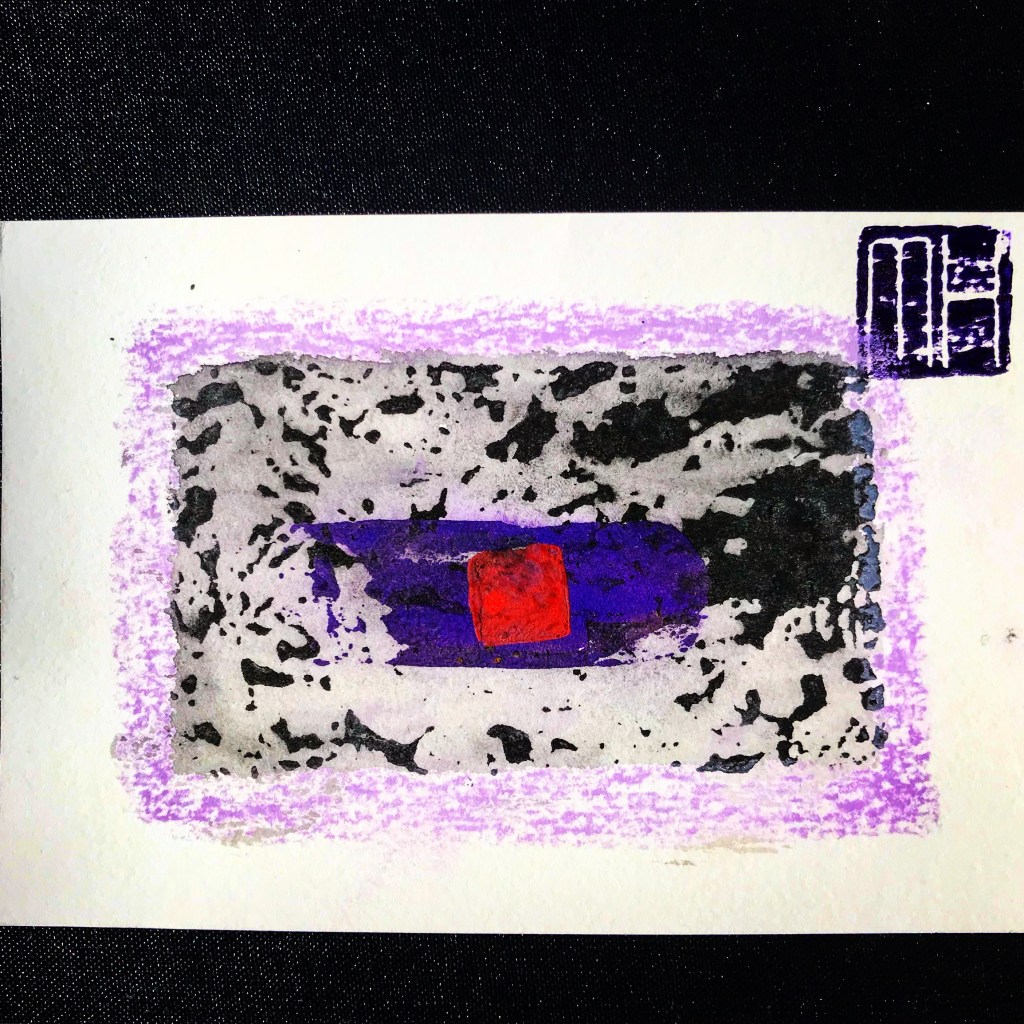
Another of my art postcards…no two cards the same…similar but different!–© 2010 Dr. Michael Hill a.k.a. Doctor Comics.

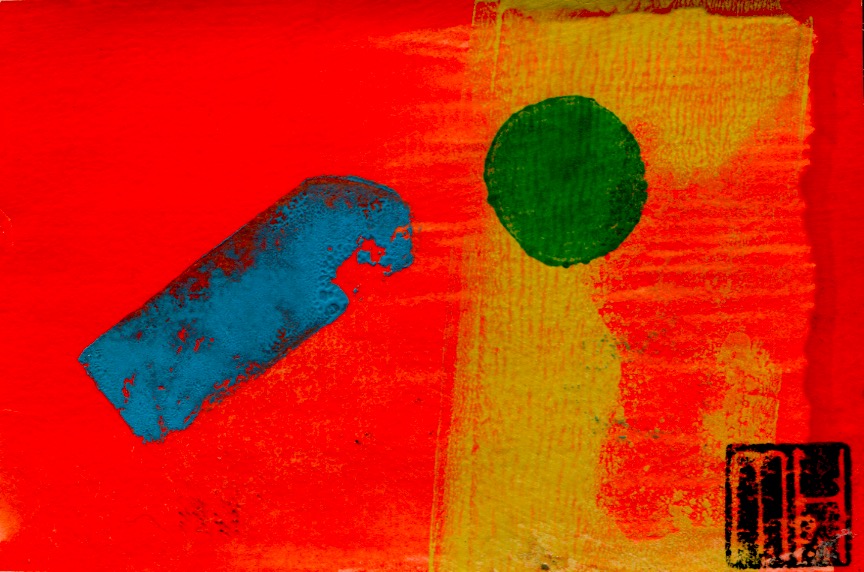
Yet another version of my art postcards–© 2010 Dr. Michael Hill a.k.a Doctor Comics.

A different art postcard, similar but not identical–© 2010 Dr. Michael Hill a.k.a. Doctor Comics.

A different art postcard–© 2010 Dr. Michael Hill a.k.a. Doctor Comics

Another art postcard…not included in the exhibition accompanying the launch–© 2010 Dr. Michael Hill a.k.a. Doctor Comics.

An art postcard from my Abstract No.11 series-© 2007 An early effort in my series of making art postcards.

(Pen and ink drawing and collage-© 2011 Dr. Michael Hill a.k.a. Doctor Comics)

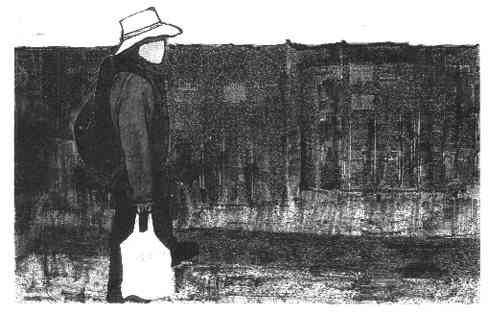
Above is a collage of 4 separate pen and ink/felt-tipped pen drawings. These separate drawings have been collaged together: (1) Sydney Harbour Bridge. (2) rear view of Doctor Comics walking (3) hand holding bag (4) hand inserting key in door. These drawings will be included in the first issue of the comic. The drawings are from different pages in the comic but have been brought together in this collage…and have been overlaid in the same graphic space. This grouping forms a visual sign or motif for promotion of the comic. I would love to read feedback on this and my other posts.

(All text, photos and artwork except where otherwise stated-©2012 Dr. Michael Hill a.k.a. Doctor Comics).

BLOTTING PAPER The Comic: Production Report No.4

Art, Blotting Paper, Comics November 2, 2011

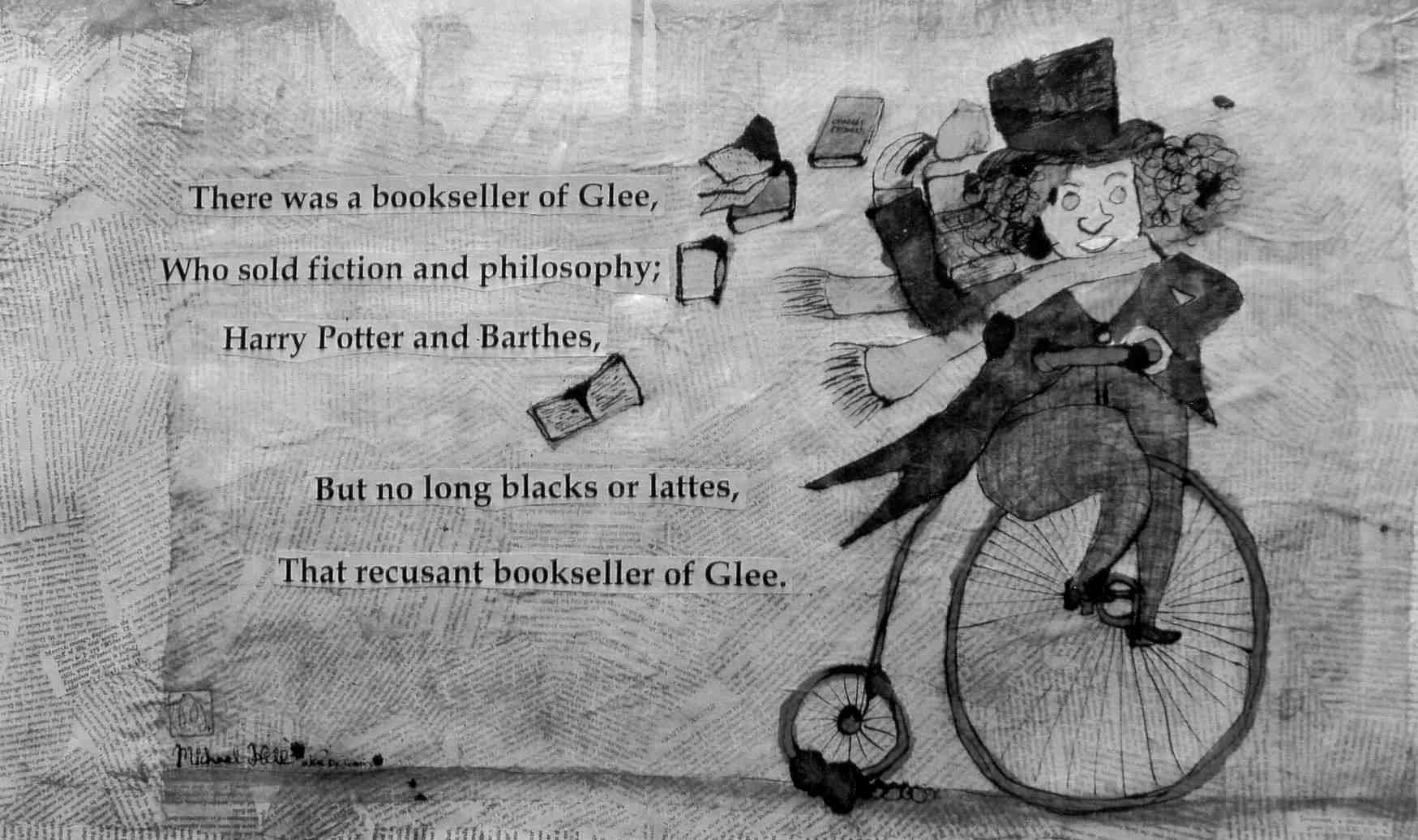
There are books, cats, fish and the occasional bicycle that appear in my comic…the one which I am currently in the process of creating. The title is BLOTTING PAPER. The principal character, Doctor Comics, is an alias of mine…an avid reader and collector of comics. He has two pet talking cats who also read comics, preferably graphic novels, and who regularly eat fish…sometimes these two activities are combined…despite the good doctor’s distaste of stains on his comics fish is a favourite dish of the Doctor’s, too,…but not whilst reading comics! The first chapter refers to books and comics, including graphic novels, both cats and one fish. The location, Glee, is a fantasy label for Glebe, the suburb of Sydney in which I live. It is a bookish suburb near the academic precinct…Sydney University, the University of Notre Dame and the University of Technology, where I work. Being tertiary education territory it has several bookshops, cafes, restaurants and pubs…and is within walking distance of the Sydney Fish Market…which is of special interest to the Doctor Comics character and his cats. I go there often, myself but leave the cats at home. The Bookseller of Glee (below) is a portrait of Roger Mackell, the proprietor of one such bookshop, Gleebooks…and a good friend of mine. Doctor Comics shops at and occasionally writes reviews of graphic novels for this bookstore. The proprietor refuses to sell coffee and cakes! With the emerging trend of cafes in bookshops, I wonder how long he will manage to hold out?

The Boookseller of Glee. (Pen and ink, drawing and collage-© 2009 Dr. Michael Hill a.k.a. Doctor Comics). This is the original colour art work. A Black & White print of it will appear in the comic (below).
The Boookseller of Glee. (B&W print of pen and ink, drawing and collage-© 2009 Dr. Michael Hill a.k.a. Doctor Comics)
Two of the fish featured in the story. (Digital scan of woodblock prints-© 1998 Dr. Michael Hill a.k.a. Doctor Comics)

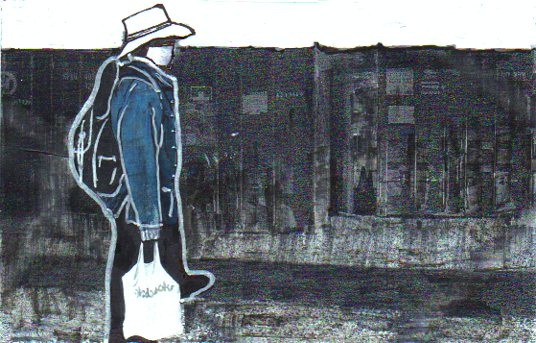
In addition to drawing, cartooning and printmaking, photography is being incorporated as a graphic tool. Below are two photographs from the Sydney Fish Market that have been graphically manipulated and merged…one of stacks of shipping containers…the other of me shopping with a bag of fish that I have purchased. The photographs were subjected to a graphic treatment then collaged together…to show Doctor Comics returning from his shopping expedition. He is carrying a bag of fish and wearing a backpack which is full of books and comics .

Doctor Comics has been shopping. (Photo by Louise Graber overlaid with my graphic treatment-© 2011 Dr. Michael Hill a.k.a. Doctor Comics)
Hand coloured version. (Photo by Louise Graber overlaid with my graphic treatment-© 2011 Dr. Michael Hill a.k.a. Doctor Comics)

Despite the intention and the progress made…it is now looking likely that the first issue of my comic won’t be published this year after all. It is nearing completion, however, and I feel certain that I shall have something to show in early 2012. In the meantime there are these blogged progress reports. The shape of the comic continues to move in an “artist book” direction. It retains some semblances of an art comic, and an Australian one at that, despite some Japanese influences. The figure in the overlaid drawings below, is the older Doctor Comics character, doing some printmaking in his studio. It goes on!

The comics art scholar turns his hand to making comics. (Felt-tipped pen drawing-© 2011 Dr. Michael Hill a.k.a. Doctor Comics)
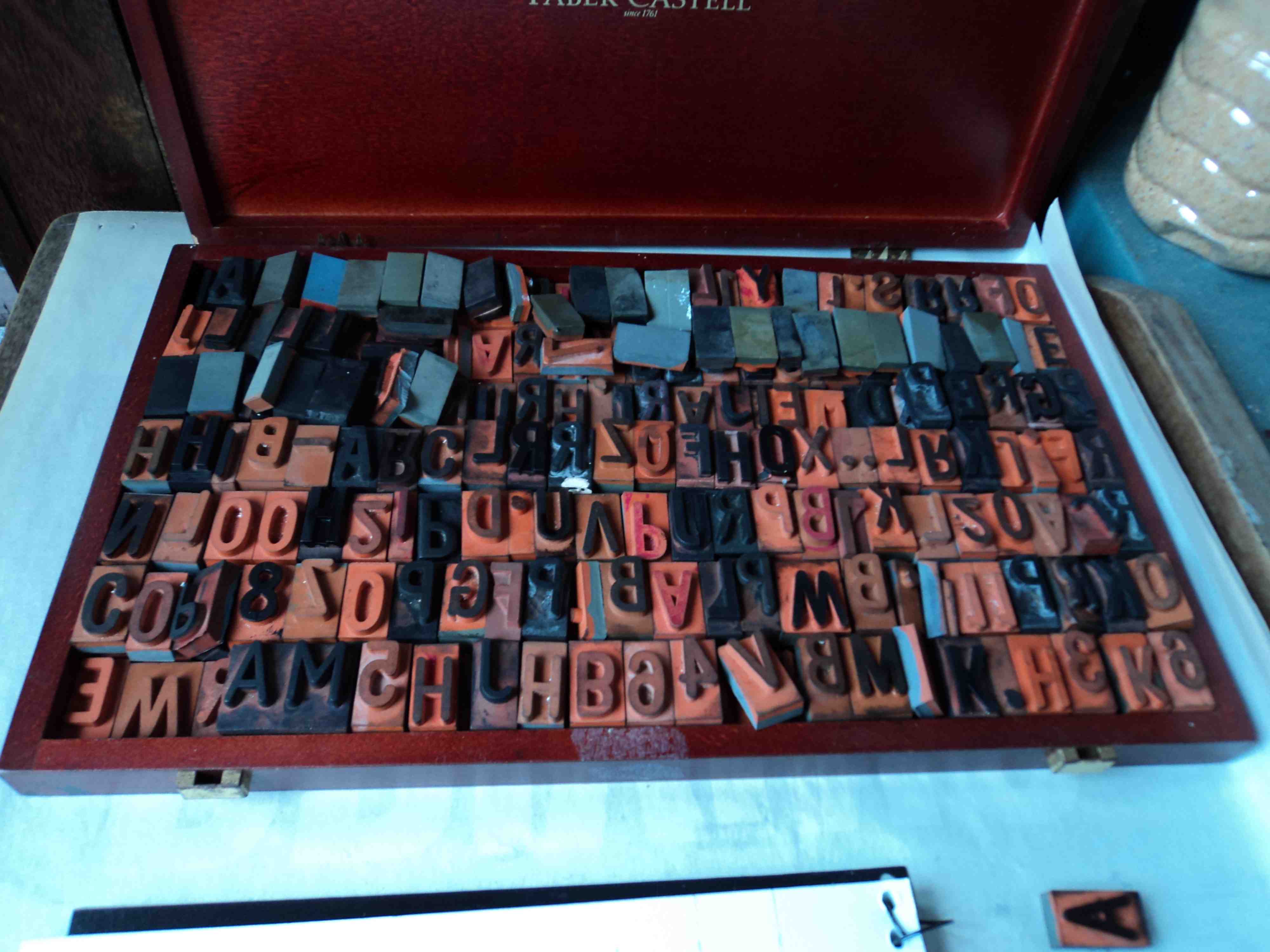
Trying out letter type. (Photo by Louise Graber)

There has also been some script editing. This has resulted in both extensions and deletions. I found that I needed more space to convey some sequences which weren’t working…and other parts were either too difficult or time-consuming for me to draw!

My box of uppercase rubber type. (Photo by Louise Graber)
The type in rubber-stamped, printed form prior to editing, cutting and pasting.

The other interesting development has been the photographic aspect of the project. Initially employed as a reference device for locations, objects and figures, photography has now become more prominent. Some pages are starting to look a little like sequences from a Mexican foto-novela or picto grafia comic. This was not my original intention. There remains, however, the anticipated drawn and printed elements along with the traditional rubber-stamped text (see the photos above). I hope to confirm the completion of the first issue and announce its publication date, shortly…but I won’t hold my breath, Michael.

(All text, photos and artwork-©2011 Dr. Michael Hill aka Doctor Comics).

BLOTTING PAPER The Comic: Production Report No.3

Art, Blotting Paper, Comics August 9, 2011

Production of the first issue of my comic Blotting Paper continues despite delays from my ongoing academic commitments. However, my intention of having the first chapter finished by the end of the year remains. Comparing research to production I have discovered the enormous amount of time it takes to design and create artwork. I can write a thousand word critique of a comic in just over an hour…but creating one page of comics art will take me several times that. Many of the comics creators that I have interviewed say their rate was “a day per page”. I wish!…but I don’t really mind as I love the feeling of being deep in creative space. At the moment, besides printmaking, I am also doing some drawing. I love it and the mental space it takes me into. I like the feeling of getting lost in there.

My ink sketch of the Sydney Harbour Bridge for the first chapter of my comic…it could use a little more detail, perhaps? (Pen and ink drawing-© 2011 Dr. Michael Hill a.k.a. Doctor Comics)

The bridge and Doctor Comics, pen and ink drawing collage #1(© 2011 Michael Hill)
Rough collage of Doctor Comics out walking and contemplating near the Sydney Harbour Bridge…a rough draft design, including corrections, in pen and ink.
(© 2011 Dr. Michael Hill a.k.a. Doctor Comics)

I am experimenting with a range of image-making media to produce the artwork and text. Below are some of the images that have been generated through printmaking at Studio Buljan, in Sydney. (My thanks to Katharine Buljan for the access to her studio). These prints appear in the first chapter of my comic The Ingurgitator. The chapter begins in sunshine in Sydney then things take a dark turn into the subconscious terrain. There is also the evening ritual wherein Doctor Comics cooks dinner…then drinks wine whilst reading his recent comics purchases. During this time he converses with his feline friends. The evening often ends in a dream state that is a melange of art, thought, taste and reflection.

Doctor Comics has his evening proverbial swim in a sea of sumi ink.
(Monotype print-© 2011 Dr. Michael Hill a.k.a. Doctor Comics)
Losing one’s footing and feeling out-of-depth and the fear of ‘going under’.
(Monotype print-© 2011 Dr. Michael Hill a.k.a. Doctor Comics)
Struggling for breath and sinking into the blackness.
(Monotype print-© 2011 Dr. Michael Hill a.k.a. Doctor Comics)

These images are monoprints, so called for their singularity…only one of each is made. However, by re-inking the block and marginally alterating the images, a degree of continuity is maintained. This enables a sequential element to come into play. I have learned this approach in creating the artwork for animation projects. For me, working in printmaking, comics and animation is both labour saving and exhaustive. The images come up quickly but the act of re-inking and printing the block destroys the originals. There is no going back. I enjoy working with the inky element of printmaking. It is so graphic! Any thoughts? Comments about this and my posts are welcome, Michael.

(All text, photos and artwork-©2011 Dr. Michael Hill a.k.a. Doctor Comics).

BLOTTING PAPER The Comic: Production Report No.1

Art, Blotting Paper, Comics, Japanning June 12, 2011

This is the first post documenting the production and progress of my own creative comics project. After studying and researching comics for the past few years…and reading them since I was seven…I have now decided to have a go at making my own. I have more experience of researching comics than producing them. In fact I gained a Ph.D. for my research into comics. That is where I picked up the “Doctor Comics” tag. Then I decided to write some blog posts on the topic…and that led to the decision to create my own comic. The title of my comic is Blotting Paper: The Recollected Graphical Impressions Of Doctor Comics. My research into comics art is now being followed by the creation of it…in a self-reflective approach. I like the juxtaposition of research and production although it may prove difficult to balance. We will see. Please let me know what you think of my efforts. I expect that my comic will be partly autobiographical and partly fictive. It will include comics art related events from my academic career…and my attempts to carry the comics flag in art and design tertiary education. There will be anecdotes relating to my Doctor Comics’s adventures and to my own longstanding interest in comics art studies.

Following a few false starts the first chapter has been written, the design roughed out and the artwork constructed. My experience in printmaking was employed in the generation of some of the graphic work. Techniques included woodblock, linocut and Japanese sosaku hanga techniques along with the use of rubber stamps and seals. Printmaking has also shaped the title of the comic, namely Blotting Paper. It suggests the sometimes messy outcome of shaping words and images in ink on paper…and the latter’s absorption and rejection of it. It is a process where things can get messy at times…but I enjoy the appearance of inkblots and stains and attempts to resolve graphic issues arising from it. Drawing, photography, typography, collage and handwriting have all been utilised as image-making techniques. My intention is to construct a free form, creative comic in an artist’s book format. I really enjoy the process of printmaking…including its potential to produce variations on a theme e.g. unexpected blots, streaks and stains. I would also like to acknowledge of how I first learned it. That was at Sydney College of the Arts whilst working in the Film and Video department of the Design School. I was approached by a fellow academic from the Art School who wanted to learn animation. So we arranged a swap deal. If I taught her basic animation techniques she would introduce me to the art of printmaking. That sounded interesting and it worked like a charm. I fell under the printmaking spell. In fact, I’m still under it!

Typographic design with rubber type assemblage of title of my comic.(Photo-© 2011 Dr. Michael Hill a.k.a. Doctor Comics)

I am how much more time it takes to create a comic than to read or review one…but I am enjoying the creative and technical challenges. I now expect I shall be spending more time creating and less time critiquing comics art in the future. I have since altered the order of emphasis in my social media profile…from ‘critiquing and creating’ to ‘creating and critiquing!’

Some of the stamps, chops and seals. (Photo by Michael Hill)
Some of the stamps, chops and seals I have accrued and assembled for this project are from my printmaking days. (Photo-© 2011 Dr. Michael Hill a.k.a. Doctor Comics)

My basic set of woodblock printmaking chisels purchased in Tokyo. (Photo-© 2011 Dr. Michael Hill a.k.a. Doctor Comics)

Red cat (pencil and ink drawing-© 2010 Michael Hill)

My experimental character design of possible feline character, Red Cat (© 2010 Dr. Michael Hill a.k.a. Doctor Comics)

Accompanying the Doctor Comics character in the comic are his cats, Busch and Cohl. They not only live with him and keep him company but they also read his comics and critique them! Being talking cats they also give him feedback, advising him in a critical manner, of his skills, shortcomings and selections. These comics reading cats are a seeming contrast to him…although their characters are still being designed. One possible design is the Red Cat above. Future posts will document the graphic resolution of this matter.
My animated ink sketch of Doctor Comics rushing to buy cat food at feeding time. He had run out of it and his cats are unpleasantly difficult to deal with when hungry! I have used an animation technique approach of juxtaposed sequential stages of the action for this one…to emphasize Doc’s movement. (© 2010 Dr. Michael Hill a.k.a. Doctor Comics)

Well that’s the third post on my blog…three weeks since the last one…smaller in size…and the first one dealing with my own developing creative project. I think I’m starting to get the hang of it. Thanks for the feedback I have received…I welcome any comments about my blog and my comics project. Here’s to comics art, Michael.

(All text, photos and artwork-©2011 Dr. Michael Hill a.k.a. Doctor Comics).