Good news for me! The first issue of my comic Blotting Paper: The Recollected Graphical Impressions Of Doctor Comics is to be published…in a signed, limited edition. Scheduled for 11 February 2012 at HONDARAKE Full of Books in Sydney (details in the poster below). The comic will be launched by my friend and colleague Gene Kannenberg, Jr. via a Skype link from the U.S.A. Kannenberg, a noted comics historian, is the director of ComicsResearch.org. He is former Chair of the International Comic Arts Festival…and the Comic Art & Comics Area of the Popular Culture Association…and he has written widely on comics art including the book “500 Essential Graphic Novels.”
Poster designed by Louise Graber incorporating original print by Dr. Michael Hill a.k.a. Doctor Comics.
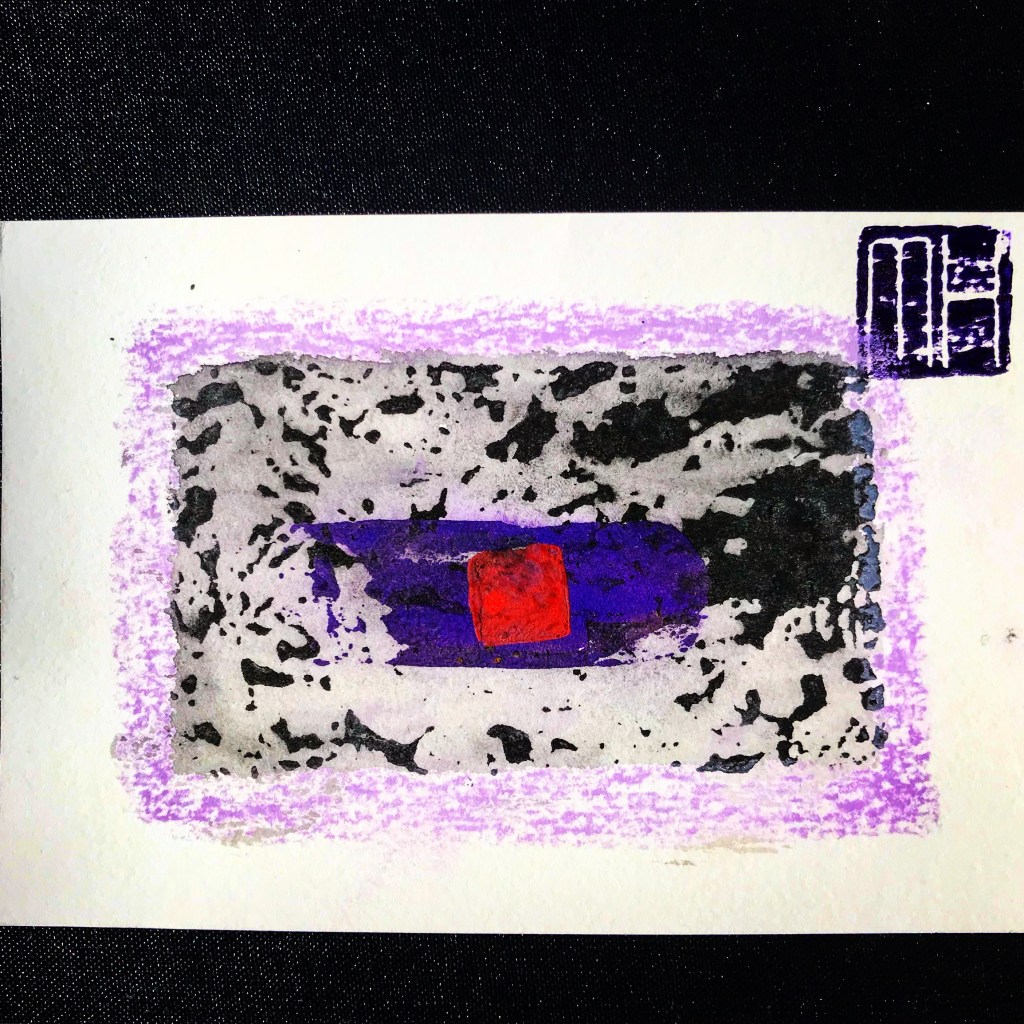
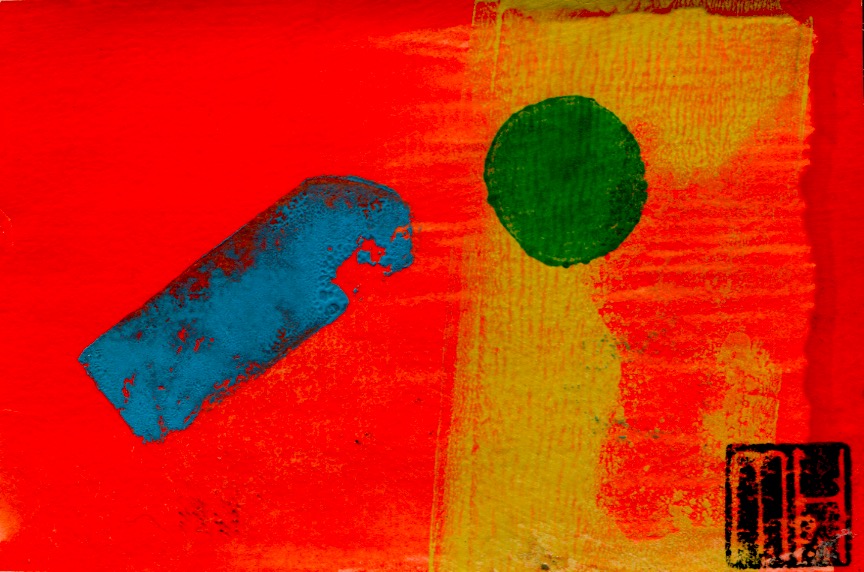
The launch will be accompanied by an exhibition of 33 of my handmade art postcards. These have been produced following the sosaku hanga ‘creative print’ style. This method originated in a movement that emerged just over a century ago in Tokyo. Creative prints became the voice of a group of artists who went under the name Pan. They met for sake parties by the Sumida River. It was the centre of the Floating World of old Edo and site of the classic Ukiyo-e print movement. James Michener wrote: “…in contrast to the classical system in which the artist merely designed the print, leaving the carving of the blocks to one technician and the printing to another, the newer print artists preached that the artist himself must do the designing, carving and printing. A new term was devised to describe such a print-sosaku hanga, meaning “creative print.” ” (Michener, 1968: The Modern Japanese Print p.11). I follow this method in my printmaking.
Above is a collage of 4 separate pen and ink/felt-tipped pen drawings. These separate drawings have been collaged together: (1) Sydney Harbour Bridge. (2) rear view of Doctor Comics walking (3) hand holding bag (4) hand inserting key in door. These drawings will be included in the first issue of the comic. The drawings are from different pages in the comic but have been brought together in this collage…and have been overlaid in the same graphic space. This grouping forms a visual sign or motif for promotion of the comic. I would love to read feedback on this and my other posts.
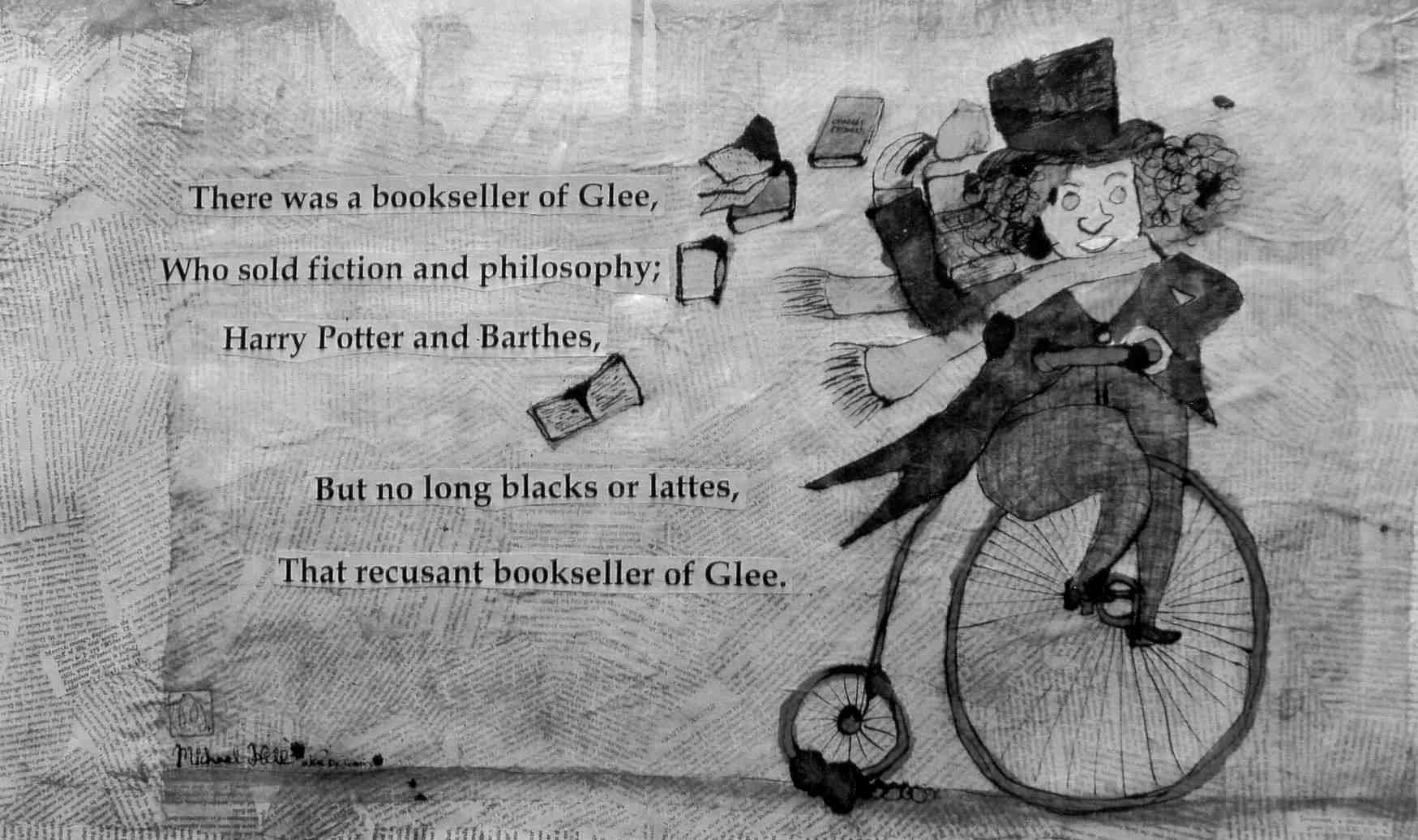
There are books, cats, fish and the occasional bicycle that appear in my comic…the one which I am currently in the process of creating. The title is BLOTTING PAPER. The principal character, Doctor Comics, is an alias of mine…an avid reader and collector of comics. He has two pet talking cats who also read comics, preferably graphic novels, and who regularly eat fish…sometimes these two activities are combined…despite the good doctor’s distaste of stains on his comics fish is a favourite dish of the Doctor’s, too,…but not whilst reading comics! The first chapter refers to books and comics, including graphic novels, both cats and one fish. The location, Glee, is a fantasy label for Glebe, the suburb of Sydney in which I live. It is a bookish suburb near the academic precinct…Sydney University, the University of Notre Dame and the University of Technology, where I work. Being tertiary education territory it has several bookshops, cafes, restaurants and pubs…and is within walking distance of the Sydney Fish Market…which is of special interest to the Doctor Comics character and his cats. I go there often, myself but leave the cats at home. The Bookseller of Glee (below) is a portrait of Roger Mackell, the proprietor of one such bookshop, Gleebooks…and a good friend of mine. Doctor Comics shops at and occasionally writes reviews of graphic novels for this bookstore. The proprietor refuses to sell coffee and cakes! With the emerging trend of cafes in bookshops, I wonder how long he will manage to hold out?
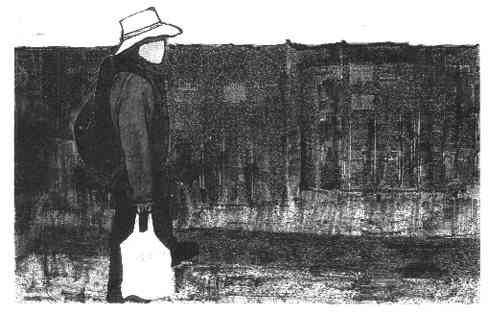
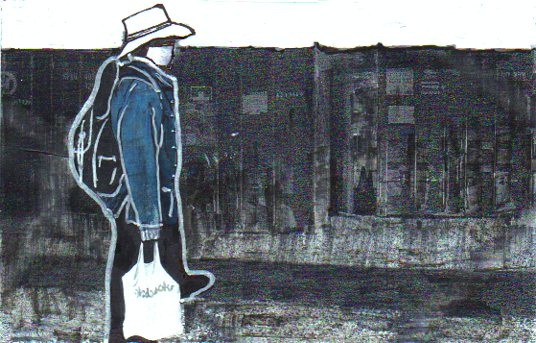
In addition to drawing, cartooning and printmaking, photography is being incorporated as a graphic tool. Below are two photographs from the Sydney Fish Market that have been graphically manipulated and merged…one of stacks of shipping containers…the other of me shopping with a bag of fish that I have purchased. The photographs were subjected to a graphic treatment then collaged together…to show Doctor Comics returning from his shopping expedition. He is carrying a bag of fish and wearing a backpack which is full of books and comics .
Despite the intention and the progress made…it is now looking likely that the first issue of my comic won’t be published this year after all. It is nearing completion, however, and I feel certain that I shall have something to show in early 2012. In the meantime there are these blogged progress reports. The shape of the comic continues to move in an “artist book” direction. It retains some semblances of an art comic, and an Australian one at that, despite some Japanese influences. The figure in the overlaid drawings below, is the older Doctor Comics character, doing some printmaking in his studio. It goes on!
There has also been some script editing. This has resulted in both extensions and deletions. I found that I needed more space to convey some sequences which weren’t working…and other parts were either too difficult or time-consuming for me to draw!
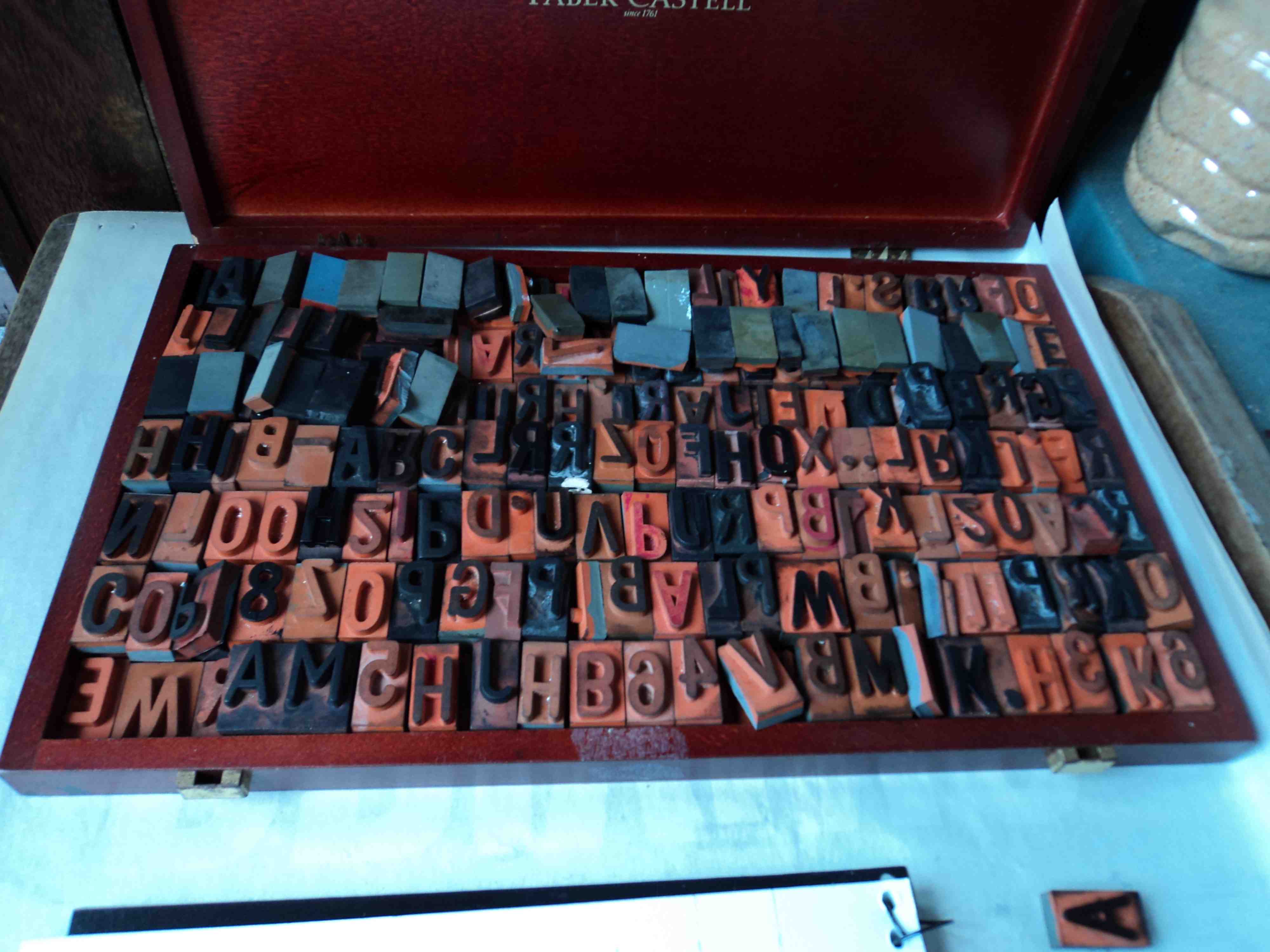
My box of uppercase rubber type. (Photo by Louise Graber)
The type in rubber-stamped, printed form prior to editing, cutting and pasting.
The other interesting development has been the photographic aspect of the project. Initially employed as a reference device for locations, objects and figures, photography has now become more prominent. Some pages are starting to look a little like sequences from a Mexican foto-novela or picto grafia comic. This was not my original intention. There remains, however, the anticipated drawn and printed elements along with the traditional rubber-stamped text (see the photos above). I hope to confirm the completion of the first issue and announce its publication date, shortly…but I won’t hold my breath, Michael.
Production of the first issue of my comic Blotting Paper continues despite delays from my ongoing academic commitments. However, my intention of having the first chapter finished by the end of the year remains. Comparing research to production I have discovered the enormous amount of time it takes to design and create artwork. I can write a thousand word critique of a comic in just over an hour…but creating one page of comics art will take me several times that. Many of the comics creators that I have interviewed say their rate was “a day per page”. I wish!…but I don’t really mind as I love the feeling of being deep in creative space. At the moment, besides printmaking, I am also doing some drawing. I love it and the mental space it takes me into. I like the feeling of getting lost in there.
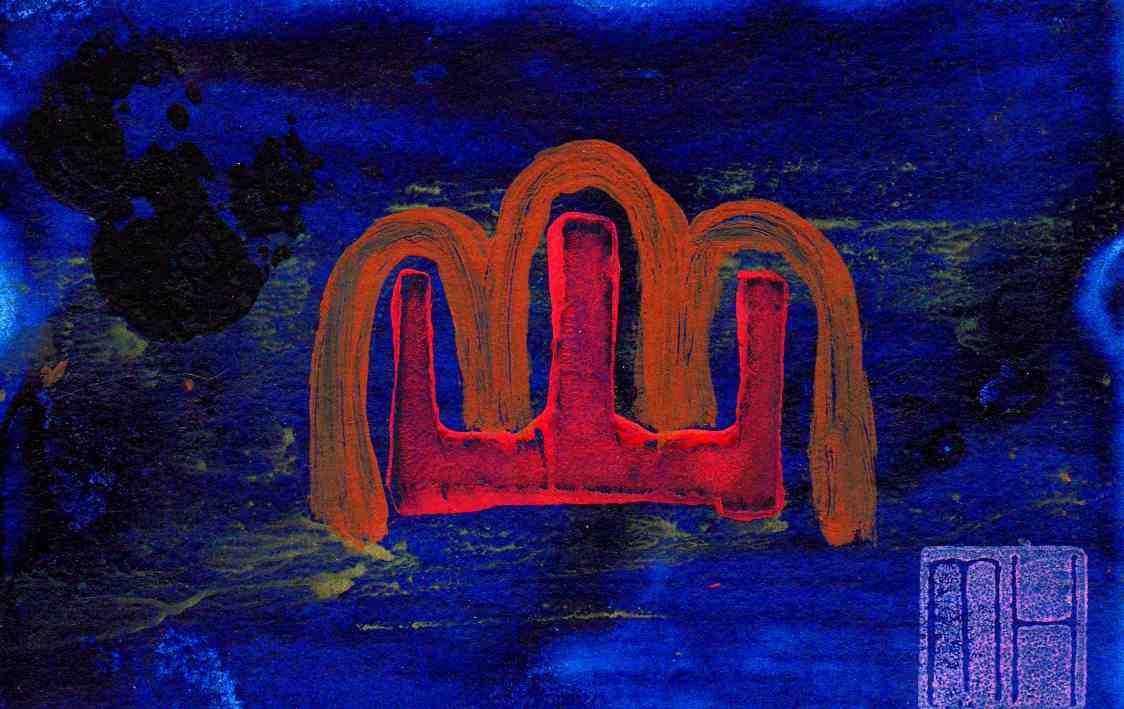
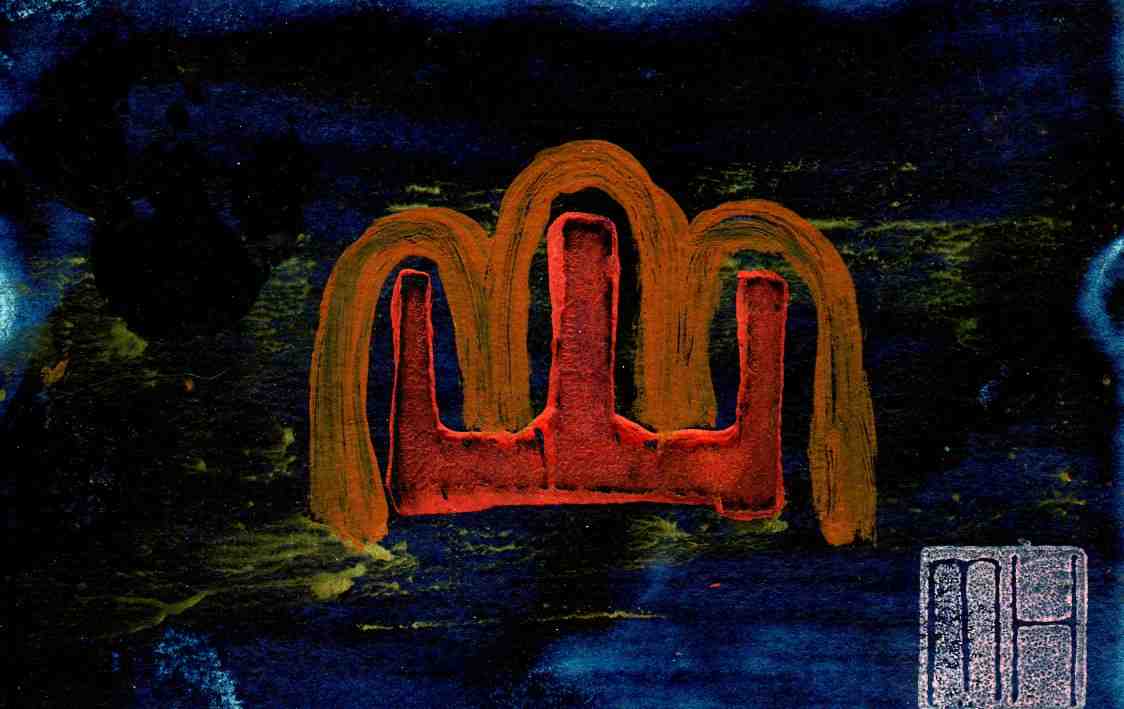
I am experimenting with a range of image-making media to produce the artwork and text. Below are some of the images that have been generated through printmaking at Studio Buljan, in Sydney. (My thanks to Katharine Buljan for the access to her studio). These prints appear in the first chapter of my comic The Ingurgitator. The chapter begins in sunshine in Sydney then things take a dark turn into the subconscious terrain. There is also the evening ritual wherein Doctor Comics cooks dinner…then drinks wine whilst reading his recent comics purchases. During this time he converses with his feline friends. The evening often ends in a dream state that is a melange of art, thought, taste and reflection.
These images are monoprints, so called for their singularity…only one of each is made. However, by re-inking the block and marginally alterating the images, a degree of continuity is maintained. This enables a sequential element to come into play. I have learned this approach in creating the artwork for animation projects. For me, working in printmaking, comics and animation is both labour saving and exhaustive. The images come up quickly but the act of re-inking and printing the block destroys the originals. There is no going back. I enjoy working with the inky element of printmaking. It is so graphic! Any thoughts? Comments about this and my posts are welcome, Michael.
The above image is an experimental graphic impression of the typographic design of the title of my emerging first comic. Keen to experiment graphically with rubber stamping I have moved the letters during printing to create a smudged effect. I have also used some askew registration and mixed the fonts. How postmodern! My comic is based on my experiences…both practical and metaphorical…that I have had in a career in higher education. This involved teaching and research at an art and design college…followed by a university, in the disciplines of film, video, animation and visual communication design. The subject of comics often arose and I actively endorsed that. Initially considered as an effective method of teaching storyboarding it then became a medium in its own right. I also began to research the comics medium. This ultimately led to my doctoral research in comics studies and the gaining of my Ph.D in that field. The Art and Design schools of Sydney College of the Arts were virtually neighbours. As mentioned in my previous post, I became involved in printmaking when I temporarily swapped classes with a colleague…my graphics students with her printmaking students for a couple of sessions, and her students learning animation with me. I became very interested in the printmaking studio and its graphic methods…and began to learn printmaking techniques myself. The printmaking lecturer and I taught each other the rudiments of our respective skills. It was a good exchange. I enjoyed it both as a technical medium and as a form of artistic expression. Consequently, printmaking became an adopted part of my artistic practice. In my own comic production I have employed printmaking to generate titles and visual expressions. These have been edited and combined in my developing graphic novel project Blotting Paper.
I experimented with the visual communication design elements of the work and found this approach both exciting and productive. I also began to think of my project extending beyond a single issue…possibly even becoming a graphic novel?
The ‘graphical impressions’ are drawings and prints of graphic memories. These were generated and printed in ink from rubber, wood, lino and other surfaces. The titles were made with rubber type and my name credit from a linocut. Besides printmaking as a method of image-making I also did some drawing…using traditional metal dip pens, pencils, felt-tipped pens and brushes plus a range of inks.
PRODUCTION UPDATE: Recently the production progress of my comic has experienced a few interruptions. On the plus side of this I have been working on interesting studies projects during the delays. One project involves the works of Tezuka, Rintaro, Matsumoto and Miyazaki, and their films. These include Galaxy Express 999, The Dagger of Kamui, Laputa-Castle in the Sky, and The Girl Who Leapt Through Time. Another project involves workshops in the sosaku hanga technique of creative Japanese printmaking. Both of these activities will form part of a Japanese Cultural Festival in Suva in the South Pacific. I shall be participating in and teaching at this event. In terms of my comic’s progress, I have pulled some pieces of completed work together. I have also been modifying other work that I had considered completed. That’s the title page design(above) for the first chapter The Ingurgitator, as it currently stands. Although created in colour a black and white version may appear in the comic. It consists of a combination of image-making techniques including drawing, painting, inking, printmaking and collage. The original collage/sketch, below, was made during a trip to Shanghai to attend the Animation Expo in Hangzhou in 2007.
So there is my third post on this blog…a month since my previous post…which seems to be a better and more manageable gap…and the second post on my comics project. I would love to hear any comments and suggestions about my blog…including the frequency of my postings, Michael.
This is the first post documenting the production and progress of my own creative comics project. After studying and researching comics for the past few years…and reading them since I was seven…I have now decided to have a go at making my own. I have more experience of researching comics than producing them. In fact I gained a Ph.D. for my research into comics. That is where I picked up the “Doctor Comics” tag. Then I decided to write some blog posts on the topic…and that led to the decision to create my own comic. The title of my comic is Blotting Paper: The Recollected Graphical Impressions Of Doctor Comics. My research into comics art is now being followed by the creation of it…in a self-reflective approach. I like the juxtaposition of research and production although it may prove difficult to balance. We will see. Please let me know what you think of my efforts. I expect that my comic will be partly autobiographical and partly fictive. It will include comics art related events from my academic career…and my attempts to carry the comics flag in art and design tertiary education. There will be anecdotes relating to my Doctor Comics’s adventures and to my own longstanding interest in comics art studies.
Following a few false starts the first chapter has been written, the design roughed out and the artwork constructed. My experience in printmaking was employed in the generation of some of the graphic work. Techniques included woodblock, linocut and Japanese sosaku hanga techniques along with the use of rubber stamps and seals. Printmaking has also shaped the title of the comic, namely Blotting Paper. It suggests the sometimes messy outcome of shaping words and images in ink on paper…and the latter’s absorption and rejection of it. It is a process where things can get messy at times…but I enjoy the appearance of inkblots and stains and attempts to resolve graphic issues arising from it. Drawing, photography, typography, collage and handwriting have all been utilised as image-making techniques. My intention is to construct a free form, creative comic in an artist’s book format. I really enjoy the process of printmaking…including its potential to produce variations on a theme e.g. unexpected blots, streaks and stains. I would also like to acknowledge of how I first learned it. That was at Sydney College of the Arts whilst working in the Film and Video department of the Design School. I was approached by a fellow academic from the Art School who wanted to learn animation. So we arranged a swap deal. If I taught her basic animation techniques she would introduce me to the art of printmaking. That sounded interesting and it worked like a charm. I fell under the printmaking spell. In fact, I’m still under it!
I am how much more time it takes to create a comic than to read or review one…but I am enjoying the creative and technical challenges. I now expect I shall be spending more time creating and less time critiquing comics art in the future. I have since altered the order of emphasis in my social media profile…from ‘critiquing and creating’ to ‘creating and critiquing!’
Accompanying the Doctor Comics character in the comic are his cats, Busch and Cohl. They not only live with him and keep him company but they also read his comics and critique them! Being talking cats they also give him feedback, advising him in a critical manner, of his skills, shortcomings and selections. These comics reading cats are a seeming contrast to him…although their characters are still being designed. One possible design is the Red Cat above. Future posts will document the graphic resolution of this matter.
Well that’s the third post on my blog…three weeks since the last one…smaller in size…and the first one dealing with my own developing creative project. I think I’m starting to get the hang of it. Thanks for the feedback I have received…I welcome any comments about my blog and my comics project. Here’s to comics art, Michael.
Since retiring from the university, having concluded my full-time academic career, I have enjoyed having a lot more free time….especially time to read and also to draw comics, listen to music, watch films and go for walks. It has been wonderful! I have also found more time to work on my art projects…printmaking, designing art postcards, creating comics…and doing the odd bit of blogging. I had previously enjoyed doing a bit of guest blogging. I enjoyed this and subsequently decided to start my own blog, posting reports on my research and comics creation. I initially even thought of having two blogs: one formal and critical, as in my academic research work…and the other more playful and creative, about the making of comics. Ultimately, I decided to merge these two approaches into a single interwoven blog that would be both informative and entertaining. So here is my first post…on the new, one and only, Doctor Comics blog. It will include posts on both the creation and critiquing of comics art particularly documenting the creation of my own comic. Many thanks to my excellent agent, Andrew Hawkins, for obtaining the Doctor Comics name tag, website and email…and for his arrangement of media interviews for me. It’s now time to get my website and blog up and running. I welcome feedback from readers of my blog.
Doctor Comics aka Dr. Michael Hill…happy to read, research and create comics. (Photo by Alison Van Hees).
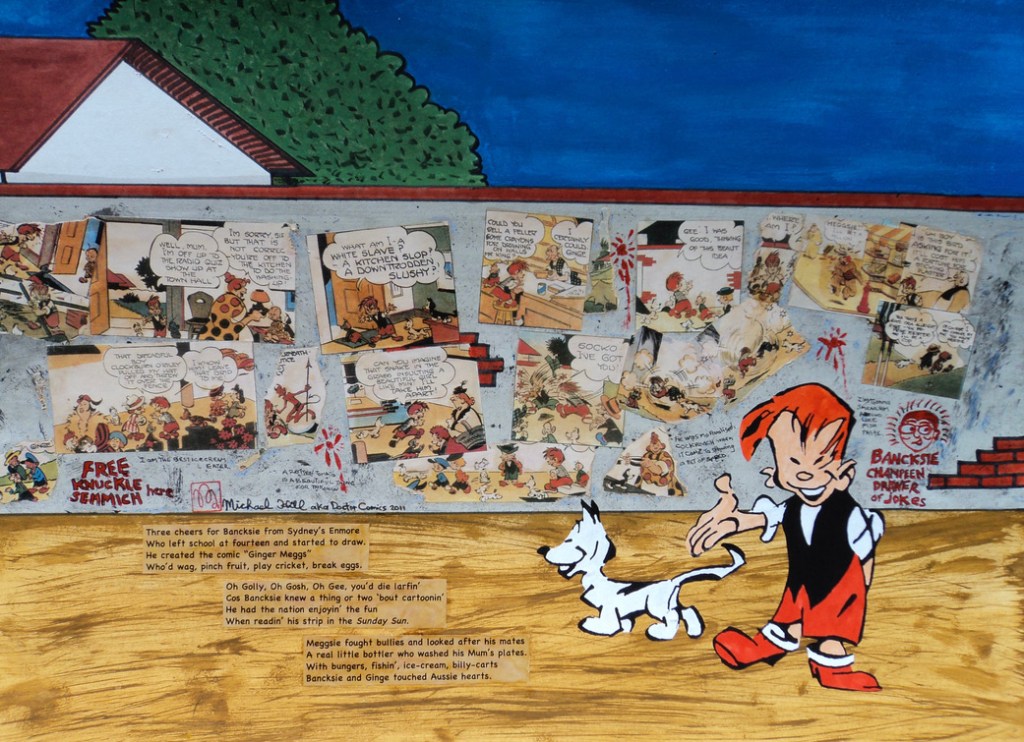
I want to begin my blog by declaring that I absolutely love both reading and creating comics. I have read, collected and studied comics since I was a child. Every Sunday morning after church, I would wait for the opportunity to read the comics section of the Sunday newspaper. My father had first reading rights. He began with the comics section before moving on to the sports pages. He didn’t like to separate the paper into sections, preferring to keep it all together…so the family had to wait till he had finished his complete reading of it. It was good to hear him laughing at the comics. He particularly loved The Potts by Jim Russell, whom I would meet years later at a comics convention in Sydney. He also loved Australian cartoonist Jimmy Bancks’s strip Adventures of Ginger Meggs. It was printed in glorious four tone colour (see my art tribute collage Bancksie Champion Drawer of Jokes, below). He also liked action comics, especially English war tales and American Wild West adventures. He had served as an Australian soldier in the Second World War. Whilst reading the war and western comic strips he would make the sounds of bombing raids and gunfights.
Once he finished his reading he left the newspaper for the rest of the family. That was when it got separated into sections. I was usually the first to follow his reading and, like him, I started with the comics section. Unlike him, I didn’t proceed to the Sports pages but stopped reading there. For me the comics were the highlight of the Sunday paper. News of the world, sporting results and weather reports did not match the joy of reading the comics for me. My mother would buy me a comic when I was ill and absent from school…especially when I was hospitalised to have my tonsils out. It was usually a Donald Duck or Mickey Mouse…sometimes a Denis The Menace. The graphic humour would soothe my illness. I got to know comics by their titles and characters and gradually learned the names of the creators e.g. comics artists Carl Barks and Hank Ketcham. So I can claim that my parents contributed to my developing love of comics.
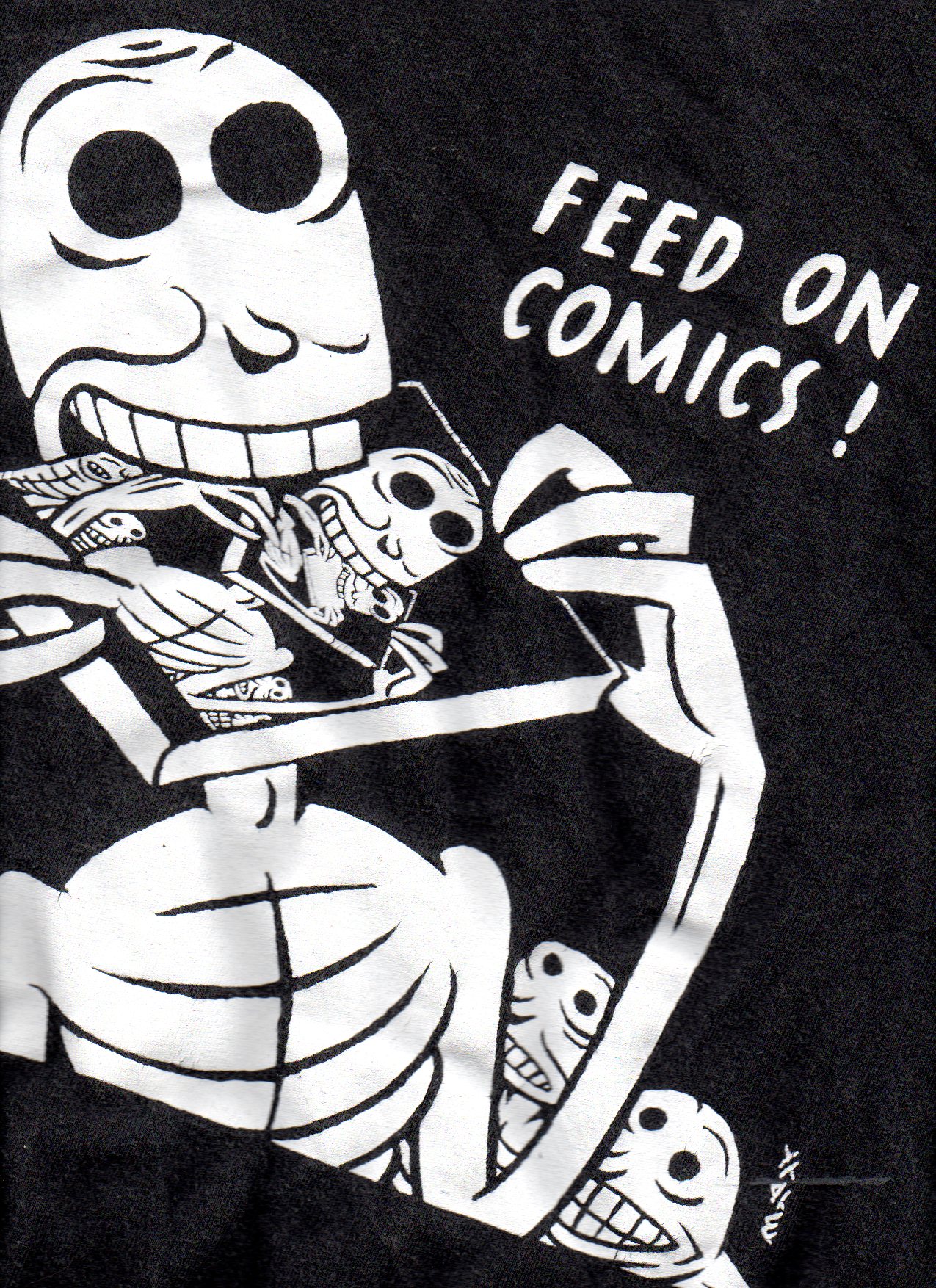
The FEED ON COMICS! T-shirt design by Max. Doctor Comics intends to follow this call on his Blog.
I also had two kind aunties who would regularly buy me comics weeklies in the 1960s…titles like BEANO or EAGLE. These were shipped to Australia from England and arrived approximately three months after their U.K. publication date. I suspect my interest in space travel, English football and cartoon animals arose from reading and collecting these “boys papers”. Throughout my teenage years I continued to read and collect comics. This continued in adulthood. Some of my friends thought it somewhat childish and that I should grow up and stop reading comics. No way! Never! Eventually I was no longer limited to reading comics after church, after homework or during periods of illness. I had left school, found a job, and left home. This enabled me to stop going to church, buy my own comics and read them in bed!
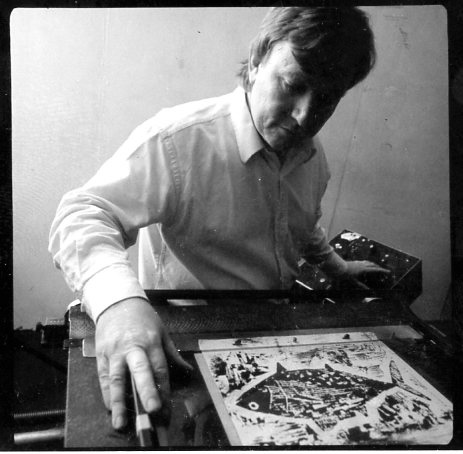
Animating my woodblock prints on the Oxberry animation stand at Sydney College of the Arts.
My interest in and enthusiasm for comics continued and reached another level at Sydney College of the Arts. As an academic in the Visual Communication Design program…I developed a more formal interest in studying and researching comics and animation. I also learned the technique of printmaking from a colleague…(see photo above…more details to come in future posts). I had always loved to draw and often received colour pencil and paint sets as Birthday and Xmas presents. I had had no art tuition in my primary and secondary schooling…but one year I was awarded the Religious Prize in Primary School that was probably attributed to my artistic skills. My teachers were Nuns. It was for a drawing I did of The Little Flower (Saint Teresa) floating up to Heaven on her death. I drew her literally as a flower. It was my unknowing introduction to visual metaphor. My drawing made the nuns cry! At the time I thought I had done something wrong, upsetting them, but the tears were apparently joyous! I wish I still had that drawing but the nuns ran off with it. In fact they never returned it! I never saw it again and my parents never ever saw it! Those nuns did seemingly compensate me, however, by awarding me the Religious Prize that year! The top student in my class and his parents complained to them on Speech Night (the Prize giving event)…saying “Unfair!..he only got a Credit in the subject but he won the prize!” They just didn’t know about that drawing…and the magic of art. Despite this so-called “injustice” I managed to keep my prize…although I did lose my art! My parents were very proud of my award. They had taught me to never challenge a teacher, especially a Nun. So I had to forget about asking them for the return of my drawing. This proved to be sound advice in the long term.
After Primary School with the Dominican Nuns I came up against the much tougher Christian Brothers in my Secondary education. Their chosen instrument of punishment and persuasion was “the strap!” This consisted of layers of leather strips, stitched together, with which they vigorously struck the student’s open palm. Each Brother had his own particular “strap” and technique of administration. Some preferred fast, repeated strokes from a short distance…whilst others preferred the delayed but vigorous downward stroke from a higher level. It proved more painful than the nuns’ short but hard cane tap. These were rigid disciplinarians with seemingly little interest in art. Any mathematics or science drawing or doodle on the edge of a page was met with a disapproving frown. No extra marks were awarded if you added an illustration to an essay…you might get away with a map in History but not a landscape in Geography…and definitely no art in a composition in English! These were considered an unnecessary waste of word space! Years later, however, I was to experience the joy of visual expression in art and design schools. They absolutely loved it there!
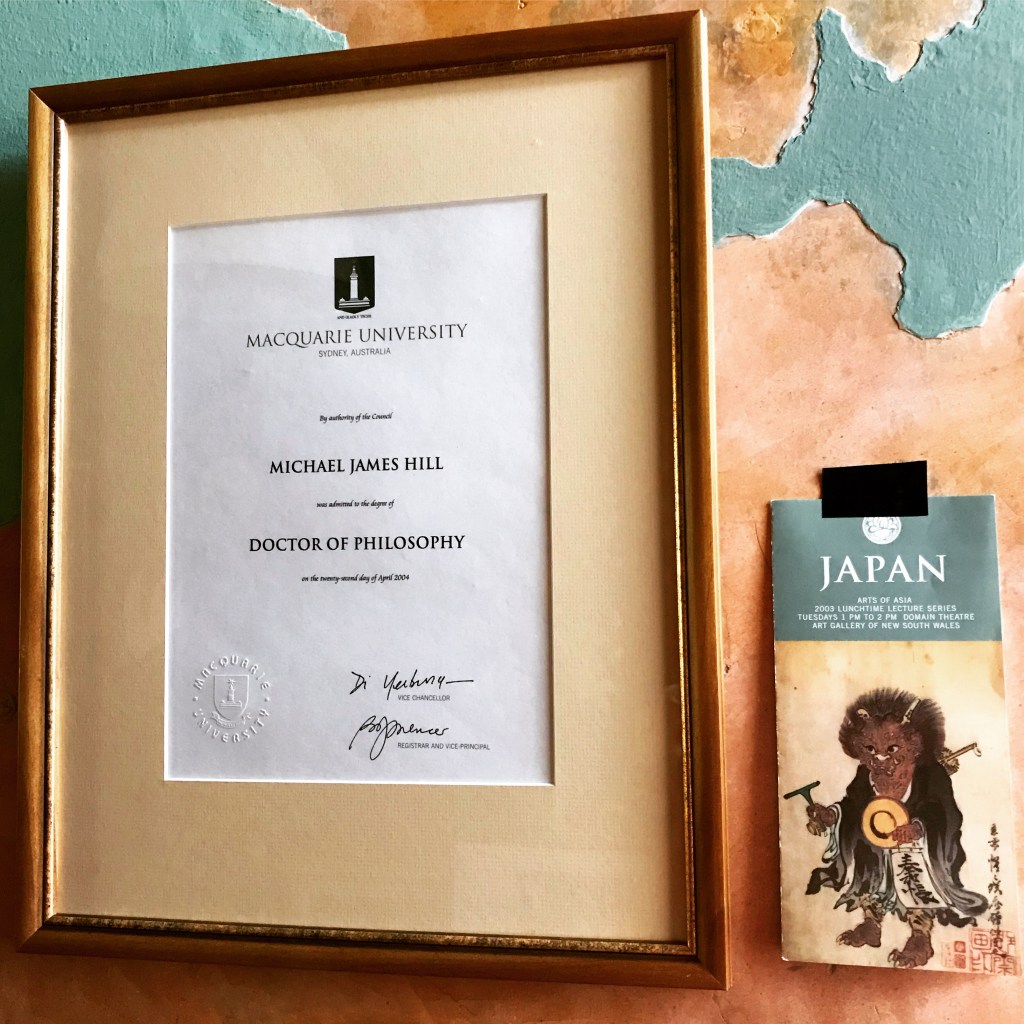
My PhD was awarded for my original research into Australian comics art and production. The accompanying brochure refers to my interest in Japanese art.
Since early adolescence I have been involved in comics art studies and research. First, through leisurely reading of the English comic strips from my aunties…followed by compulsive collecting…some review writing…all leading to the creation of my own comics. Later, working at an Art College I found that comics were considered a valid field of study and research. Oh joy! This ultimately led to my PhD for research into Australian ‘small press’ comics. That is where my alias arose. I’m known as Michael Hill, PhD (a.k.a Doctor Comics). I completed the doctorate in 2003 and acquired the alias in 2006. It was on a radio chat show that my agent, Andrew Hawkins, arranged for me to be interviewed. One caller said he wanted to talk to “that Doctor Comics guy!” To the amusement of listeners the announcer informed them that I actually had a PhD in “comics”! So instead of “Doctor in comics”…or “Doctor of comics”…it was strategically shortened and sharpened in focus toDoctor Comics. My agent formalised this with the registration of my doctorcomics@gmail.com email account and the doctorcomics.com website. This caught on in the local media and led to a chain of interviews.
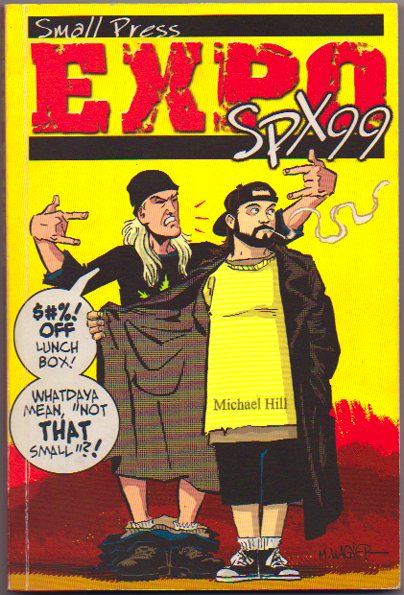
My entry card to U.S.A. comics event THE EXPO 99…with the Brian Ralph illustration.
My intention with this blog is to document my reading, researching, critiquing, creation and celebration of comics art. This is expressed by the Feed On Comics! T-shirt by the artist MAX (see illustration above). I acquired it at the ICAF (International Comic Arts Festival) at Bethesda, Maryland, USA in 1999. I could not believe there was an academic conference on comics! Not only that…it was followed by a comics convention, the Small Press Expo! It turned out to be an inspiring event being both a conference and a convention. The academic conference was chaired by Gene Kannenberg, Jr., the “big guy” who enthusiastically led proceedings, to a gathering of like-minded souls, i.e. academics researching comics art. Gene made me feel very welcome. Amongst those who attended was Dr. John A. Lent who was selling the first issue of IJOCA, the International Journal of Comic Art Vol. 1, No. 1 Spring/Summer 1999, that he had produced and published as Editor-in-Chief. I became a member of the International Editorial Board of that journal, representing Australia. Other new comics colleagues I met at that event were Michael Rhode, Randy Duncan, Charles Hatfield…and Mike Kidson whose paper “William Hogarth: Printing Techniques and Comics” inspired my later graphic research into Hogarth and printmaking. That introduction to printmaking eventually led to my adoption of it as an artistic practice. Also in attendance were other comics art researchers…Pete Coogan, Pascal Lefèvre, Jeff Miller, Ana Merino, Jeff Williams, Mark Nevins, Guy Spielmann, and Joseph “Rusty” Witek. They were pleased to have another Australian attend (Spiros Tsaousis had attended the previous year). They even let me, as guest, choose the restaurant on the first day…I suggested “Mexican?” a novel choice for me, not familiar with the cuisine. They all smiled and took me to one of the many local Mexican restaurants. I have since, somewhat subliminally, associated dining on Mexican food with researching comics art!
SPX99, my copy of the Small Press Expo program in Bethesda, Maryland, U.S.A., the first comics art conference I attended.
This conference gave me the reassurance to undertake the academic study and research of comics art. It also connected me with other academics from around the world who studied and researched comics art. This ultimately led me to the gaining of my PhD in comics studies. At that Bethesda conference, I made a presentation on Australian indie comics based on the research I had been doing. As the conference concluded the comics expo kicked off downstairs. This convention, known as the Small Press Expo, honoured indie comics (see my99 EXPO card above). I bought several comics and even sold some I had brought with me from Australian small press creators. I also met Gary Groth, “wow!” the guy who runs The Comics Journal…he seemed to be on the look out for “comics stuff”…and Neil Gaiman, “yes, him!”, in the lift, speaking in his dulcet English tone that was wonderful to hear! They, and many others that I had only read about, were in attendance, wandering around at the event. Comics art was what they studied, created, promoted, traded or researched! In the evening there was an award ceremony at which comics artist James Kochalka performed, surprisingly, absolutely naked! Amazing! Each category winner was awarded a brick, just like the one Ignatz threw at Krazy. I was most impressed and inspired by the level of comics art interest and the emerging philosophy surrounding it! The event celebrated both the study and creation of comics art. This has had ongoing resonance for me as I start this blog. I also intend continuing my reading, researching and writing about comics art.
Doctor Comictopus alias for Michael Hill a.k.a. Doctor Comics, designed by Michelle Park.
So there is my first post….a little lengthy perhaps…but I am off and running along the blogging trail and feeling very excited about it…and I welcome any comments and suggestions from readers of my blog, Michael.













 Doctor Comics