I am beginning to feel that I am nearing the final post documenting the production of my graphic novel/artist book/comic…Blotting Paper: The Recollected Graphical Impressions Of Doctor Comics…as I tie the ends of the storyline together and head towards the conclusion. Initially I thought that this would be a sequel with a different title…but after having second thoughts I decided to make it the final chapter of the graphic novel…with the same title…Blotting Paper: The Recollected Graphical Impressions Of Doctor Comics. Owing to the absence of the Doctor Comics character in this new chapter, it contains less of his anecdotes…and fewer human characters as it drifts more in the direction of the funny animal comics genre. This seems to be a good move.
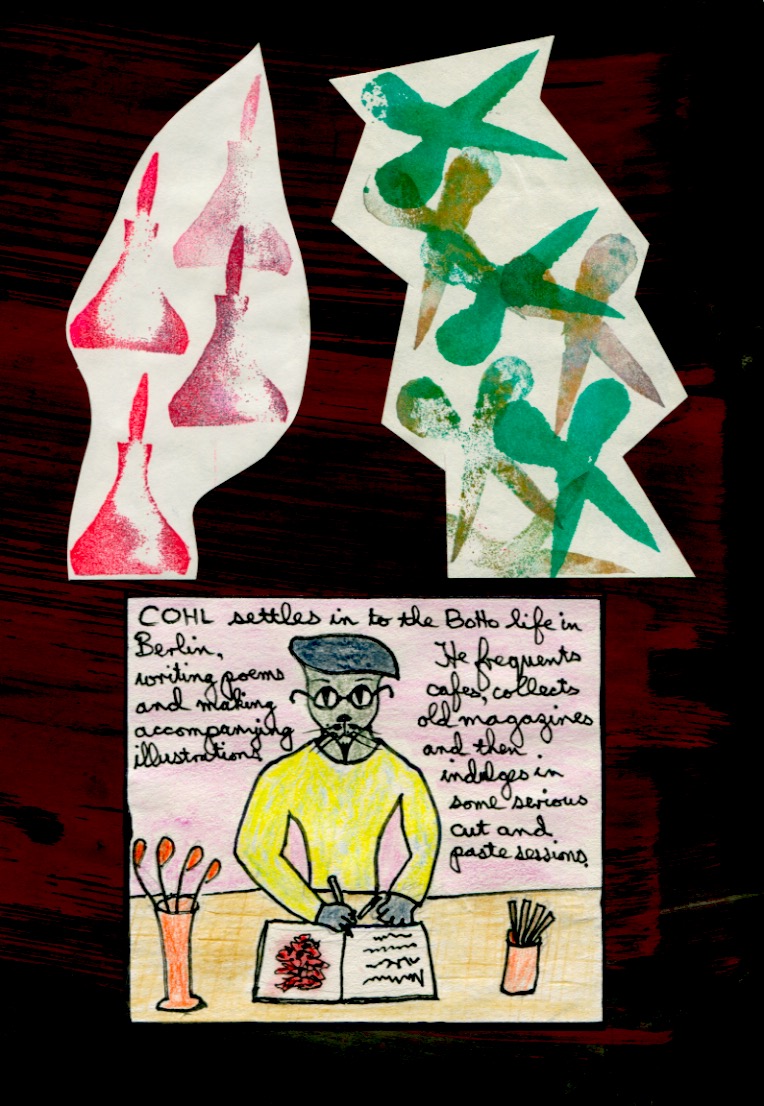
The chapter begins in Berlin…where Cohl, having heard no word from his friend Busch for almost two years…decides to follow him to Tokyo and try to find him. Cohl has been very comfortable in the German city…and somewhat reluctant to leave but his curiosity and friendship ultimately awakened him from his cultural slumber.
In addition to the restaurant supplies district some scenes take place in Kanda, the bookshop area of Tokyo. Cohl initially explores the manga shops…then extends his search to sources of traditional woodblock printed books as well as books about yokai spirits.
Near the end of the Blotting Paper graphic novel (page 286 above and page 287 below of 300 pages), Cohl is ultimately content to remain in Berlin despite his attempts to find his friend Busch who had left Germany for Japan with his new friend Barks.
Owing to the absence of the Doctor Comics character in this new chapter…it contains hardly any of his anecdotes…and even fewer human characters as it drifts more in the direction of the funny animal comics genre. The principal character, Cohl the cat from the Blotting Paper graphic novel,…has some adventures in the Asakusa area of Tokyo…to which he has travelled in search of his missing friend and flatmate, the other cat and feline friend, Busch.
Doctor Comics researching the bookshop area of Tokyo during an earlier visit. (Photo by Louise Graber.)
In addition to the restaurant supplies district some scenes take place in Kanda, the bookshop area of Tokyo. Cohl initially explored the manga shops…then extended his search to sources of traditional woodblock printing books…as well as books about yokai and the spirit world…as Doctor Comics had done. All good! I shall now start heading toward the conclusion of my graphic novel.
I have still not completed this issue of my comic but I am getting there! Completion of the fourth issue of my artist book/comic…and ultimately, graphic novel…Blotting Paper: The Recollected Graphical Impressions Of Doctor Comics is near. The printing and publishing process of those pages will follow. This includes the sequential stages of the pages being printed, collated, trimmed, covered and bound. As with the first three issues the fourth one has a total of 40 pages plus end-papers and covers. For this issue the covers will feature a wraparound print that includes the title. Being an artist book there will be a limited edition of 30. Each book in this first edition will be numbered and signed by the artist.
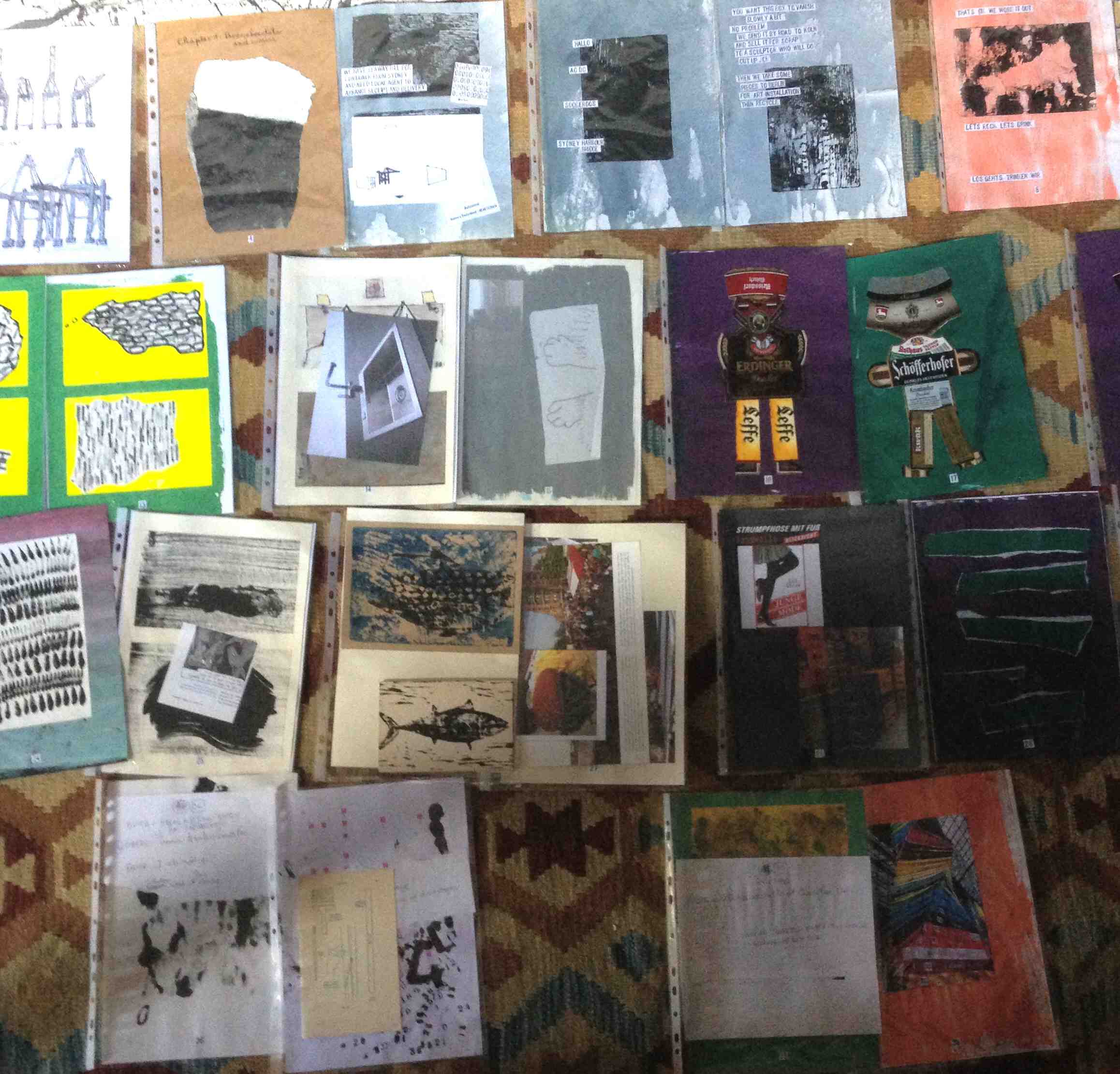
The addition of some spot colour plus a few paragraphs of handwriting is needed. It may also receive a bit of a toning touch-up and a little overprinting. I have spread out the pages in sequence on the floor of the studio. This reveals some sense of the overall flow of the comic. There might be the odd alteration to the sequencing in the final edit. I try to feel a sense of rhythm from reading and turning the pages.
UPDATE 6 JULY 2015: COMPLETION OF ISSUE #4! Although it took a little longer than expected I have now completed production of the fourth issue of my comic! The pages have been printed, collated, trimmed, bound and covered with title labels. Copies have been mailed to my supportive, personal readers. A possible launch is being looked at in Tokyo in October.
After running past the planned deadline and being slightly over budget I decided to finish in D.I.Y mode. This resulted in a somewhat hand-crafted look.
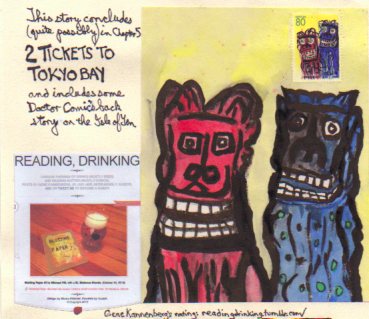
Now it’s on to the likely final issue…although reprints of previously published chapters are also a possibility…as is the eventual merging of all chapters into graphic novel form…I wish!…and can’t stop thinking about that possibility. Looking ahead, the tentatively titled 2 Tickets to Tokyo Bay Chapter 5 will be set in Germany and Japan. It depicts the continued activities of Doctor Comics’ cats and their new canine companion Barks in “funny animal” comics style. It may also contain further comics related recollections from Doctor Comics’ past, particularly his research of manga. Below is the ad for Chapter 5 on the back page of Issue 4.
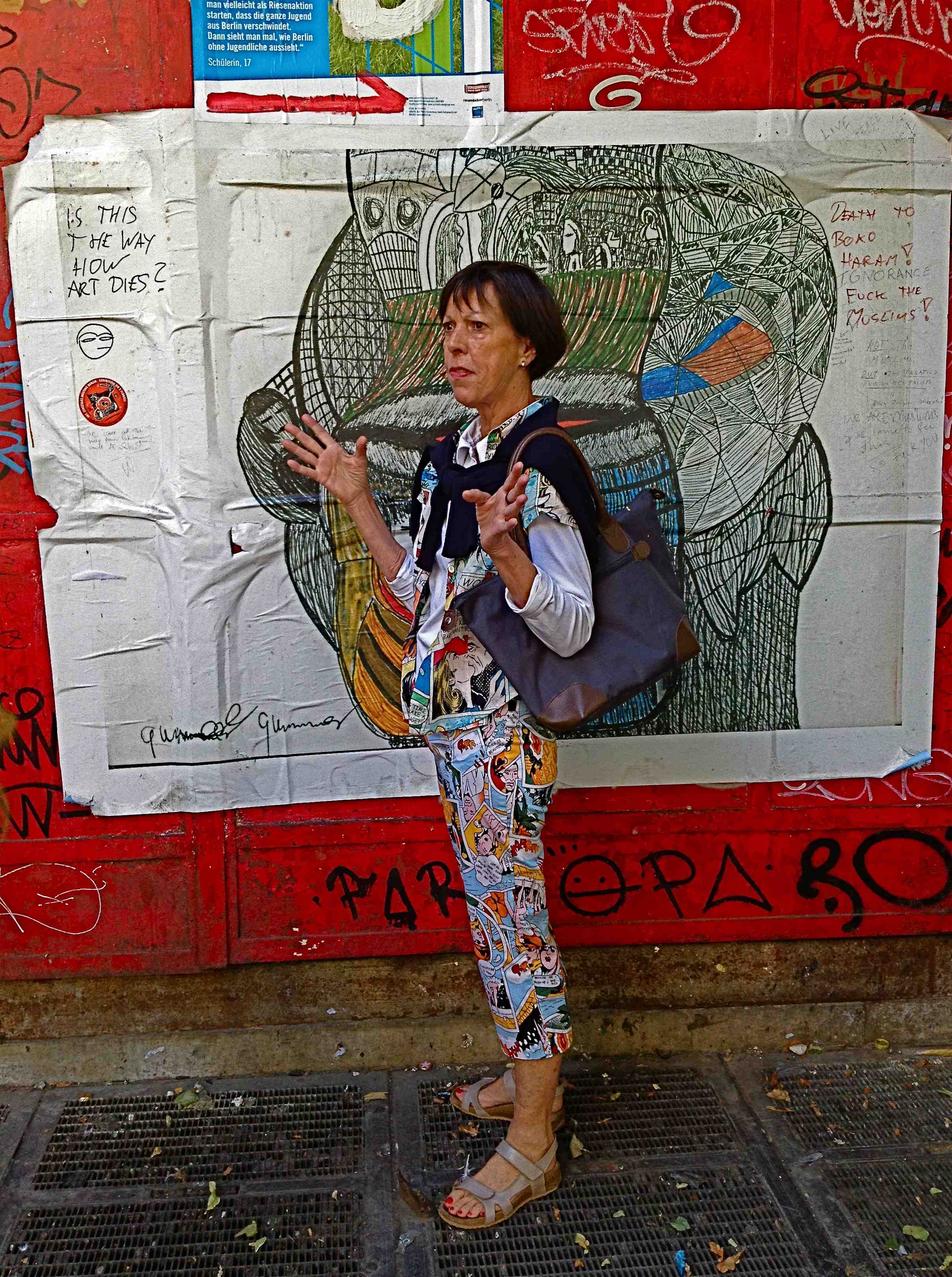
This post documents a recent walking tour of Berlin’s Staadt Mittee area…with friend, local resident and interpreter Mailef as my guide. The plan was to see the graffiti and traces of an artists’ commune (kunsthaus). I also wanted to visit Renate comics shop and bibliothek which has been located there since the early 1990s. I thought it would be good to purchase some German kunst comicbuchs (art comics) there!
Mailef escorted me to the Kunsthaus (arthouse) Tacheles building on Oranienburger Strasse…a site that was previously part of East Berlin when the wall was up. The Tacheles (translation “let’s talk business”) building had, over a century, successively housed…an elegant shopping arcade, then Nazi offices and squatter artists. The building was damaged in World War 2 then repaired by the GDR…vacated in 1989 then occupied as an international artist squat in the 1990s. The artists were eventually displaced/evicted by representatives of the investors in 2012.
Art comics (kunst comicbuchs) by the hundreds were available at Renate Comics. Many of them were signed and marked as limited editions. These varied in size from A6 minicomics to the larger A3 format. Art postcards (kunst postkartes) have become an additional creative outlet for comics creators. I enjoy making art postcards myself…and there was a range of German stock in a rotating rack on the pavement outside the shop.
Art minicomicbuch purchase from the shop- Pure Sultana by Franziska Schaum.
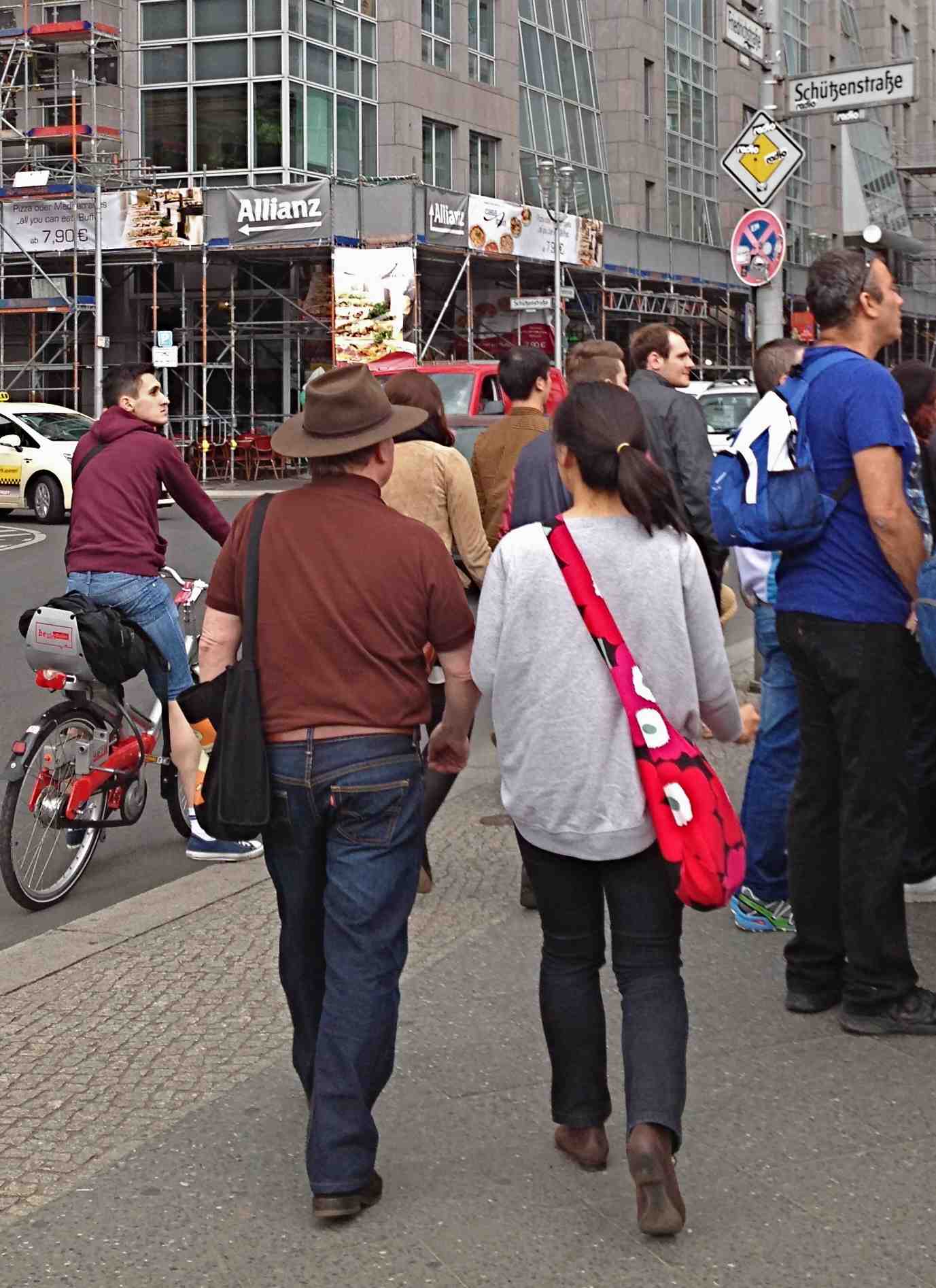
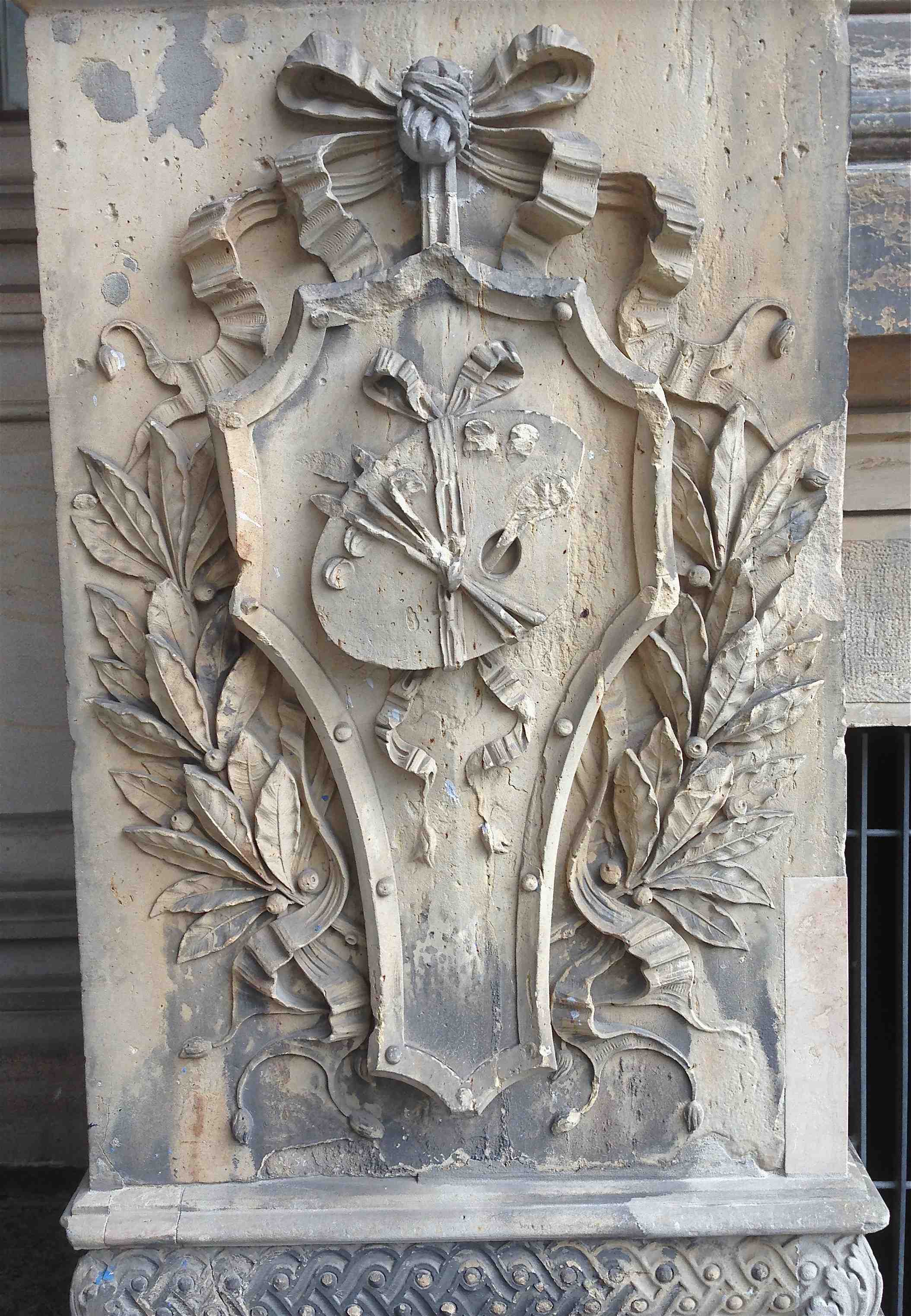
I took another walking tour of Mitte in Berlin with friend, former student, now animator, illustrator and printmaker, Michelle Park. She showed me a study of terror(see photos below). It was a busy morning for walking tours in Berlin. Starting out in Bezirk Kreuzburg…we passed the Deutsches Currywurst Museum in Schützenstraße,…Checkpoint Charlie Museum in Friedrichstraße, then walked along Niederkirchnerstraße to the old Gestapo and SS Headquarters site.
The Gestapo Headquarters building had taken a direct hit from English bombing during World War II. It was demolished after the war. It is now an open-air museum Topography Des Terrors (Topography of Terror). Some rubble remains. There is a section of the Berlin Wall(without the barbed wire) and a new building with an exhibition and information. The exhibition was titled Errfast, Verfolgt, Vernichtet (Registered, Persecuted, Annihilated). It was both grim and candid about the horror that had taken place there.
Next door at Martin Gropius Bau museum was the Hans Richter exhibition…Begegnungen, Von Dada Bis Heute (Encounters: From Dada to the Present Day).It was part of the Berlin Festival. Also present wasthe David Bowie exhibition from London’s Victoria and Albert Museum, and Chinese artist Ai Weiwei’s Evidence. What a line-up! This building had also suffered from the bombing alyjough not as much as the Gestapo site. It has been restored but still displays its scarification from shrapnel and bullets.
With both of us interested in animation and printmaking I wanted to show Michelle this wonderful exhibition of the artistic career of Hans Richter. He had been born in Berlin in 1888 and was a key figure in 20th Century art and animation. Three sides of Martin Gropius Bau had been allocated so a lot of walking was required. There were his woodcuts and paintings and his contributions to Dada. These included Dada magazine and his own zine G -Material zur elementarun Gestaltung (Material for elementary design). There were also his experiments with painted scrolls. These had led him to the discovery of displaying images in motion through animation. On screen were his abstract animations and live-action films including Dreams That Money Can Buy. There were also some home movies, plus documentation of his film teaching work in New York. Added to this were works by colleagues Max Ernst, Man Ray, Marcel Duchamp, Hans Arp, Raoul Hausmann, George Grosz, Francis Picabia, Viking Eggeling, Alexander Calder and Kurt Schwitters. Richter was a well connected man.
Hans Richter exhibition pamphlet at Martin Gropius Bau.
DADA: art and anti-art by Hans Richter.
With a life’s work on display there was much inter-connected visual material in the exhibition…we found ourselves walking back and forth. We could have spent 4 or 5 hours watching the films, videos and documentaries alone. It was an exhibition that called for fresh legs and more than one visit. Excellent art, impressive show, Michael.
Blauer Mann, 1917, by Hans Richter
Visionary self-portrait by Hans Richter.
Stalingrad (Sieg im Osten) (Victory in the East), scroll painting by Hans Richter.
Job done! Production of the third issue of my artist book/comic Blotting Paper: The Recollected Graphical Impressions Of Doctor Comics has been completed. The comic was launched in June at Comic-Salon Erlangen in Germany. I had been invited to attend the event by German design colleagues…Professors Markus Fischmann and Michael Mahlstedt…of Visuelle Kommunikation, Design und Medien Department…Hochschule Hannover University of Applied Arts and Sciences where I had a visiting academic engagement back in 2007. Comic-Salon is the largest comics convention in Germany with 25,000+ attendees. Oh wow!
This is the first in a series of regular reports documenting the production of the third issue of my artist book/comic…Blotting Paper: The Recollected Graphical Impressions Of Doctor Comics. It continues on from my previous posts on the first chapter/issue The Ingurgitator…and the second chapter/issue A Blot On His Escutcheon. The new chapter, The Chthonian Turn: The Cats’ Revenge…deals with the feline characters’ reaction to the demise of Doctor Comics…and that gentleman’s adventures in another dimension to which he has travelled. I hope to self-publish it before the end of the year.
As with the two previous issues printmaking is involved in the generation of images…via woodblock, linocut, Japanese sosaku hanga technique, rubber stamps and wooden seals. In addition other visual communication techniques…such as drawing, painting, collage, cartooning and photography…with the intention of producing a limited edition artist’s book comic.
I also intend having more colour pages in this issue…following the use of sporadic spot colour in Issue #1 and the 8 full colour pages in Issue #2. The colour will assist in the graphic representation of both the real and imaginary worlds featured in the comic.
I am continuing to edit the script, refine ideas, and develop others. There has been some unscripted image-making and printmaking activity…with the intention of using this as a loose but parallel means of creating vaguely conceived and experimental visual content. Examples produced through this printmaking strategy are featured below.
In the present chapter the two feline characters deliberate over the decision of what to do following the sudden departure of Doctor Comics. Meanwhile the latter character continues his travels in the chthonian world…confronting various vaporous forms and ghostly figures…including a trio of roaming red shades (see the three red shade illustrations). The raw state of these printmaking images will most likely be subject to further graphic manipulation.
The target date for completion of the five 8-page signatures have been approximated…and with a good run the comic could possibly be ready for binding as early as June.
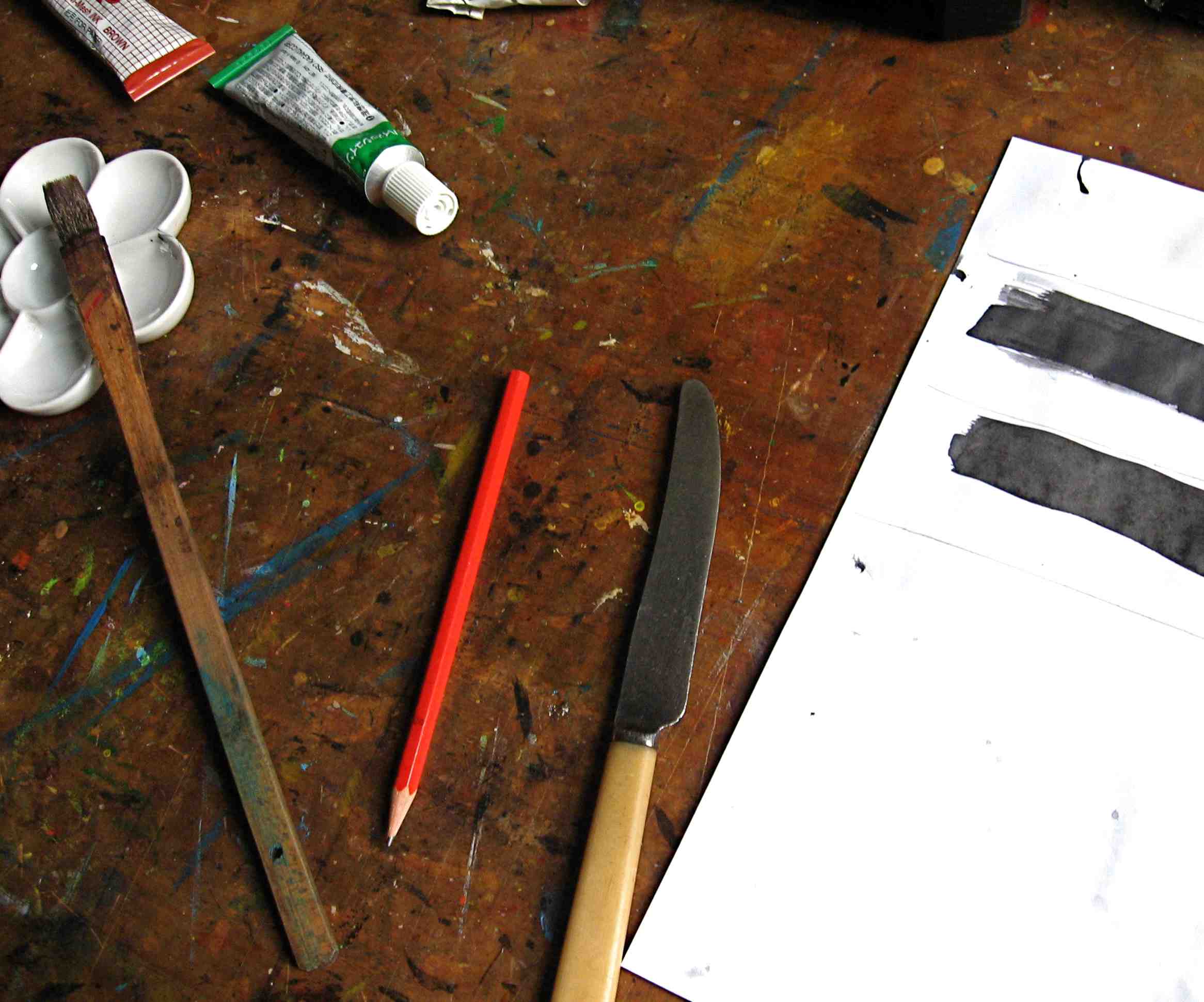
Ink, more so than paint, appears to be the dominant graphic ingredient in the production…with dip pens, drawing pens and brush calligraphy involved…although some of the inking will be made onto previously painted paper.
There are some pencils in there too…as well as the pens,…with drawing and handwriting components plus my regular use of printmaking for image generation.
Having gotten deeper into production modeI am now approaching completion of the artwork …having advanced from scripting to page layout…however, I am keeping things open in terms of the resolution of the story.
I find the creation of the images…and the entire image-making process…including the resultant generation of the artwork…to be the most pleasurable part of the production process. Culling, selecting and editing the artwork is a tougher task.
Printmaking has again been employed in the image-making…a little more than photography…but about the same proportion as drawing. In terms of style, abstraction is making an impression. The notion of developing this project into graphic novel form continues to firm.
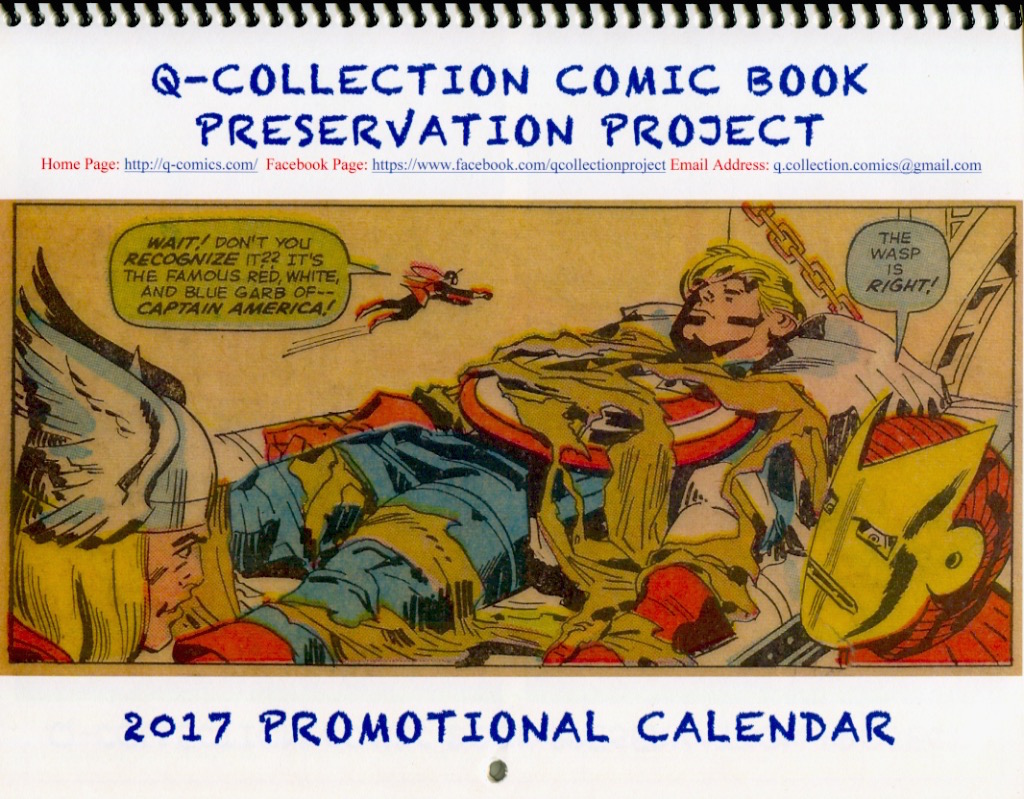
I have been involved with this project as an academic advisor for the past three years. It’s formal title is Q-COLLECTION COMIC BOOK PRESERVATION PROJECT, an initiative to preserve a particular collection of comics. I like to refer to it as Q, the “Q” standing for the city of Quincy, Massachusetts. The city’s shield was presented to the project’s founder Dr. John Offerman Sindall for use on the project. Sindall, a member of Mensa, has collected around 200 key American comic books from the period 1930s-1960s. This was an era of printing comics on low grade paper that will eventually crumble into powdery form when handled. The Q project is a strategy to prevent this by cutting up the comics, coating them with Mylar and mounting them in wooden binders that will provide an estimated life of 10,000 years. Hearing this part of the process, that the comics will have to be destroyed in order to be saved, is disturbing for some collectors. Librarians understand the beneficial outcome, however. It means the comics will be able to be read. In terms of financial investment this collection is not about unopened first issues in sealed plastic bags.
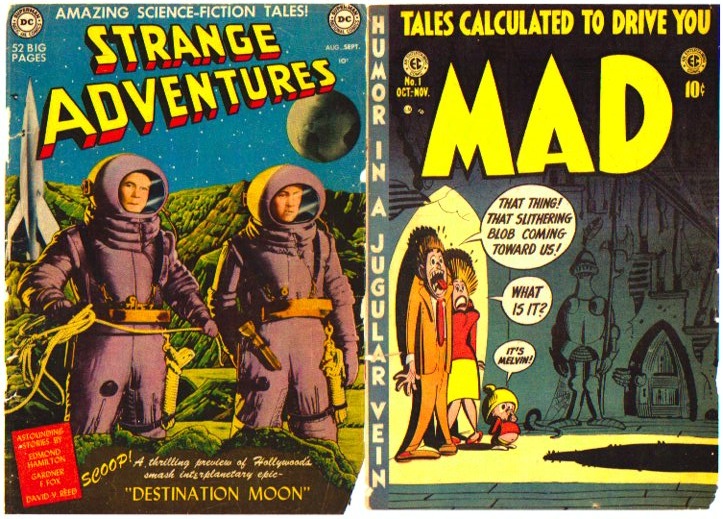
Two of the comics in the collection, both No.1’s, Strange Adventures (1950) and MAD (1952).
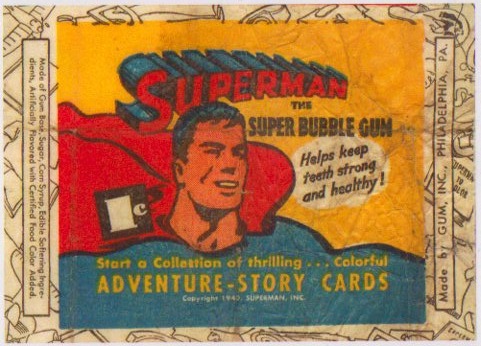
In addition to the comics, the collection contains associated artifacts such as trading cards, bubble gum wrappers, photographs, ads, membership cards etc. These items will be subject to the preservation process.
Superman bubble gum wrapper.
Sindall has put together a wide-ranging international advisory committee for the project. Here is my statement of support: In a world in which comic books have been treated for far too long as consumables and ephemera the Q-Collection Comic Book Preservation Project represents a significant plan to preserve key items of these as popular culture artifacts. This project also provides physical protection against the transitory status of comic books by means of coating, wrapping and encasement in protective materials that will ensure defense against their decay. The selection and acquisition of these rare comic books that have become classics of popular culture, their preservation treatment, deposit and safekeeping and subsequent availability for reading and research by future generations has my support and deserves backing by business benefactors, patrons of popular culture and by an appropriate public collection institution.
The collection is destined for the Library of Congress.
UPDATE: FEBRUARY 2016: An article about the project’s founder has been published: Comic Book Heroics: Mensan Leads Efforts To Preserve Aged Comics by Michael Hill, Ph.D., The Mensa Bulletin, February 2016, No. 592.
UPDATE: DECEMBER 2016: The Q-Collection Comic Book Preservation Project’s 2017 promotional calendar-strictly limited edition gifted to committee members. Thank you John!
The above image is an experimental graphic impression of the typographic design of the title of my emerging first comic. Keen to experiment graphically with rubber stamping I have moved the letters during printing to create a smudged effect. I have also used some askew registration and mixed the fonts. How postmodern! My comic is based on my experiences…both practical and metaphorical…that I have had in a career in higher education. This involved teaching and research at an art and design college…followed by a university, in the disciplines of film, video, animation and visual communication design. The subject of comics often arose and I actively endorsed that. Initially considered as an effective method of teaching storyboarding it then became a medium in its own right. I also began to research the comics medium. This ultimately led to my doctoral research in comics studies and the gaining of my Ph.D in that field. The Art and Design schools of Sydney College of the Arts were virtually neighbours. As mentioned in my previous post, I became involved in printmaking when I temporarily swapped classes with a colleague…my graphics students with her printmaking students for a couple of sessions, and her students learning animation with me. I became very interested in the printmaking studio and its graphic methods…and began to learn printmaking techniques myself. The printmaking lecturer and I taught each other the rudiments of our respective skills. It was a good exchange. I enjoyed it both as a technical medium and as a form of artistic expression. Consequently, printmaking became an adopted part of my artistic practice. In my own comic production I have employed printmaking to generate titles and visual expressions. These have been edited and combined in my developing graphic novel project Blotting Paper.
I experimented with the visual communication design elements of the work and found this approach both exciting and productive. I also began to think of my project extending beyond a single issue…possibly even becoming a graphic novel?
The ‘graphical impressions’ are drawings and prints of graphic memories. These were generated and printed in ink from rubber, wood, lino and other surfaces. The titles were made with rubber type and my name credit from a linocut. Besides printmaking as a method of image-making I also did some drawing…using traditional metal dip pens, pencils, felt-tipped pens and brushes plus a range of inks.
PRODUCTION UPDATE: Recently the production progress of my comic has experienced a few interruptions. On the plus side of this I have been working on interesting studies projects during the delays. One project involves the works of Tezuka, Rintaro, Matsumoto and Miyazaki, and their films. These include Galaxy Express 999, The Dagger of Kamui, Laputa-Castle in the Sky, and The Girl Who Leapt Through Time. Another project involves workshops in the sosaku hanga technique of creative Japanese printmaking. Both of these activities will form part of a Japanese Cultural Festival in Suva in the South Pacific. I shall be participating in and teaching at this event. In terms of my comic’s progress, I have pulled some pieces of completed work together. I have also been modifying other work that I had considered completed. That’s the title page design(above) for the first chapter The Ingurgitator, as it currently stands. Although created in colour a black and white version may appear in the comic. It consists of a combination of image-making techniques including drawing, painting, inking, printmaking and collage. The original collage/sketch, below, was made during a trip to Shanghai to attend the Animation Expo in Hangzhou in 2007.
So there is my third post on this blog…a month since my previous post…which seems to be a better and more manageable gap…and the second post on my comics project. I would love to hear any comments and suggestions about my blog…including the frequency of my postings, Michael.
Since retiring from the university, having concluded my full-time academic career, I have enjoyed having a lot more free time….especially time to read and also to draw comics, listen to music, watch films and go for walks. It has been wonderful! I have also found more time to work on my art projects…printmaking, designing art postcards, creating comics…and doing the odd bit of blogging. I had previously enjoyed doing a bit of guest blogging. I enjoyed this and subsequently decided to start my own blog, posting reports on my research and comics creation. I initially even thought of having two blogs: one formal and critical, as in my academic research work…and the other more playful and creative, about the making of comics. Ultimately, I decided to merge these two approaches into a single interwoven blog that would be both informative and entertaining. So here is my first post…on the new, one and only, Doctor Comics blog. It will include posts on both the creation and critiquing of comics art particularly documenting the creation of my own comic. Many thanks to my excellent agent, Andrew Hawkins, for obtaining the Doctor Comics name tag, website and email…and for his arrangement of media interviews for me. It’s now time to get my website and blog up and running. I welcome feedback from readers of my blog.
Doctor Comics aka Dr. Michael Hill…happy to read, research and create comics. (Photo by Alison Van Hees).
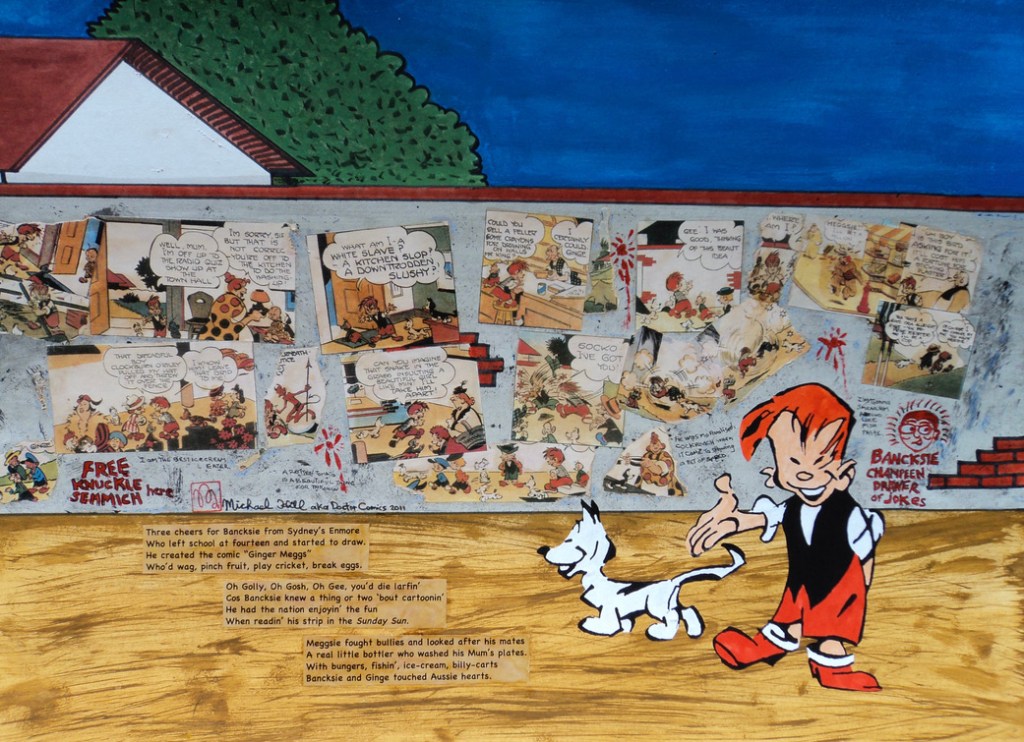
I want to begin my blog by declaring that I absolutely love both reading and creating comics. I have read, collected and studied comics since I was a child. Every Sunday morning after church, I would wait for the opportunity to read the comics section of the Sunday newspaper. My father had first reading rights. He began with the comics section before moving on to the sports pages. He didn’t like to separate the paper into sections, preferring to keep it all together…so the family had to wait till he had finished his complete reading of it. It was good to hear him laughing at the comics. He particularly loved The Potts by Jim Russell, whom I would meet years later at a comics convention in Sydney. He also loved Australian cartoonist Jimmy Bancks’s strip Adventures of Ginger Meggs. It was printed in glorious four tone colour (see my art tribute collage Bancksie Champion Drawer of Jokes, below). He also liked action comics, especially English war tales and American Wild West adventures. He had served as an Australian soldier in the Second World War. Whilst reading the war and western comic strips he would make the sounds of bombing raids and gunfights.
Once he finished his reading he left the newspaper for the rest of the family. That was when it got separated into sections. I was usually the first to follow his reading and, like him, I started with the comics section. Unlike him, I didn’t proceed to the Sports pages but stopped reading there. For me the comics were the highlight of the Sunday paper. News of the world, sporting results and weather reports did not match the joy of reading the comics for me. My mother would buy me a comic when I was ill and absent from school…especially when I was hospitalised to have my tonsils out. It was usually a Donald Duck or Mickey Mouse…sometimes a Denis The Menace. The graphic humour would soothe my illness. I got to know comics by their titles and characters and gradually learned the names of the creators e.g. comics artists Carl Barks and Hank Ketcham. So I can claim that my parents contributed to my developing love of comics.
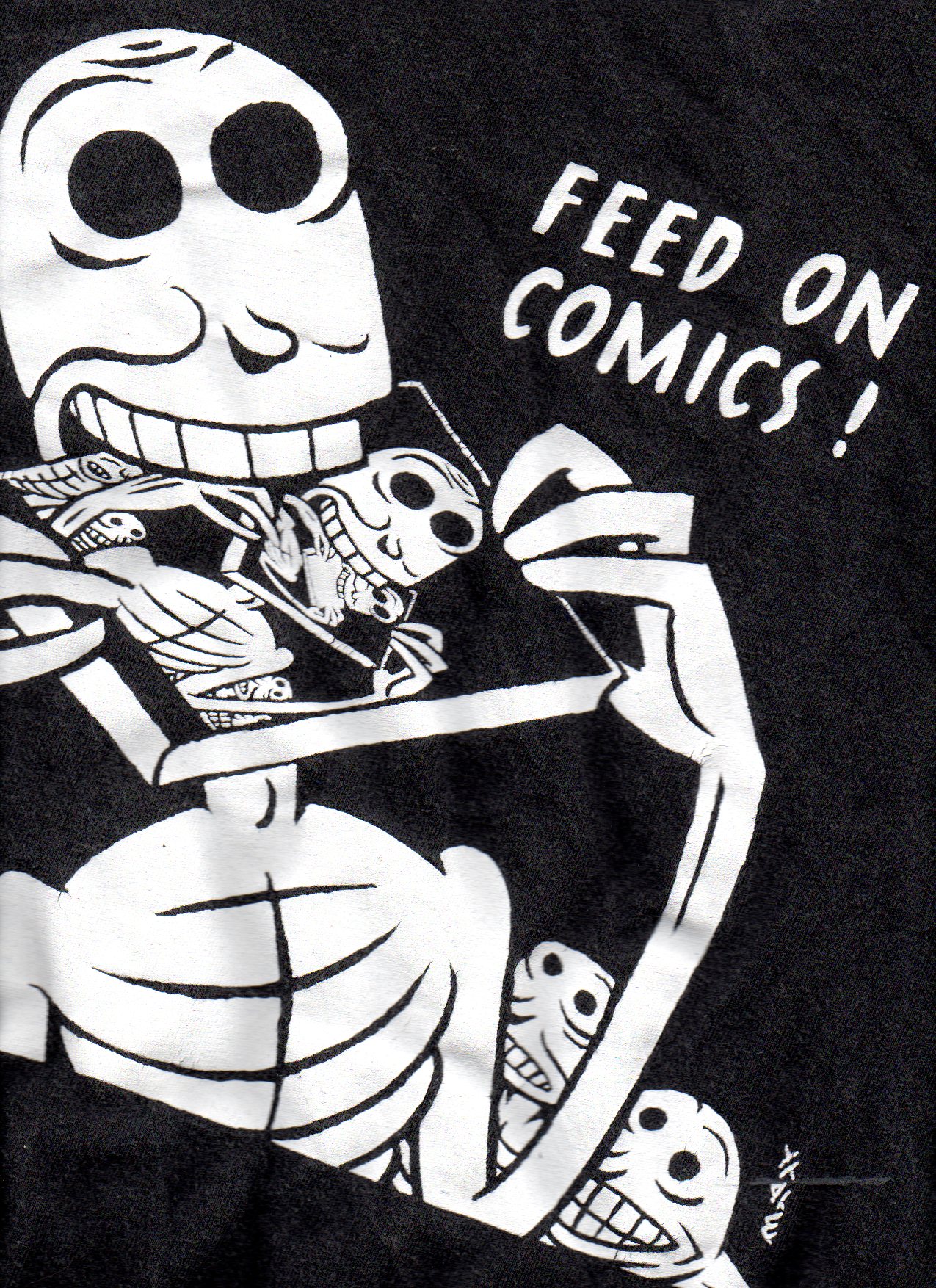
The FEED ON COMICS! T-shirt design by Max. Doctor Comics intends to follow this call on his Blog.
I also had two kind aunties who would regularly buy me comics weeklies in the 1960s…titles like BEANO or EAGLE. These were shipped to Australia from England and arrived approximately three months after their U.K. publication date. I suspect my interest in space travel, English football and cartoon animals arose from reading and collecting these “boys papers”. Throughout my teenage years I continued to read and collect comics. This continued in adulthood. Some of my friends thought it somewhat childish and that I should grow up and stop reading comics. No way! Never! Eventually I was no longer limited to reading comics after church, after homework or during periods of illness. I had left school, found a job, and left home. This enabled me to stop going to church, buy my own comics and read them in bed!
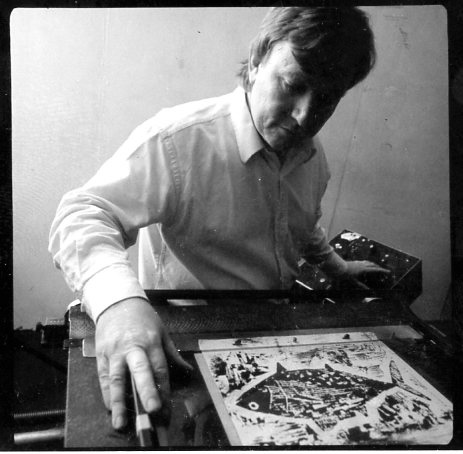
Animating my woodblock prints on the Oxberry animation stand at Sydney College of the Arts.
My interest in and enthusiasm for comics continued and reached another level at Sydney College of the Arts. As an academic in the Visual Communication Design program…I developed a more formal interest in studying and researching comics and animation. I also learned the technique of printmaking from a colleague…(see photo above…more details to come in future posts). I had always loved to draw and often received colour pencil and paint sets as Birthday and Xmas presents. I had had no art tuition in my primary and secondary schooling…but one year I was awarded the Religious Prize in Primary School that was probably attributed to my artistic skills. My teachers were Nuns. It was for a drawing I did of The Little Flower (Saint Teresa) floating up to Heaven on her death. I drew her literally as a flower. It was my unknowing introduction to visual metaphor. My drawing made the nuns cry! At the time I thought I had done something wrong, upsetting them, but the tears were apparently joyous! I wish I still had that drawing but the nuns ran off with it. In fact they never returned it! I never saw it again and my parents never ever saw it! Those nuns did seemingly compensate me, however, by awarding me the Religious Prize that year! The top student in my class and his parents complained to them on Speech Night (the Prize giving event)…saying “Unfair!..he only got a Credit in the subject but he won the prize!” They just didn’t know about that drawing…and the magic of art. Despite this so-called “injustice” I managed to keep my prize…although I did lose my art! My parents were very proud of my award. They had taught me to never challenge a teacher, especially a Nun. So I had to forget about asking them for the return of my drawing. This proved to be sound advice in the long term.
After Primary School with the Dominican Nuns I came up against the much tougher Christian Brothers in my Secondary education. Their chosen instrument of punishment and persuasion was “the strap!” This consisted of layers of leather strips, stitched together, with which they vigorously struck the student’s open palm. Each Brother had his own particular “strap” and technique of administration. Some preferred fast, repeated strokes from a short distance…whilst others preferred the delayed but vigorous downward stroke from a higher level. It proved more painful than the nuns’ short but hard cane tap. These were rigid disciplinarians with seemingly little interest in art. Any mathematics or science drawing or doodle on the edge of a page was met with a disapproving frown. No extra marks were awarded if you added an illustration to an essay…you might get away with a map in History but not a landscape in Geography…and definitely no art in a composition in English! These were considered an unnecessary waste of word space! Years later, however, I was to experience the joy of visual expression in art and design schools. They absolutely loved it there!
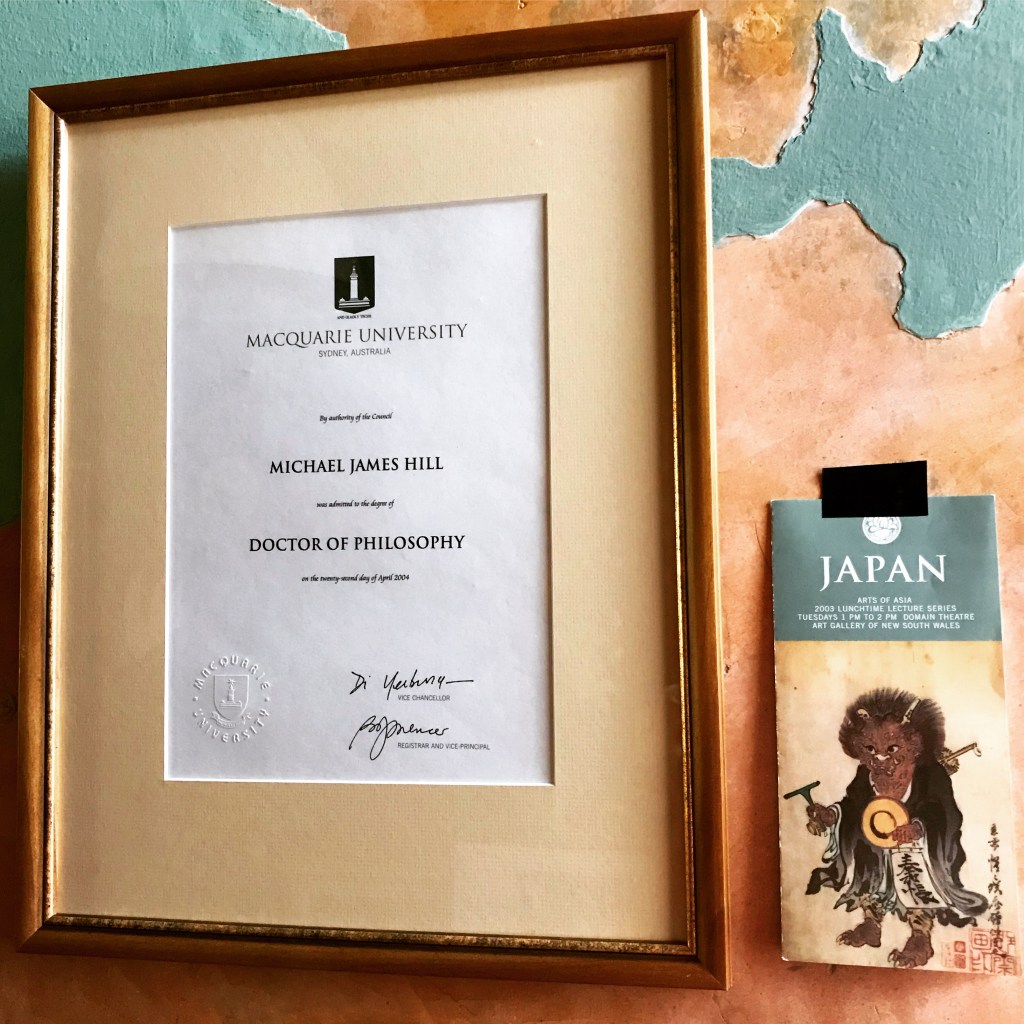
My PhD was awarded for my original research into Australian comics art and production. The accompanying brochure refers to my interest in Japanese art.
Since early adolescence I have been involved in comics art studies and research. First, through leisurely reading of the English comic strips from my aunties…followed by compulsive collecting…some review writing…all leading to the creation of my own comics. Later, working at an Art College I found that comics were considered a valid field of study and research. Oh joy! This ultimately led to my PhD for research into Australian ‘small press’ comics. That is where my alias arose. I’m known as Michael Hill, PhD (a.k.a Doctor Comics). I completed the doctorate in 2003 and acquired the alias in 2006. It was on a radio chat show that my agent, Andrew Hawkins, arranged for me to be interviewed. One caller said he wanted to talk to “that Doctor Comics guy!” To the amusement of listeners the announcer informed them that I actually had a PhD in “comics”! So instead of “Doctor in comics”…or “Doctor of comics”…it was strategically shortened and sharpened in focus toDoctor Comics. My agent formalised this with the registration of my doctorcomics@gmail.com email account and the doctorcomics.com website. This caught on in the local media and led to a chain of interviews.
My entry card to U.S.A. comics event THE EXPO 99…with the Brian Ralph illustration.
My intention with this blog is to document my reading, researching, critiquing, creation and celebration of comics art. This is expressed by the Feed On Comics! T-shirt by the artist MAX (see illustration above). I acquired it at the ICAF (International Comic Arts Festival) at Bethesda, Maryland, USA in 1999. I could not believe there was an academic conference on comics! Not only that…it was followed by a comics convention, the Small Press Expo! It turned out to be an inspiring event being both a conference and a convention. The academic conference was chaired by Gene Kannenberg, Jr., the “big guy” who enthusiastically led proceedings, to a gathering of like-minded souls, i.e. academics researching comics art. Gene made me feel very welcome. Amongst those who attended was Dr. John A. Lent who was selling the first issue of IJOCA, the International Journal of Comic Art Vol. 1, No. 1 Spring/Summer 1999, that he had produced and published as Editor-in-Chief. I became a member of the International Editorial Board of that journal, representing Australia. Other new comics colleagues I met at that event were Michael Rhode, Randy Duncan, Charles Hatfield…and Mike Kidson whose paper “William Hogarth: Printing Techniques and Comics” inspired my later graphic research into Hogarth and printmaking. That introduction to printmaking eventually led to my adoption of it as an artistic practice. Also in attendance were other comics art researchers…Pete Coogan, Pascal Lefèvre, Jeff Miller, Ana Merino, Jeff Williams, Mark Nevins, Guy Spielmann, and Joseph “Rusty” Witek. They were pleased to have another Australian attend (Spiros Tsaousis had attended the previous year). They even let me, as guest, choose the restaurant on the first day…I suggested “Mexican?” a novel choice for me, not familiar with the cuisine. They all smiled and took me to one of the many local Mexican restaurants. I have since, somewhat subliminally, associated dining on Mexican food with researching comics art!
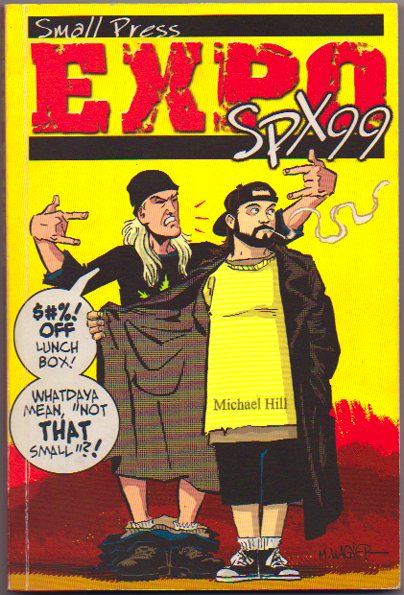
SPX99, my copy of the Small Press Expo program in Bethesda, Maryland, U.S.A., the first comics art conference I attended.
This conference gave me the reassurance to undertake the academic study and research of comics art. It also connected me with other academics from around the world who studied and researched comics art. This ultimately led me to the gaining of my PhD in comics studies. At that Bethesda conference, I made a presentation on Australian indie comics based on the research I had been doing. As the conference concluded the comics expo kicked off downstairs. This convention, known as the Small Press Expo, honoured indie comics (see my99 EXPO card above). I bought several comics and even sold some I had brought with me from Australian small press creators. I also met Gary Groth, “wow!” the guy who runs The Comics Journal…he seemed to be on the look out for “comics stuff”…and Neil Gaiman, “yes, him!”, in the lift, speaking in his dulcet English tone that was wonderful to hear! They, and many others that I had only read about, were in attendance, wandering around at the event. Comics art was what they studied, created, promoted, traded or researched! In the evening there was an award ceremony at which comics artist James Kochalka performed, surprisingly, absolutely naked! Amazing! Each category winner was awarded a brick, just like the one Ignatz threw at Krazy. I was most impressed and inspired by the level of comics art interest and the emerging philosophy surrounding it! The event celebrated both the study and creation of comics art. This has had ongoing resonance for me as I start this blog. I also intend continuing my reading, researching and writing about comics art.
Doctor Comictopus alias for Michael Hill a.k.a. Doctor Comics, designed by Michelle Park.
So there is my first post….a little lengthy perhaps…but I am off and running along the blogging trail and feeling very excited about it…and I welcome any comments and suggestions from readers of my blog, Michael.



























 Doctor Comics