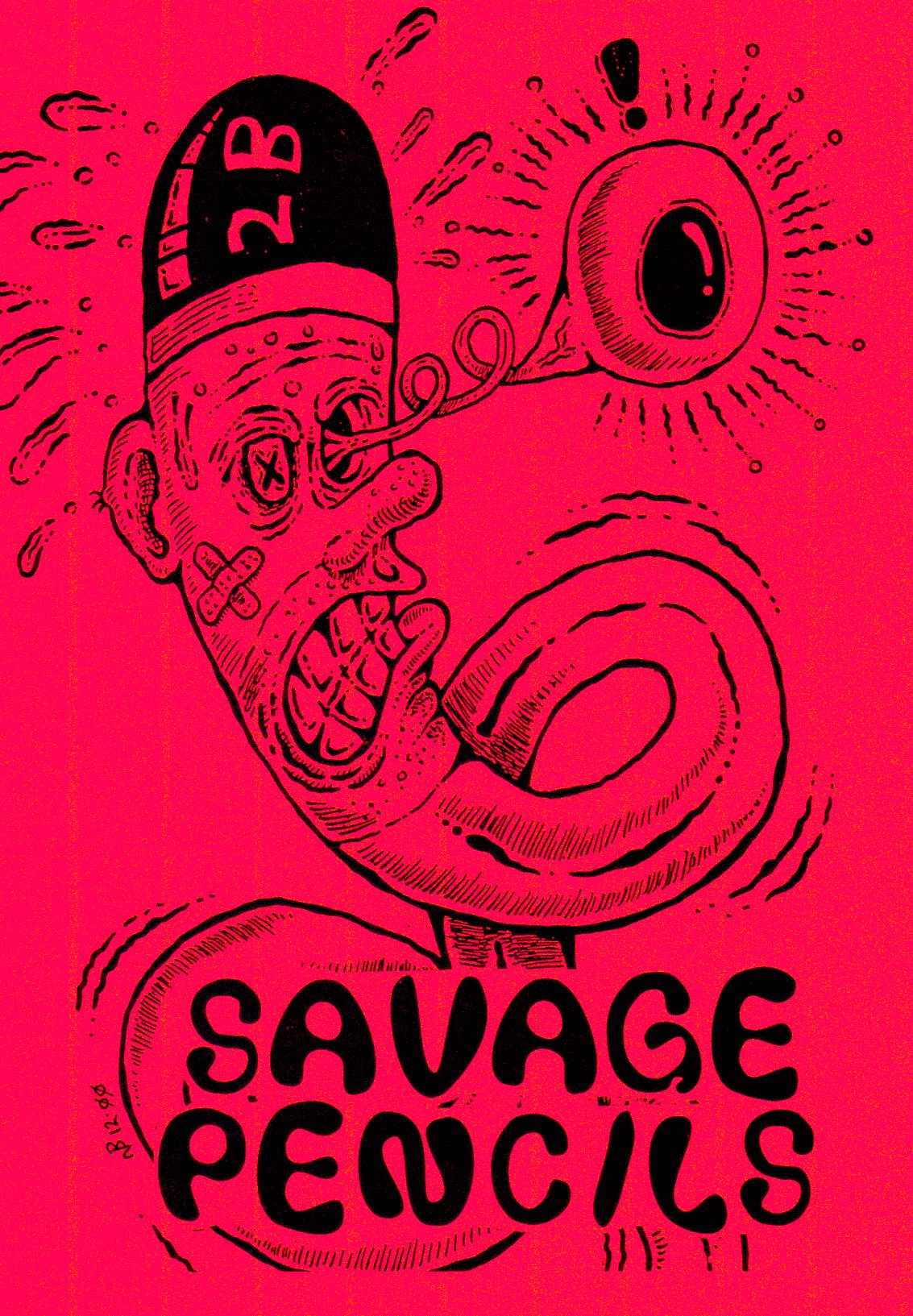
Category: Archive of Australian Alternative Comics

RESEARCHING COMICS ART: Fifth Reading

Archive of Australian Alternative Comics, Art, comic art, Comics November 4, 2023

Welcome to another visit to my little library collection of comics, books, journals and associated comics art paraphernalia. These are related to my research, study and enjoyment of comics art. In this series of posts I intend to focus on a particular creator, series, book, art or event.
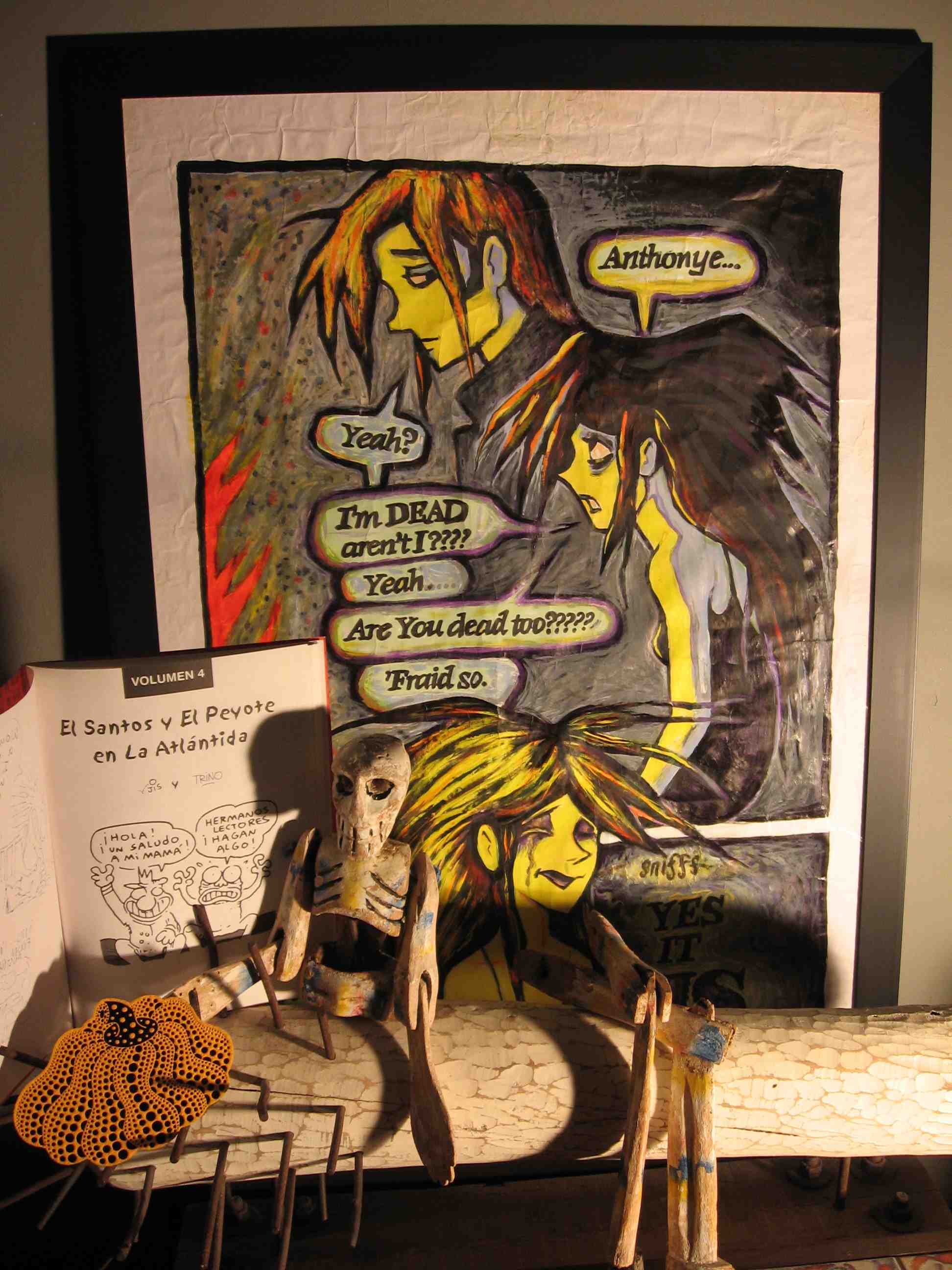
In a decorated corner of the art studio for a previous Halloween we set up a thematic grouping. This included of an actual Day of the Dead (Día de los Muertos) skeleton doll from Mexico. It had been split into two halves. The skull and torso are on the left and legs to the right. These are positioned on a sculpture by Richard Black called The Cloud. The comic by the Mexican comics artists JIS & TRINO is open on the title page. The skeleton doll has shed its legs and is relaxing on the wooden Cloud sculpture. There is also a Dancing Pumpkin postcard by Japanese artist Yayoi Kusama. Behind this is a painting of an after-death scene from Louise Graber‘s Gothic comic Black Light Angels. (Photo-© 2012 Dr. Michael Hill a.k.a. Doctor Comics).
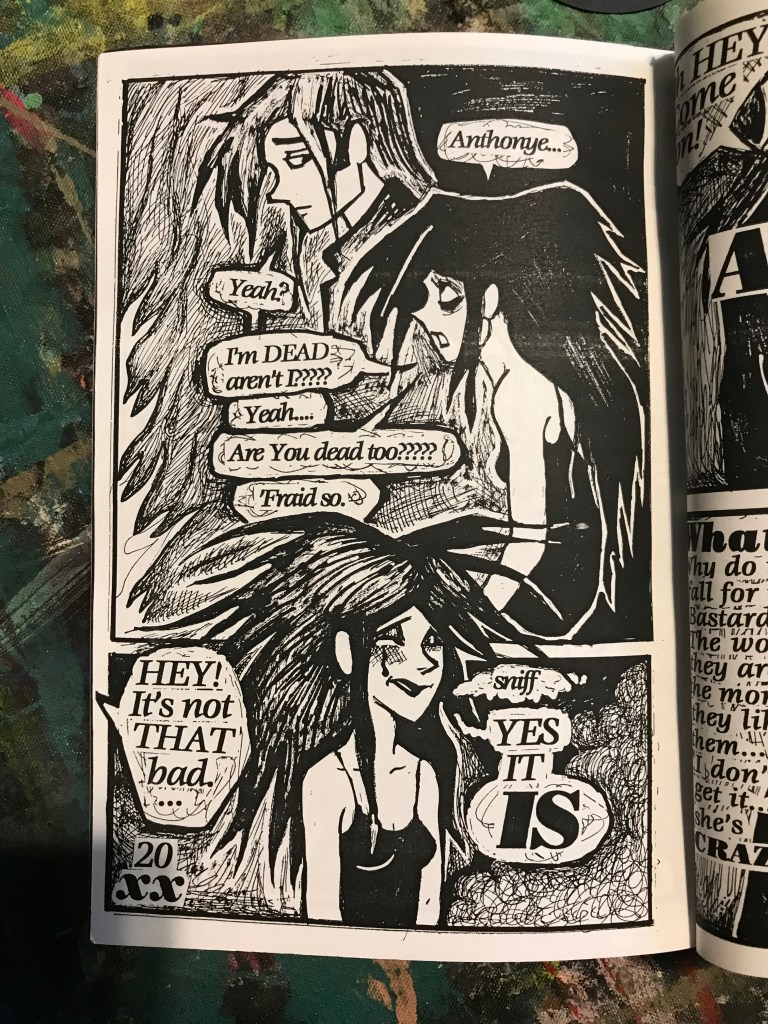
Here is that ‘moment after death’ scene in Issue X of the BLACK LIGHT ANGELS by Louise Graber. The version of this panel at the top of this post has been enlarged, coloured and framed for gallery exhibition. (Photo-©2023 Dr. Michael Hill a.k.a. Doctor Comics)
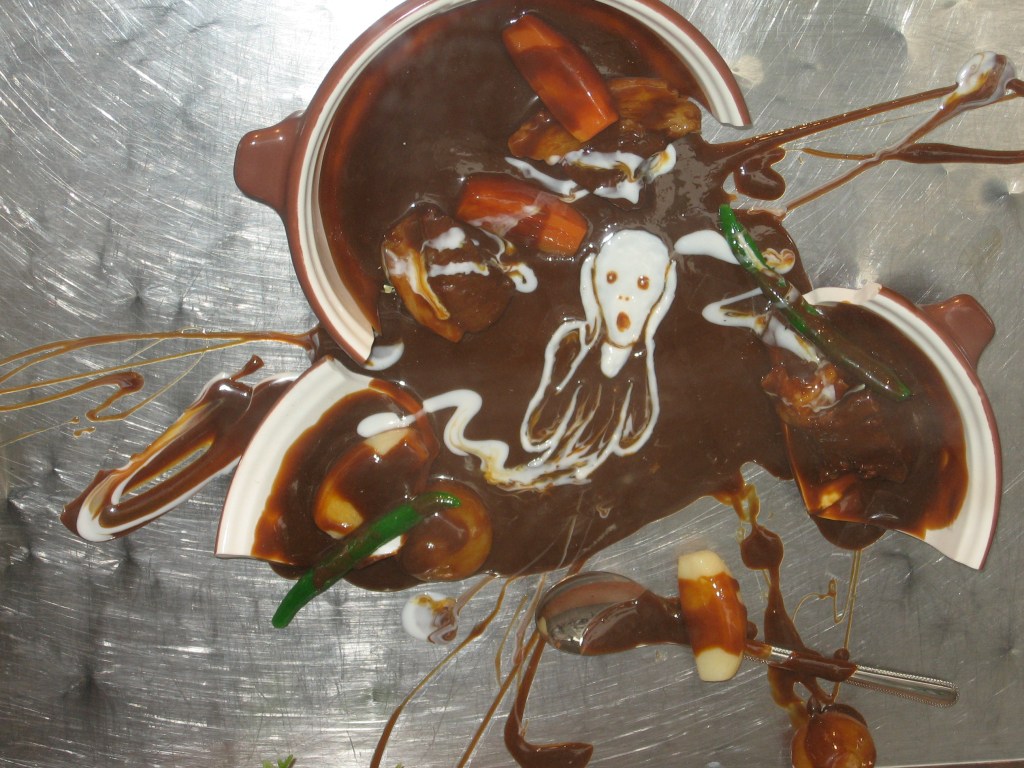
This photo of an interpretation of Edvard Munch’s “Scream” painting…as a decorated, demolished cake in a shop window in Tokyo somehow comes to mind at this time. Perhaps it is picking up on the cheeky attitude apparent in the work of those two Mexican artists.

The other book featured in this post is the large format comic El Santos y El Peyote en La Atlántida…created by the Mexican cartoonists Jis and Trino (see photo below). I met them at ICAF (Fifth Annual International Comic Arts Festival: “Culture, Industry, Discourse,”) Georgetown University and Bethesda, Maryland, USA. The conference was presented in association with THE EXPO (Small Press Expo), September 16-18, 1999. It was the first overseas comics art conference that I attended. I presented a paper based on my own research into comics art. What a magical experience it turned out to be! Meeting overseas colleagues then attending a Comic-Con was a rewarding juxtaposition. Then dining on Mexican food, a culinary rarity in my home city of Sydney at the time, was a treat!. (Photo-© 2012 Dr. Michael Hill a.k.a. Doctor Comics).
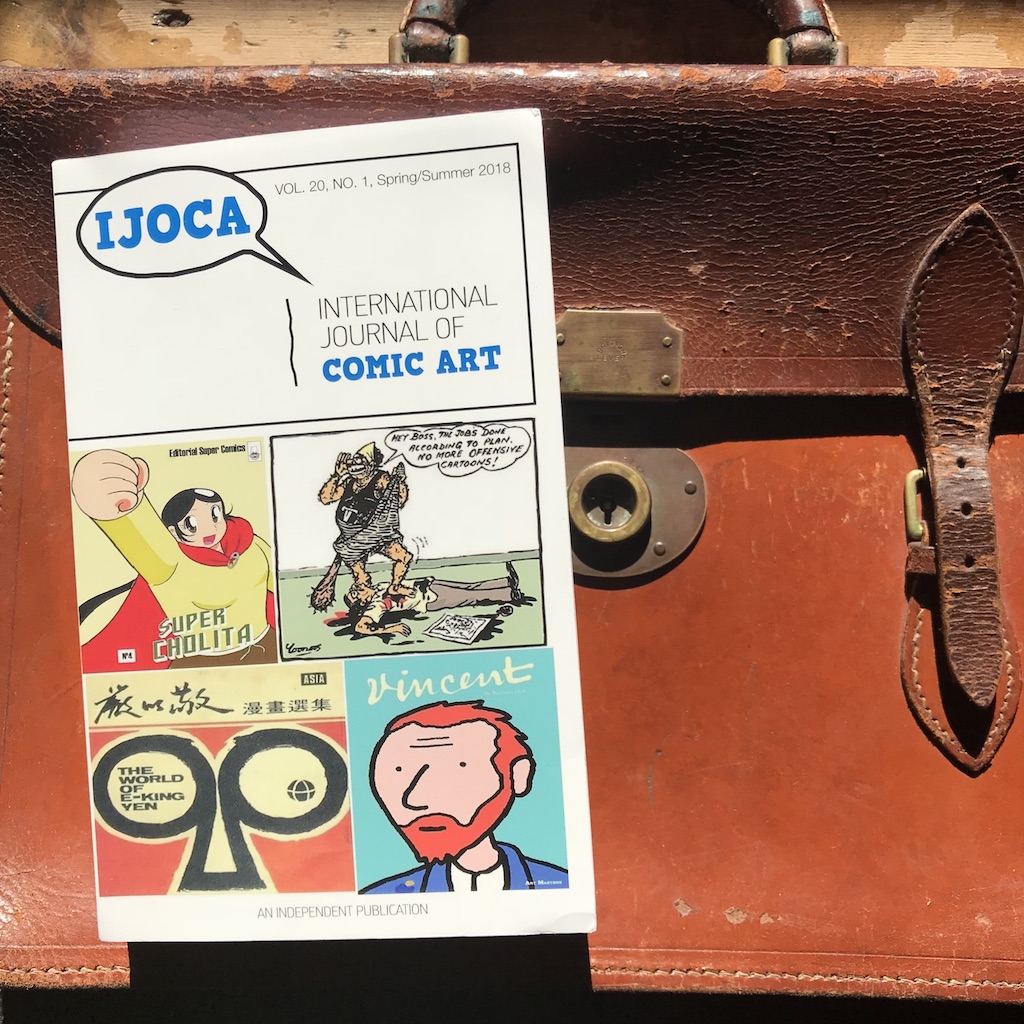
The International Journal Of Comic Art, or IJOCA for short. I always carry an issue of this in my brief case.

At this event I first met  Gene Kannenberg, Jr. along with several other American comics based academics including Professor John A. Lent. The good professor was launching the first issue of his International Journal of Comic Art or IJOCA…(see later issue of journal that I carry in my brief-case in photo above)…other academics included Charles Hatfield, Jeff Miller, Ana Merino, Mark Nevins, Michael Rhode, Marc Singer, Guy Spielmann, Jeff Williams, Joseph “Rusty” Witek, and Pascal Lefevre from Belgium. Above is that first ever issue of the journal from 1999. It is now nearing a total of 50 published issues, having chalked up 25 years of continuous publication. It also seemed to grow steadily in size over subsequent issues. It turned into the solid block that I affectionately named “THE BRICK”, a metaphorical building block for comics art studies. Go John! (Photo-©2023 Dr. Michael Hill a.k.a. Doctor Comics)
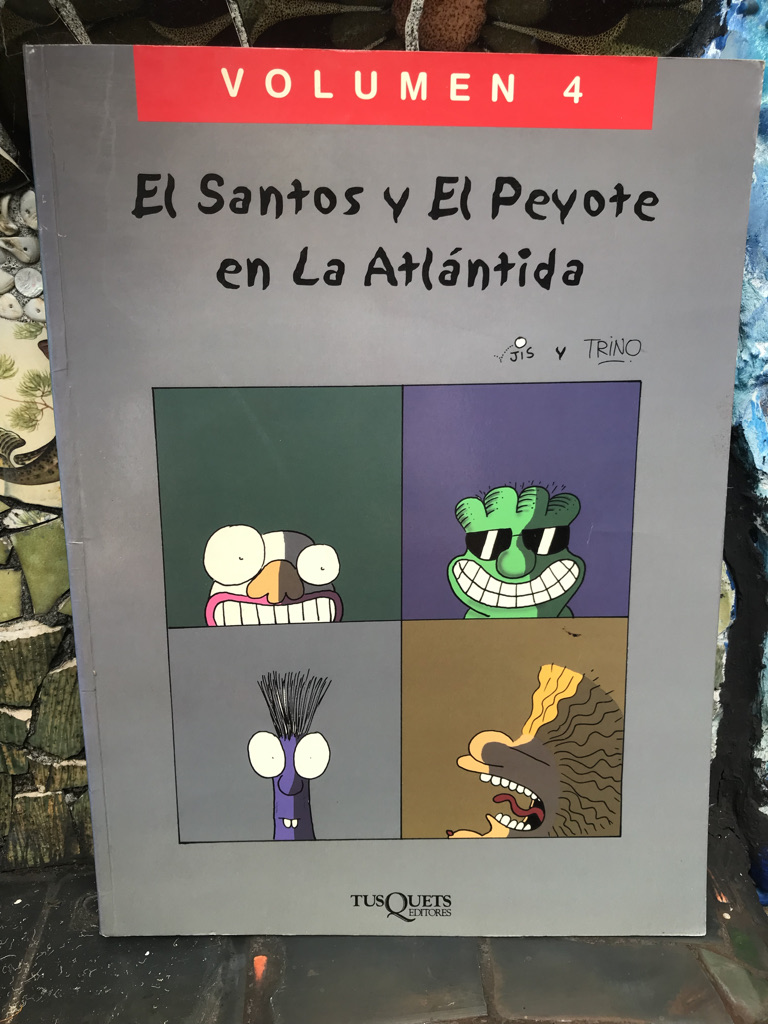
The guest Mexican artists, Jis and Trino, made a playful presentation of their comics art work at the conference. They also each did a drawing of me in my copy of their book (see photo below). Their comic El Santos y El Peyote en La Atlantida is humorous, satirical, risqué in parts and in Spanish. Above is a cover shot of Issue 4, the one I bought from them at the EXPO in Maryland. To see more of their work both Jis and Trino are quite active on social media these days…search for: trinomonero on Instagram, @trinomonero on Twitter and jis_monero on Instagram. (Photo-©2023 Dr. Michael Hill a.k.a. Doctor Comics)

Above are the drawings of me by Jis and Trino. They took me by surprise with their flamboyant cartoons and their playful conversation. They even offered me a glass of tequila…at a morning session of the conference. (Photo-©2023 Dr. Michael Hill a.k.a. Doctor Comics)

I reiterate the importance of my attendance at ICAF (Fifth Annual International Comic Arts Festival: “Culture, Industry, Discourse,”). It assisted the development of my research into comics art. I was fortunate in being introduced to, and seeing the presentations of, a group of international researchers into comics art. I also obtained the first ever issue of the International Journal Of Comic Art from 1999. I eventually became the Australian representative on the International Editorial Board of the journal. The journal enabled me to read a plethora of research articles on comics art by international scholars. I also had my own articles on research into Australian comics published. Along with my acquisition of it at the conference, it has proved an inspiring and motivating experience.

My LIBRARY posts form part of my graphic based material. This includes painting, printmaking and cartooning…including artwork for my comic and graphic novel BLOTTING PAPER: The Recollected Graphical Impressions of Doctor Comics.

 (Original text, photos, artwork and scans-©2024 Dr. Michael Hill a.k.a. Doctor Comics).
IN THE STUDIO-Session 2

Archive of Australian Alternative Comics, Art, Blotting Paper, Comics, printmaking May 21, 2021

These production posts document the “making” stage, whether animation, comics, postcards, prints or paintings, in a small studio. I always work to music and some photos in my blog posts show the equipment and the CD…not these, unfortunately.

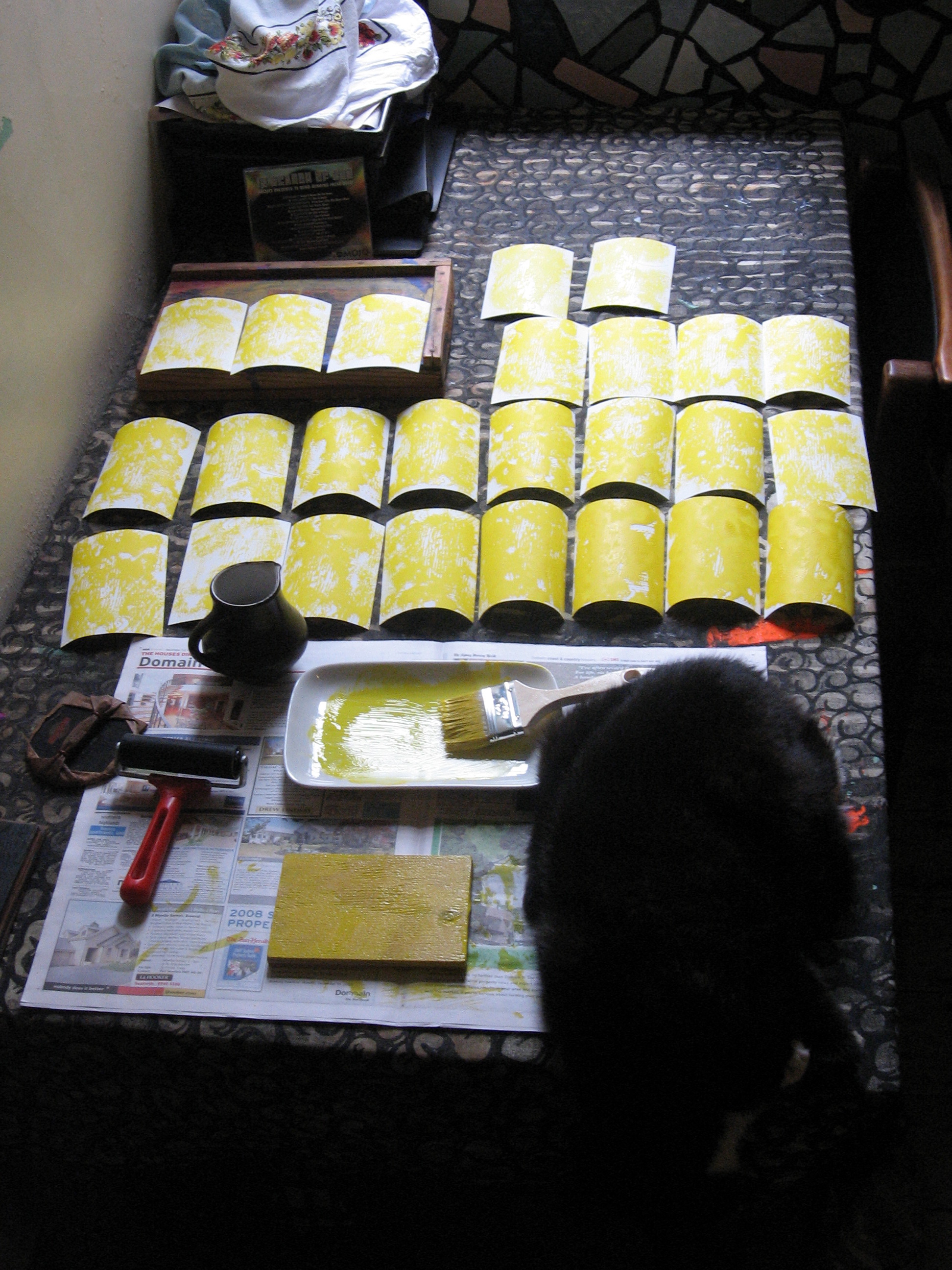
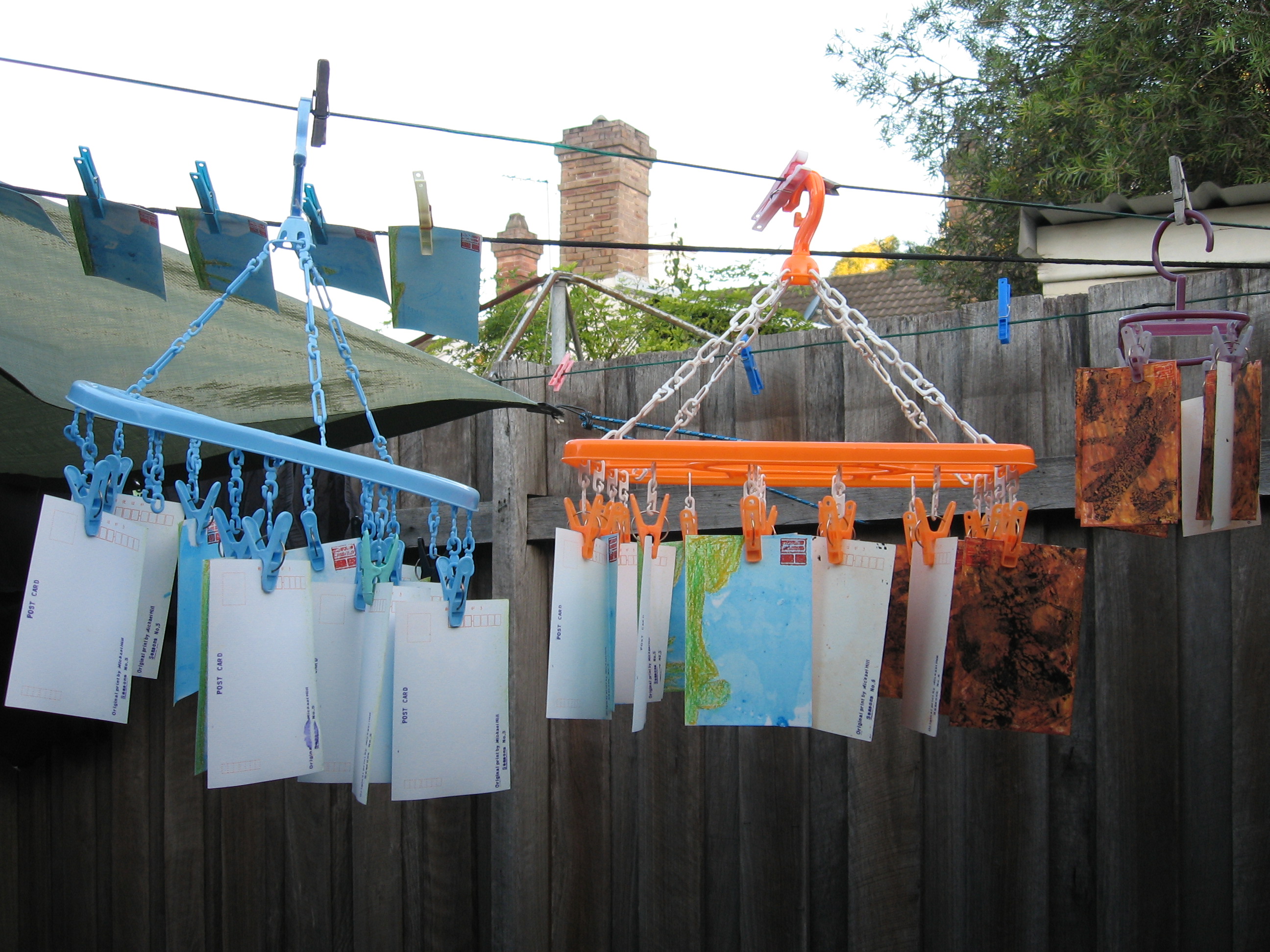
Miro, our studio cat, in the foreground bottom, right, is keeping watch whilst a batch of background coloured postcards dry. Our cat offered a similar service for the printing of comics labels (see below). (Photo and artwork-©2015 Dr. Michael Hill a.k.a. Doctor Comics)
Exposure to sunlight for a batch of freshly printed postcards. This proved to be a quick method of drying the ink and paint. (Photo and artwork-©2015 Dr. Michael Hill a.k.a. Doctor Comics)
Printed sheets hanging out to dry. These long strips were sometimes cut into smaller pieces, depending upon their graphic application. (Photo and artwork-©2015 Dr. Michael Hill  a.k.a. Doctor Comics)
First stage in the printing of labels for an issue of my comic BLOTTING PAPER…labels would then be overprinted with the title (see below). (Photo and artwork-©2015 Dr. Michael Hill a.k.a. Doctor Comics)
Second stage…labels drying in the sun…different studio…a little windswept. These are some of the overprinted covers for my comic BLOTTING PAPER, following addition of second layer (see above). (Photo and artwork-©2015 Dr. Michael Hill a.k.a. Doctor Comics)
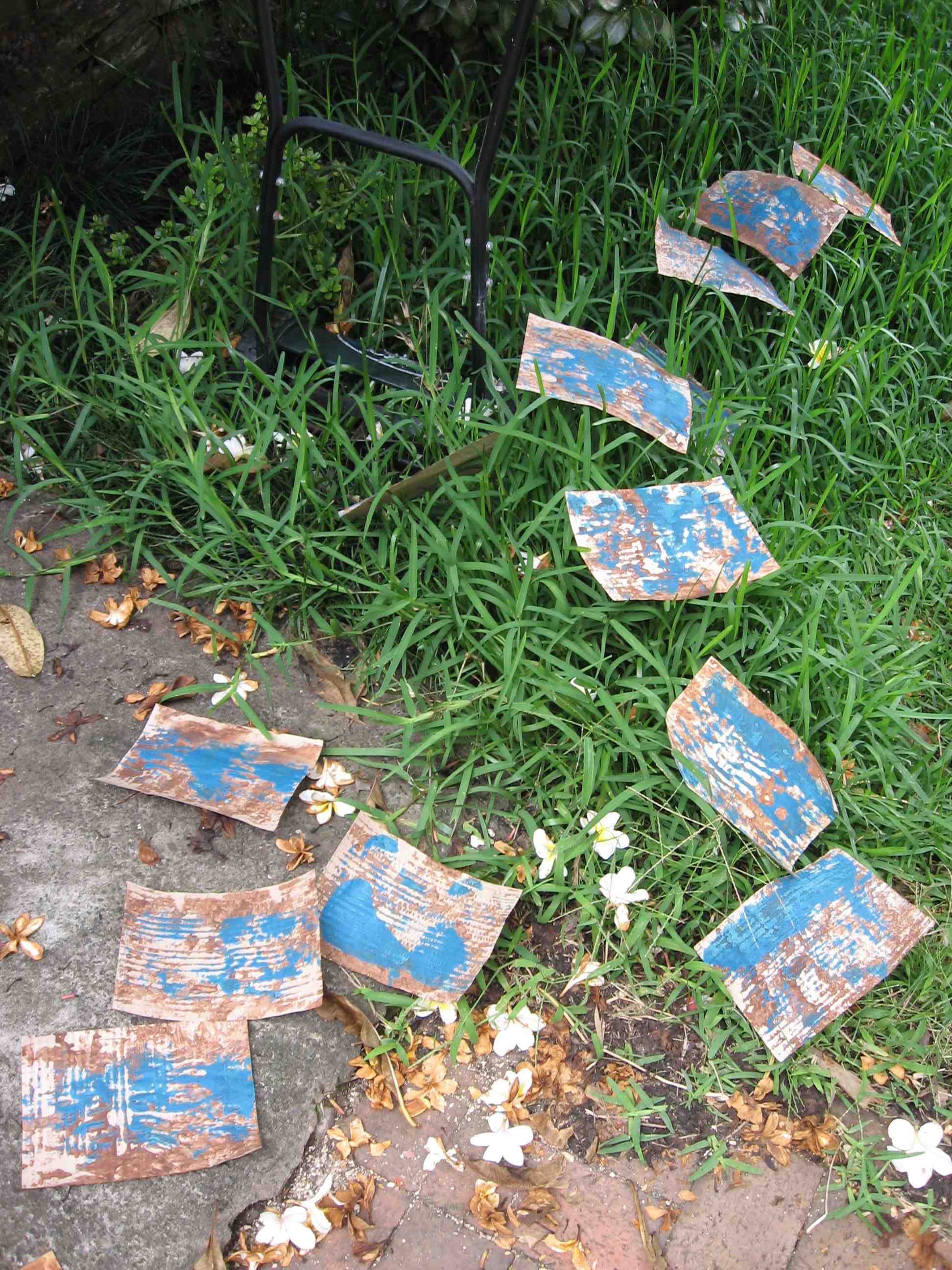
Second stage at the other studio…some of the comics covers have been blown into the grass. These are left to dry…usually pegged on a clothesline…but not these, left lying before being blown away…then being returned to the studio for overprinting with the title of the comic. (Photo and artwork-©2015 Dr. Michael Hill a.k.a. Doctor Comics)
Third stage, title block for the comics cover…with loosely assembled rubber type…becomes the third print layer. (Photo and printmaking block-©2015 Dr. Michael Hill a.k.a. Doctor Comics)
Third stage of printing…complete with labels following overprinting of title of the comic. (Photo-©2015 Dr. Michael Hill a.k.a. Doctor Comics)
Finally, the finished labels are glued to the covers containing the printed copies of the comic. (Photo and artwork-©2015 Dr. Michael Hill a.k.a. Doctor Comics)

This post and all photos, postcards, postcard art and printmaking-© 2015 Dr. Michael Hill aka Doctor Comics.


Archive of Australian Alternative Comics: IMAGINARY WORLDS SYMPOSIUM

Archive of Australian Alternative Comics, Art, Comics, Film January 22, 2014

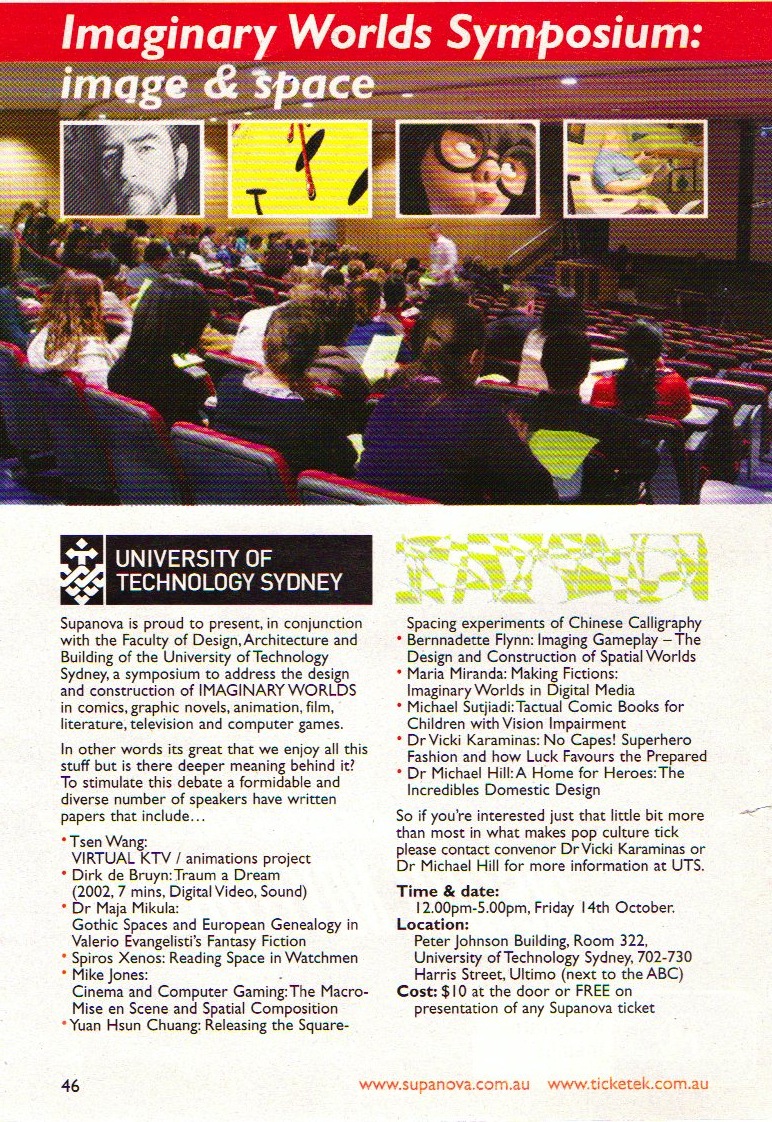
This symposium continued the productive association between the University of Technology, Sydney and Supanova of co-staging comics related research events. In this case topics were not confined to the study of comics in general nor Australian alternative comics in particular. Rather, the papers reflected  a more wide-ranging list of subjects that included connections between comics and fashion, film, animation, literature, calligraphy and computer games. There was also a presentation on the design of comics for young readers with vision impairment. This range of topics reflected the a broad scope of the university’s teaching and research areas. This had resonance with Supanova’s own broadening interests that had spread from an initial focus on comics (it was originally known as ComicFest) to a wider pop culture spread.

Page from the SUPANOVA program listing the event.

Page from the SUPANOVA program listing the event.

In this symposium researchers focused on the use of the design elements image and space and the manipulation of these in the creation of fantasy worlds in various media forms. Co-curated by Dr. Vicki Karaminas and I, the symposium was staged at the UTS city campus in the Faculty of Design, Architecture and Building on 14th October 2005 and opened by the Dean of the faculty.

This is the twelth in a series of posts called Archives of Australian Comics History that document moments in the recent history of Australian comics, particularly alternative comics and the Australian Small Press, however, as stated above, this post has a broader orientation. I began researching this subject in the late 1990s and it eventually led to my PhD thesis and doctorate: Ph.D. Macquarie University, Division of Society, Culture, Media and Philosophy,  A Study Of Contemporary Australian Alternative Comics 1992-2000 With Particular Reference To The Work Of Naylor, Smith, Danko And Ord, 2003. On completion of the research I donated the materials and comics I had collected to the National Library of Australia: Michael Hill Collection of Australian Comics.

(All text, photos and artwork-©2014 Dr. Michael Hill a.k.a. Doctor Comics).
Archive of Australian Alternative Comics: COMIC-FEST

Archive of Australian Alternative Comics, Comics July 18, 2013

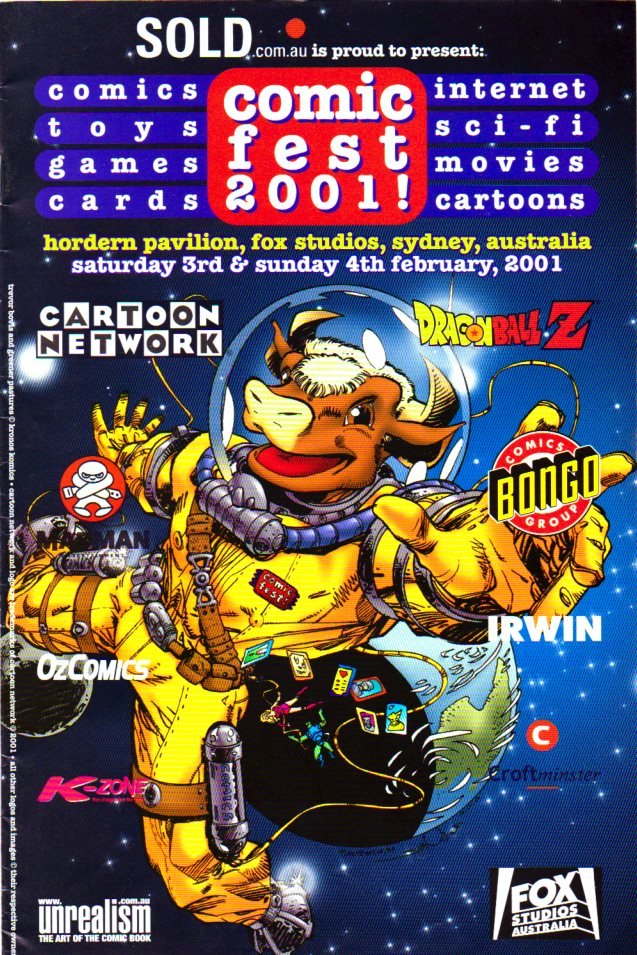
Prior to the emergence of one of the larger comics and entertainment media conventions in Australia Supanova Pop Culture Expo the same management team, led by Daniel Zachariou, staged an event called Comic-Fest. This had a mostly comics oriented focus compared with the subsequent broader span of Supanova in which comics represents just one of several entertainment media that included films, television series, toys, trading cards, computer games and the internet. There were two stagings in 2001, at Fox Studios in February then followed in September by Comi-Fest 2 at the Sydney Centrepont Convention Centre.

Trevor Bovis in space, the Greener Pastures program cover.

Trevor Bovis in space, the Greener Pastures program cover, designed by Tim McEwen.


Saturday seminar details with my involvement  in the superheroes panel.

Saturday seminar details with my involvement in the superheroes panel.


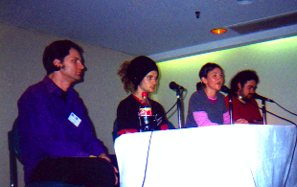
The Comic-Fest panel line-up, L to R, Dillon Naylor, Daniel Gloag, Amber Carvan and Ben Hutchings.

The Comic-Fest panel line-up, L to R, Dillon Naylor, Daniel Gloag, Amber Carvan and Ben Hutchings (Photo-©2001 Dr. Michael Hill a.k.a. Doctor Comics).

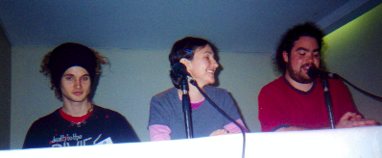
For the September event, withsupport from the event director, Daniel Zachariou, I organised a panel discussion on Australian alternative comics by local creators Dillon Naylor, Daniel Gloag, Amber Carvan and Ben Hutchings who each talked about their own comics and answered my questions. A general discussion of the Australian comics scene followed.

Another shot of the panel, L to R, Gloag, Carvan and Hutchings.

Another shot of the panel, L to R, Gloag, Carvan and Hutchings (Photo-©2001 Dr. Michael Hill a.k.a. Doctor Comics).

Aside from the panel discussion the big attraction for the local small press was the opportunity to set up shop and trade their work on the commercial floor along with the imported comics. There was also the opportunity to meet fellow local creators and exchange comics, contact details and curry recipes.

On the trading floor, Louise Graber and Alex Major.

On the trading floor, Louise Graber and Alex Major (Photo-©2001 Dr. Michael Hill a.k.a. Doctor Comics).


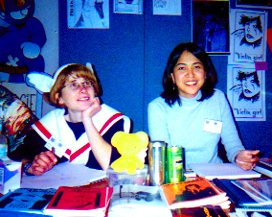
Also trading, Komala Singh.

Also trading, Komala Singh, on the right (Photo-©2001 Dr. Michael Hill a.k.a. Doctor Comics).

Also trading, Daniel McKeown with Alex Major.

Also trading, Daniel McKeown with Alex Major (Photo-©2001 Dr. Michael Hill a.k.a. Doctor Comics).

Along with the commercial trading there was the social attraction of meeting and chatting with fellow comics creators and sharing ideas and production experiences.

Lewis Morley and Louise Graber.

Lewis Morley and Louise Graber (Photo-©2001 Dr. Michael Hill a.k.a. Doctor Comics).


Two funny blokes and cartoonists, Ross Tesoriero and Ben Hutchings.

Two funny blokes and even funnier cartoonists, Ross Tesoriero and Ben Hutchings (Photo-©2001 Dr. Michael Hill a.k.a. Doctor Comics).


Ross Tesoriero and Louise Graber.

Big Ross Tesoriero with little Louise Graber (Photo-©2001 Dr. Michael Hill a.k.a. Doctor Comics).
Did you go to COMIC-FEST? What did you think? Would you like to add a comment about your impression of that event on this Blog post? I would be happy to hear, Michael.

This is the eleventh in a series of posts called Archives of Australian Comics History that document moments in the recent history of Australian comics, particularly alternative comics and the Australian Small Press. I started researching this subject in the late 1990s and it eventually led to my PhD thesis: Ph.D. Macquarie University, Division of Society, Culture, Media and Philosophy,  A Study Of Contemporary Australian Alternative Comics 1992-2000 With Particular Reference To The Work Of Naylor, Smith, Danko And Ord, 2003. On completion of the research I donated the materials and comics I had collected to the National Library of Australia: Michael Hill Collection of Australian Comics.

(All text, photos and artwork(except for Comic-Fest 2001 poster)-©2013 Dr. Michael Hill a.k.a. Doctor Comics).
Archive of Australian Alternative Comics: 2ND SEQUENTIAL ART STUDIES CONFERENCE

Archive of Australian Alternative Comics, Comics, Japanning May 1, 2013

It was ten years ago that the second Sequential Art Studies Conference took place at the University of Technology, Sydney. At the time, minicomics, having blossomed throughout the 1990s, were making an impression on the local alternative comics scene.  The event was billed as A Mini Conference on Minicomics and featured presentations by comics creators as well as scholars. The conference was convened by Spiros Tsaousis (now Spiros Xenos) and I. It was a sequel to our previous and first Sequential Art Studies conference held in Sydney in 2002. That was the first comics conference held in Australia. It was also staged in association with Supanova Pop Culture Expo again. Included in the event was a minicomics market.

CALL FOR PAPERS: 2nd Sequential Art Studies Conference May 23, 2003, Sydney. The Interdisciplinary Studies Unit of the Faculty of Design at UTS (University of Technology, Sydney) http://www.uts.edu.au will again host this new scholarly conference that will be held during the same week as the Sydney Writers’ Festival. The inaugural event in 2002 attracted a small but stimulating range of papers from local academics and students. It is hoped that this year’s event will build on that. Scholars are invited to submit 250 word proposals which address alternative approaches to comics, whether local or global, recent or historical, online or offline, artistic or commercial. The conference will adopt an interdisciplinary approach and so welcomes papers from a broad range of areas. Send proposals by email to either of the conference convenors and coordinators by February 28, 2003: Michael.Hill@uts.edu.au  Spiros.Tsaousis@bigpond.com 
CONFERENCE PROGRAM: Scholarly Papers

4.00pm                Opening of Conference and Welcome by Assoc. Professor Steve Harfield Assoc. Dean of Research Faculty of Design, Architecture and Building  University of Technology, Sydney

4.05pm                 The Sydney Morning Hell of Glenn Smith, Dr. Michael Hill, Interdisciplinary Studies Unit, Faculty of Design, Architecture and Building University of Technology, Sydney

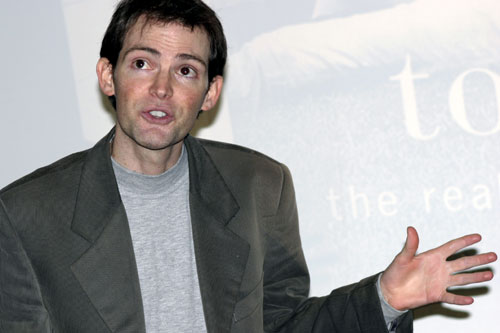
4.30pm                 Fear and yearning of “manga Japan” in Australia, Craig Norris, School of Communication, Design and Media, University of Western Sydney

4.55pm                 Taming the ‘Superhuman’ Shrew: Identification with Superheroes in Comics and the Popularisation of the Human Potential Ethic, Adam Possamaï, School of Applied Social Sciences, University of Western Sydney

5.20pm                The Problem of The Yellow Kid: From Single Panels to Sequential Images, Spiros Tsaousis, La Trobe University

Craig Norris, University of Western Sydney.
Adam Possamaï, University of Western Sydney
CONFERENCE PROGRAM: Artist Presentations 

6.00pm             Alex Major (Naomi and Poggie)

6.20pm             Komala Singh (Moshi Moshi)

6.40pm             Bernard Caleo (Big Cardigan Comics)

7.00pm             Katarina Knebel (Cult Fiction Comics)

7.20pm             Ben Hutchings (Geeen Comix)

7.40pm             David McDermott (Glitter Shy)

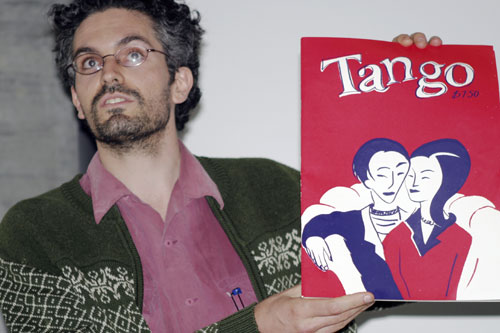
Bernard Caleo proclaimed his comics manifesto and promoted Tango.
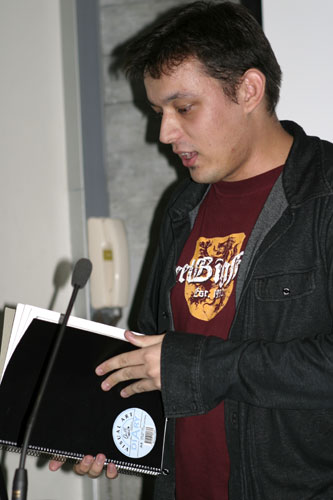
Bernard Caleo ‘performed’ his comics manifesto…brilliantly!..and promoted his own comic Tango.
Komala Singh talking about Moshi Moshi.
Komala Singh talked about her minicomic Moshi Moshi.
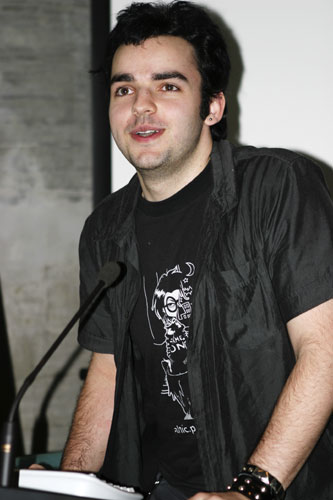
David McDermott goes Glitter Shy.
David McDermott goes Glitter Shy and playfully ‘performed’ some of his pages live to projected images of the panels.
Chloe Lyttle introducing David Maccad.
Ben Hutchings going Geeen!
Ben Hutchings had fun going Geeen!
Katarina Knebel talks Cult Fiction Comics.
Alex Major describes Naomi and Poggie.
Alex Major describes his minicomic Naomi and Poggie.
Minicomics market at the conferece.
Minicomics market at the conference.

This conference about MINICOMICS as a form of sequential art was a sequel to the first comics conference in 2002…the first comics conference held in Australia I think! Did you attend? If so would you like to add a comment about the proceedings? Please do! I would love to hear, Michael.

This is the tenth in a series of posts called Archives of Australian Comics History. These document moments in the recent history of Australian comics, particularly alternative comics and the Australian Small Press. I started researching this subject in the late 1990s and it eventually led to my PhD thesis. That degree was awarded to me as follows: Ph.D. Macquarie University, Division of Society, Culture, Media and Philosophy…A Study Of Contemporary Australian Alternative Comics 1992-2000 With Particular Reference To The Work Of Naylor, Smith, Danko And Ord, 2003.

On completion of my research I donated the materials and comics I had collected to the National Library of Australia, as: Michael Hill Collection of Australian Comics.

(All text, photos and artwork-©2013 Dr. Michael Hill a.k.a. Doctor Comics).

Archive of Australian Comics History: DOWN UNDER GROUND

Archive of Australian Alternative Comics, Art, Comics February 13, 2013

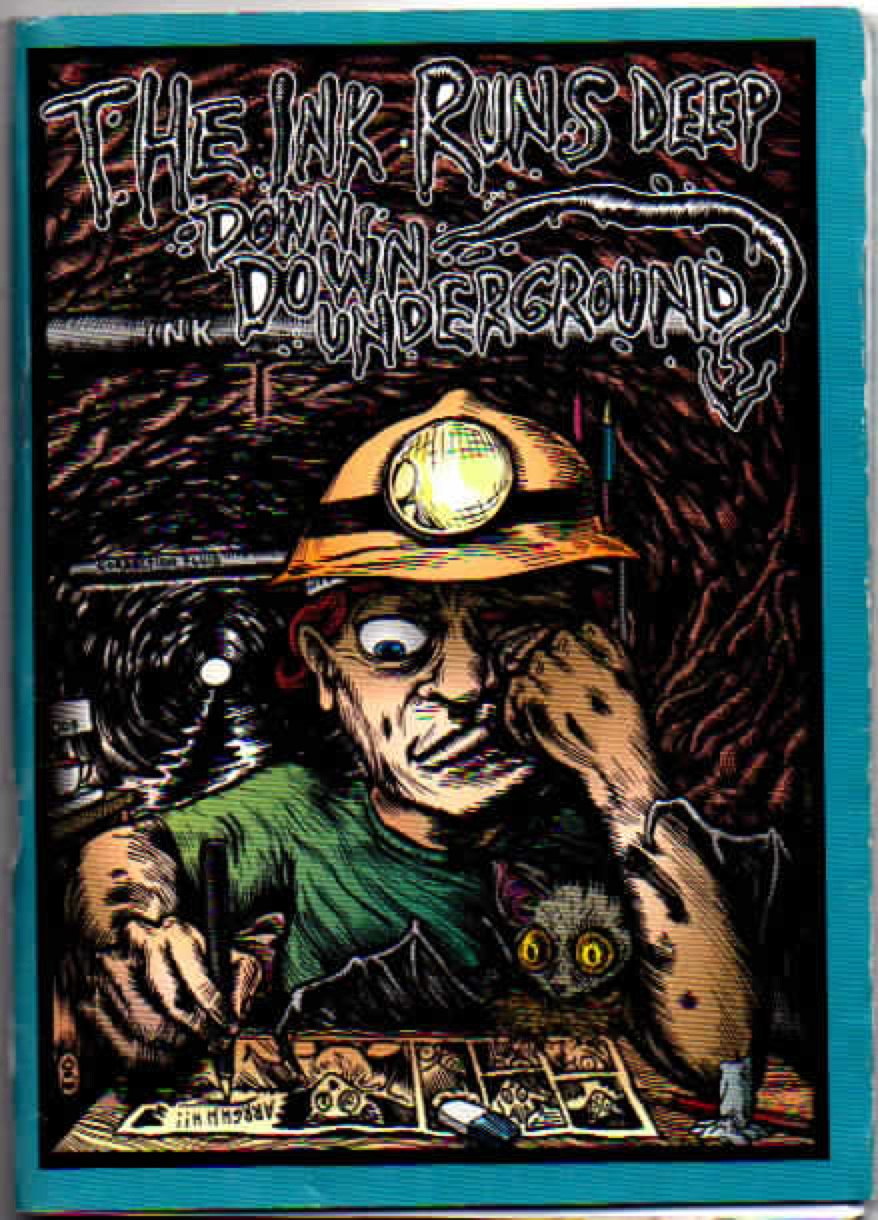
Underground comics are the subject of this post…in particular Australian alternative comics. I start with a review of an exhibition that Glenn Smith curated at the Orange Regional Gallery, in N.S.W. in 2005. The exhibition was titled The Ink Runs Deep Down, Down Underground. I wrote an essay titled “Art From The Inkubator” for inclusion in the exhibition catalogue.

The Ink Runs Deep...exhibition catalogue. (Design by Glenn Smith)
The Ink Runs Deep...exhibition catalogue. (Art & Design by Glenn Smith)

The successive waves of Australian alternative comics produced since the 1980s often feature a raw, spontaneous graphic style. This is accompanied by an irreverent attitude and a D.I.Y. Punk influenced approach to production. It is notably different from mainstream approaches to comics production. These alternative comics can be pluralistic, wide-ranging, antagonistic, mocking and containing taboo themes. The exhibition in Orange celebrated the creative expression behind these comics. Comics art…this much maligned art form…usually consigned to the pop culture trash bin…was hung for exhibition on the gallery wall.

Back cover of the exhibition catalogue. (Design by Glenn Smith)

Creators featured in the exhibition, all 27 of them, are listed on the back cover of the exhibition catalogue, above. They exhibited applications of comics art in a range of mediums from pen and ink to digital imaging. These were applied in animation, painting, posters, book covers and skate boards.

Display of Anton Emdin comics in the exhibition.
Exhibit of Cruel World minicomics by Anton Emdin.
Display of Black Light Angels minicomics by Louise Graber in the exhibition.
Exhibit of Black Light Angels minicomics by Louise Graber.

Noting the emergence of underground comix in Australia in his book Panel By Panel…John Ryan pointed to the social context of the 1970’s. This was a period in which a sense of national pride emerged. This led to a consequent interest in locally made art. That first wave of Australian alternative comics also seems to have been influenced by the North American Underground Comix movement. As in the Abstract Expressionist art movement of the 1950s, Australia seemed to have imported rather than grown, the art. Initially appearing somewhat derivative an Australian style later developed .

Louise Graber with a painting of a panel from her comic Black Light Angels in the exhibition.
Louise Graber with her painting of a panel from her comic Black Light Angels from the exhibition.

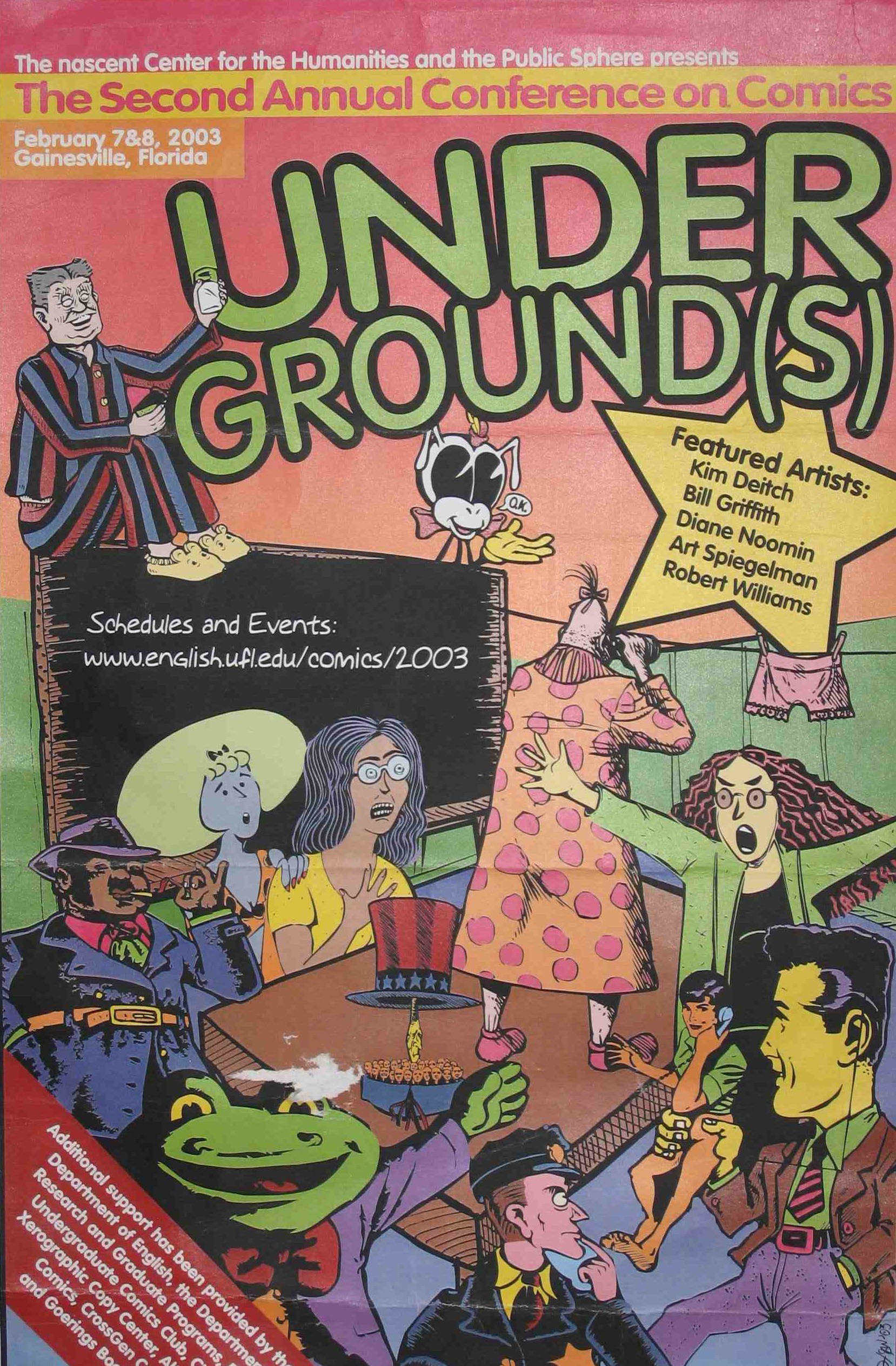
I had attended the Underground(s) conference on Comics and Graphic Novels at the University of Florida in 2003. It was organised by Donald Ault. At that conference I presented a research paper…titled “Down Under Ground: Emotional and Oppositional Outpourings from Sydney’s Subculture in the Comics of Glenn Smith”. Smith’s comics seemed to be an echo of the Underground comix of the late 1960s that began in San Francisco. They were different in style and content to the mainstream North American super-hero themed comics. They opened up the way for autobiographical and artform approaches. At that conference I heard from some of the creative figures from the original Underground(see back cover of program below). It was pleasing to describe Glenno’s work, and argue that it had some resonance with what they had done.

Front cover of Underground(s) conference program. (Design by William S. Kartalopoulos)


Back cover of Underground(s) conference program. (Design by William S. Kartalopoulos)


Underground(s) poster (detail).
Underground(s) conference poster (detail).

Have you read any Underground comics? I’d love to hear your thoughts about them as well as reactions to this post. 

This is the twelth in a series of posts titled Archives of Australian Comics History. They document moments in the recent history of Australian comics, particularly alternative comics and the Australian Small Press. I started researching this subject in the late 1990s. It eventually led to the writing of my doctoral thesis.  Details: Ph.D., Macquarie University, Division of Society, Culture, Media and Philosophy, for the thesis…A Study Of Contemporary Australian Alternative Comics 1992-2000…With Particular Reference To The Work Of Naylor, Smith, Danko And Ord, 2003. On completion of the research I donated the large number of comics I had collected…to the National Library of Australia: Michael Hill Collection of Australian Comics.

(All text, photos and artwork except where otherwise stated-©2013 Dr. Michael Hill a.k.a. Doctor Comics).
Archive of Australian Alternative Comics: TiNA ARENA

Archive of Australian Alternative Comics, Art, Comics September 21, 2012
1999 event: Outsider meetings. (Photo by Louise Graber)

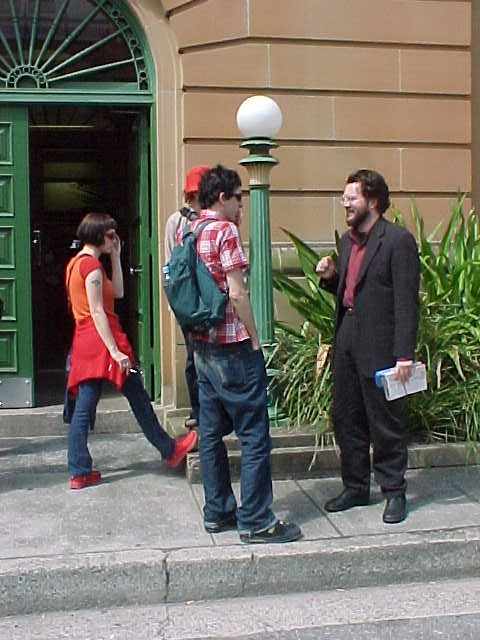
On Sunday 27th September 1998, I drove from Sydney to Newcastle…to attend the two sessions devoted to the discussion of comics at the inaugural National Young Writers’ Festival. Accompanying me were three active members of the Sydney ‘small press’: Stuart Stratu, Anton Emdin and Ross Tesoriero. As there had been no formal attempts to discuss and promote ‘small press’ activity we were impressed with their inclusion in the event. As to its presence in a writers’ festival, there was some uncertainty as comics also has its drawing side. We were also a little curious…as to why the organisers had by-passed Sydney and only invited Melbourne and Canberra based creators! Nevertheless we were curious enough to make the trip. It offered an opportunity to meet with colleagues from interstate. Although familiar with their work, we had never met many of them.

1999 event: Tim Danko, Stuart Stratu, Q-Ray and Kieran Mangan. (Photo by Louise Graber)
1999 event: Michael Fikaris(Froth) reading minicomic. (Photo by Louise Graber).
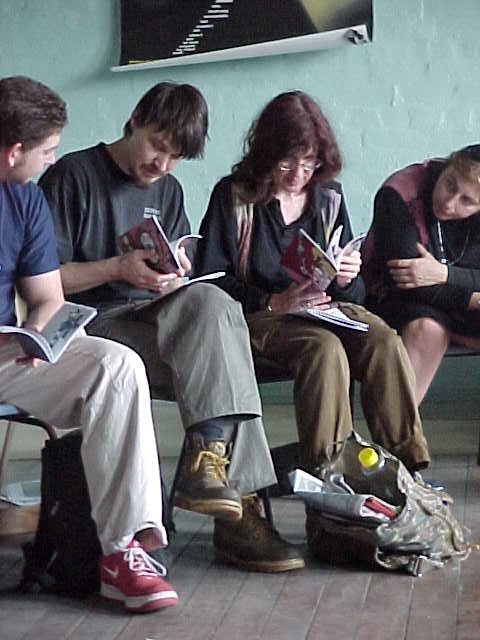
1999 event: Carol Wood and Susan Butcher aka Pox Girls reading minicomics. (Photo by Louise Graber)

The organizational aspects improved considerably over the next few years and the festival developed, expanded and diversified. Originally called the National Young Writers’ Festival it became part of the umbrella event TiNA…the acronym for This is Not Art. This became a multidisciplinary event in the week leading up to the October holiday weekend. It was spread around Newcastle and became known as the TiNa Arena. During the festival weekend the city becomes a catchment area for visiting youth…from a range of artistic, literary, music and media fields all over Australia. I even met a guy who claimed to have walked right across Australia from Perth to attend. I went to five consecutive events from 1998 to 2002…by which time comics discussions had moved into the Town Hall main room. A high point for comics creators is the annual comic and zine fair held on the Sunday afternoon. There was a busy trading event staged in the park then moved into the Mission theatre with accompanying live music.

1999 event: Anton Emdin(If Pain Persists) with Lewis P. Morley and Marilyn Pride(Red World Komics). (Photo by Louise Graber)
1999 event: Tim Danko(Dead Xerox Press) and Stuart Stratu(Sick Puppy Comix). (Photo by Louise Graber)

On arrival in the city that afternoon in 1998 we easily found the centre of activities laid out in various sumptuously appointed rooms of the Newcastle Town Hall and Civic Centre. There were panels and presentations in the Banquet Room…the Function Rooms and some impressively attired Committee Rooms in the Council Chambers and also at the nearby Wintergarden Cafe. We were, however, unable to find the venue for the discussion of comics. On asking for that information we were directed out of the main building to the back. There it was, a modest room with a few plastic chairs. A few attendees had to sit on the floor. No podium, no lectern, no microphone, no monitor, no vcr, no whiteboard, no jug of water, no media nor reporters were present. Furthermore, this was not a seminar but a workshop. Comics were not so much to be discussed as produced…and if there was to be any discourse it would be on matters of production rather than on content. Then I realised how appropriate all of this was in the then current scheme of things. It was the “accustomed” venue at a writers’ festival for the discussion of comics and it indicated how marginalised the form was. The established, pure literary forms such as the novel and poetry headed the hierarchy. Even emerging word based forms such as e-mail and writing textual content for the Internet and journalism had superior status and were located in the main hall. But comics and zines were out the back and out of sight, so to speak.

1999 event: Happy Pox Girl Susan Butcher. (Photo by Louise Graber)
1999 event: Q-Ray(The Comic Messiah) and Kieran Mangan(Urrgh). (Photo by Louise Graber)
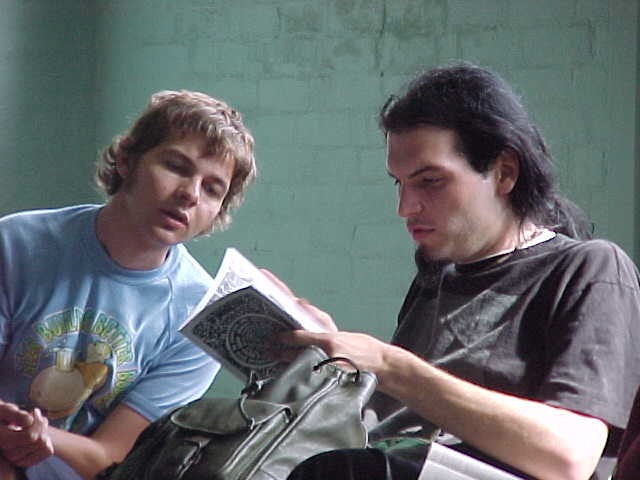
Interested (Photo by Louise Graber)

Things changed over subsequent years. There have been comics events at the Sydney Opera House with international guests…but it was so different back in Newcastle, so ‘underground’, so beneath the radar. Comics were even made during the event in an upstairs, cut and paste graphics studio called Octapod…where minicomics had been produced. At the 1999 event I did a series of interviews with many of the comics creators in attendance. This became research material for my doctoral thesis. In closing, I welcome comments about this blog, especially if you have attended an events like this.

1999 event: Ross Tesoriero(Radiation Sickness). (Photo by Louise Graber)
Event organiser Kylie Purr with Glenn Smith.
Event organiser Kylie Purr with Glenn Smith. (Photo by Louise Graber)

This is the tenth in a series of posts called Archives of Australian Comics History…that document moments in the recent history of Australian comics, particularly alternative comics and the Australian Small Press. I started researching this subject in the late 1990s and it eventually led to my PhD thesis: Ph.D. Macquarie University, Division of Society, Culture, Media and Philosophy…A Study Of Contemporary Australian Alternative Comics 1992-2000 With Particular Reference To The Work Of Naylor, Smith, Danko And Ord, 2003. On completion of the research I donated the materials and comics I had collected to the National Library of Australia: Michael Hill Collection of Australian Comics.

1999 event: Michael Hill aka Doctor Comics. (Photo by Louise Graber)
1999 event: Dr. Michael Hill. (Photo by Louise Graber)

(All text, photos and artwork except where otherwise stated-©2012 Dr. Michael Hill a.k.a. Doctor Comics).
Archive of Australian Alternative Comics: COMICS IN RECORD SHOPS

Archive of Australian Alternative Comics, Art, Comics August 8, 2012

In the 1990s it was not unusual to find alternative comics in record shops in Sydney. Examples were Phantom Records, Red Eye Records and Waterfront Records. Customers could find an assortment of locally made comics…in a corner on the floor or on a shelf or display rack. Odd sized comics which did not fit the display racks were laid on the floor. A similar layout could be found in Brisbane at Rocking Horse Records…in Canberra at Impact Records and in Adelaide at Big Star Records and Dominator Records. It was in these record shops that I first found some Australian alternative comics. These became the subject of my research into comics. There were also specialist bookshops that stocked comics as well as fantasy, science-fiction and movie material. In Sydney such shops were Land Beyond Beyond, Comic Kingdom, Kings Comics, and Half A Cow. The latter was a really wonderful shop to browse in with its carefully selected subcultural range of goods. It also had that strange logo of a cow cut in half…across not along like the Damien Hirst version and in cartoon rather than realistic style. There were also mail order distros such as Chewing Gravel that sold Australian comics.

The shop in Glebe. (Photo by Louise Graber)


Half A Cow business card with it’s eye catching sliced cow illustration.

The reason why independent record shops were selling alternative comics…was perhaps due to the perceived affinity of both medium’s independent approach to production and distribution. This positioning of the small press in the independent landscape…created parallels with the independent music industry that had flowed on from the Punk Rock movement. The term ‘Xerox music’ referred to the independent production of Punk records where the distribution system also employed a D.I.Y. approach with product being delivered to interested shops by hand. Alternatively it could be distributed by mail order. There were similarities in the way alternative comics were produced and distributed. These comics of the 1980s and 1990s…with their small print runs (usually less than 500), were commonly printed on photocopy machines by their creators. This was instead of the more costly offset process or digital printing used by professional print technicians for commercial clients. After printing their comics the creators, like their musical colleagues, would distribute their work themselves. Visiting comics, books and record shops…on foot, bus, train or bicycle…were creators carrying small amounts of stock in their bags. Then they would return a week later to check on sales. Eventually most of the more mainstream comics shops carried some alternative comics. There were even some musicians who made comics. Ray Ahn, Ryan Vella and Glenn Smith are examples. Half A Cow’s affinities with independent music ended up morphing them from a bookshop into an independent record label. Have you ever bought a comic from a record shop? I would love to hear!

Louise Graber's Black Light Angels comic-first sold at Half A Cow in Glebe.
Louise Graber’s Black Light Angels Gothic comic-first sold at Half A Cow in Glebe.

This is the ninth in a series of posts called Archives of Australian Comics History…that document moments in the recent history of Australian comics, particularly alternative comics and the Australian Small Press. I started researching this subject in the late 1990s and it eventually led to my PhD thesis: …Ph.D. Macquarie University, Division of Society, Culture, Media and Philosophy…A Study Of Contemporary Australian Alternative Comics 1992-2000…With Particular Reference To The Work Of Naylor, Smith, Danko And Ord, 2003. On completion of the research I donated the materials and comics I had collected to the National Library of Australia:…Michael Hill Collection of Australian Comics.

(All text, photos and artwork except where otherwise stated-©2012 Dr. Michael Hill).
Archive of Australian Alternative Comics: SAVAGE PENCILS

Archive of Australian Alternative Comics, Art, Comics May 30, 2012

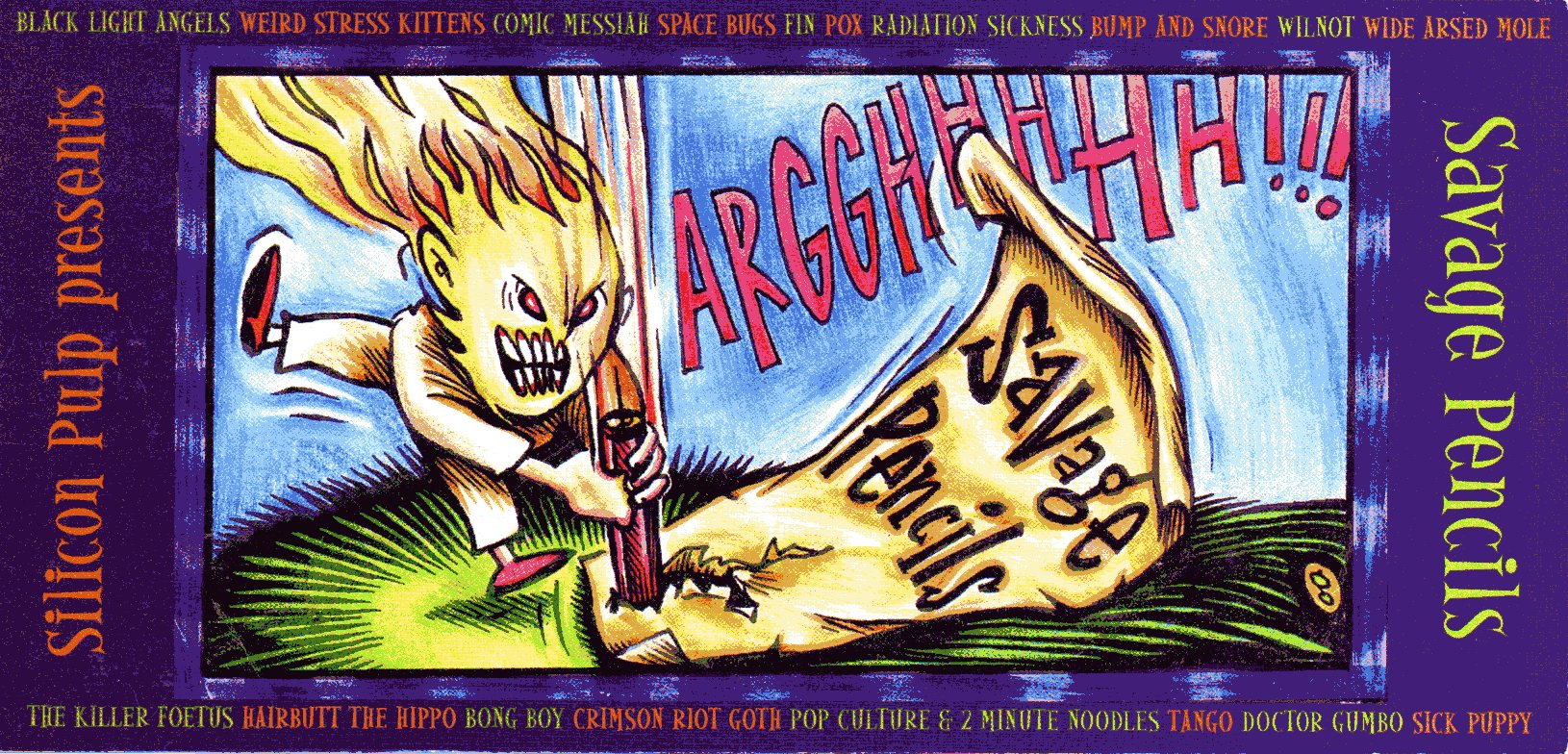
Savage Pencils was an exhibition of contemporary Australian comics cover art that I curated at Silicon Pulp Animation Gallery, Sydney in 2001. It featured original art by Paul Abstruse, Ray Ahn, Gerard Ashworth, Anita Bacic, Xander Black, Neale Blanden, Anna Brown, Bronson Boyd, Susan Butcher, Bernard Caleo, Dakanavar, Tim Danko, Anton Emdin, Michael Fikaris, Edo Fuijkschot, Louise Graber, Ben Hutchings, Scott Johnson, Gregory Mackay, Alex Major, Kieran Mangan, Daniel McKeown, Chris Mikul, Alice Mrongovius, John Murphy, Dillon Naylor, Linzee R. Nold, Mandy Ord, Jason Paulos, Q-Ray, Kirrily Schell, Jan Scherpenhuizen, Shags, Bernie Slater, Glenn Smith, Cipta Tanamas, Dean Tarjavaara, Matt Taylor, Ross Tesoriero, Tolley, Ryan Vella, Kevin Whitfield, Colin Wilson and  Carol Wood.
The invitation designed by Glenn Smith.

The exhibition catalogue contained the essays: “The Broken Pencils of Southeast Asia” by International Journal of Comic Art editor John A. Lent, “Why the Australian Small Press Make Eskimo Comics” by Tim Danko, and my own paper “Sick Puppies With Pencils”.

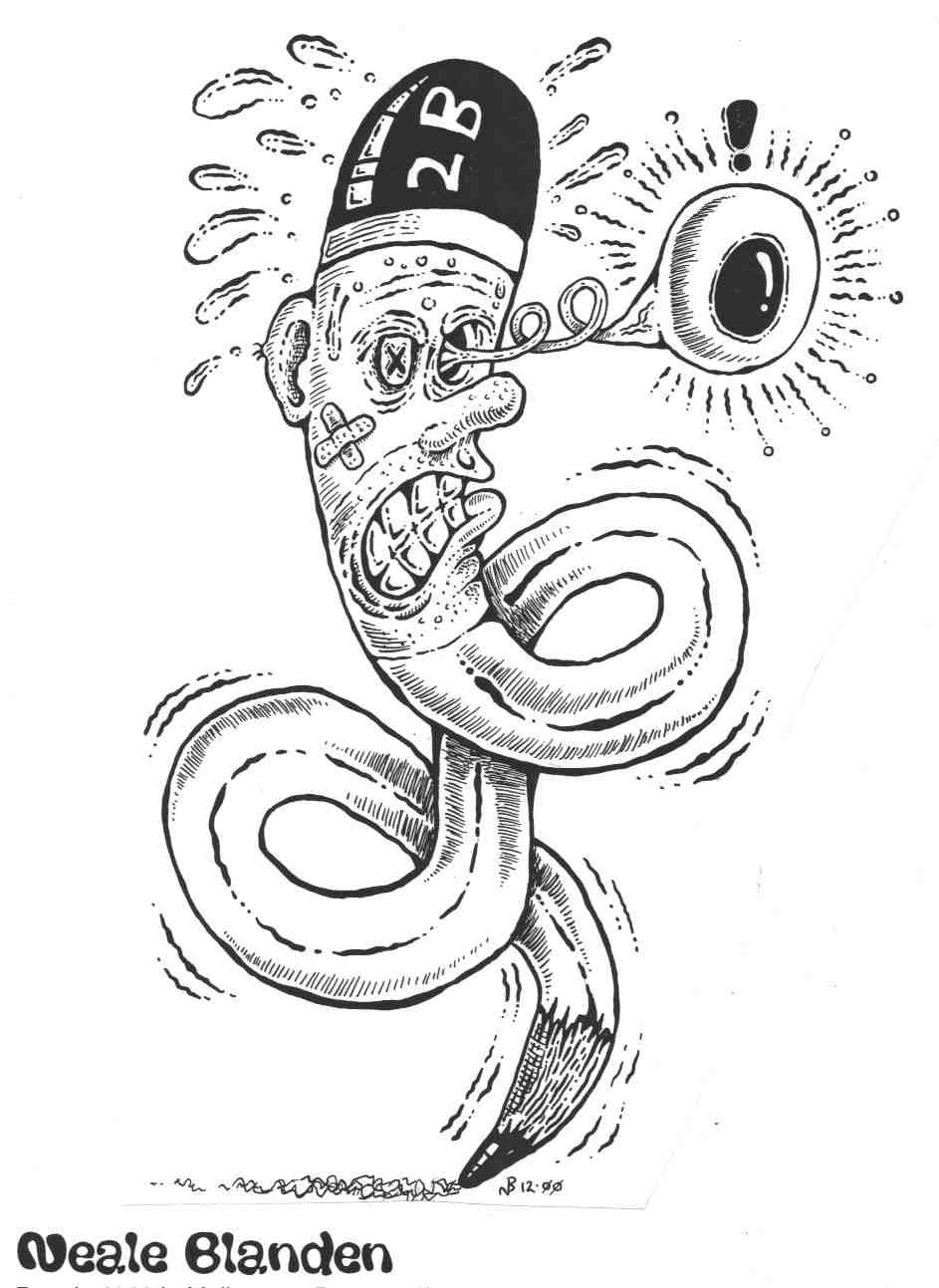
The Neale Blanden illustration was also used as the exhibition catalogue cover.

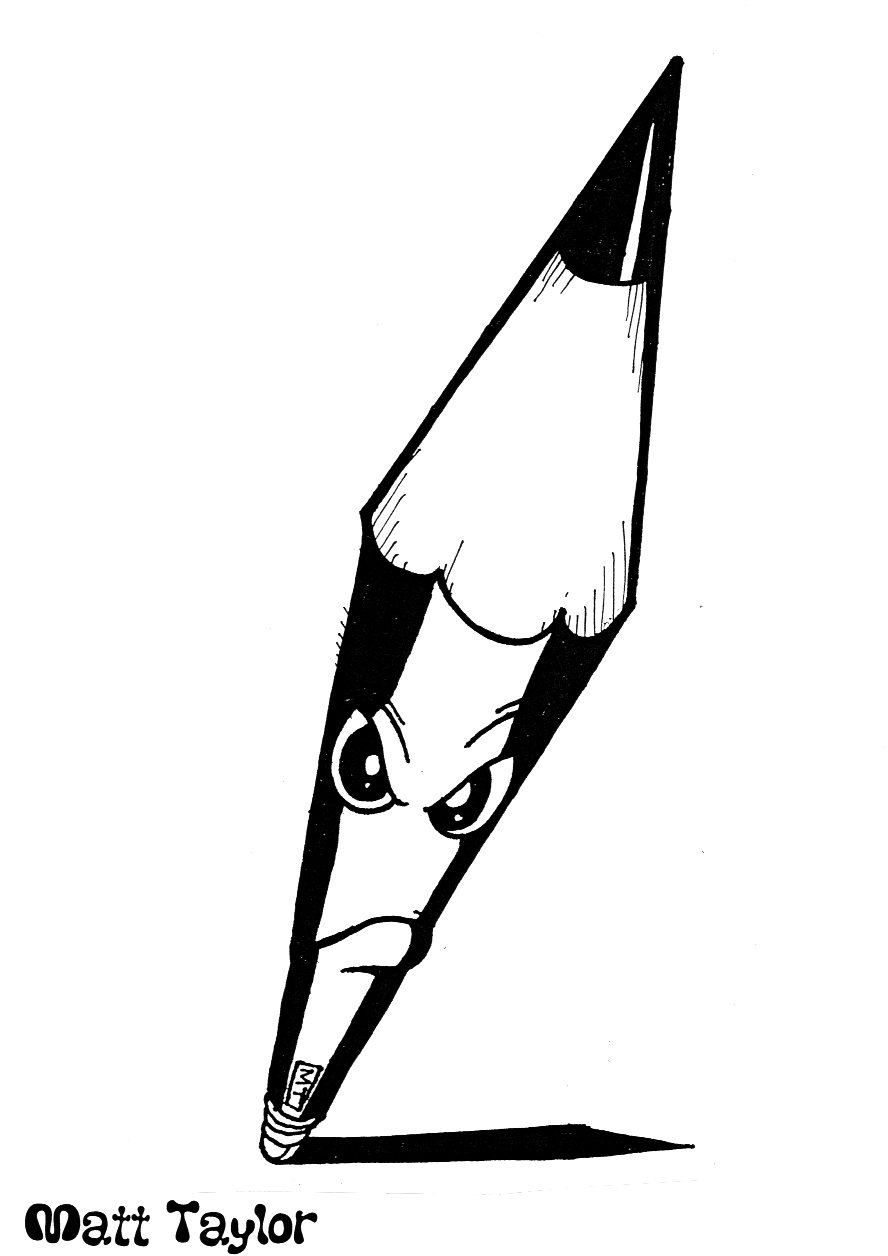
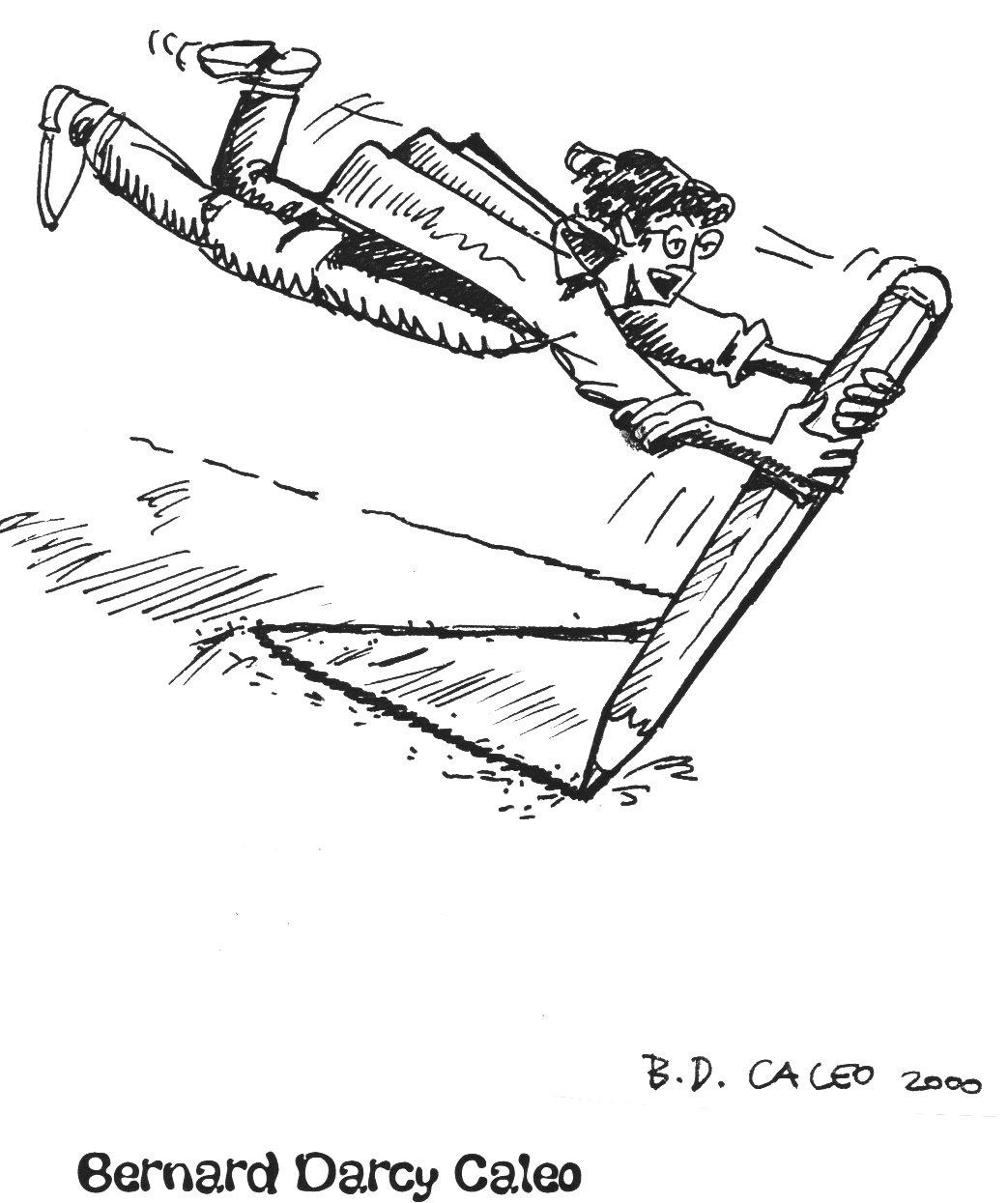
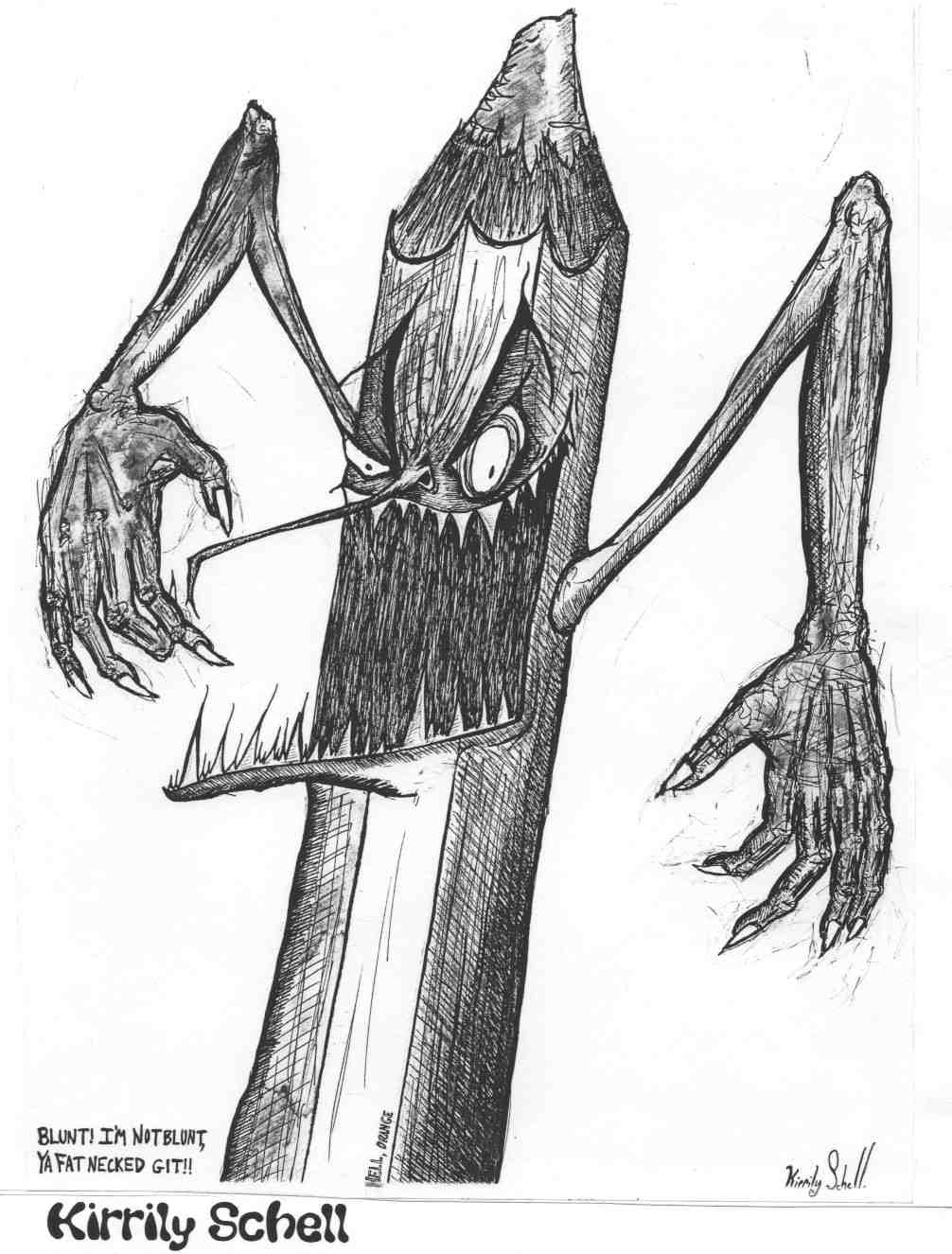
As a playful idea for the catalogue I asked the artists to draw a ‘savage pencil’. Here is a selection. All art is the copyright of the respective creators.

Colin Wilson

Colin Wilson

Butcher and Wood aka the Pox Girls.

Louise Graber

Louise Graber

Ross Tesoriero

Alice Mrongovius

Linzee R. Nold

Shags

Chris Mikul

Chris Mikul

Matt Taylor

Ben Hutchings

Tolley

Bernard Caleo

Bernard Caleo

Ryan Vella

Kirrily Schell

The notion of collecting comics art is a recent but growing trend in Australia. This exhibition offered 50 works ranging from the mainstream to the the avant-garde, from 44 artists representing every State of Australia except the Northern Territory. Some of the cover art was displayed on the gallery’s website.

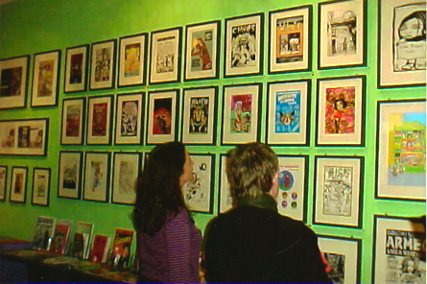
Exhibition installation view. (Photo by Louise Graber)

The exhibition catalogue with cut-up Neale Blanden illo on the cover.

The exhibition catalogue with cut-up Neale Blanden illo on the cover.

The title for the exhibition was taken from the alias of Edwin Pouncey, an English comics creator of the early 1980s whose ‘punk’ style of graphics proved inspirational to alternative cartoonists. This show celebrated drawing, a precious commodity in an age of appropriation and scanning, and the creative expression that drawing is given in comics. Here the drawing was both art and pop culture trash and very affordible.

Massive thanks to the people at Silicon Pulp! What they have done for local creators of comics art is immense! And to the artists, whether you exhibited, attended the exhibition or just read my blog post on it, I would love to hear your thoughts. This is the eighth in a series of posts called Archives of Australian Comics History that document moments in the recent history of Australian comics, particularly alternative comics and the Australian Small Press. I started researching this subject in the late 1990s and it eventually led to my PhD thesis: Ph.D. Macquarie University, Division of Society, Culture, Media and Philosophy, A Study Of Contemporary Australian Alternative Comics 1992-2000 With Particular Reference To The Work Of Naylor, Smith, Danko And Ord, 2003. On completion of the research I donated the materials and comics I had collected to the National Library of Australia: Michael Hill Collection of Australian Comics.

Archive of Australian Alternative Comics: 2002 SEQUENTIAL ART STUDIES CONFERENCE

Archive of Australian Alternative Comics, Art, Comics, Japanning April 7, 2012

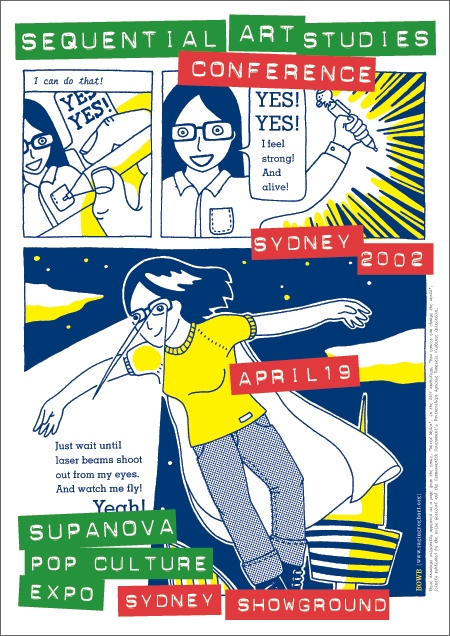
Conference poster designed by BOWB.

Ten years ago this event, the first Sequential Art Studies Conference took place on April 19 2002 in Sydney at the University of Technology, and by my reckoning, was the first scholarly conference on comics studies to be held in Australia, more than 3 years prior to the “Men In Tights” conference at Melbourne University in 2005 that also makes this claim! The conference was named after the descriptive term for comics, sequential art, introduced by Will Eisner in 1985. Thank you Will! Convened by Jeremy Allen and myself, with panels chaired by Jeremy, Spiros Tsaousis and I, the conference was held in association with Supanova Pop Culture Expo with support from Daniel Zachariou. The conference poster was designed by BOWB.

CALL FOR PAPERS

SEQUENTIAL ART STUDIES CONFERENCE, Sydney, Australia, April 19 2002 SUPANOVA POP CULTURE EXPO Sydney Showground, April 20-21 2002. This inaugural scholarly conference on comics will take place on the day preceding Australia’s largest comics convention and will be associated with that event. Scholars are invited to submit 250 word proposals which address alternative approaches to comics, whether local or global, recent or historical, online or offline, artistic or commercial. The conference will adopt a multidisciplinary approach and welcomes papers from a broad range of disciplines. Send enquiries and proposals, by email only, to either of the conference coordinators: Jeremy Allen: Jeremy.S.Allen@uts.edu.au  or  Michael Hill: Michael.Hill@uts.edu.au Interdisciplinary Studies, Faculty of Design, University of Technology, Sydney.

DEADLINE: Friday December 21 2001

PROGRAM

Michael Hill-Bite of the Mongrel Breed: A Study of Satire in Contemporary Australian Alternative Comics 

Abstract: This paper involves an examination of the contemporary Australian alternative comics scene as a lively form of lampooning and derision in the late 20th Century. In contrast to the mainstream print media, many of the artists, creators and cartoonists involved antagonise, irritate and ridicule with their graphic humour and horror, provoking irreverent laughter as well as an element of fear and amazement within their limited audience. In so doing, they take advantage of what is a relatively unregulated outlet of creativity and visual communication. As a wide-ranging group of artists, their repertoire houses a mix of graphic styles and comic art genres and their attitude has strains of ‘larrikin’ and ‘ratbag’ humour.

Bio: Michael Hill is Senior Lecturer in Visual Communication and Director of the Interdisciplinary Studies Unit at UTS, and partner in Graber Hill, publisher of the alternative comic B.L.A.CK.

Craig Norris-Manga in Australia: erasing and re-animating Japan   

Abstract: The export of manga (Japanese comics) from Japan to Australia is a journey from erasing race and culture to redrawing ideal bodies and communities. Using my two years of field research in Tokyo I argue that the export agenda of Japanese animation distributors is based on the erasure of Japanese racial characteristics and life-style to allow for easier localisation of animation and comics such as Astro Boy, Poke-Mon and Dragonball Z (Iwabuchi, 1998). I compare these producer-dominated ‘erased’ manga with the ‘redrawn’ manga of fan artists throughout Australia. I focus on the work of a number of manga fan-artists based in Sydney whose work appears in fan-zines, online, and on more unusual surfaces such as car-body art work.

Bio: Craig Norris is a PhD candidate at the University of Western Sydney. His research interests include cultural globalisation, audience-studies, and Asian/Australian popular culture flows.

Jeremy Allen-OZ.COM: Australian Comic Creators and the Web  

Abstract: Over the last seven years the web has emerged as a focal point for comicsculture. It is a place for fans to connect, for the purchase of latest titles and back issues, for comic news to be broadcast, for upcoming comics to be ‘spoiled’, and for established comic companies to advertise. Significantly, it has also given a mass media voice to aspiring comiccreators. In this respect, the web has become a gallery of online comics to be appreciated by potentially millions of people across the world. It is through this new method of distribution and new form of comics that the Internet has perhaps had its most revolutionary impact on comics, by producing a true alternative to the ‘offline’ comics industry.  

Bio: Jeremy Allen is currently researching his Ph.D. on Online Comics on an Australian Postgraduate Award Scholarship in the Faculty of Design, Architecture and Building at the University of Technology, Sydney.  

Zeldz Magnoonis-The sequential art of the skateboard sequence   

Abstract: Skateboarding is an activity full of dynamic action and motion.  Inevitably, attempts to capture this phenomenon require communication of this movement.  Representing movement in print has obvious limitations and the most obvious solution is that of the photographic sequence.  In this paper, it will be argued that these sequences can be read much like a comic strip.  It will be demonstrated that they not only share characteristics of comic strips, but have developed alternative processes that could be of use to the comic creator.

Bio: After falling into the cauldron of magic comics as a baby, monsieur Magnoonis has been addicted to the medium ever since, currently studying visual communication and creating the mini comic Pepe’s Quest.

Kurt Brereton-From Paper to Pixels: Animating Drawings and Paintings   

Abstract: Many artists and new animators work with desktop Mac and PCs at home or in schools and colleges. Great ideas can be well expressed using alternative approaches without resorting to high tech wiz bang special effects. New media and interactive multimedia technical restrictions have forced alternative animators to think big and work small.  This talk will focus on practical and conceptual issues at play in working in multimedia.

Bio: Kurt Brereton is Adjunct Professor in Computer Based Art & Design at the University of the Sunshine Coast and the University of Technology, Sydney, Managing Director of Spark Interactive and an internationally represented visual artist, photographer and film maker.

Spiros Tsaousis- The Spatial Logic of Krazy Kat   

Abstract: Modernist spatiality evidenced two strains – one orderly, mechanistic, logical and gridbased; the other fluid, dynamic, a transvaluation. However the rational and orderly exhibits the symptoms of anxiety, containing within its formulation the seeds of its unconscious propensity toward disorder and fluidity. Broadly tracing the spatial development of the comic strip from, say, Hogan’s Alley to Little Nemo to Krazy Kat evidences the movement of the medium between the two poles. In this paper I assert that the ‘logic’ of Krazy Kat is made coherent, legible and thematically consistent with appeal to its representation of space and place; and that its spatial presentation – its design and rearrangement of the comics page – is a significant departure from the relatively uniform and stable arrangements of comic strips such as Hogan’s Alley and Little Nemo.

Bio: Spiros Tsaousis has recently completed his thesis, “Disturbance of Distance: Postmodern Spatiality and the Comic Strip, Comic Book and Graphic Novel”. He has presented and published a number of papers on comics.

Adam Possamai-The Social Construction of Comic Books as a (Non) Recognised Form of Art in Australia 

Abstract: Even if since the 1990s there is an emergent community of comic book artists, Comic Books in Australia appear to be negatively stigmatised as immature literature in everyday life and in academic spheres. Even if comics started in newspapers as a way to attract working class adults to buy newspapers, and later became a literature form aimed at young readers, this medium has reached its Lettres de Noblesses and has been recognised as an art form since the 1970s in Europe, Japan, and the USA, but NOT – as it appears – in Australia. The aim of this paper is to describe the social construction of comic books as an immature literature in Australia since WW II.

Bio: Adam Possamai lectures in sociology at the University of Western Sydney. His doctoral thesis won the Jean Martin Award for the best PhD in Sociology submitted in Australia during 1998-9.

Note: Jeremy Allen is now known as Jeremy Kerr and Spiros Tsaousis is now Spiros Xenos.

Well this post came up a bit sooner than I preferred but I had to report on the event asap. Whether you attended  this event or have just read this blog post I would love to hear your impressions of either. Please post. It is the seventh in a series of posts called Archives of Australian Comics History that document moments in the recent history of Australian comics, particularly alternative comics and the Australian Small Press. I started researching this subject in the late 1990s and it eventually led to my PhD thesis: Ph.D. Macquarie University, Division of Society, Culture, Media and Philosophy,  A Study Of Contemporary Australian Alternative Comics 1992-2000 With Particular Reference To The Work Of Naylor, Smith, Danko And Ord, 2003. On completion of the research I donated the materials and comics I had collected to the National Library of Australia: Michael Hill Collection of Australian Comics.

(All text-©2012 Dr. Michael Hill a.k.a. Doctor Comics).