I am beginning to feel that I am nearing the final post documenting the production of my graphic novel/artist book/comic…Blotting Paper: The Recollected Graphical Impressions Of Doctor Comics…as I tie the ends of the storyline together and head towards the conclusion. Initially I thought that this would be a sequel with a different title…but after having second thoughts I decided to make it the final chapter of the graphic novel…with the same title…Blotting Paper: The Recollected Graphical Impressions Of Doctor Comics. Owing to the absence of the Doctor Comics character in this new chapter, it contains less of his anecdotes…and fewer human characters as it drifts more in the direction of the funny animal comics genre. This seems to be a good move.
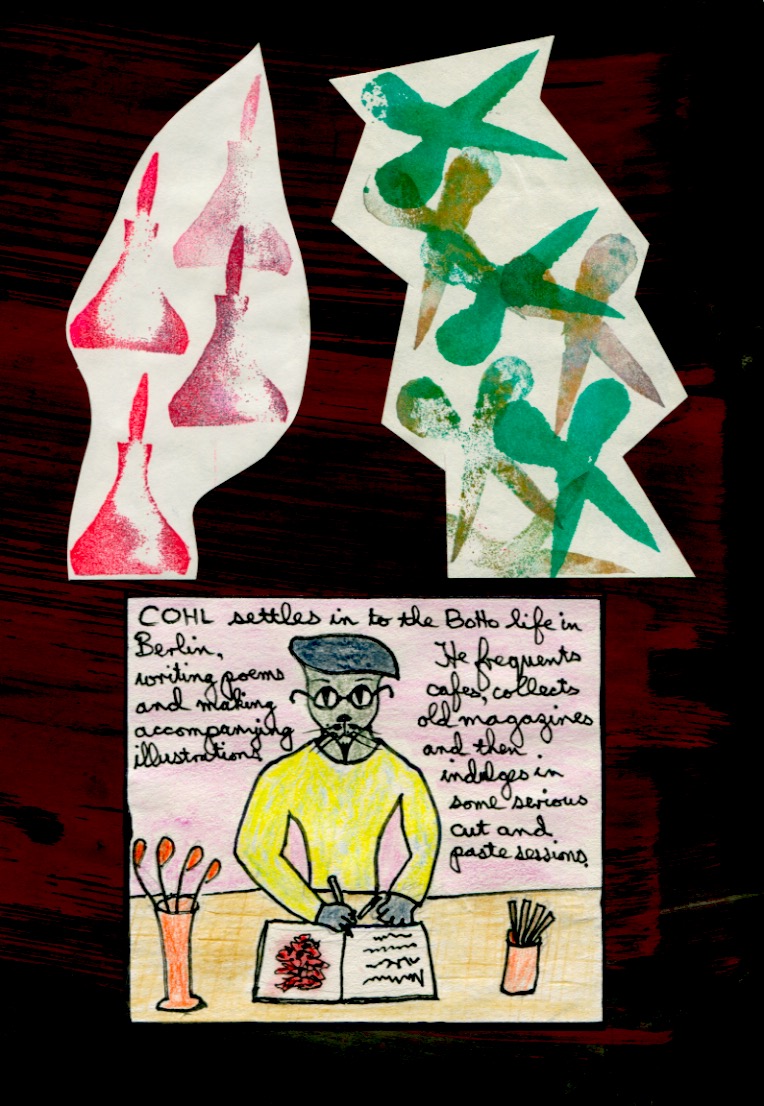
The chapter begins in Berlin…where Cohl, having heard no word from his friend Busch for almost two years…decides to follow him to Tokyo and try to find him. Cohl has been very comfortable in the German city…and somewhat reluctant to leave but his curiosity and friendship ultimately awakened him from his cultural slumber.
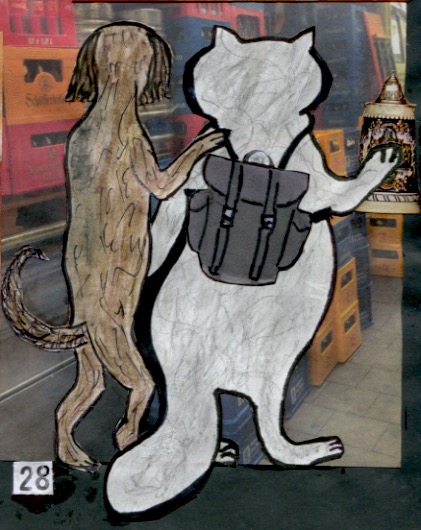
In addition to the restaurant supplies district some scenes take place in Kanda, the bookshop area of Tokyo. Cohl initially explores the manga shops…then extends his search to sources of traditional woodblock printed books as well as books about yokai spirits.
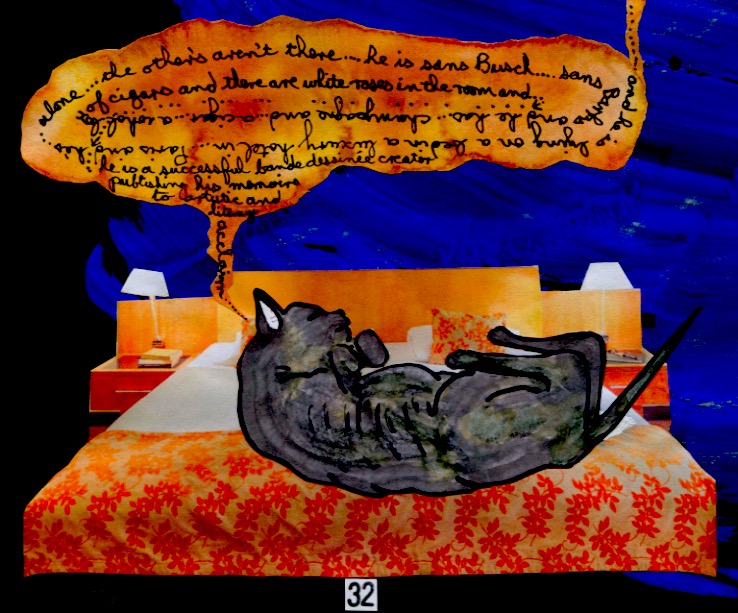
Near the end of the Blotting Paper graphic novel (page 286 above and page 287 below of 300 pages), Cohl is ultimately content to remain in Berlin despite his attempts to find his friend Busch who had left Germany for Japan with his new friend Barks.
Owing to the absence of the Doctor Comics character in this new chapter…it contains hardly any of his anecdotes…and even fewer human characters as it drifts more in the direction of the funny animal comics genre. The principal character, Cohl the cat from the Blotting Paper graphic novel,…has some adventures in the Asakusa area of Tokyo…to which he has travelled in search of his missing friend and flatmate, the other cat and feline friend, Busch.
Doctor Comics researching the bookshop area of Tokyo during an earlier visit. (Photo by Louise Graber.)
In addition to the restaurant supplies district some scenes take place in Kanda, the bookshop area of Tokyo. Cohl initially explored the manga shops…then extended his search to sources of traditional woodblock printing books…as well as books about yokai and the spirit world…as Doctor Comics had done. All good! I shall now start heading toward the conclusion of my graphic novel.
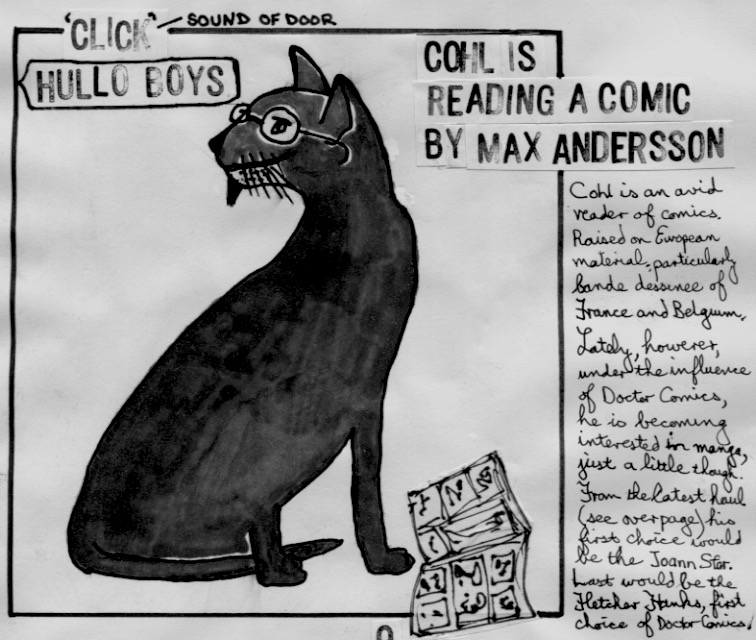
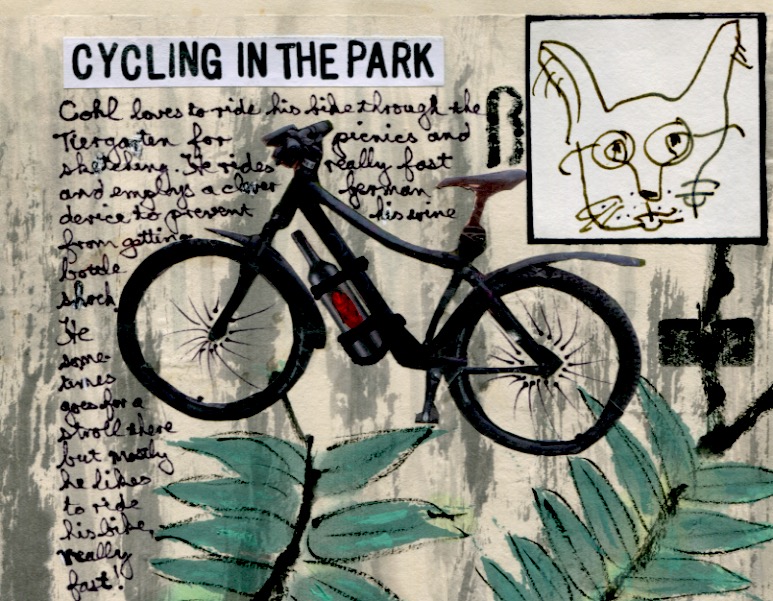
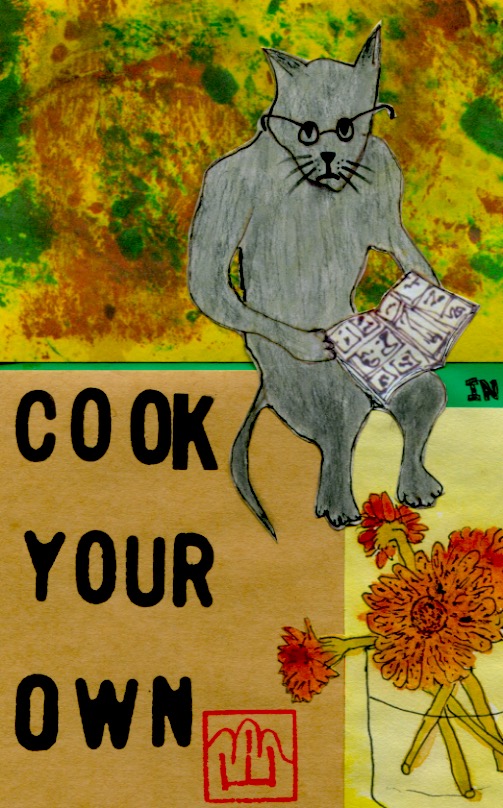
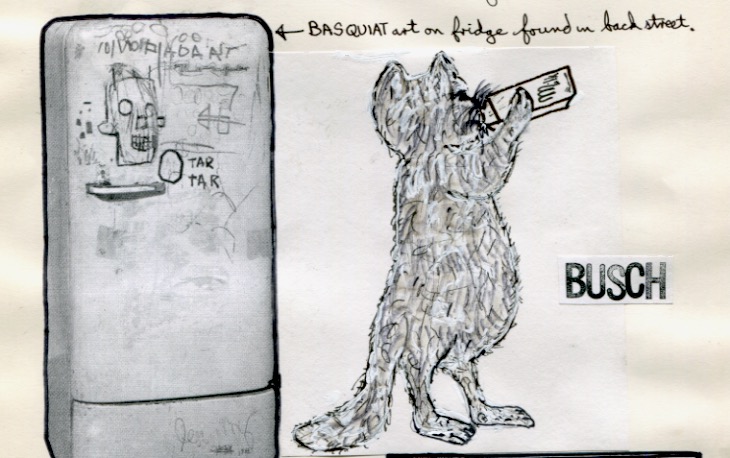
It’s been a long time between bowls of milk and plates of fish for my cat characters…in my occasional series of mini-profiles…that I have created in my comics! So, in this overdue post…I am focusing on the two animal characters of my own creation…Busch and Cohl, the pair of cats from my comic Blotting Paper: The Recollected Graphical Impressions Of Doctor Comics. Cohl is a cat of French origin who absolutely loves reading comics…not to mention draw, especially with pen and ink…on quality art paper. Although he favours bande dessinée, the Euro-Comics, and more Marcinelle than Bruxelle School…he has somewhat reluctantly been prepared to read some manga…and is finally beginning to find it quite appealing. Mon Dieu!
And now to the other cat in the comic…Busch, of German origin, who loves to eat…mostly meat and seafood…and to occasionally read comics…and even to draw, with a pencil or crayon on whatever paper is to hand…even if it already has an image on it such as a newspaper or magazine page or shopping receipt. He will generally expect that drawing results in the awarding of a snack. Busch can eat and Busch can dance…and sometimes he goes hungry, gets seasick, goes shopping, dresses up and has tantrums.
Last month I spent a wonderfully productive week in Fiji…on behalf of the Japanese Embassy and the Japan Foundation in Sydney…to present a lecture and workshop at the School of Arts, Language and Media, University of the South Pacific. I also introduced films at an Anime festival held there. It was part of Japan Culture Week 2011 in Suva, the capital city on the largest of the 300 islands. It seemed like an act of cultural colonisation…with the raising of the Anime and Manga flags and the flying of their colours on Treasure Island…creating a little Anime and Manga paradise in the Pacific Ocean.
Dr. Michael Hill at the University of the South Pacific in Fiji…presenting a slide lecture for the Japan Foundation on the global spread of Japanese pop culture in the 1980s. (Photo by Louise Graber)
My lecture titled Up In The Air: Anime’s Journey To The Stars described the global success of Japanese animation…and its rise to prominence both in the film world and in popular culture. It covered the work of Osamu Tezuka and its international success. It also referred to Rintaro’s involvement with him as an animation director on Astro Boy…prior to his subsequent productions that included his Tezuka homage film Metropolis…his adaption of Leiji Matsumoto’s manga Galaxy Express 999, and of Sanpei Shirato’s manga The Dagger of Kamui. Describing Shirato’s beginnings as a kamishibai artist…before moving to manga and the alternative publication GARO…the lecture included anecdotes from my time as a lecturer at Sydney College of the Arts…and the University of Technology, Sydney where I observed the growing interest of students in Japanese popular culture. They became fascinated with manga, Anime, cosplay, fashion,…J-Pop, scanlations, computer games…cameras, turntables, TV game shows,…food and fashion, not to mention learning Japanese and visiting Tokyo. The lecture concluded with an analysis of the productions…and the rise to prominence of Hayao Miyazaki and Studio Ghibli…who, like Tezuka, found both both an international audience and critical acclaim.
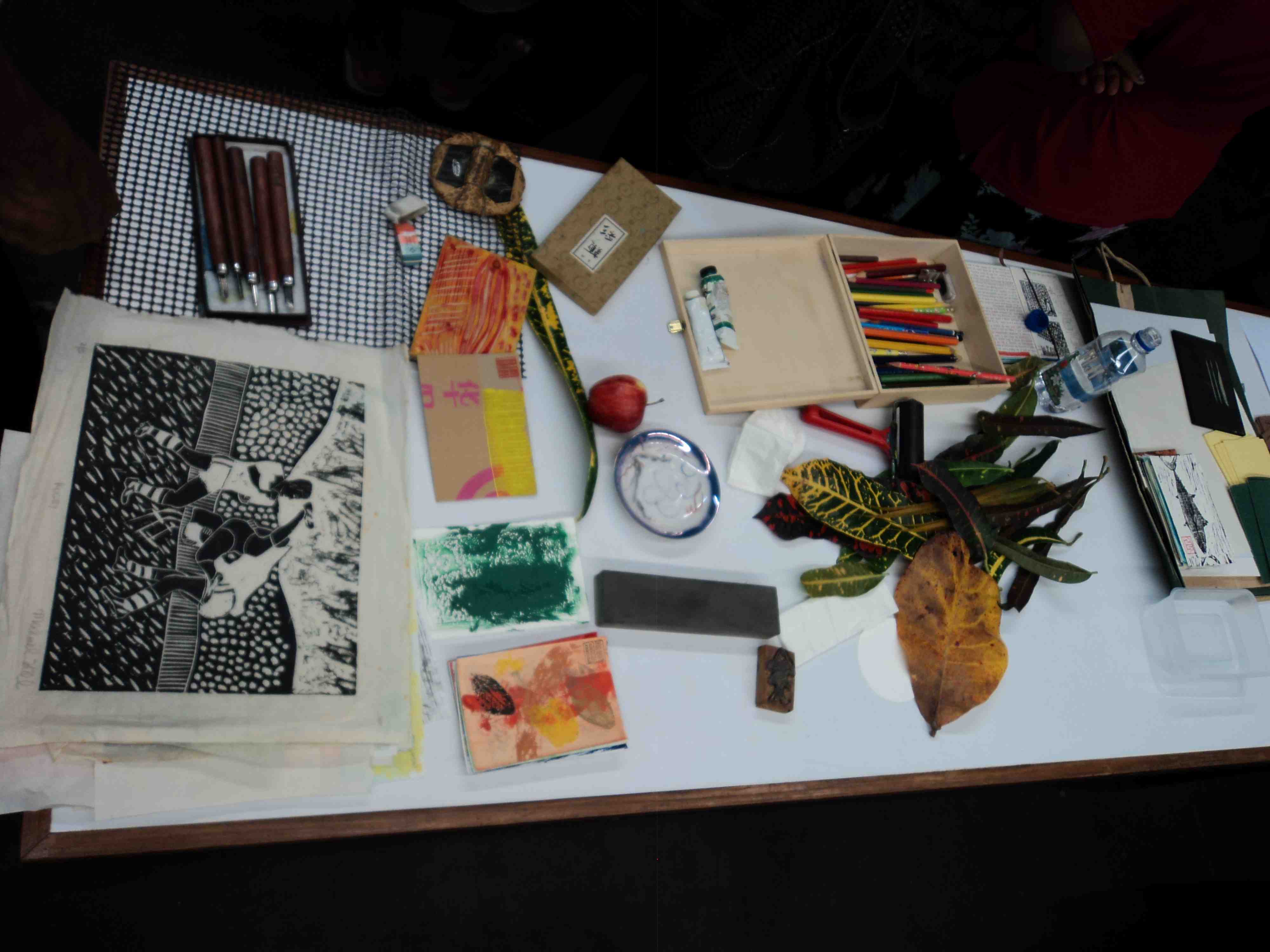
The tools and materials for the printmaking workshop. My Rugby woodblock print is on the table alongside some of my art postcards and printmaking tools. (Photo by Louise Graber)
In addition to the theory lecture I presented a practical arts workshop…demonstrating the printmaking technique I had developed as part of my artistic practice. Based on the Japanese creative print movement Sosaku Hanga,…and the work of Koshiro Onchi and Shiko Munakata in particular. I showed examples of my work that had been made using this approach and methodology…and applied to my prints, postcards, T-shirts and comics.
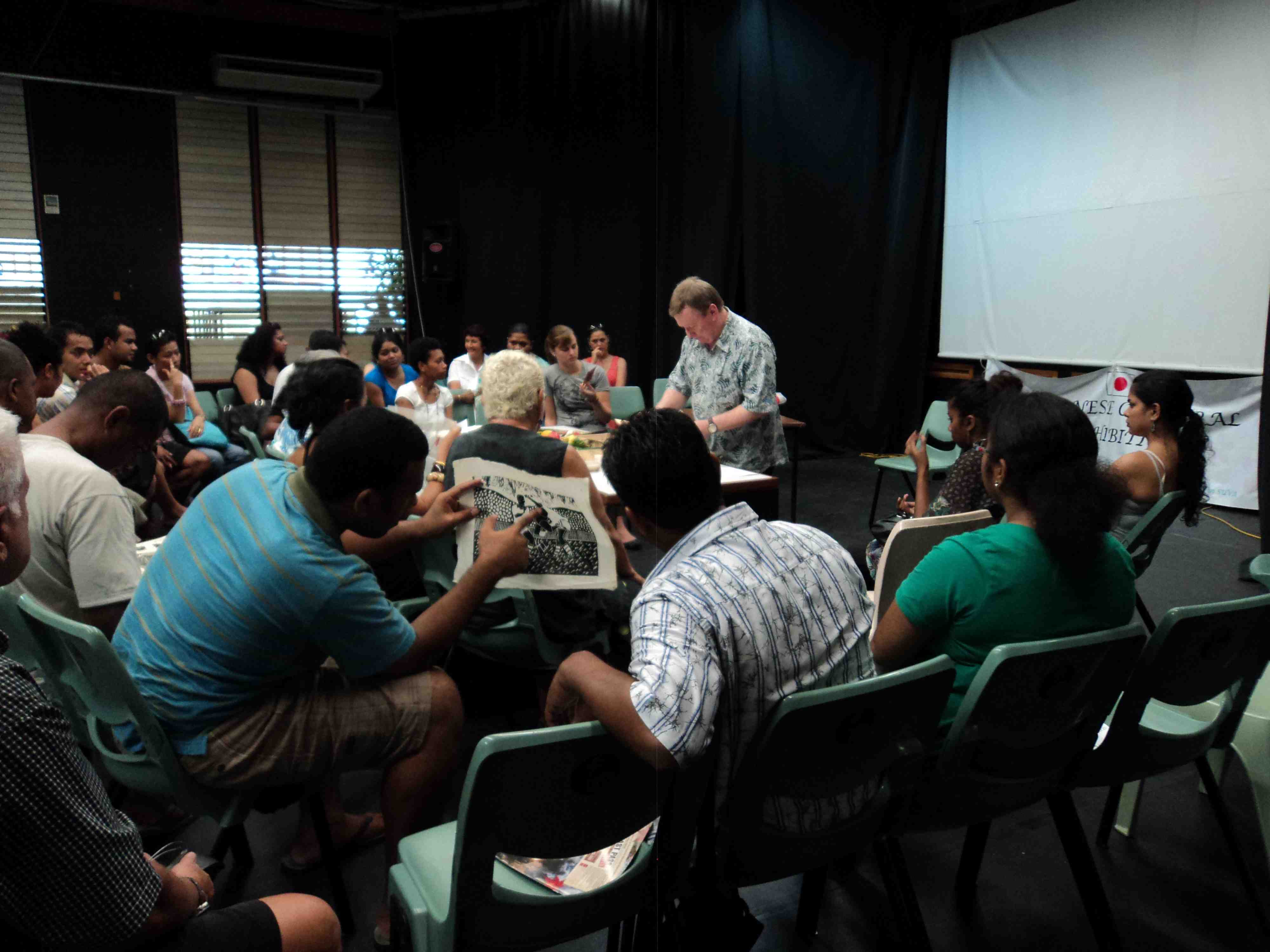
Dr. Michael Hill teaching printmaking techniques to students of the University of the South Pacific. In the foreground his Rugby themed woodblock print is being studied. (Photo by Louise Graber)
After the demonstration the students had the opportunity to make their own prints. By chance, the cultural activities took place in the same week as the Rugby World Cup finals…and the only paint colours to hand were those of the Wallabies, yellow and green. My own rugby woodblock print (being passed around the class, in the photos above) provided some amusement and interest.
The ‘sosaku hanga’ creative printmaking workshop. (Photo by Louise Graber)
Downtown, on the roof of the Village Cinema complex Batman and Spiderman look down…intrigued at the sight of people going in to see the Ninja super hero Kamui. It was here that the Anime Film Festival was held each evening. Films screened included Galaxy Express 999…The Dagger of Kamui…Laputa: Castle in the Sky and The Girl Who Leapt Through Time. Anime is now a fixed part of the Japanese cultural coat of arms…emblematic of the country’s long history of graphic arts which feeds into and nurtures both Anime and manga. The week long festival of Anime films and supporting cultural events was an alternative offering to American movies…and helped spread Japanese popular culture in the South Pacific.
Village Cinema Centre, Suva, with superhero cinema on the screens. (Photo by Louise Graber)
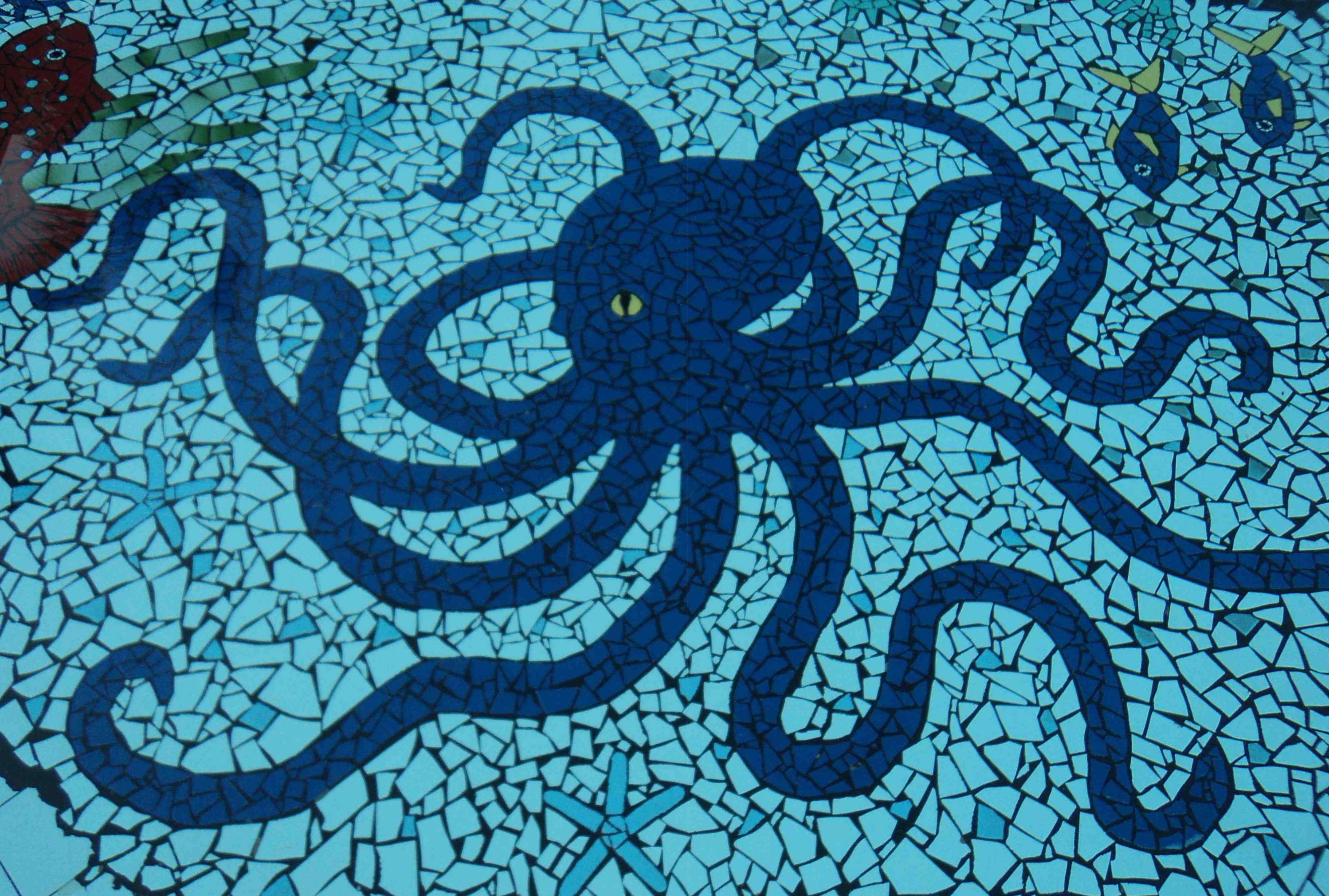
At the bottom of the hotel pool in Nadi, the elegant octopus tile design. (Photo by Louise Graber)
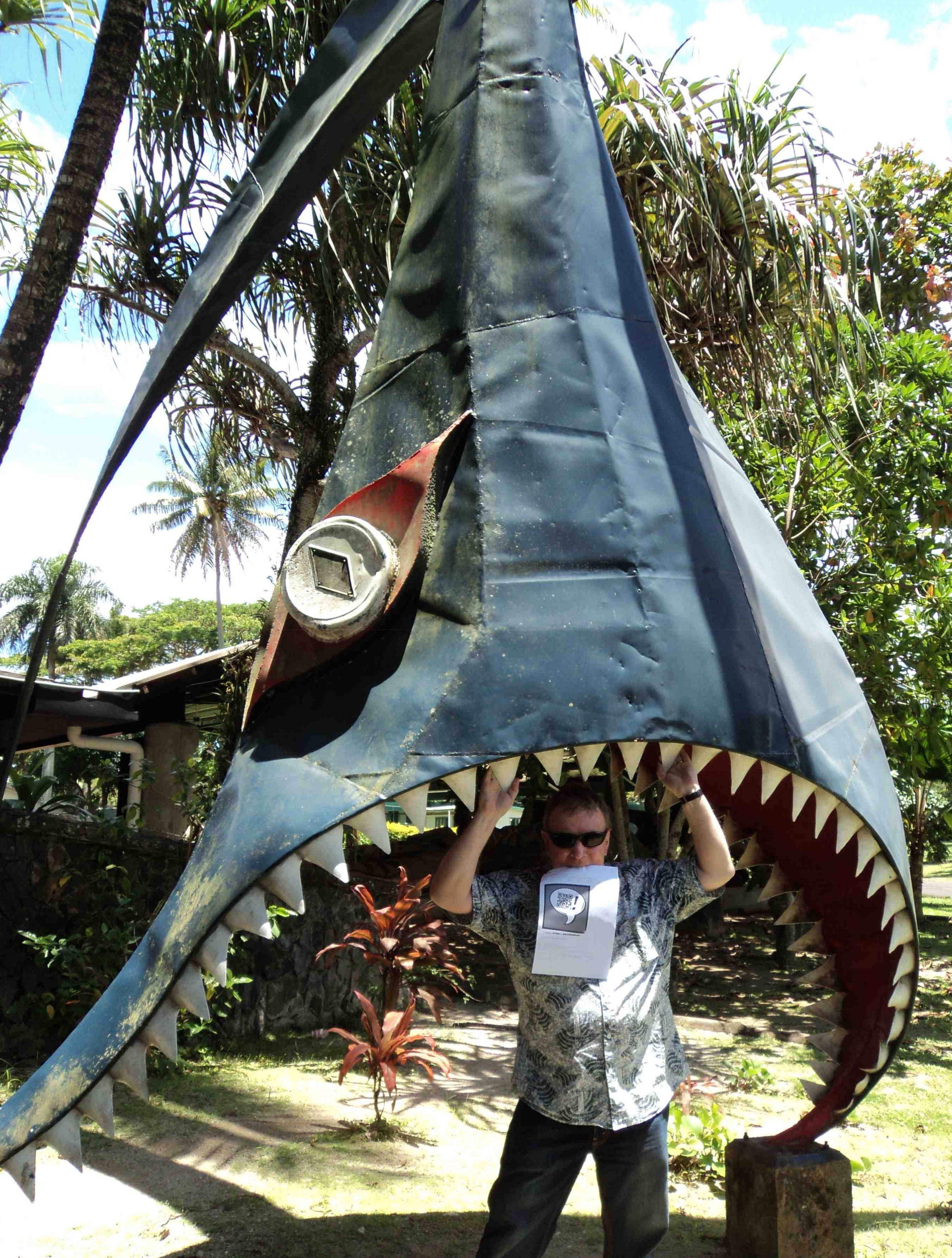
Dr. Michael Hill a.k.a. Doctor Comics playfully poses in shark jaws at the University of the South Pacific in 2011. (Photo by Louise Graber)
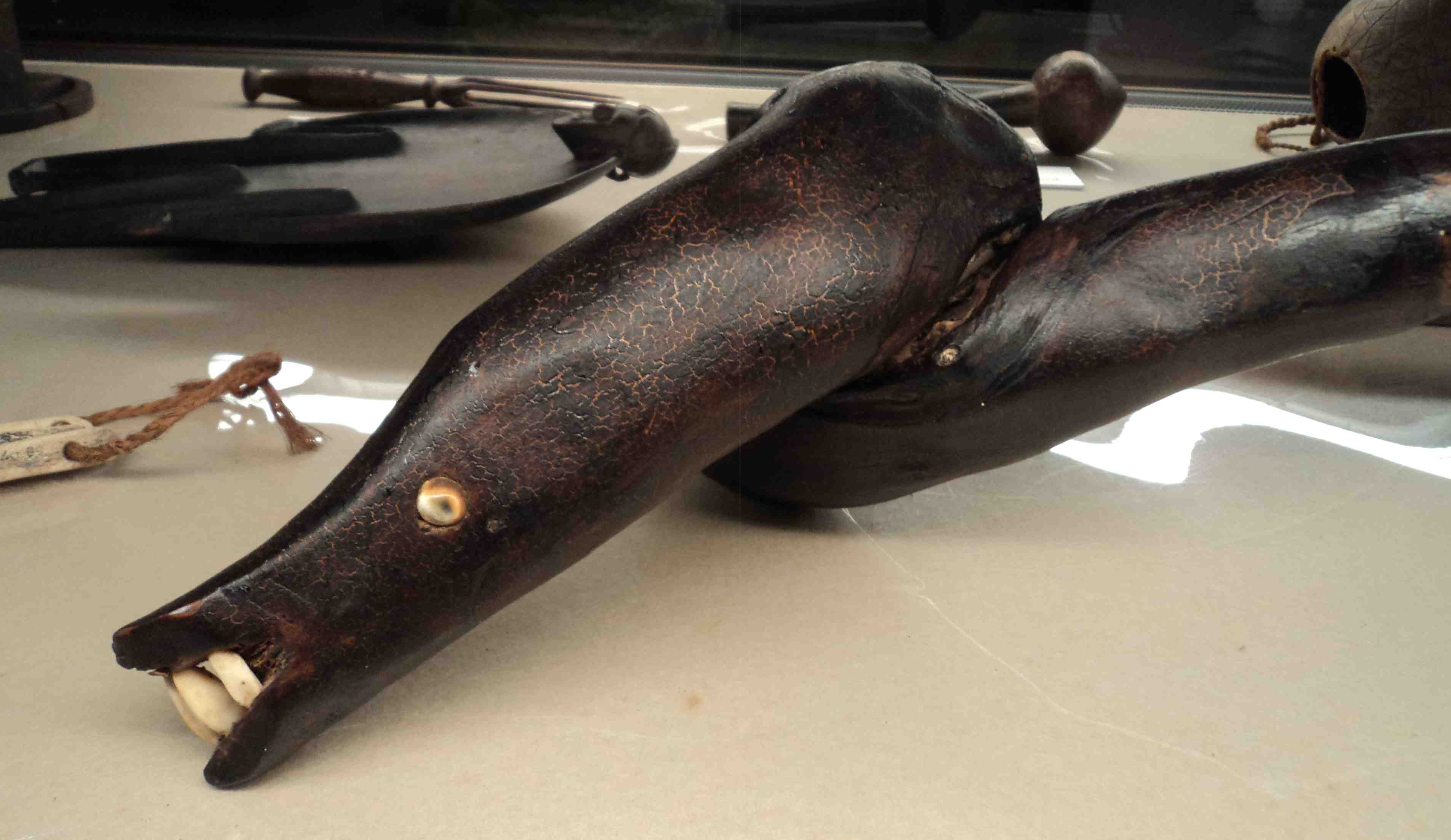
In the Fiji Museum in Suva, the Eel God sacred club. (Photo by Louise Graber)
In addition to my admiration of the octopus and various fish I am also a fan of the eel. During my Fiji visit I was pleased to find that the eel had acquired the status of a deity…and a creative one at that…in Melanesian mythology. Below is an artwork I had created, featuring eels once found in the Parramatta River near Blacktown in Sydney.
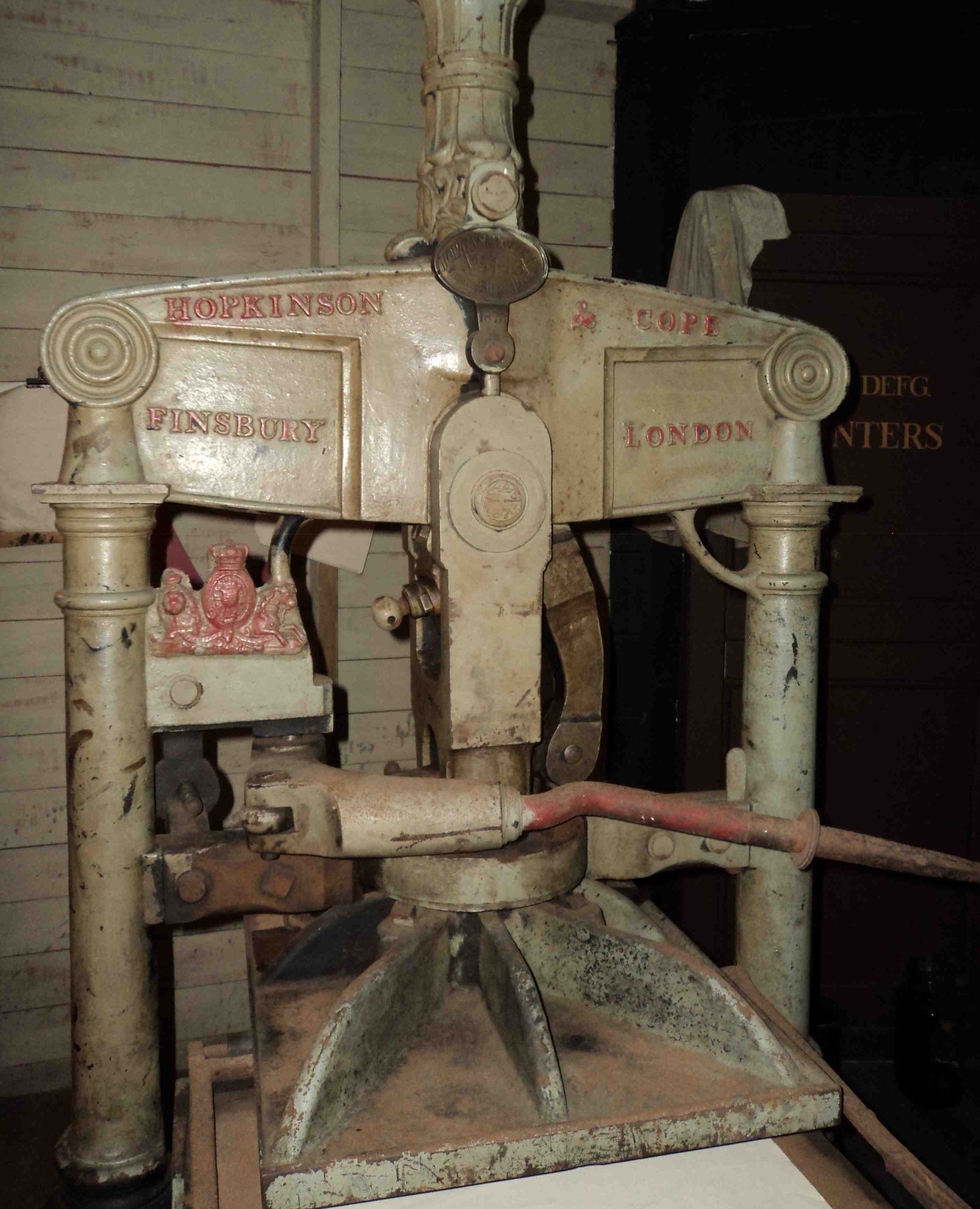
Another treasure inside the Fiji Museum was this old metal Hopkinson & Cope printing press…imported from England in earlier days. At my printmaking workshop in Suva I demonstrated an alternative, Japanese method…that employs one’s body weight as a press instead of a device such as this.
Old metal, pre-digital printing press. (Photo by Louise Graber)
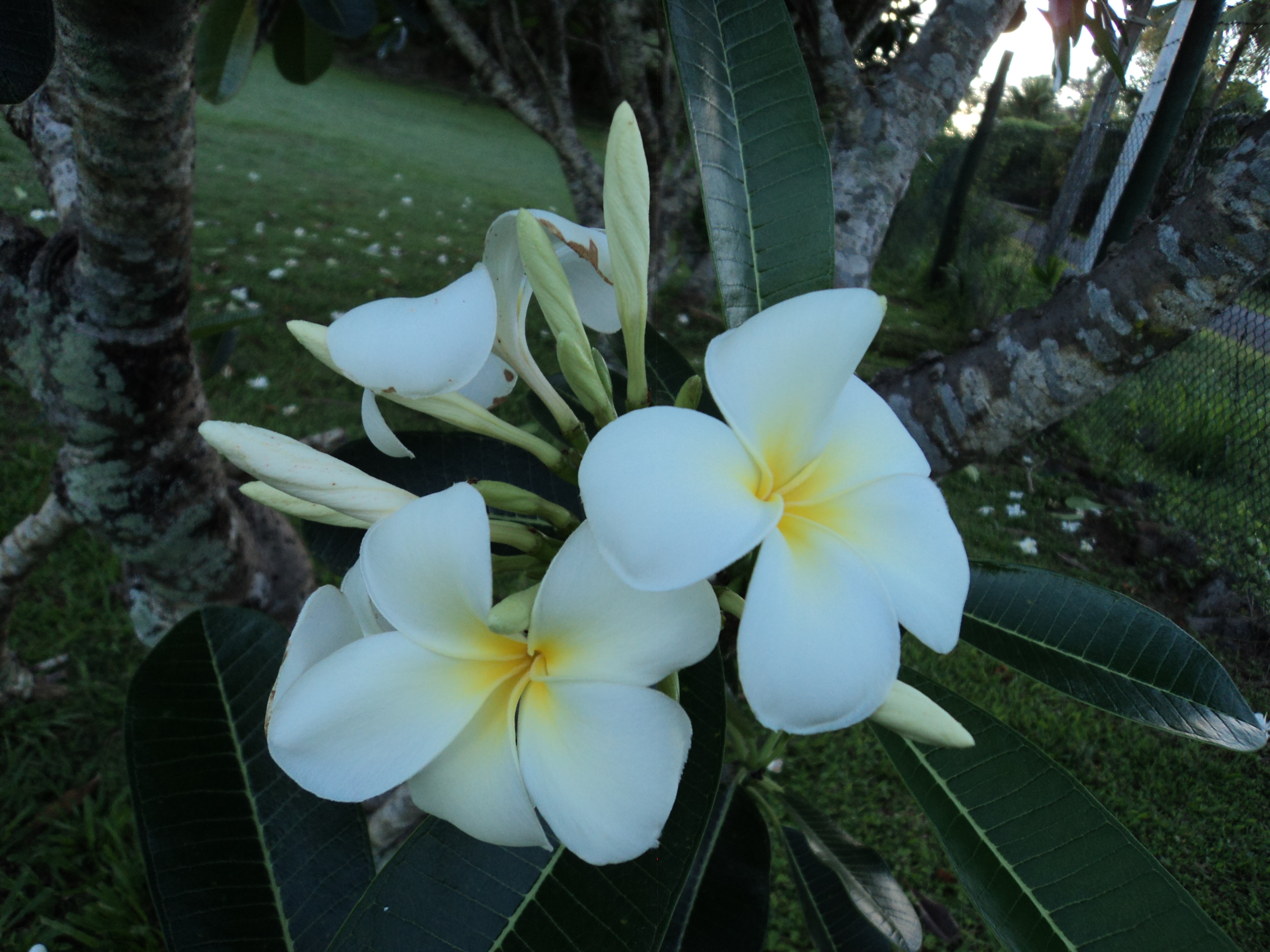
On this “Treasure Island”…in addition to the art and marine life…there were collections of coconuts, palm trees and flowers including red hibiscus and white frangipani.
An example of the abundant frangipani presence on the island. (Photo by Louise Graber)
Many thanks to Sayuri Tokuman and Susan Yamaguchi of the Japanese Studies & Intellectual Exchange Department…and Tokiko Kiyota, Director of the Japan Foundation in Sydney…and to Nobuko Iwatani, Mako Nakauchi and Mele of the Embassy of Japan in Fiji..and His Excellency Yutaka Yoshizawa, Ambassador of Japan, for their ideas, assistance and support with this project.
INVITATION: Please respond to this post if you would like to make a comment…or suggest topics for future posting. Being new to blogging I would love to hear any feedback about my posts. Are they too long?…have too many images?…or too much text?…or there are too many of them?…or not enough? Michael.













 Doctor Comics