Tag: Mandy Ord

Archive of Australian Comics History: DOWN UNDER GROUND

Archive of Australian Alternative Comics, Art, Comics February 13, 2013

Underground comics are the subject of this post…in particular Australian alternative comics. I start with a review of an exhibition that Glenn Smith curated at the Orange Regional Gallery, in N.S.W. in 2005. The exhibition was titled The Ink Runs Deep Down, Down Underground. I wrote an essay titled “Art From The Inkubator” for inclusion in the exhibition catalogue.
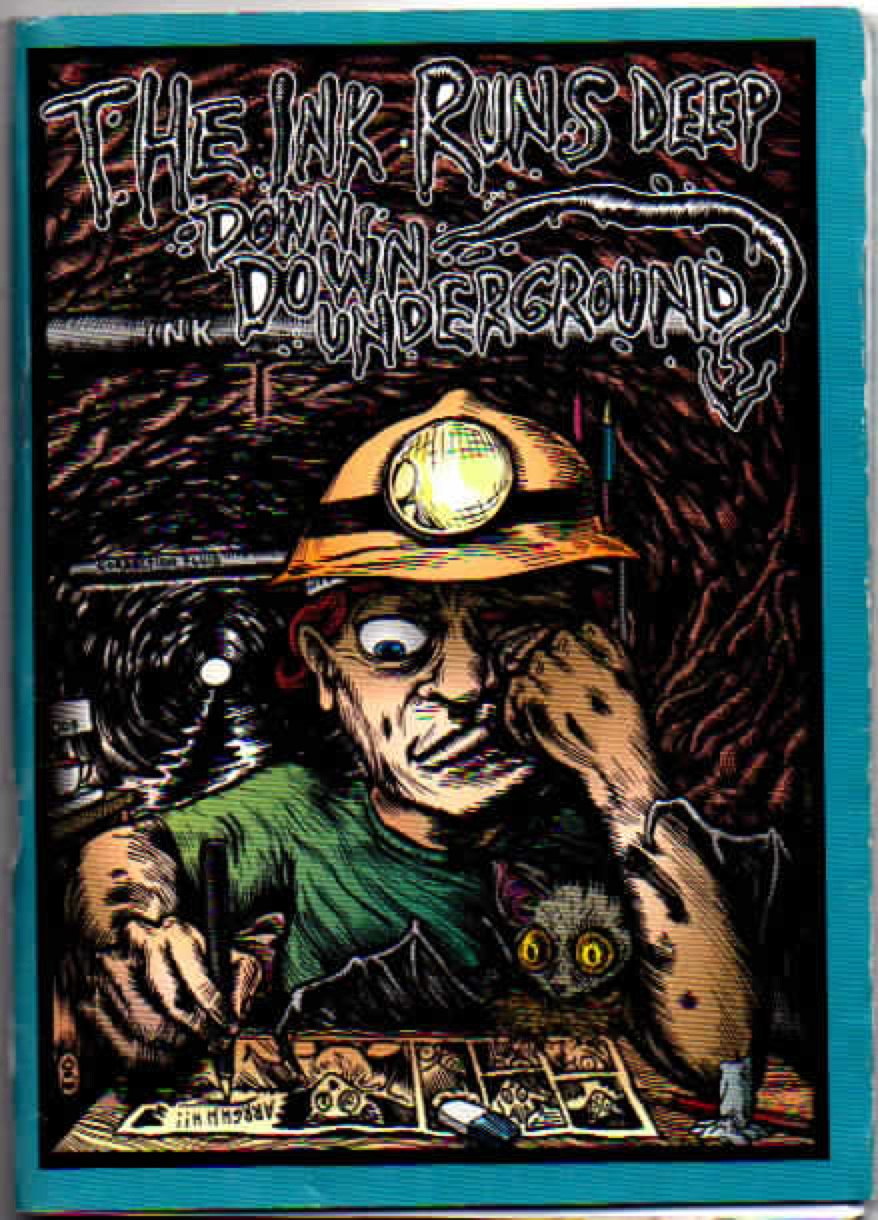
The Ink Runs Deep...exhibition catalogue. (Design by Glenn Smith)
The Ink Runs Deep...exhibition catalogue. (Art & Design by Glenn Smith)

The successive waves of Australian alternative comics produced since the 1980s often feature a raw, spontaneous graphic style. This is accompanied by an irreverent attitude and a D.I.Y. Punk influenced approach to production. It is notably different from mainstream approaches to comics production. These alternative comics can be pluralistic, wide-ranging, antagonistic, mocking and containing taboo themes. The exhibition in Orange celebrated the creative expression behind these comics. Comics art…this much maligned art form…usually consigned to the pop culture trash bin…was hung for exhibition on the gallery wall.

Back cover of the exhibition catalogue. (Design by Glenn Smith)

Creators featured in the exhibition, all 27 of them, are listed on the back cover of the exhibition catalogue, above. They exhibited applications of comics art in a range of mediums from pen and ink to digital imaging. These were applied in animation, painting, posters, book covers and skate boards.

Display of Anton Emdin comics in the exhibition.
Exhibit of Cruel World minicomics by Anton Emdin.
Display of Black Light Angels minicomics by Louise Graber in the exhibition.
Exhibit of Black Light Angels minicomics by Louise Graber.

Noting the emergence of underground comix in Australia in his book Panel By Panel…John Ryan pointed to the social context of the 1970’s. This was a period in which a sense of national pride emerged. This led to a consequent interest in locally made art. That first wave of Australian alternative comics also seems to have been influenced by the North American Underground Comix movement. As in the Abstract Expressionist art movement of the 1950s, Australia seemed to have imported rather than grown, the art. Initially appearing somewhat derivative an Australian style later developed .

Louise Graber with a painting of a panel from her comic Black Light Angels in the exhibition.
Louise Graber with her painting of a panel from her comic Black Light Angels from the exhibition.

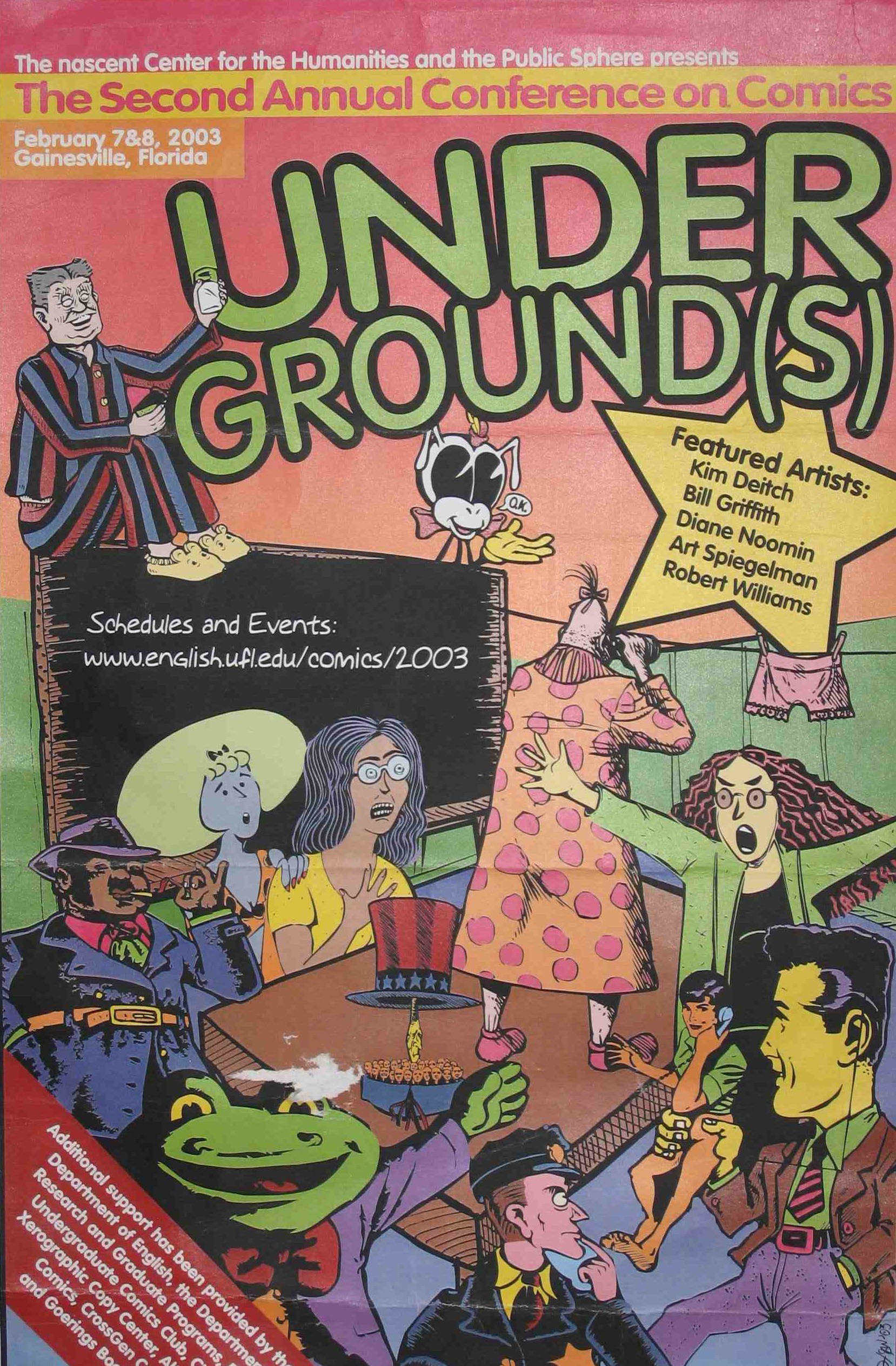
I had attended the Underground(s) conference on Comics and Graphic Novels at the University of Florida in 2003. It was organised by Donald Ault. At that conference I presented a research paper…titled “Down Under Ground: Emotional and Oppositional Outpourings from Sydney’s Subculture in the Comics of Glenn Smith”. Smith’s comics seemed to be an echo of the Underground comix of the late 1960s that began in San Francisco. They were different in style and content to the mainstream North American super-hero themed comics. They opened up the way for autobiographical and artform approaches. At that conference I heard from some of the creative figures from the original Underground(see back cover of program below). It was pleasing to describe Glenno’s work, and argue that it had some resonance with what they had done.

Front cover of Underground(s) conference program. (Design by William S. Kartalopoulos)


Back cover of Underground(s) conference program. (Design by William S. Kartalopoulos)


Underground(s) poster (detail).
Underground(s) conference poster (detail).

Have you read any Underground comics? I’d love to hear your thoughts about them as well as reactions to this post. 

This is the twelth in a series of posts titled Archives of Australian Comics History. They document moments in the recent history of Australian comics, particularly alternative comics and the Australian Small Press. I started researching this subject in the late 1990s. It eventually led to the writing of my doctoral thesis.  Details: Ph.D., Macquarie University, Division of Society, Culture, Media and Philosophy, for the thesis…A Study Of Contemporary Australian Alternative Comics 1992-2000…With Particular Reference To The Work Of Naylor, Smith, Danko And Ord, 2003. On completion of the research I donated the large number of comics I had collected…to the National Library of Australia: Michael Hill Collection of Australian Comics.

(All text, photos and artwork except where otherwise stated-©2013 Dr. Michael Hill a.k.a. Doctor Comics).

Archive of Australian Alternative Comics: INTERNATIONAL EXHIBITION OF DRAWINGS-COMICS

Archive of Australian Alternative Comics, Art, Comics January 12, 2012

Thirteen years ago the 14th International Exhibition of Drawings opened at the Museum of Modern Art in Rijeka, Croatia. It ran from 17th December 1998-20th March 1999. It was devoted to comics. I had been invited to contribute to the curation of the show…based on the research into comics art that I was undertaking at the time… following a referral from Professor Joan Kerr of Australian National University…I selected and sent 13 works by 14 creators…I also wrote an essay The Australian Underground. It was published in the exhibition catalogue in both Croatian and English…here is a short extract:..”In its own small way the underground comics community not only contributes to the visual cultural life of Australia but also to an understanding of it. It adds to the ongoing critique of Australian culture and provides a healthy and relatively unregulated creative outlet. From its position on the margins its critical viewpoint is expressed with great humour. ‘Taking the piss out of things’ would seem an appropriate and very Australian way of describing it.” (extract) Dr. Michael Hill

Cover of the exhibition catalogue. Design by Mirko Ilić, drawing by Davor Vrankić
The Comic Messiah by Q-Ray (Clint Cure), 1998, ink on paper.

Other artists in this exhibition included: Max Andersson, Enki Bilal, Guido Crepax, Will Eisner, Jason(John Arne Sæterøy), Henry “Hank” Ketcham, Brant Parker, Hugo Pratt, Quino, Bryan Talbot, Mort Walker and Song Qing Zhu (Gao Diao). It was wonderful to see the work of emerging Australian creators displayed alongside these established international comics art creators. I’d love to hear your comments and comparisons of their graphic styles.

Black Light Angels by Louise Graber, 1998, ink on paper.
Blackie’s last day by Tony Single, 1994, pencil, felt pen, ink on paper.
Upward + Onward by Damien Woods, technical pen and felt pen on photocopy paper.
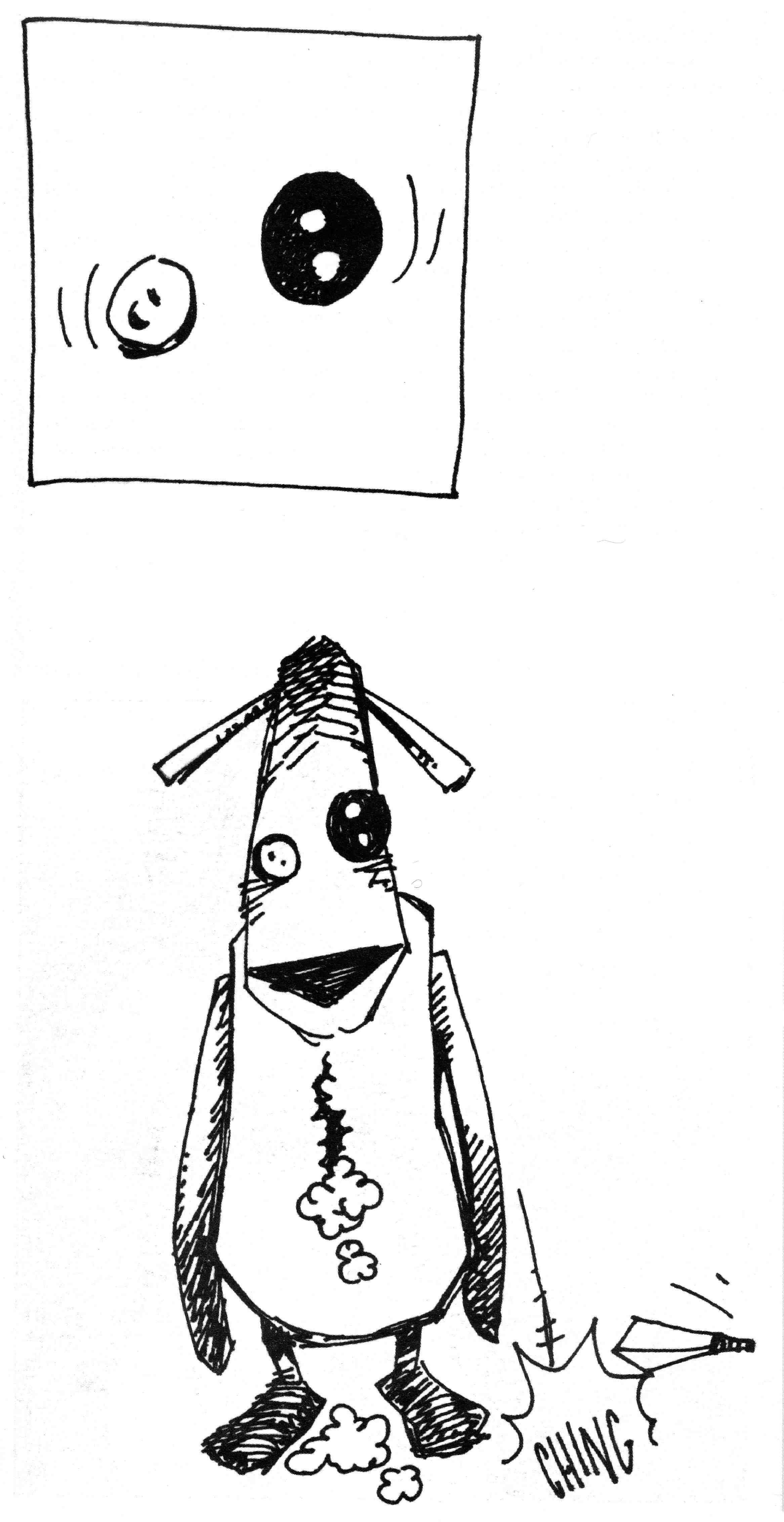
Lightning Strike by Mandy Ord, 1998, ink on paper.
Radiation Sickness by Ross Tesoriero, 1997, ink on paper.
Ah-choo by Neale Blanden, 1997, combined technique on paper.
Jean and Rolly by Timothy John Danko, 1995, collage on paper.
Kurt Hurt’s Reasons to Draw Comix by Stuart Stratu, 1997, ink and whiteout on paper.
Francis Bear by Gregory Mackay, 1998, ink on paper.
Stranger Danger by Ryan Vella, 1997, ink on paper.
Bernard Caleo and Tolley-The False Impressionists, 1997-combined technique on paper.
The False Impressionists by Bernard Caleo and Tolley, 1997, combined techniques on paper.
The Killer Foetus by Ben Hutchings, 1997, combined technique on paper.

It was most significant for my research into Australian comics art to be included in this international exhibition of drawings. In the meantime, I’m endeavouring to establish a minimum three week gap between posts. Perhaps I was a little too enthusiastic in my first year of blogging but I am working on improved scheduling. As always, I would love to hear your response to my posts. This post is the fifth in the series Archives of Australian Comics History…that document moments in the recent history of Australian comics… particularly alternative comics and the Australian Small Press. I started researching this subject in the late 1990s and it eventually led to my PhD thesis: Ph.D. Macquarie University, Division of Society, Culture, Media and Philosophy… A Study Of Contemporary Australian Alternative Comics 1992-2000 With Particular Reference To The Work Of Naylor, Smith, Danko And Ord, 2003. On completion of the research I donated the research materials and comics I had collected to the National Library of Australia, titled the Michael Hill Collection of Australian Comics

(All text-©2012 Dr. Michael Hill a.k.a. Doctor Comics).