Tag: Carol Wood

Archive of Australian Comics History: DOWN UNDER GROUND

Archive of Australian Alternative Comics, Art, Comics February 13, 2013

Underground comics are the subject of this post…in particular Australian alternative comics. I start with a review of an exhibition that Glenn Smith curated at the Orange Regional Gallery, in N.S.W. in 2005. The exhibition was titled The Ink Runs Deep Down, Down Underground. I wrote an essay titled “Art From The Inkubator” for inclusion in the exhibition catalogue.
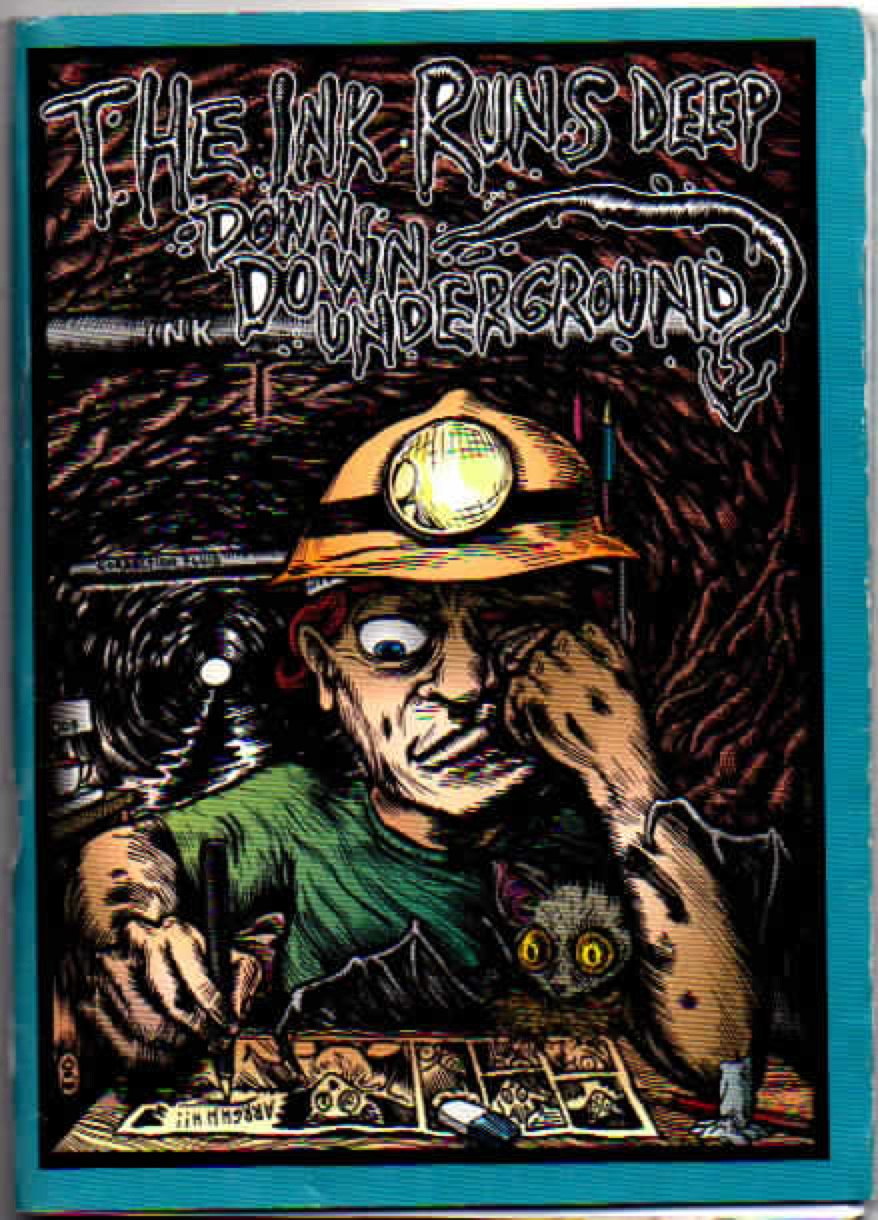
The Ink Runs Deep...exhibition catalogue. (Design by Glenn Smith)
The Ink Runs Deep...exhibition catalogue. (Art & Design by Glenn Smith)

The successive waves of Australian alternative comics produced since the 1980s often feature a raw, spontaneous graphic style. This is accompanied by an irreverent attitude and a D.I.Y. Punk influenced approach to production. It is notably different from mainstream approaches to comics production. These alternative comics can be pluralistic, wide-ranging, antagonistic, mocking and containing taboo themes. The exhibition in Orange celebrated the creative expression behind these comics. Comics art…this much maligned art form…usually consigned to the pop culture trash bin…was hung for exhibition on the gallery wall.

Back cover of the exhibition catalogue. (Design by Glenn Smith)

Creators featured in the exhibition, all 27 of them, are listed on the back cover of the exhibition catalogue, above. They exhibited applications of comics art in a range of mediums from pen and ink to digital imaging. These were applied in animation, painting, posters, book covers and skate boards.

Display of Anton Emdin comics in the exhibition.
Exhibit of Cruel World minicomics by Anton Emdin.
Display of Black Light Angels minicomics by Louise Graber in the exhibition.
Exhibit of Black Light Angels minicomics by Louise Graber.

Noting the emergence of underground comix in Australia in his book Panel By Panel…John Ryan pointed to the social context of the 1970’s. This was a period in which a sense of national pride emerged. This led to a consequent interest in locally made art. That first wave of Australian alternative comics also seems to have been influenced by the North American Underground Comix movement. As in the Abstract Expressionist art movement of the 1950s, Australia seemed to have imported rather than grown, the art. Initially appearing somewhat derivative an Australian style later developed .

Louise Graber with a painting of a panel from her comic Black Light Angels in the exhibition.
Louise Graber with her painting of a panel from her comic Black Light Angels from the exhibition.

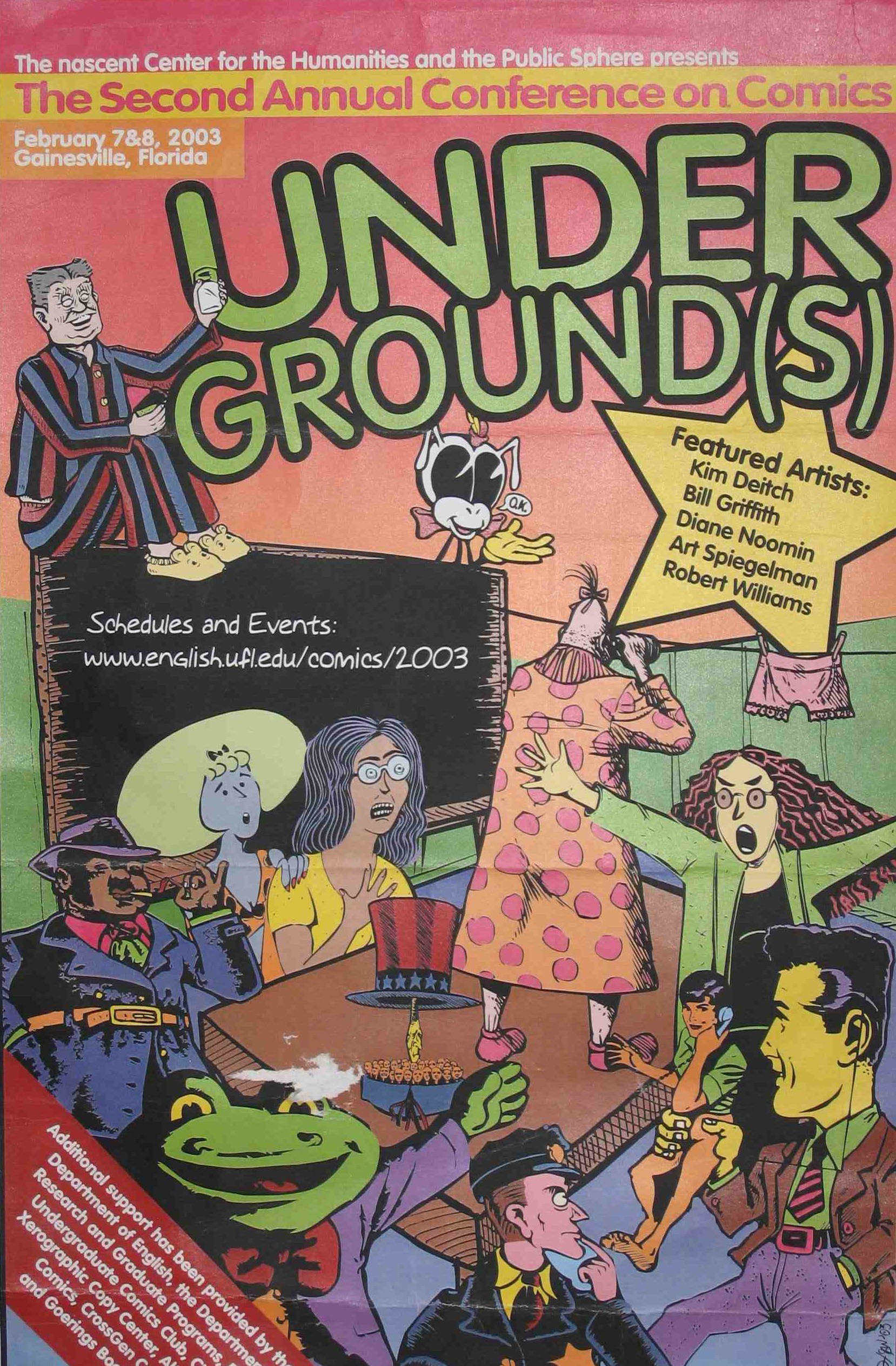
I had attended the Underground(s) conference on Comics and Graphic Novels at the University of Florida in 2003. It was organised by Donald Ault. At that conference I presented a research paper…titled “Down Under Ground: Emotional and Oppositional Outpourings from Sydney’s Subculture in the Comics of Glenn Smith”. Smith’s comics seemed to be an echo of the Underground comix of the late 1960s that began in San Francisco. They were different in style and content to the mainstream North American super-hero themed comics. They opened up the way for autobiographical and artform approaches. At that conference I heard from some of the creative figures from the original Underground(see back cover of program below). It was pleasing to describe Glenno’s work, and argue that it had some resonance with what they had done.

Front cover of Underground(s) conference program. (Design by William S. Kartalopoulos)


Back cover of Underground(s) conference program. (Design by William S. Kartalopoulos)


Underground(s) poster (detail).
Underground(s) conference poster (detail).

Have you read any Underground comics? I’d love to hear your thoughts about them as well as reactions to this post. 

This is the twelth in a series of posts titled Archives of Australian Comics History. They document moments in the recent history of Australian comics, particularly alternative comics and the Australian Small Press. I started researching this subject in the late 1990s. It eventually led to the writing of my doctoral thesis.  Details: Ph.D., Macquarie University, Division of Society, Culture, Media and Philosophy, for the thesis…A Study Of Contemporary Australian Alternative Comics 1992-2000…With Particular Reference To The Work Of Naylor, Smith, Danko And Ord, 2003. On completion of the research I donated the large number of comics I had collected…to the National Library of Australia: Michael Hill Collection of Australian Comics.

(All text, photos and artwork except where otherwise stated-©2013 Dr. Michael Hill a.k.a. Doctor Comics).
Archive of Australian Alternative Comics: TiNA ARENA

Archive of Australian Alternative Comics, Art, Comics September 21, 2012
1999 event: Outsider meetings. (Photo by Louise Graber)

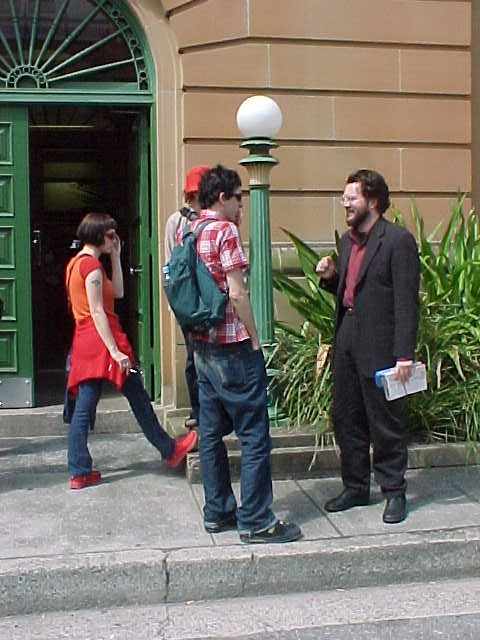
On Sunday 27th September 1998, I drove from Sydney to Newcastle…to attend the two sessions devoted to the discussion of comics at the inaugural National Young Writers’ Festival. Accompanying me were three active members of the Sydney ‘small press’: Stuart Stratu, Anton Emdin and Ross Tesoriero. As there had been no formal attempts to discuss and promote ‘small press’ activity we were impressed with their inclusion in the event. As to its presence in a writers’ festival, there was some uncertainty as comics also has its drawing side. We were also a little curious…as to why the organisers had by-passed Sydney and only invited Melbourne and Canberra based creators! Nevertheless we were curious enough to make the trip. It offered an opportunity to meet with colleagues from interstate. Although familiar with their work, we had never met many of them.

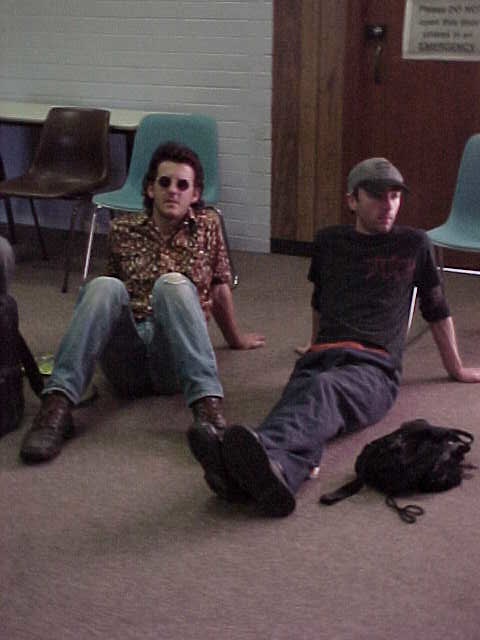
1999 event: Tim Danko, Stuart Stratu, Q-Ray and Kieran Mangan. (Photo by Louise Graber)
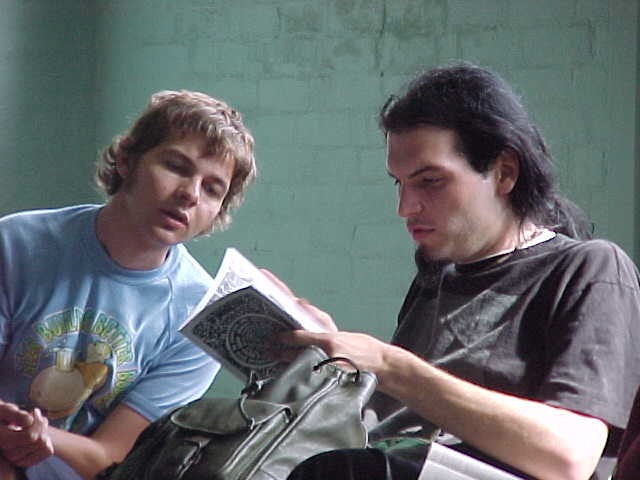
1999 event: Michael Fikaris(Froth) reading minicomic. (Photo by Louise Graber).
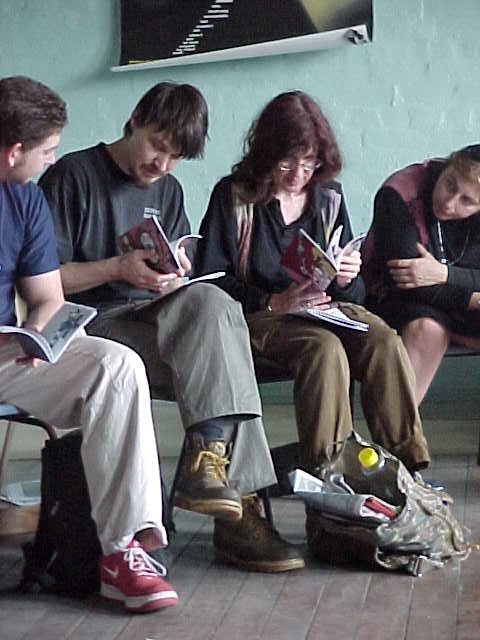
1999 event: Carol Wood and Susan Butcher aka Pox Girls reading minicomics. (Photo by Louise Graber)

The organizational aspects improved considerably over the next few years and the festival developed, expanded and diversified. Originally called the National Young Writers’ Festival it became part of the umbrella event TiNA…the acronym for This is Not Art. This became a multidisciplinary event in the week leading up to the October holiday weekend. It was spread around Newcastle and became known as the TiNa Arena. During the festival weekend the city becomes a catchment area for visiting youth…from a range of artistic, literary, music and media fields all over Australia. I even met a guy who claimed to have walked right across Australia from Perth to attend. I went to five consecutive events from 1998 to 2002…by which time comics discussions had moved into the Town Hall main room. A high point for comics creators is the annual comic and zine fair held on the Sunday afternoon. There was a busy trading event staged in the park then moved into the Mission theatre with accompanying live music.

1999 event: Anton Emdin(If Pain Persists) with Lewis P. Morley and Marilyn Pride(Red World Komics). (Photo by Louise Graber)
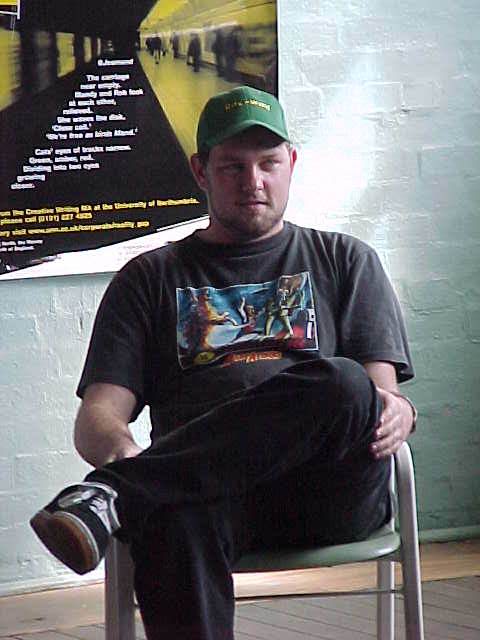
1999 event: Tim Danko(Dead Xerox Press) and Stuart Stratu(Sick Puppy Comix). (Photo by Louise Graber)

On arrival in the city that afternoon in 1998 we easily found the centre of activities laid out in various sumptuously appointed rooms of the Newcastle Town Hall and Civic Centre. There were panels and presentations in the Banquet Room…the Function Rooms and some impressively attired Committee Rooms in the Council Chambers and also at the nearby Wintergarden Cafe. We were, however, unable to find the venue for the discussion of comics. On asking for that information we were directed out of the main building to the back. There it was, a modest room with a few plastic chairs. A few attendees had to sit on the floor. No podium, no lectern, no microphone, no monitor, no vcr, no whiteboard, no jug of water, no media nor reporters were present. Furthermore, this was not a seminar but a workshop. Comics were not so much to be discussed as produced…and if there was to be any discourse it would be on matters of production rather than on content. Then I realised how appropriate all of this was in the then current scheme of things. It was the “accustomed” venue at a writers’ festival for the discussion of comics and it indicated how marginalised the form was. The established, pure literary forms such as the novel and poetry headed the hierarchy. Even emerging word based forms such as e-mail and writing textual content for the Internet and journalism had superior status and were located in the main hall. But comics and zines were out the back and out of sight, so to speak.

1999 event: Happy Pox Girl Susan Butcher. (Photo by Louise Graber)
1999 event: Q-Ray(The Comic Messiah) and Kieran Mangan(Urrgh). (Photo by Louise Graber)
Interested (Photo by Louise Graber)

Things changed over subsequent years. There have been comics events at the Sydney Opera House with international guests…but it was so different back in Newcastle, so ‘underground’, so beneath the radar. Comics were even made during the event in an upstairs, cut and paste graphics studio called Octapod…where minicomics had been produced. At the 1999 event I did a series of interviews with many of the comics creators in attendance. This became research material for my doctoral thesis. In closing, I welcome comments about this blog, especially if you have attended an events like this.

1999 event: Ross Tesoriero(Radiation Sickness). (Photo by Louise Graber)
Event organiser Kylie Purr with Glenn Smith.
Event organiser Kylie Purr with Glenn Smith. (Photo by Louise Graber)

This is the tenth in a series of posts called Archives of Australian Comics History…that document moments in the recent history of Australian comics, particularly alternative comics and the Australian Small Press. I started researching this subject in the late 1990s and it eventually led to my PhD thesis: Ph.D. Macquarie University, Division of Society, Culture, Media and Philosophy…A Study Of Contemporary Australian Alternative Comics 1992-2000 With Particular Reference To The Work Of Naylor, Smith, Danko And Ord, 2003. On completion of the research I donated the materials and comics I had collected to the National Library of Australia: Michael Hill Collection of Australian Comics.

1999 event: Michael Hill aka Doctor Comics. (Photo by Louise Graber)
1999 event: Dr. Michael Hill. (Photo by Louise Graber)

(All text, photos and artwork except where otherwise stated-©2012 Dr. Michael Hill a.k.a. Doctor Comics).
Archive of Australian Alternative Comics: SAVAGE PENCILS

Archive of Australian Alternative Comics, Art, Comics May 30, 2012

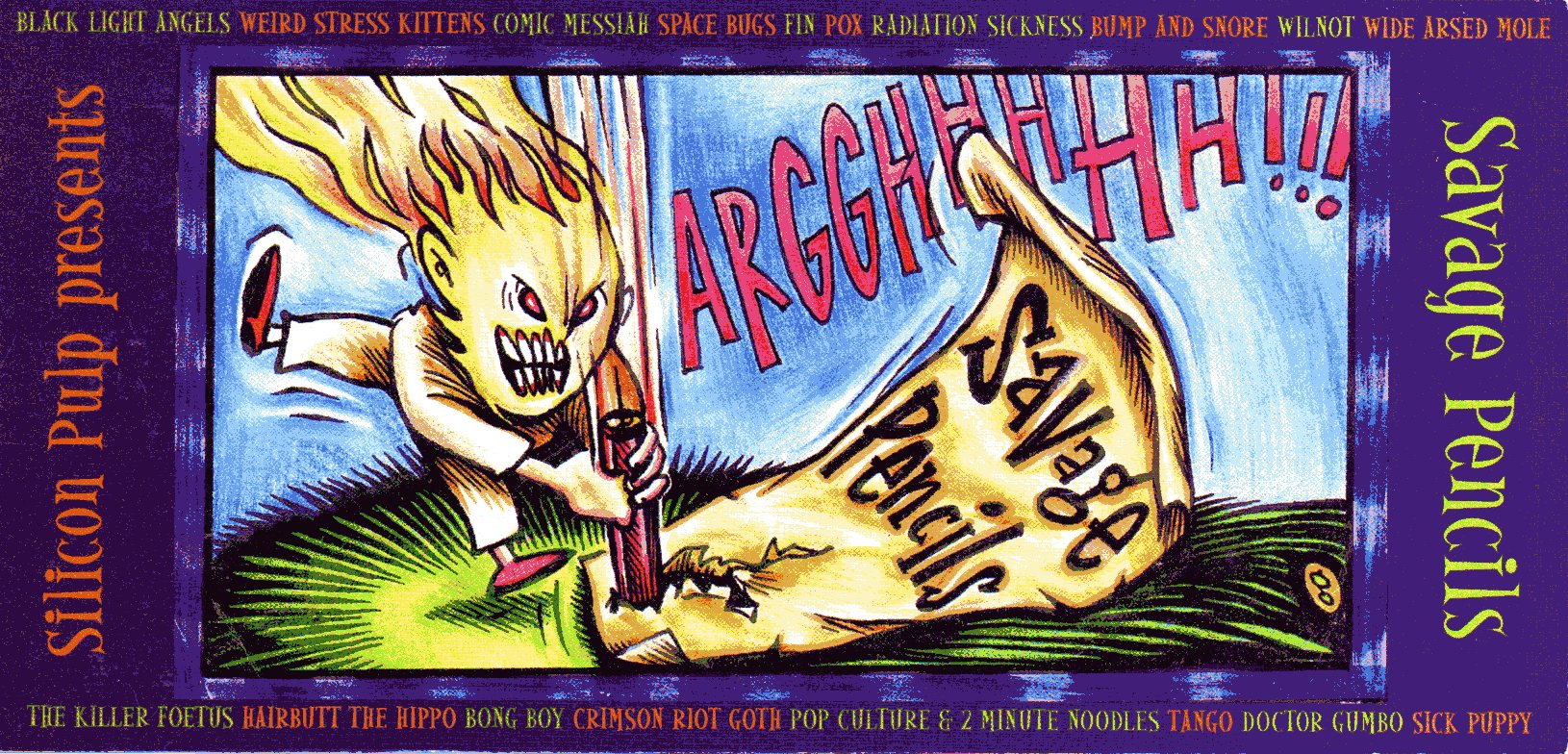
Savage Pencils was an exhibition of contemporary Australian comics cover art that I curated at Silicon Pulp Animation Gallery, Sydney in 2001. It featured original art by Paul Abstruse, Ray Ahn, Gerard Ashworth, Anita Bacic, Xander Black, Neale Blanden, Anna Brown, Bronson Boyd, Susan Butcher, Bernard Caleo, Dakanavar, Tim Danko, Anton Emdin, Michael Fikaris, Edo Fuijkschot, Louise Graber, Ben Hutchings, Scott Johnson, Gregory Mackay, Alex Major, Kieran Mangan, Daniel McKeown, Chris Mikul, Alice Mrongovius, John Murphy, Dillon Naylor, Linzee R. Nold, Mandy Ord, Jason Paulos, Q-Ray, Kirrily Schell, Jan Scherpenhuizen, Shags, Bernie Slater, Glenn Smith, Cipta Tanamas, Dean Tarjavaara, Matt Taylor, Ross Tesoriero, Tolley, Ryan Vella, Kevin Whitfield, Colin Wilson and  Carol Wood.

The invitation designed by Glenn Smith.

The exhibition catalogue contained the essays: “The Broken Pencils of Southeast Asia” by International Journal of Comic Art editor John A. Lent, “Why the Australian Small Press Make Eskimo Comics” by Tim Danko, and my own paper “Sick Puppies With Pencils”.

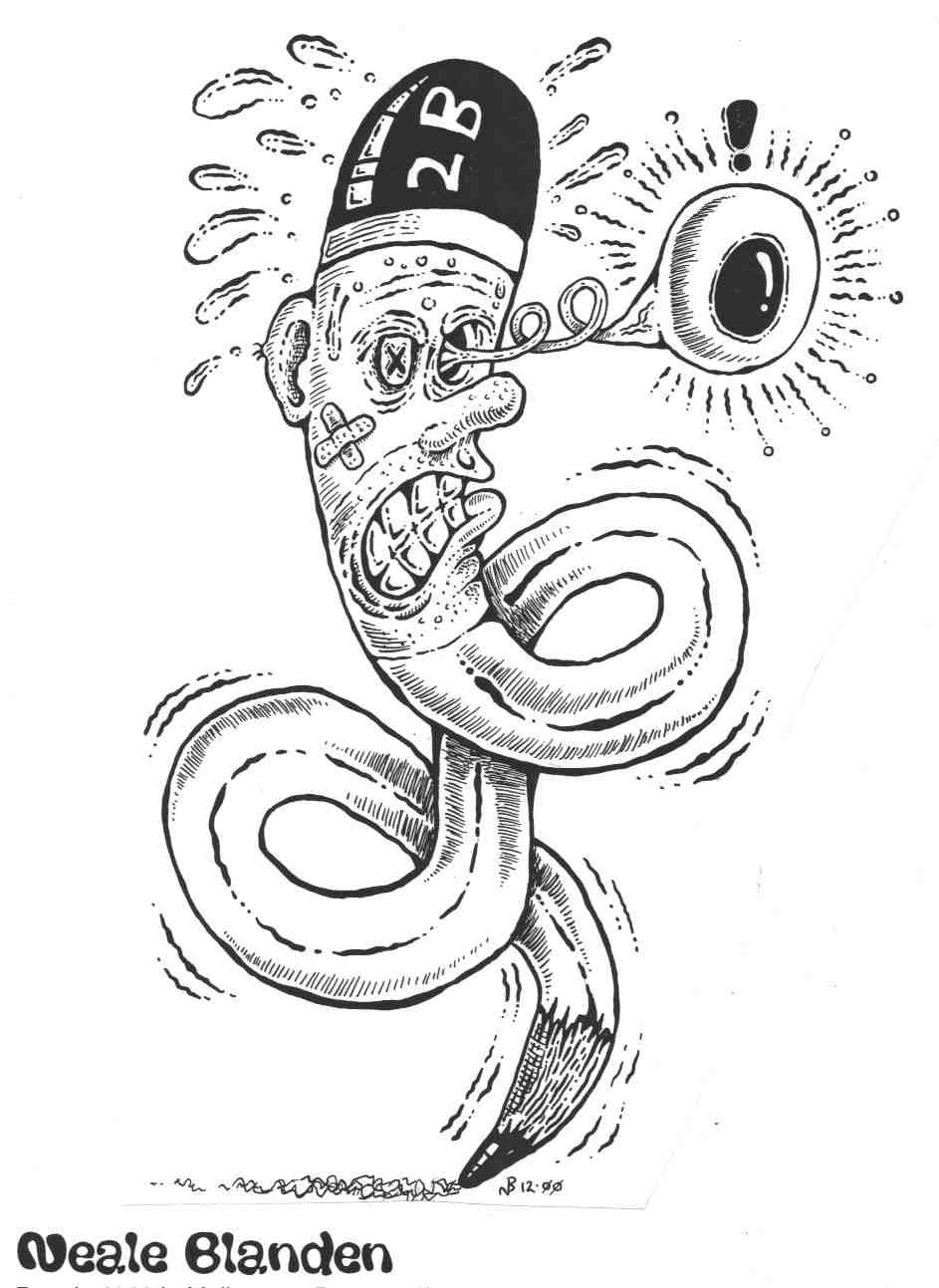
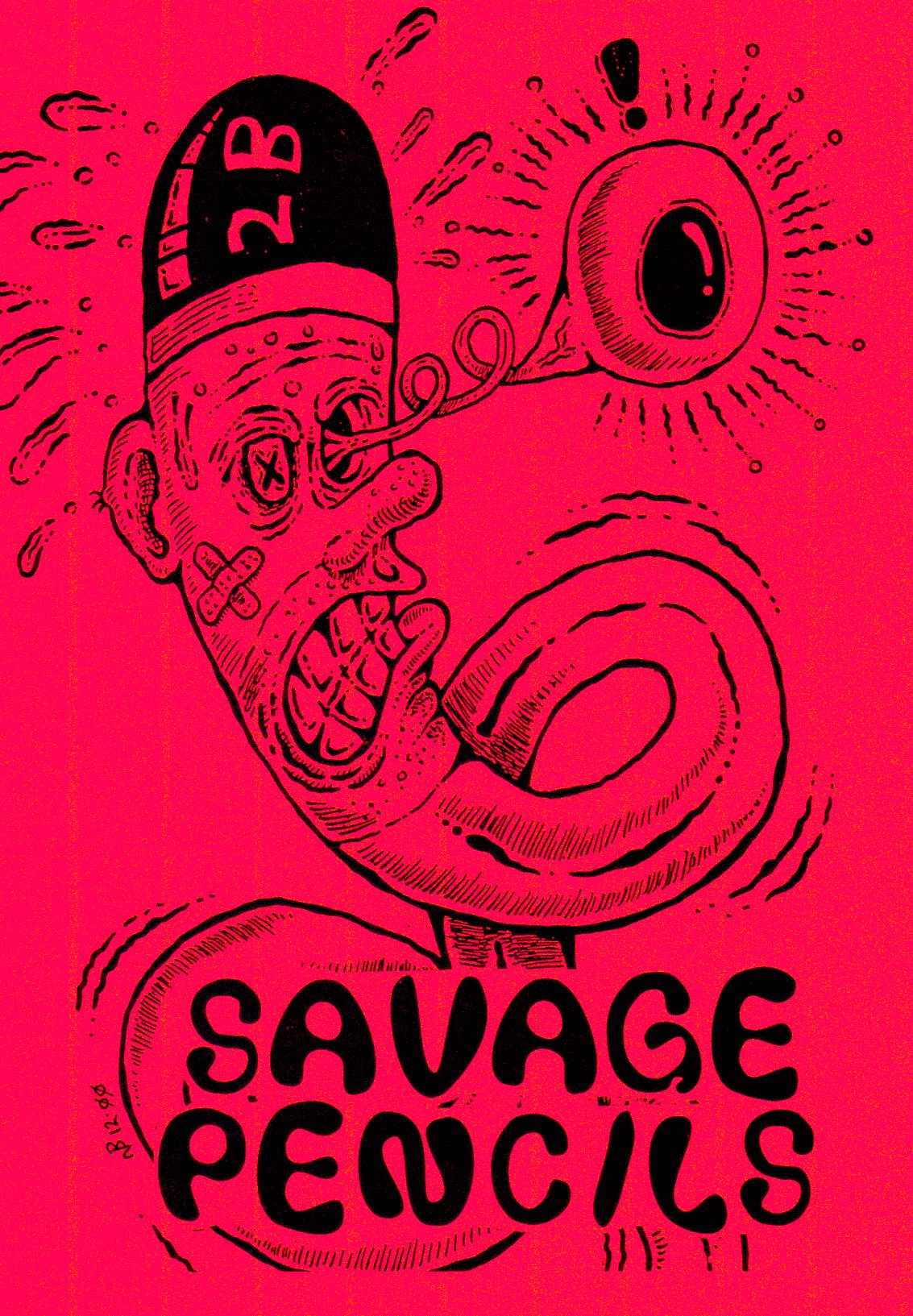
The Neale Blanden illustration was also used as the exhibition catalogue cover.

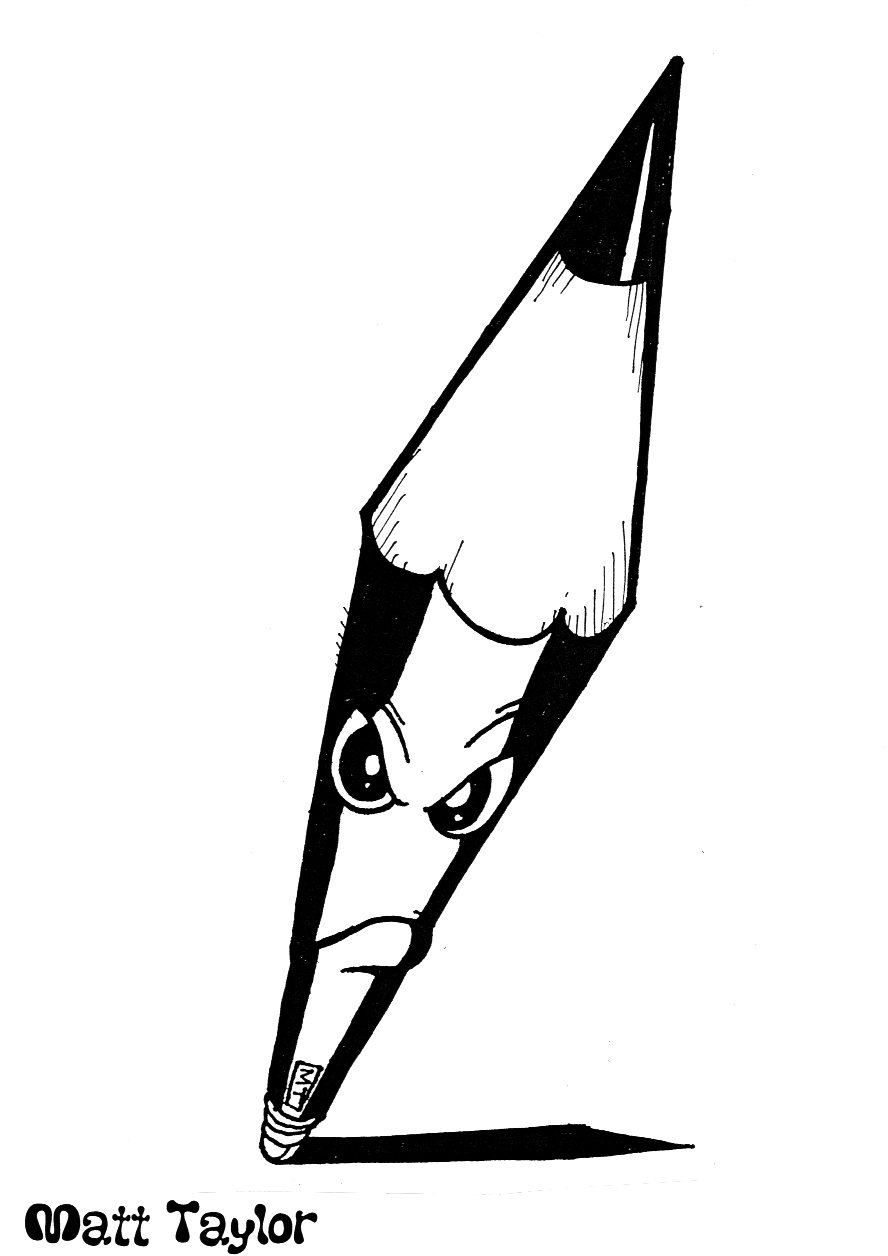
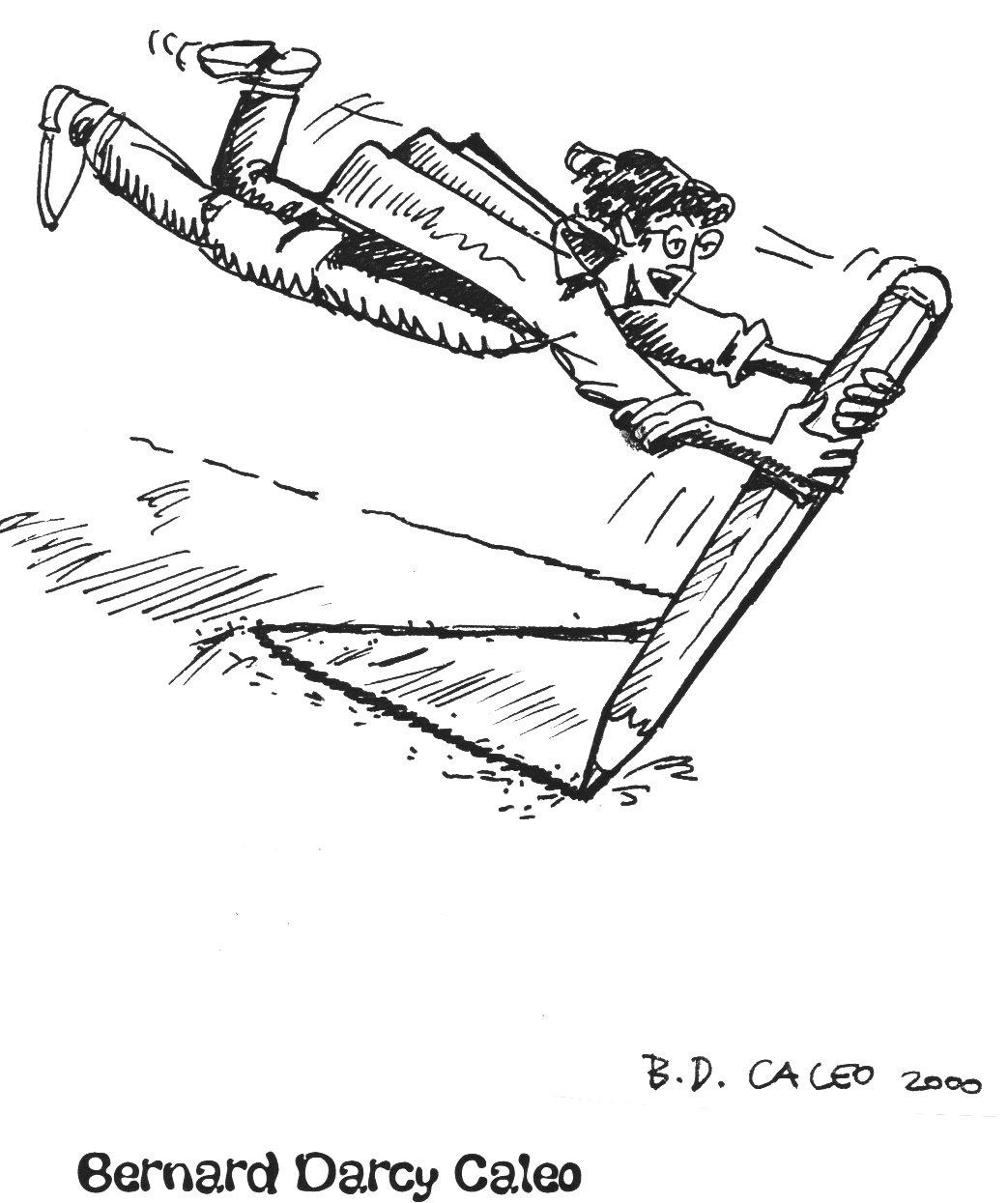
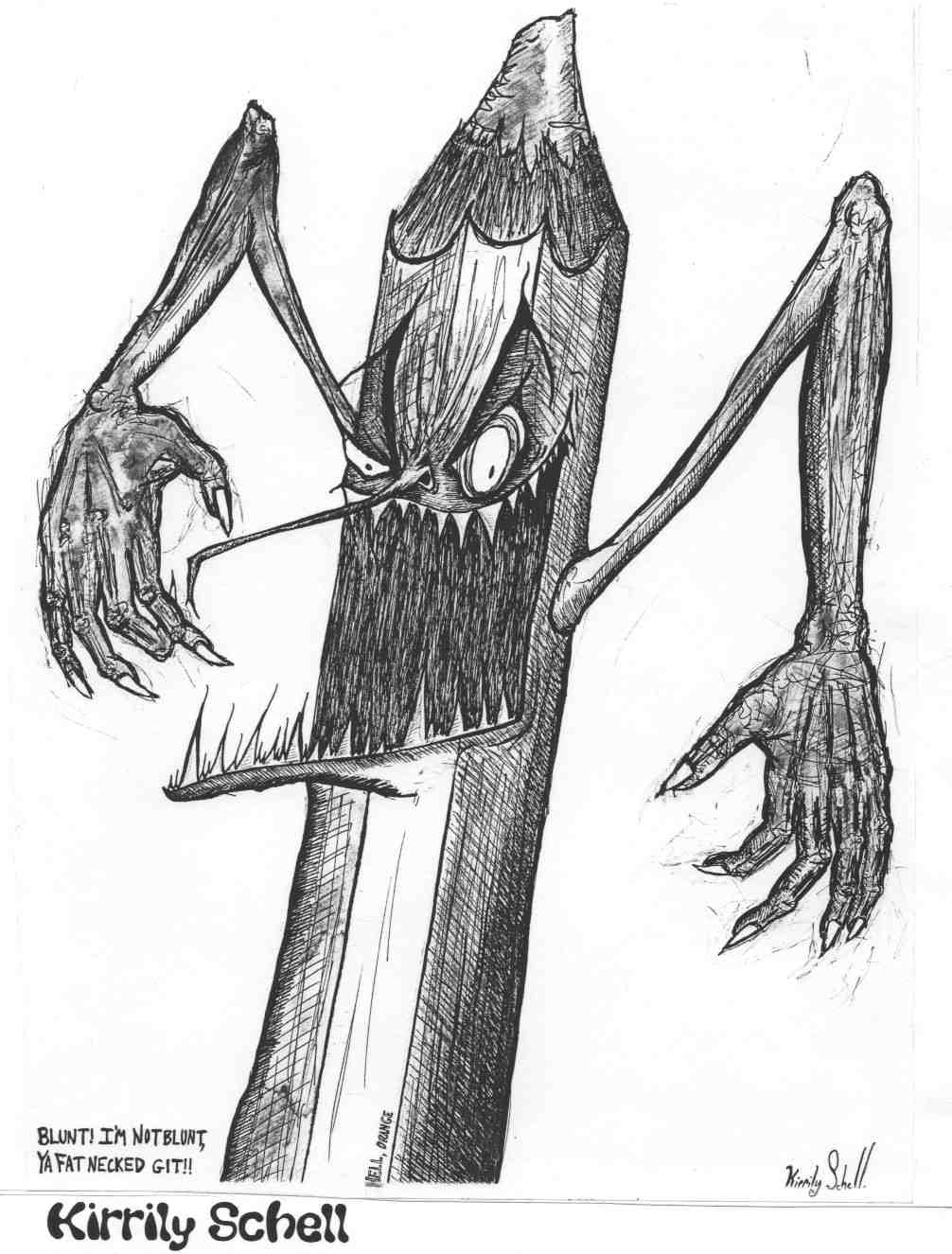
As a playful idea for the catalogue I asked the artists to draw a ‘savage pencil’. Here is a selection. All art is the copyright of the respective creators.

Colin Wilson

Colin Wilson

Butcher and Wood aka the Pox Girls.

Louise Graber

Louise Graber

Ross Tesoriero

Alice Mrongovius

Linzee R. Nold

Shags

Chris Mikul

Chris Mikul

Matt Taylor

Ben Hutchings

Tolley

Bernard Caleo

Bernard Caleo

Ryan Vella

Kirrily Schell

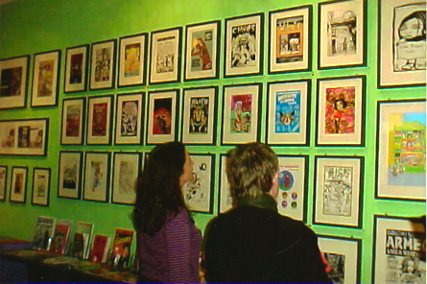
The notion of collecting comics art is a recent but growing trend in Australia. This exhibition offered 50 works ranging from the mainstream to the the avant-garde, from 44 artists representing every State of Australia except the Northern Territory. Some of the cover art was displayed on the gallery’s website.

Exhibition installation view. (Photo by Louise Graber)

The exhibition catalogue with cut-up Neale Blanden illo on the cover.

The exhibition catalogue with cut-up Neale Blanden illo on the cover.

The title for the exhibition was taken from the alias of Edwin Pouncey, an English comics creator of the early 1980s whose ‘punk’ style of graphics proved inspirational to alternative cartoonists. This show celebrated drawing, a precious commodity in an age of appropriation and scanning, and the creative expression that drawing is given in comics. Here the drawing was both art and pop culture trash and very affordible.

Massive thanks to the people at Silicon Pulp! What they have done for local creators of comics art is immense! And to the artists, whether you exhibited, attended the exhibition or just read my blog post on it, I would love to hear your thoughts. This is the eighth in a series of posts called Archives of Australian Comics History that document moments in the recent history of Australian comics, particularly alternative comics and the Australian Small Press. I started researching this subject in the late 1990s and it eventually led to my PhD thesis: Ph.D. Macquarie University, Division of Society, Culture, Media and Philosophy, A Study Of Contemporary Australian Alternative Comics 1992-2000 With Particular Reference To The Work Of Naylor, Smith, Danko And Ord, 2003. On completion of the research I donated the materials and comics I had collected to the National Library of Australia: Michael Hill Collection of Australian Comics.