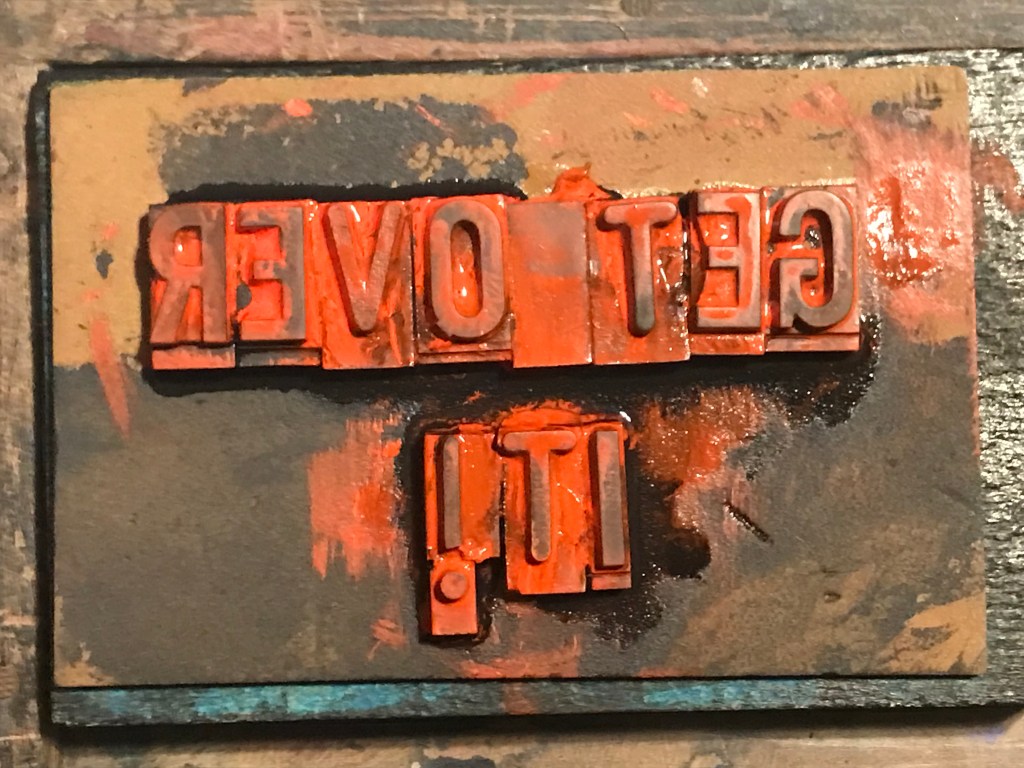
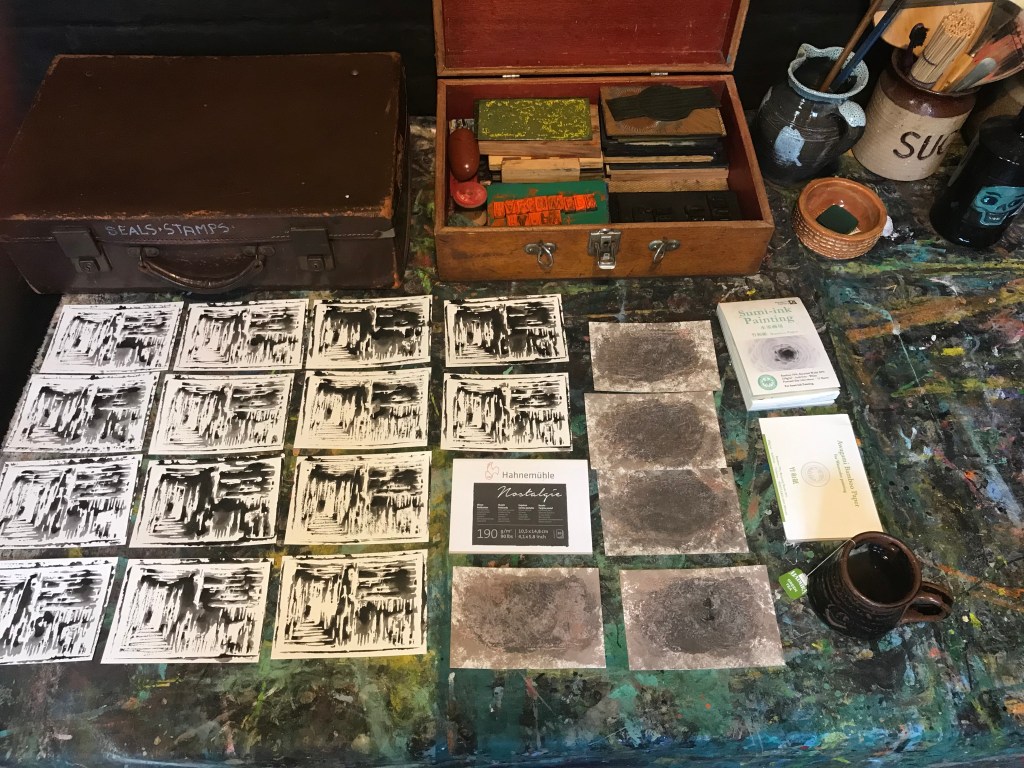
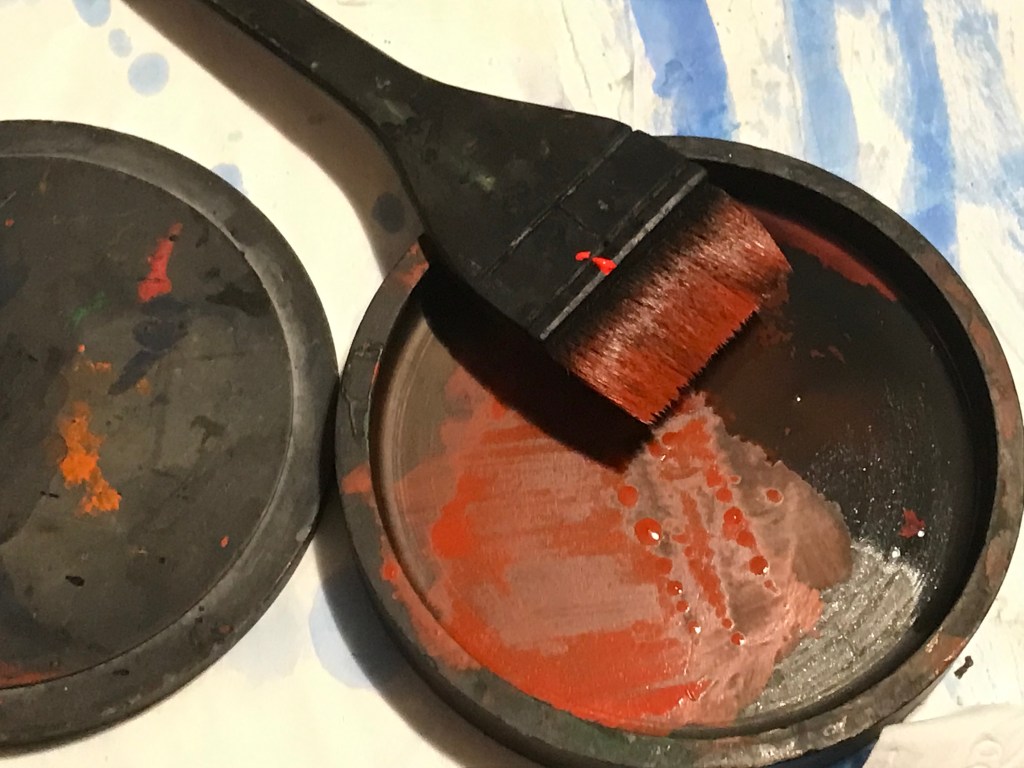
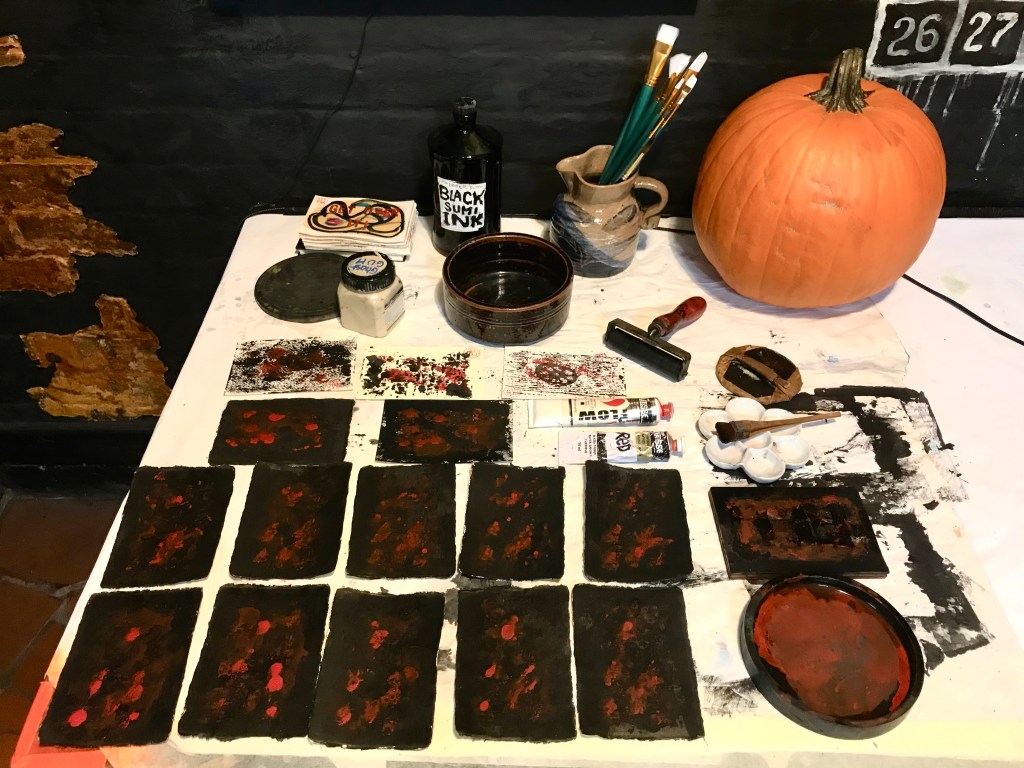
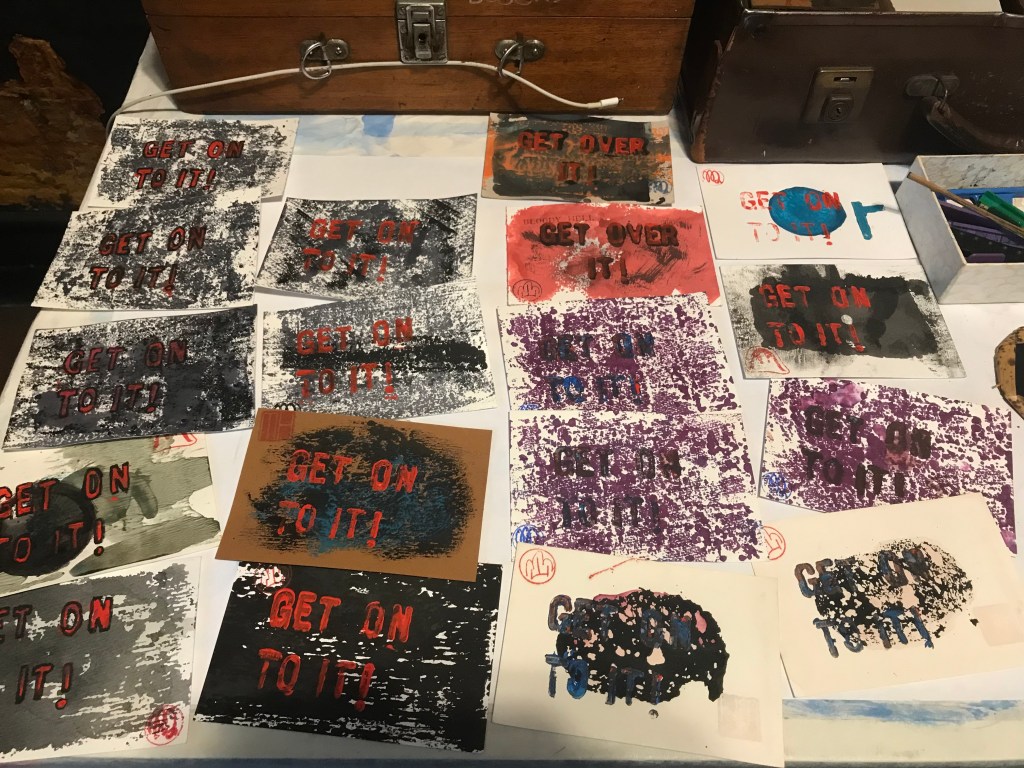
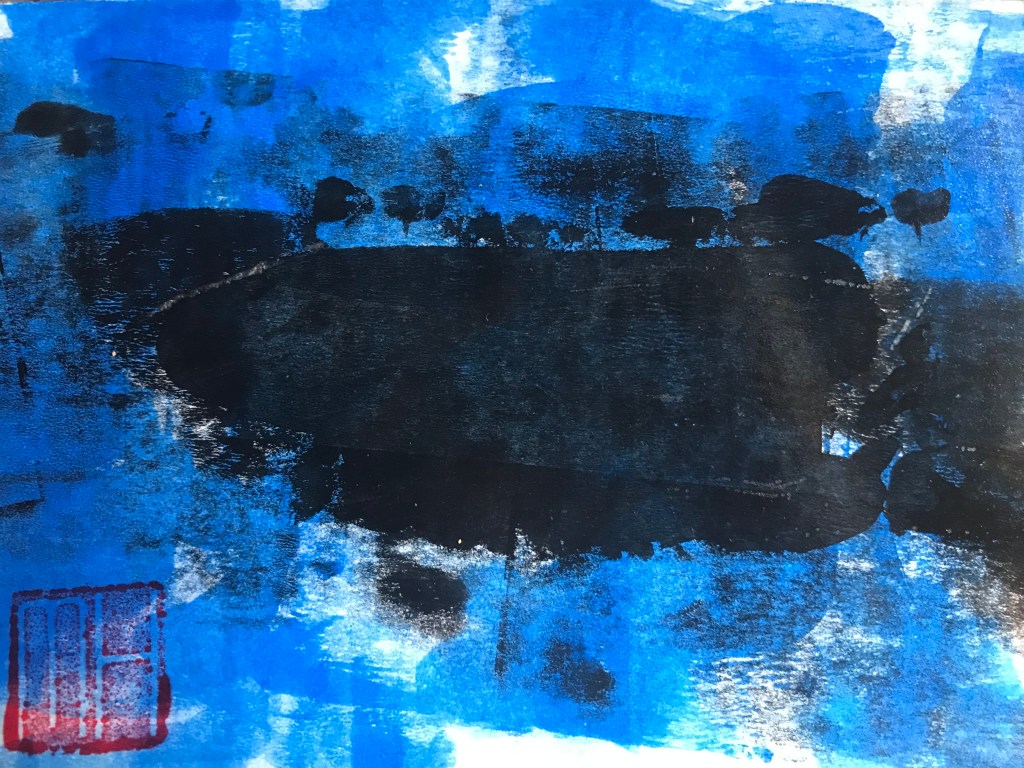
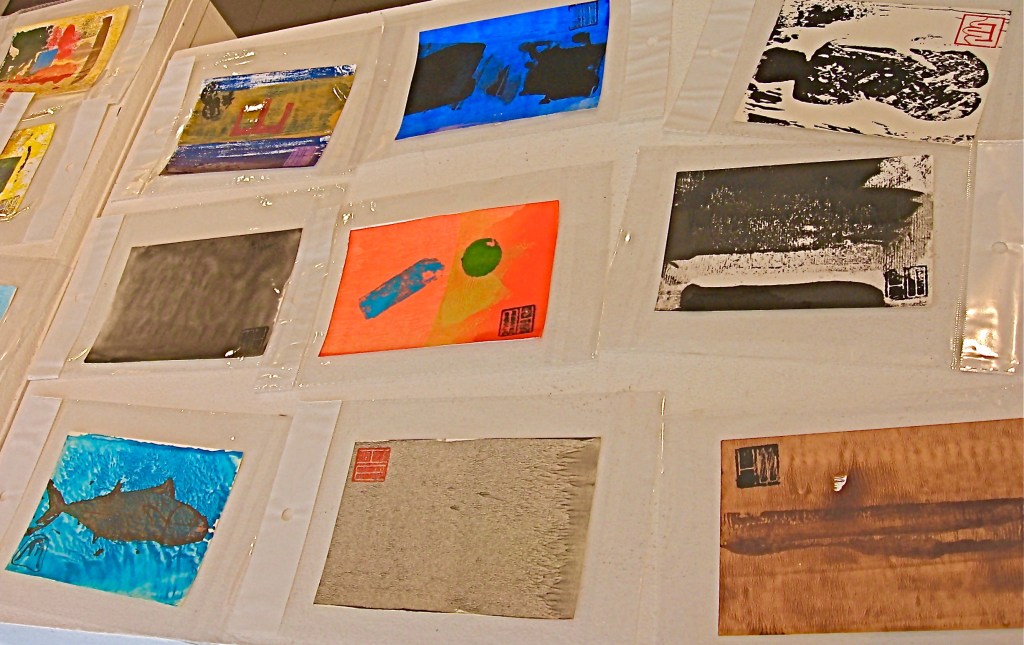
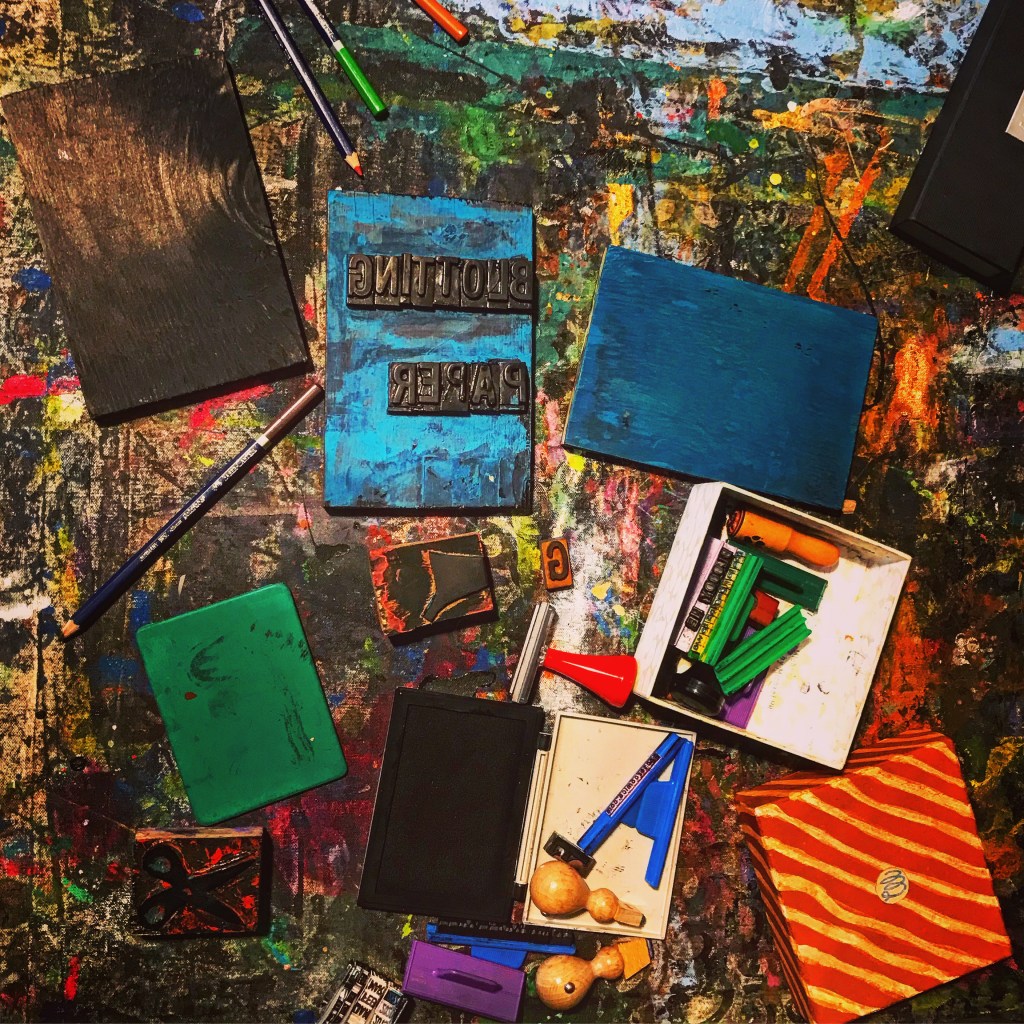
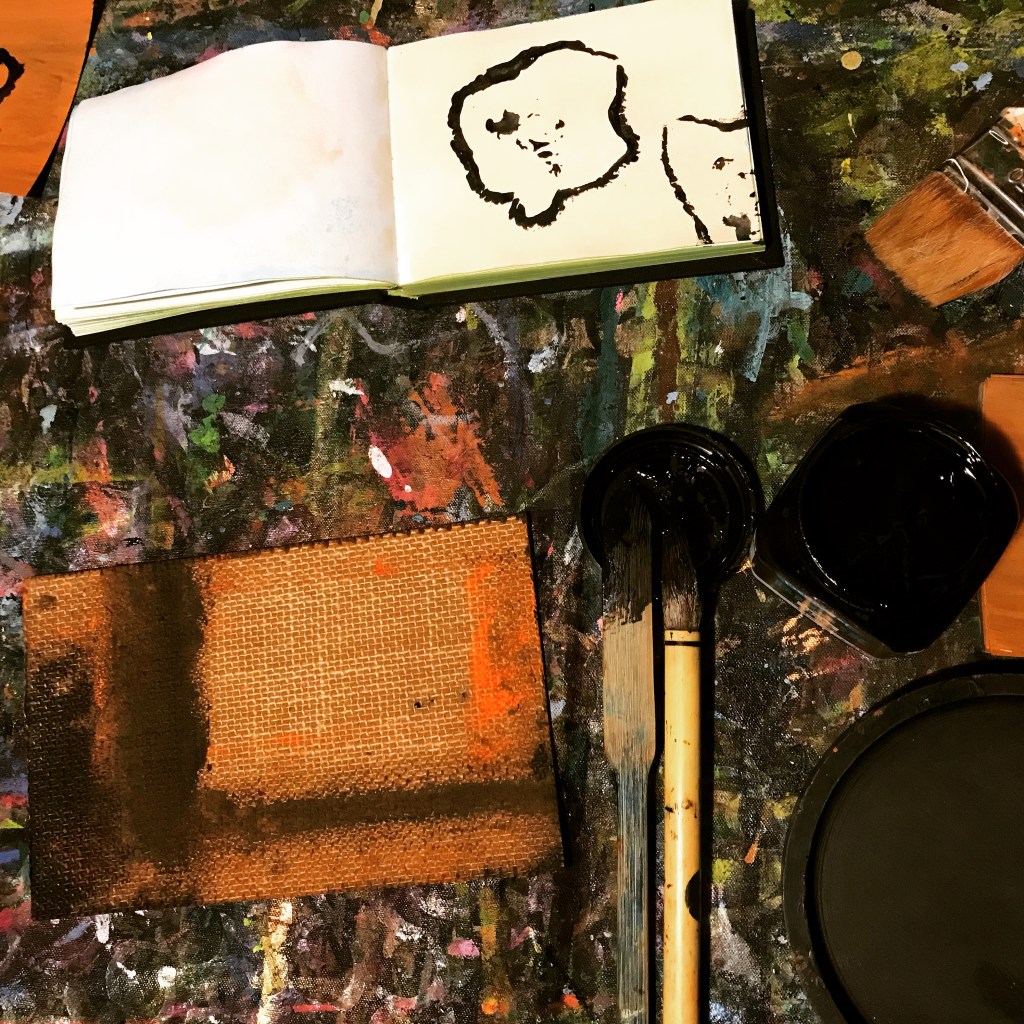
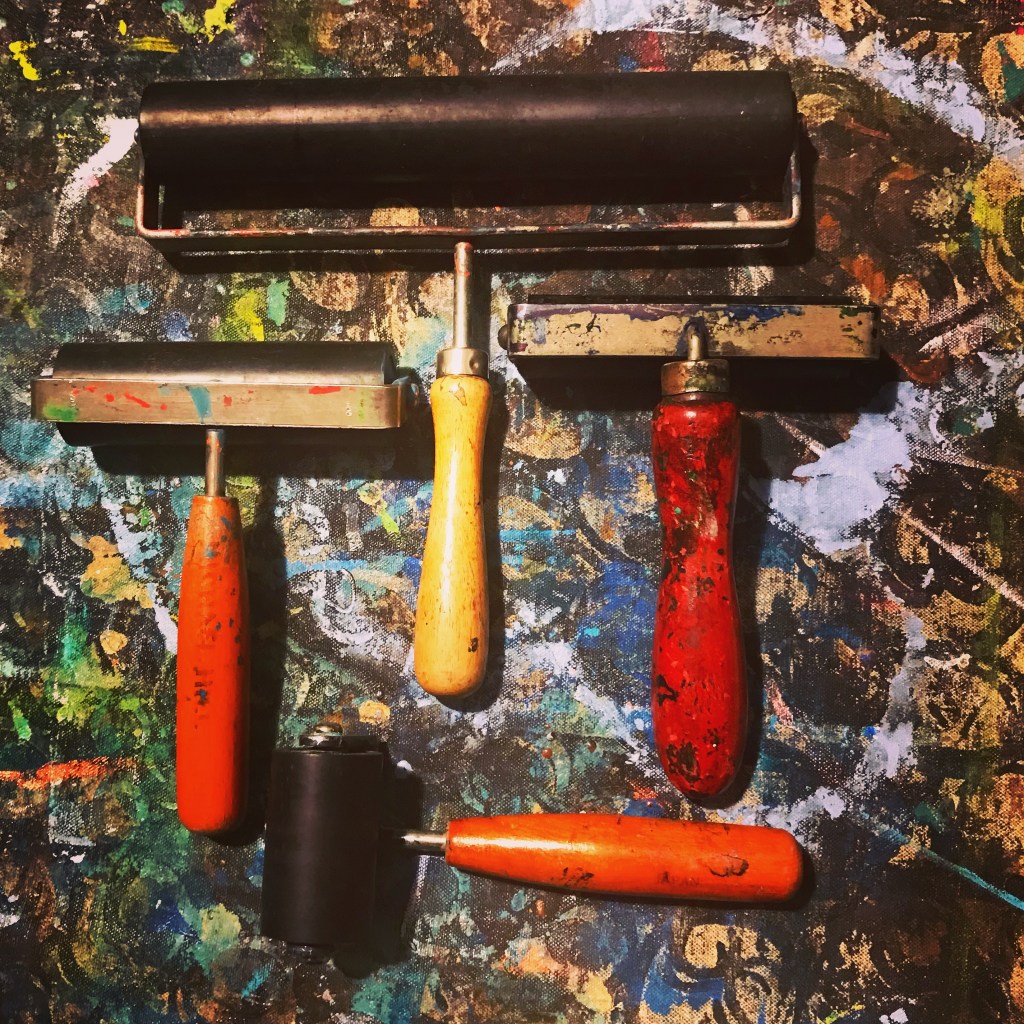
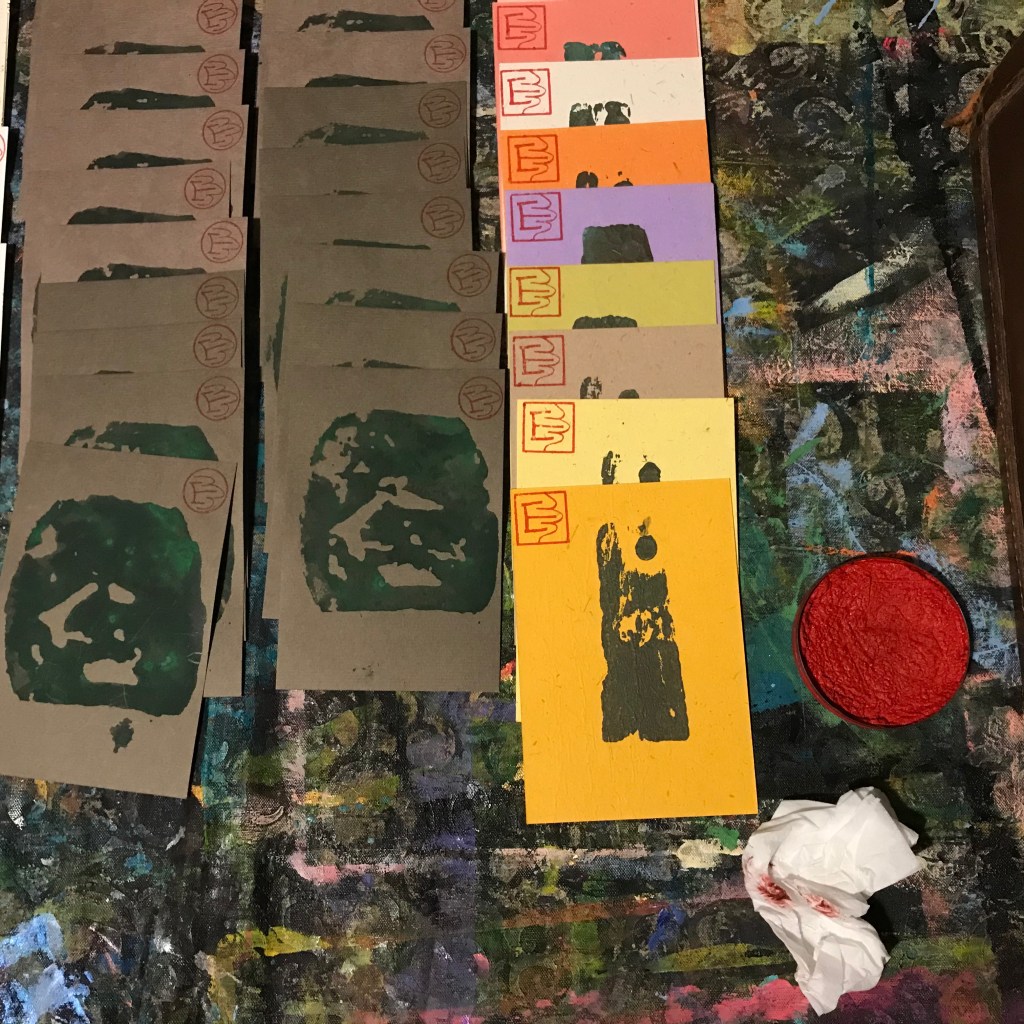
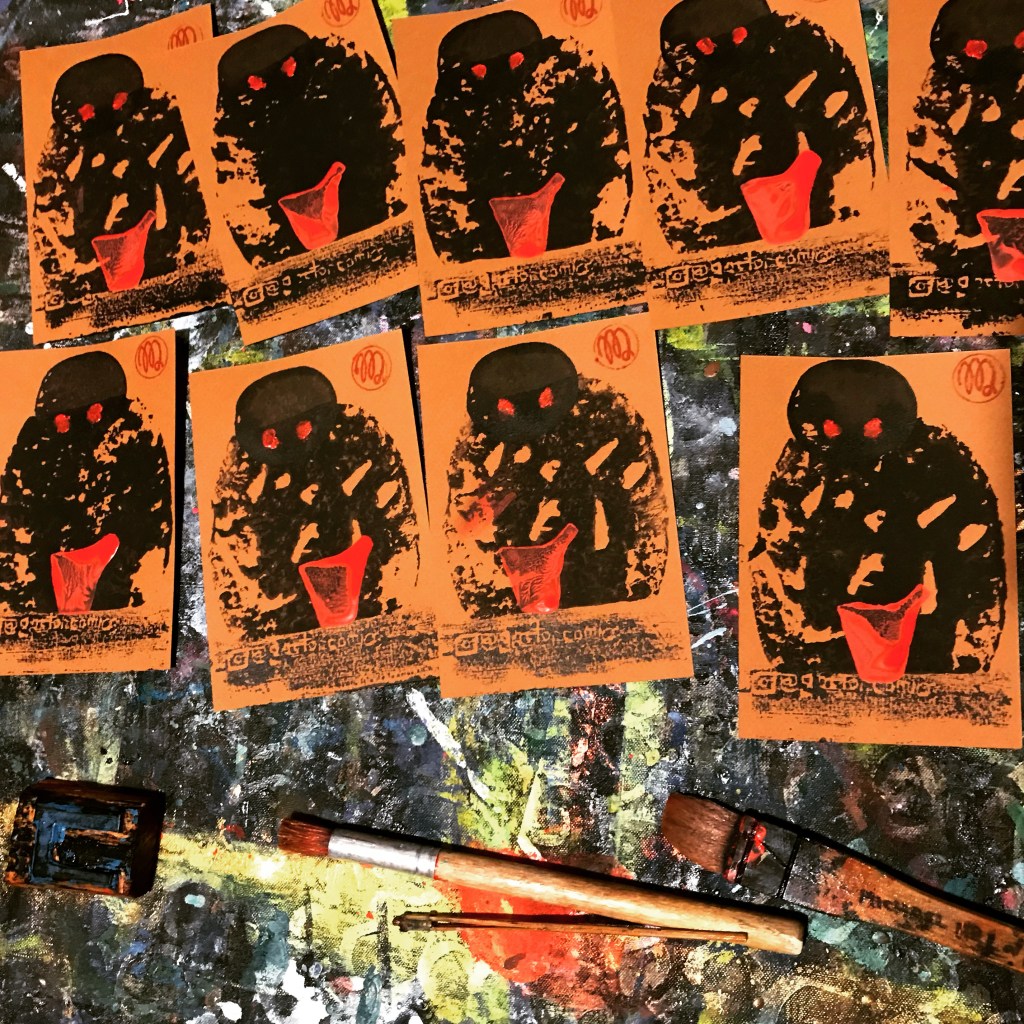
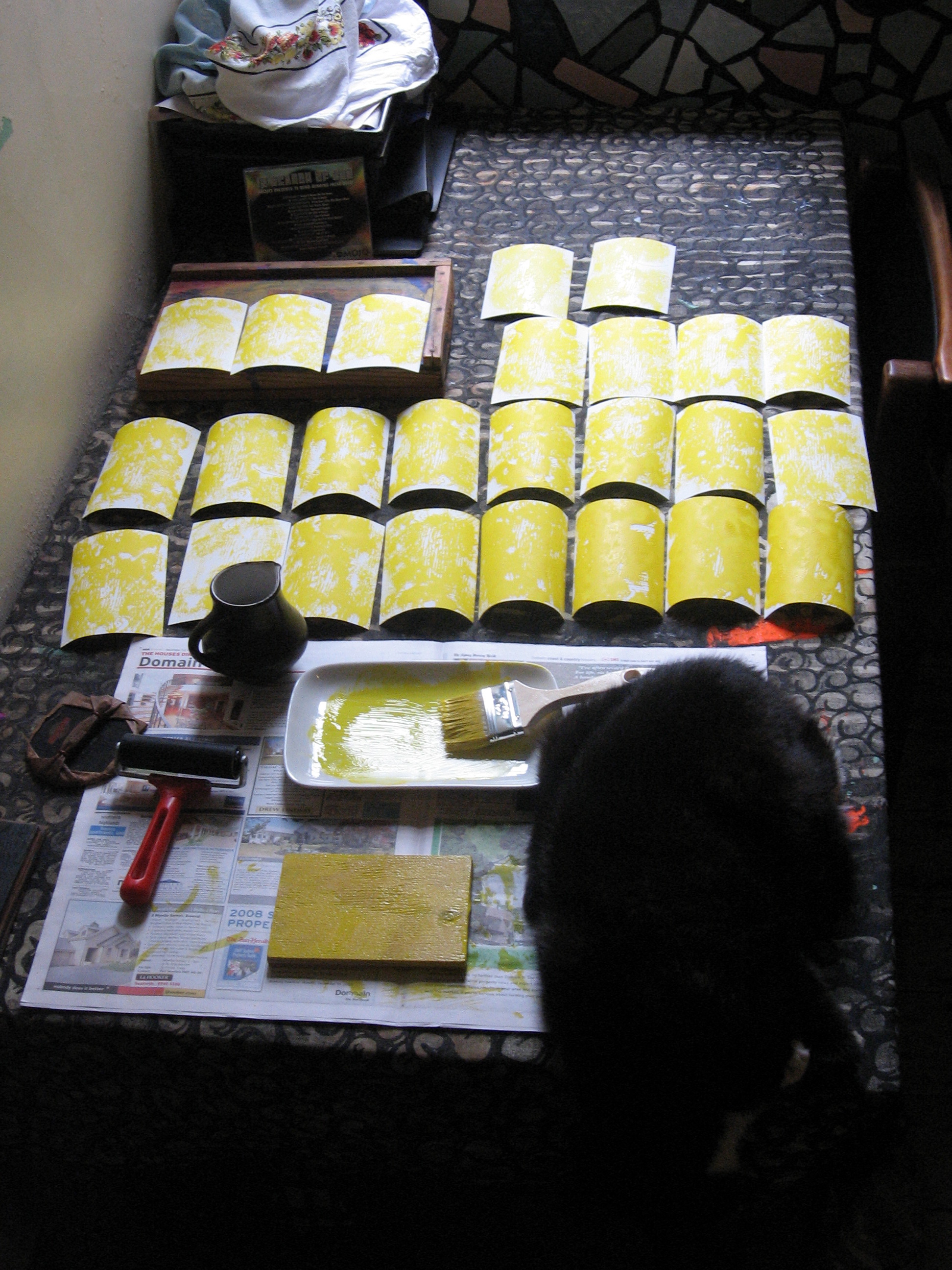
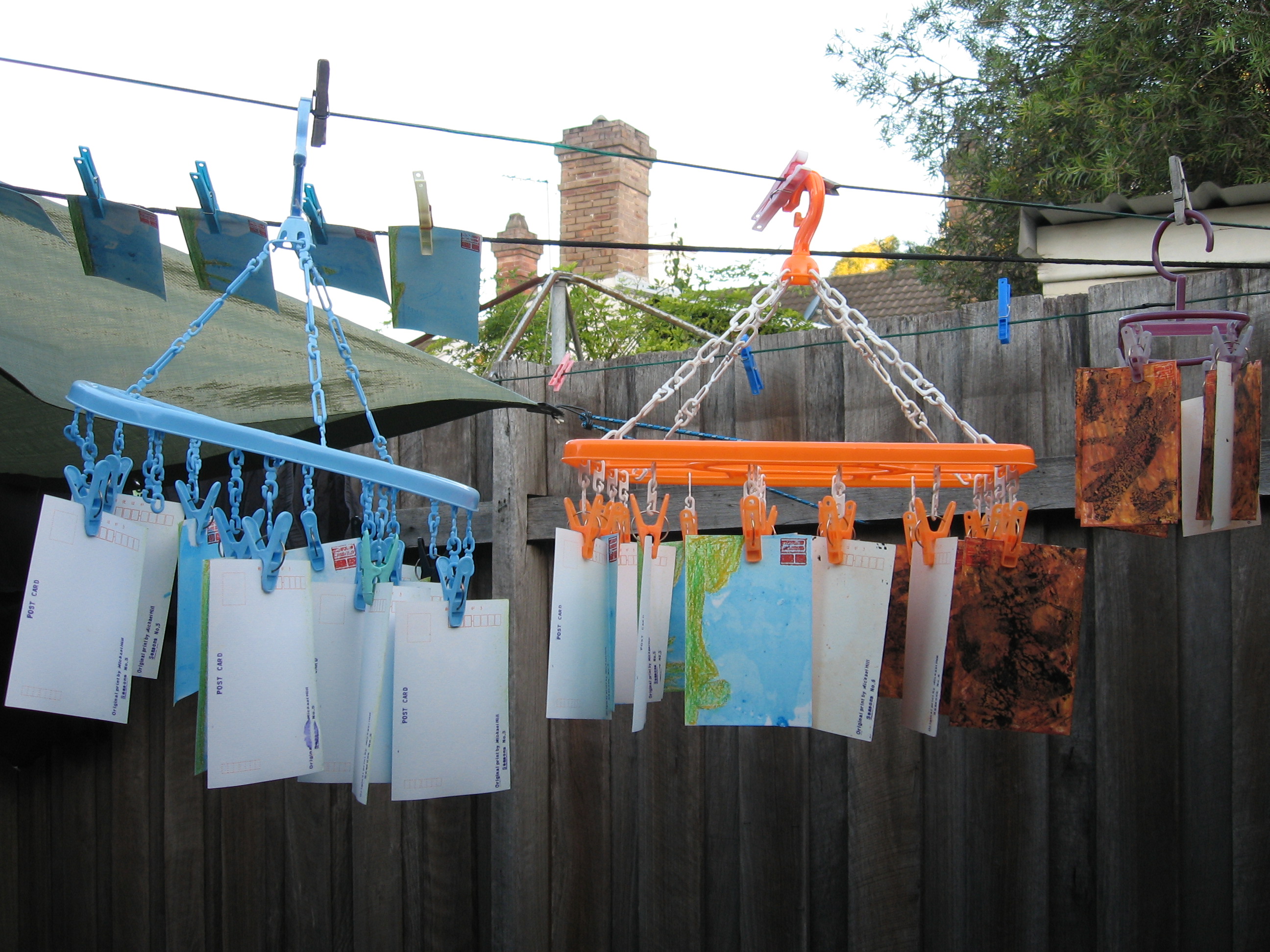
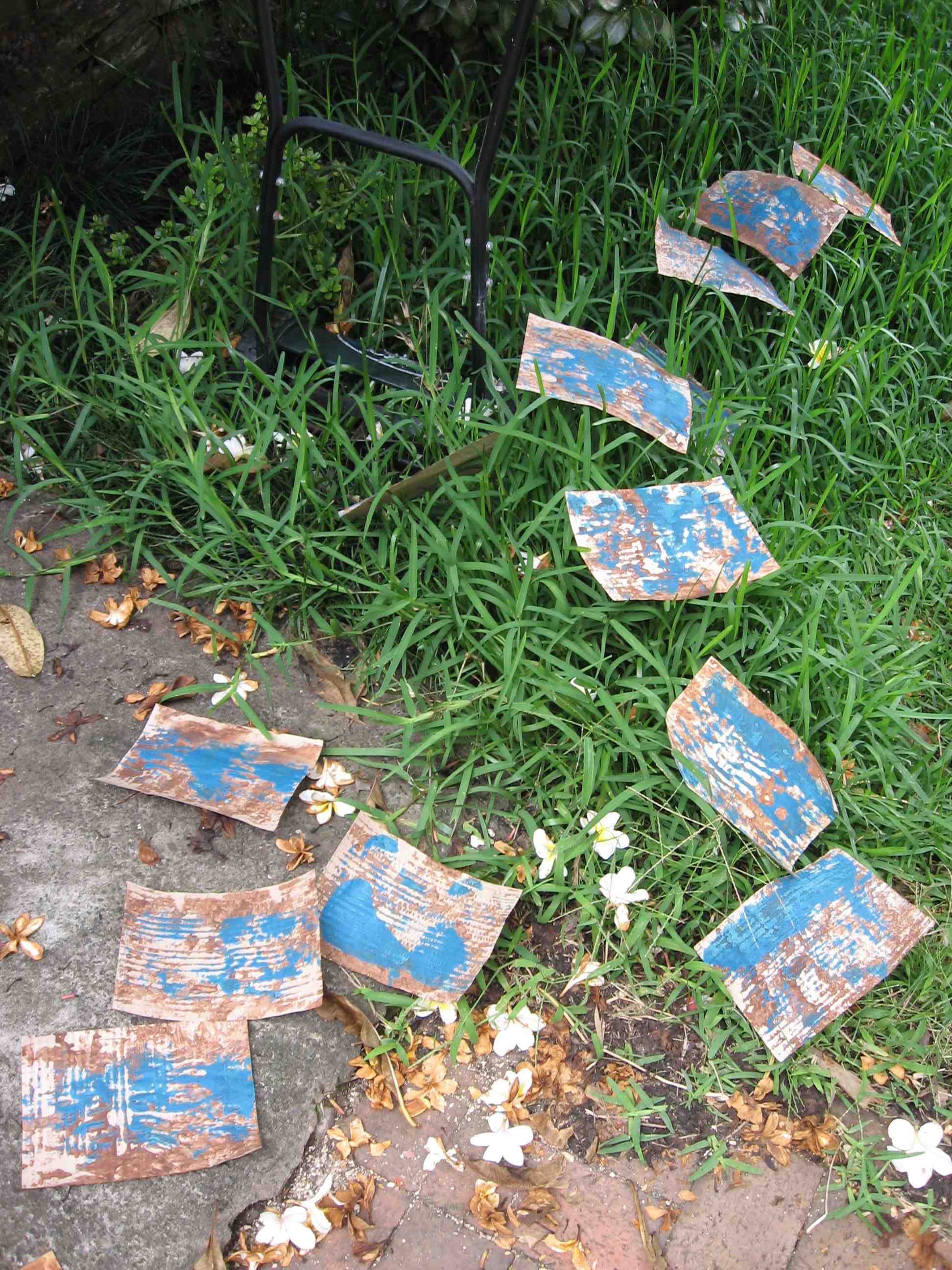
This post profiles recent experiments in my creation and design of some ideas for art postcards whilst working in my studio and employing drawing, painting and printmaking techniques with experimental and uncertain outcomes. I love working in the studio and particularly in the post card production process, especially as it involves printmaking. I do small runs of prints, usually less than 50, although each card may go through the run multiple times depending on the number of layers, as indicated in some of the photos below.
A rough sketch idea for the design of a postcard. This one remains at that draft stage.Type overlay for postcard that has already received a base layer(s). This one will be the top layer….perhaps?Two different designs with the one on the left having received its base layer whilst the one on the right has had two printed layers: base plus overcoat.Sumi ink dish being used as a paint pot with red ink and Hake brush.The black postcards in the foreground have had two print layers whilst the three cards alongside them have had three and the stack of post cards at the top left, having dried, have had four.The pumpkin just happened to visit the studio around Halloween time.A selection of different postcards most of which have had two runs through the printing process. Note also the addition of my artist stamp, at top left or bottom right, on some of the cards. As I have previously stated, making art postcards is one of my favourite artistic activities that I have been doing it for more than a decade. I also plan to do more posts on this topic.
(NOTE: Further additions and editing to this post are anticipated in the near future…including the completion of it!)
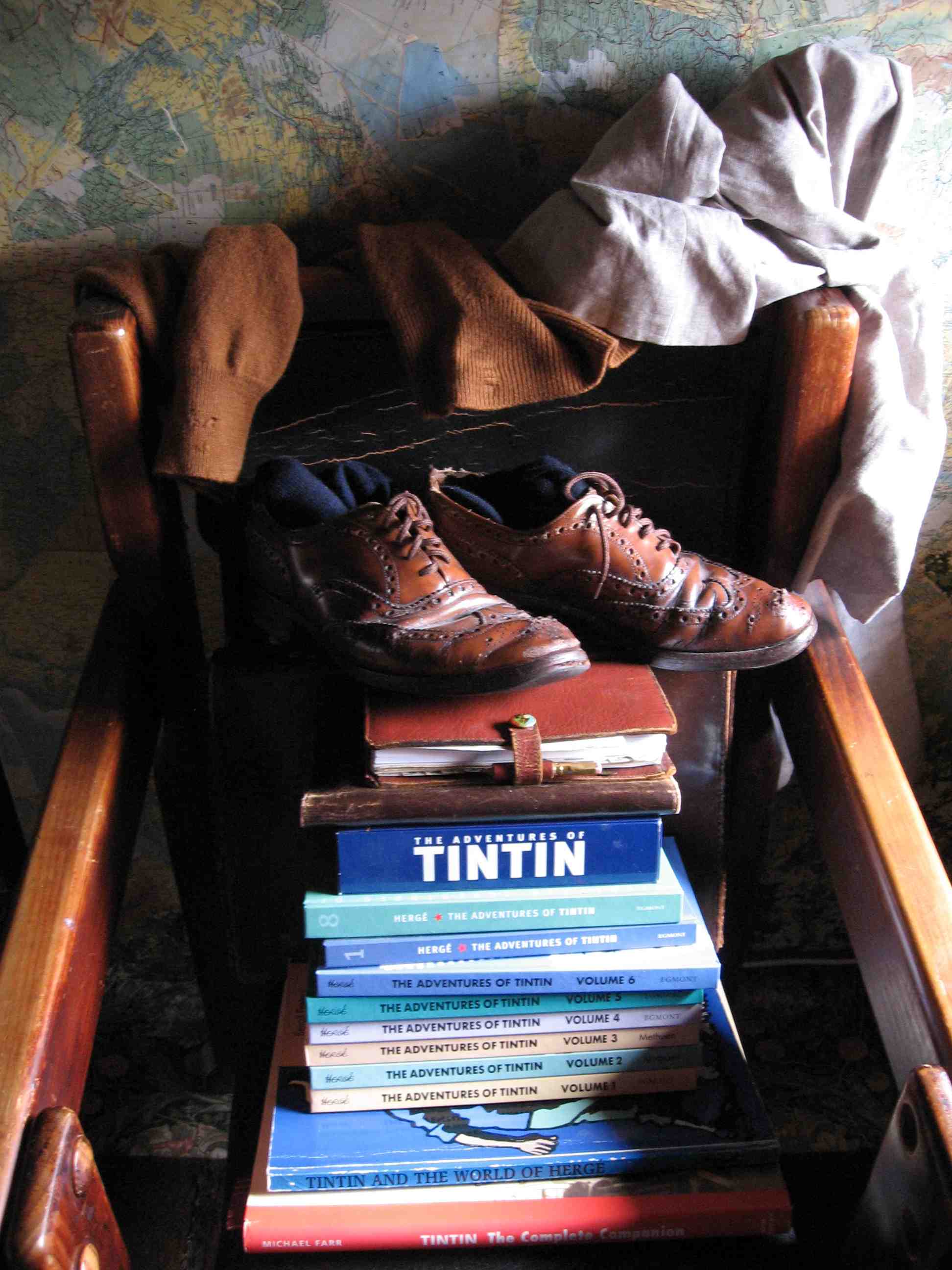
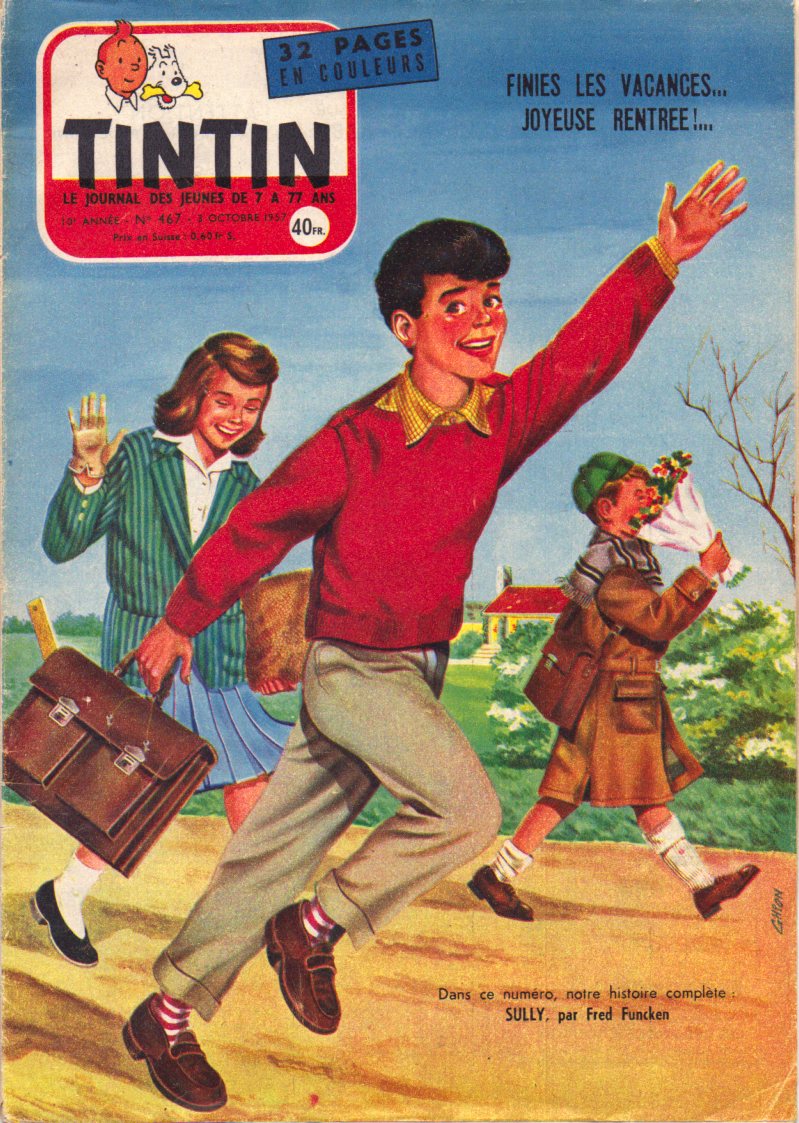
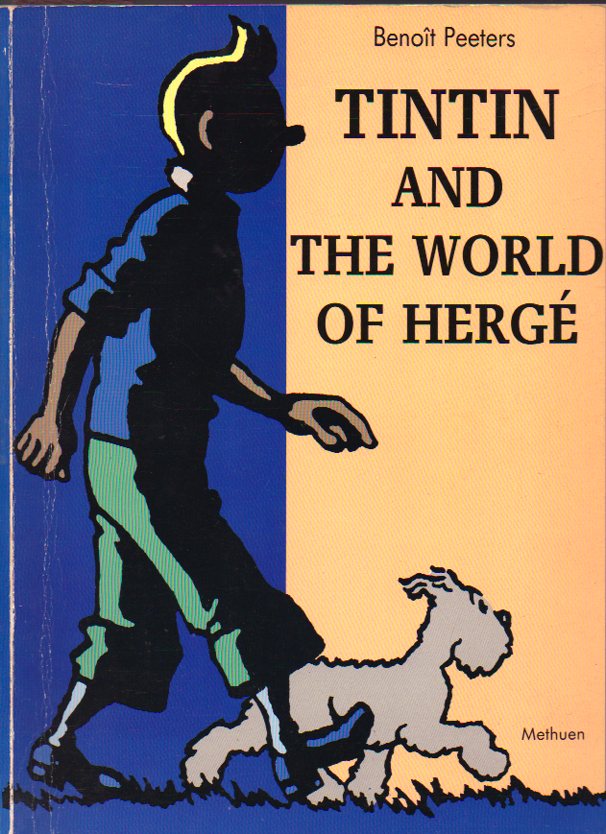
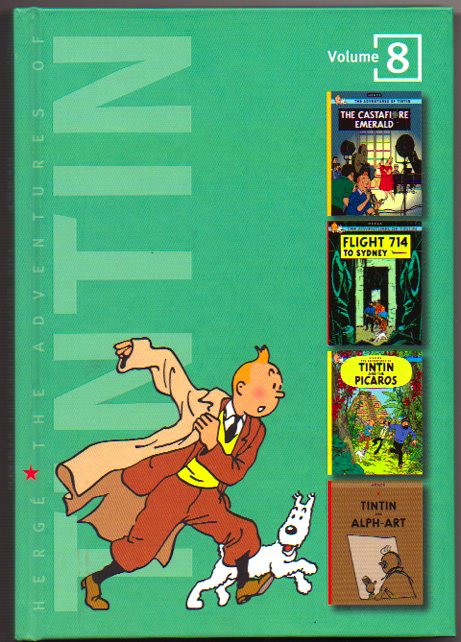
This previously published post has been re-edited and transferred to this newly added RESEARCHING COMICS ART series. It documents articles and items from my comics art library research collection. This particular post focuses on Hergéand his creation Tintin. I have collected and read a complete edition of the albums, including the unfinished final one. I also have a copy of the Tintin magazine Le Journal Des Jeunes De 7 A 77 Ans. I have viewed the complete Adventures of TINTIN DVD set. My bande dessinée franco-belgeexhibition review has been included in this post (see below). I have also acquired a few items of clothing related to the character. In my experience as a researcher, it is always useful to approach one’s subject with an open, playful attitude.
The Adventures of Tintin albums…24 in all including the unfinished final one, were executed in the ligne clair (clear line) drawing style. This was developed by Hergé and his colleague and collaborator Edgar Pierre Jacobs. I missed the opportunity to read these as a child. Two kind aunties occasionaly bought me American comics by Carl Barks and Hank Ketcham and “boys papers” from England. These included The Eagle with a Dan Dare feature story on the cover that inspired my interest in Space travel…plus a The Adventures Of Tintin episode in the centre-spread. Another weekly they bought me, TIGER and Hurricane, with a Roy of the Rovers episode, started my love of football. My father read the occasional war and western comics and the comics lift-out section of the Sunday Mail newspaper. That was when my interest in comics really began to develop. I found it a fascinating form of storytelling, combining writing and drawing.
My English lessons at Primary School and later in Secondary college prioritised words in reading rather than accompanying illustrations…although maps always seemed to be given at least a cursory glance. Consequently, when I started reading comics I automatically read and prioritised the captions and word balloons…before proceeding to look at the drawings. Sometimes I even skipped from panel to panel following the text and only cursorily scanning the images. It took me a years to unlearn this ‘upside down’ approach…and alter the balance of attention between words and images! Ultimately I learned to look at a comics page and individual panels holistically…one that included both image and text, sometimes even obtaining a degree of simultaneity. As a result my English language skills dropped a little, however, my art skills blossomed. Neither the Dominican nuns nor the Christian Brothers who taught me offered Art as a subject in their curriculums…so I was largely left to learn it by myself.
I had an uncle who read Western comics. He could also draw horses, hats and guns…and he taught me basic sketching, done quickly with a pencil. Once I started I practiced a lot. I made nuns cry in Primary School with my art…a sketch of Saint Therese rising up to Heaven as “the little flower.” It was for an essay and not expected to have any accompanying illustrations. My submission was 95% art with an accompanying paragraph. This response gave me some odd feeling of encouragement about my art…to think that I could make nuns cry! It also occurred to me that art was valued as the nuns took my drawing and never returned it! Somewhat surprisingly, I was awarded the Religious Studies prize that year…much to the dismay of the dux of the class who topped every other subject!
I didn’t actually discover Tintin until adolescence. That was when the English translations had been published. I also began to find the odd volume in libraries. They were actually the first comics that I found in libraries. That sounds surprising but in the 1960s librarians seemed reluctant to have comics in library collections…although they seemed to made an exception in the case of Tintin. They didn’t admit that they were actually comics. Instead these were referred to as European narrative, pictorial albums. They were foreign and published in hardcover editions rather than the soft, pamphlet form of North American comics…so they seemed more like books than comics…and so were suitable for library collections.
And they were really popular! Students read and borrowed them to the extent that it was often difficult to find them on the library shelves. Following tertiary study and research and I collected and read all of the Tintin comics…admiring their beautifully printed colour drawings…their adventures in unfamiliar geography…the amusing babble from Captain Haddock…and the entertainment provided by the surprising amount of slapstick. These elements combined to further my appreciation of bande dessinée and the Ninth Art. That was consolidated and extended in subsequent years as I admired Hergé’s comics art skill…and finally found myself looking at the illustrations before reading the word balloons. The adoption of my Doctor Comics persona followed. It was later that I became aware of unresolved, racist allegations against Hergé that possibly impacted on his creative work. Some of my Tintin related acquisitions are displayed in this post…along with a copy of the published review that I wrote of a Tintin themed art exhibition in Sydney.
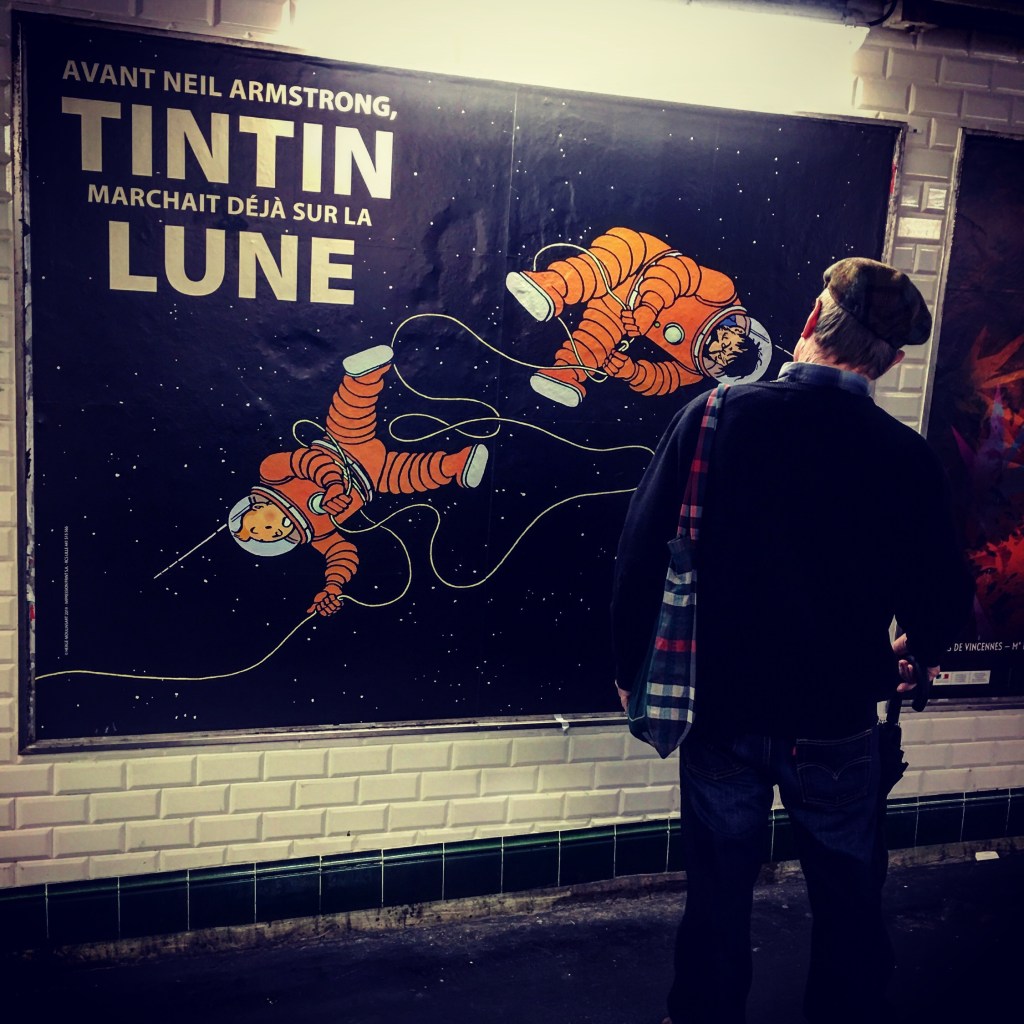
Doctor Comics finds cartoon character friends in the Paris Metro. (Photo by Louise Graber).
EXHIBITION REVIEW: Comic Strip, Passion’s Trip, Sydney, Alliance Francais de Sydney, November 18-December 20, 2002, review by Dr. Michael Hill (a.k.a. Doctor Comics), first published in International Journal of Comic Art, Vol.5 No.1 Spring/Summer 2003
The “Tintin” Qantas Flight 714 finally touched down in Sydney in November 2002. Originally carrying Tintin and associates to a scientific symposium in in 1968 his party left the plane in Jakarta. They then went off on a private jet and another adventure. Now, 34 years later, the Tintin entourage has arrived in Sydney in the shape of a cargo of beer, chocolates and comics, three of Belgium’s significant export commodities, accompanied by members of the Royal family and an exhibition of French language Belgian comics titled Comic Strip, Passion’s Trip,
Belgium exports considerable quantities of comics (approximately 65% of publication exports). It refers to comics as the Ninth Art. It also has a museum devoted to them. So it was no surprise that the exhibition was opened by members of the Belgian monarchy. Prince Philippe and Princess Mathilde attended, giving the exercise the Royal seal of approval. (see invitations to both the exhibition opening and the following Royal reception event, below). The exhibition formed part of an economic mission organised by the Wallonia-Brussels Sydney Trade Office. 300 different comics titles in French plus a further 70 in English were shipped to Sydney. These were put on sale in Dymocks, one of Sydney’s larger bookstores. This created a mini-venue for Euro comics in the local retail market…and competition for Japanese manga and Hong Kong comics.
A page from my graphic novel BLOTTING PAPER: The Recollected Graphical Impressions of Doctor Comics. It shows the invitations to the events referred to in the above text.
The exhibition was staged at Alliance Francais de Sydney, a combination gallery, café and French language teaching centre. It was a noisy location next to a city bus stop. Passengers could admire the window display of old comics whilst waiting for the bus. There were also staged acrobatics of a large model by the Belgian cartoonist André Franquin of his character Marsupilami. The exhibition had undergone a serious design process by the curator Jean-Marie Derscheid. It had a multi-strand focus that included comic books, comics art and rough process comics art. There was a display revealing the workings of the comics artist’s studio. There was a child’s bedroom decorated with comics art merchandise. There were also videos, and an oversized mock-up comics album, 82cm(heigth) x 56 cm(width). These were beautifully bound and designed. They contextualised Belgium comics and featured brief biographies and examples of the work of 20 significant artists. These included Didier Comes, André Franquin, Greg, Hergé, Hermann Huppen,…Edgar Pierre Jacobs, Jijie, Lambil, Raymond Macherot, Morris,…Peyo, Francois Schuiten, Jean-Claude Servais, Tibet, Maurice Tillieux, Tome and Janry, Will, and Yslaire. References were made to Spirou magazine and to two emergent schools of comics: the Brussels School and the Marcinelle School.
The bed in the child’s room had a printed Tintin doona cover and bed sheets. There was also a Gaston Lagaffe reading lamp by the Belgian cartoonist André Franquin and a Marsupilami alarm clock. Various posters and a cupboard containing Lucky Luke figurines were present. Interestingly there was not a Smurf in sight! The room also had a small television and video player with a collection of Belgian animated cartoon series. Amusingly, by the end of the opening night, the child’s room was littered with empty beer bottles. These had been deposited by the noisy and appreciative guests viewing the exhibition. This gave the installation a bizarre visual association between beer and comics in the nursery. If only I had taken a photograph of that! In any case, my character Doctor Comics would have approved of the pairing of beer and comics. He may even have shouted his occasional cry of “beer, chocolate and comics!” He holds this to be an excellent combination in which to indulge…the reading of comics whilst eating chocolate and drinking beer.
Another section of the exhibition consisted of individual displays of the work of particular artists.These included Hermann, Geerts, Midam, Yslaire, Morris, Jacobs,…Herge, Francois and Luc Schuiten, Francqu and Van Hamme, Dufaux and Marini,…Lambil, Marc Bnoyninx, Tome and Janry, Constant and Vandamme. There were even examples of original artwork and a copies of comics albums that were accessible for visitors to read. Some of thee appeared quite soiled near the end of the exhibition, let alone the opening night.
Upstairs in a small seminar room there was a mock-up setting called ‘the artist’s studio.’ Large blow-up photographs on the walls showed the interiors of various comic book creators’ work spaces. A working drawing table had been set up with pencils and other equipment. There was a video corner screening a documentary on one of the featured artists, Frank. It showed him at work on illustrations for his comic book The Source about Australia. This had been specially commissioned for the exhibition and scheduled for release with it. His watercolour sketches of Australian animals were impressive. Despite never having been to Australia prior to the exhibition…Frank did come to Sydney for the opening…his story showed the desert. Although his use of colour was accurate some of his conceptual content was neither sensitive nor politically correct. What he refers to as Ayers Rock, a giant natural rock formation, is now known as Uluru. having had its ownership and management reverted to the control of the indigenous owners. Consequently it is regarded as a sacred place. In his comic Frank freely plays with Aboriginal art and icons. This practice is respected by local artists as the cultural domain and ownership of the indigenous people. Conscious of the lack of local knowledge and in tongue-in-cheek fashion, perhaps?…the exhibition points to “our delightfully cliched images of Australia: kangaroos, boomerangs, mythical Aborigines and smouldering red deserts.” This exhibition was about culture in any case…the culture of a country whose comics have been elevated to the level of art…and treasured and collected by libraries and museums. I praise the high profiling of comics art in Belgium!
The Sydney exhibition brochure with an illustration by Frank showing part of Sydney Harbour juxtaposed with outback terrain.
Welcome to another visit to my modest library collection of comics art…with selected books, journals and associated paraphernalia related to my research, study and enjoyment of the comics art medium. This previously published post…from my now deleted ON THE COFFEE TABLE series…has been re-edited and transferred to the new FROM MY LIBRARY series as the Sixth Reading. It documents items from my comics art library and research collection that pertain to manga and mangaka.
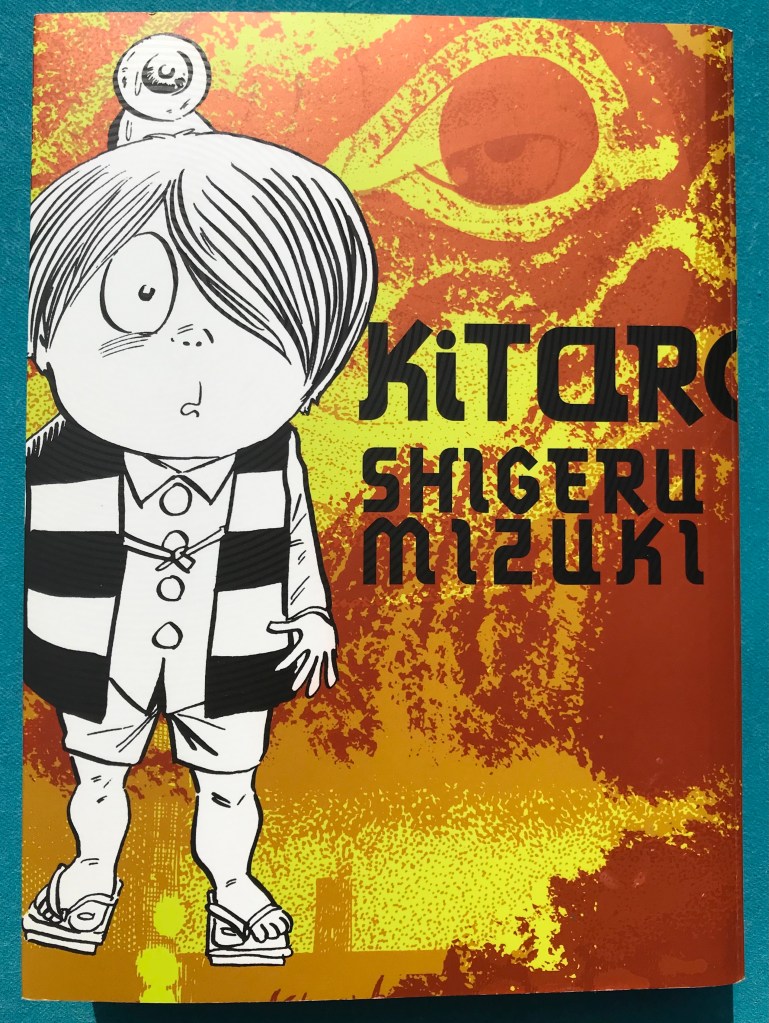
It was looking likely that I would have a yōkai themed Xmas…with master mangaka Shigeru Mizuki (1922-2015) material on my reading list. Due to a backlog, these manga readings did not get underway until after the New Year period. It proved well worth the wait as it was a wonderful read! This industrious creator of both autobiographical and fantasy manga…with his gekiga approach to graphic storytelling…placing cartoon style characters over realistically drawn backgrounds…has reached legendary status in Japan but needs to be better known in the rest of the comics world. Here’s my modest contribution.
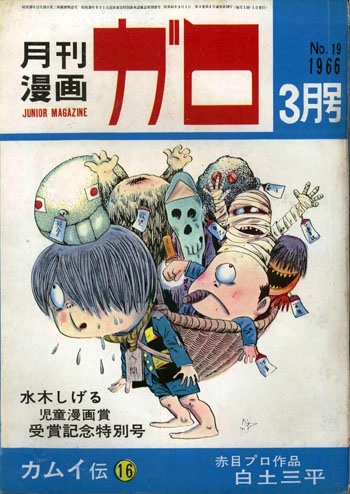
Mizuki’s cover illustration for GARO magazine of his character Kitaro carrying a basket crammed full of yokai characters.
After serving in New Guinea for the Japanese army in World War II Mizuki got his start in graphic storytelling…first as an apprentice artist in kamishibai, or paper theatre. Here successively shown painted cards…accompanied with vocal and musical narration by a street performer…told a story to audiences gathered on street corners in Japan. Mizuki moved on to the print media making manga for the rental market…and participating in the emerging gekiga form of alternative comics developed by Yoshihiro Tatsumi. From his interest in the ghosts and spirits of Japanese folk tales…he developed his Kitaro character in a series of stories…based on a popular kamishibai play by Masami Ito called Hakaba Kitaro from 1930s…inventing the yōkai genre in the process.
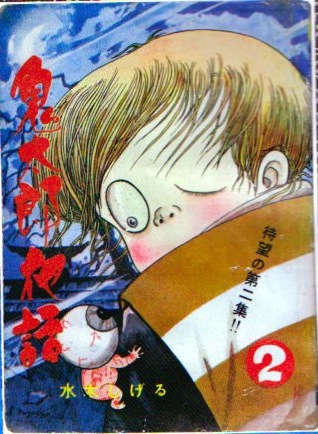
Early shape and form of Mizuki ‘s character Kitaro with his father Medama Oyaji, the small figure with eyeball head.
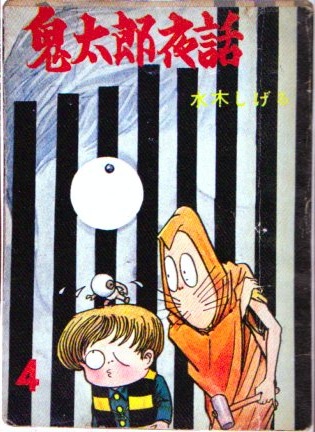
Mizuki found an outlet for his stories in GARO magazine, an eye-catchingly creative, comics art anthology publication of alternative manga. There he gained an assistant, Yoshiharu Tsuge, the developer of nejishiki, or Screw Style manga. In these stories Kitaro’s deceased father, Medama Oyaji, reanimates himself as an eyeball…and, with the eyeball as a head, grows a new body…hangs out in Kitaro’s hair and his hollow eye socket(Kitaro had lost one eye)…and tries to help his son with his adventures.
Kitaro with father, Medama Oyaji (eyeball shaped head on small body figure) and Nezumi Otoko.
One of Shigeru Mizuki ‘s manga featuring his popular one-eyed character, Kitaro…with with his father Medama Oyaji, the small figure with eyeball head, on his head.
An increasing number of Mizuki’s works have been translated into English and published by Drawn & Quarterly. This publisher publishes comics, graphic novels and textual studies of the comics art medium.
This is the Mizuki manga about the old woman who taught him all about yokai.
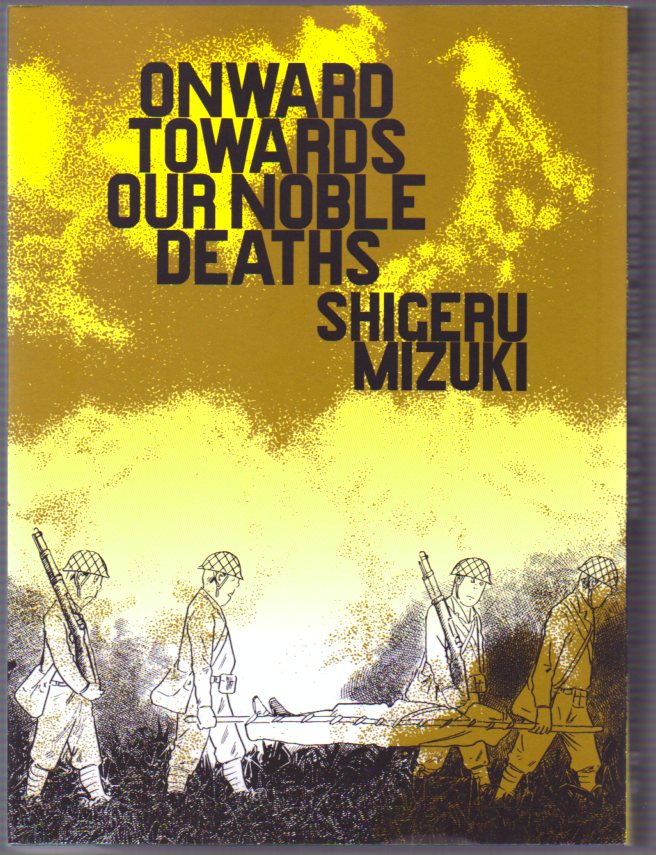
Autobiographically based war manga on Mizuki’s time served in the Japanese army in the Pacific in World War II.
In Onwards Towards Our Noble Deaths (originally published as Soin gyokusai seyo! in 1973) based on his own experiences in the Japanese army in New Guinea during World War II,…Mizuki portrays the sadistic officers who, driven by their ideological beliefs, were cruel to their own troops. This English translation from Drawn & Quarterly has an introduction by manga analyst and critic Frederik L. Schodt.
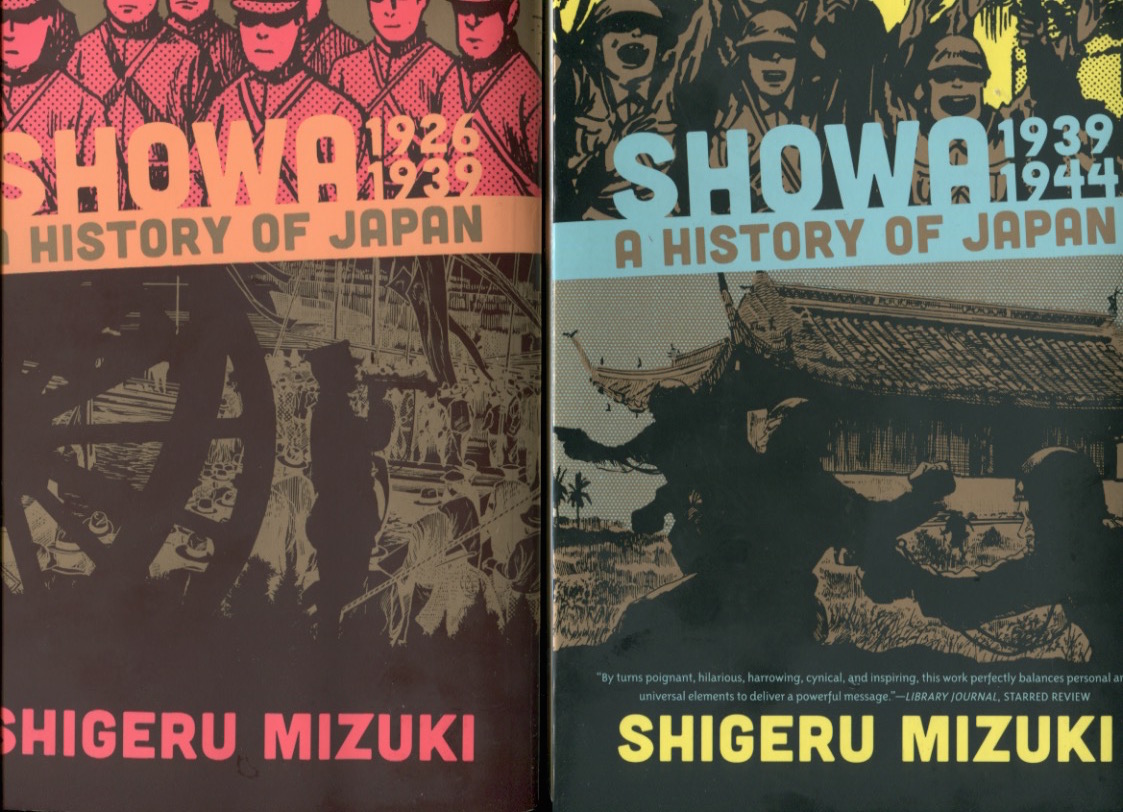
Japanese history gets the Mizuki treatment in SHOWA1926-1989…a four volume history of Mizuki and his family…presented in his juxtapositional mix of cartoons and photographic realism in manga form. It’s an impressive work.
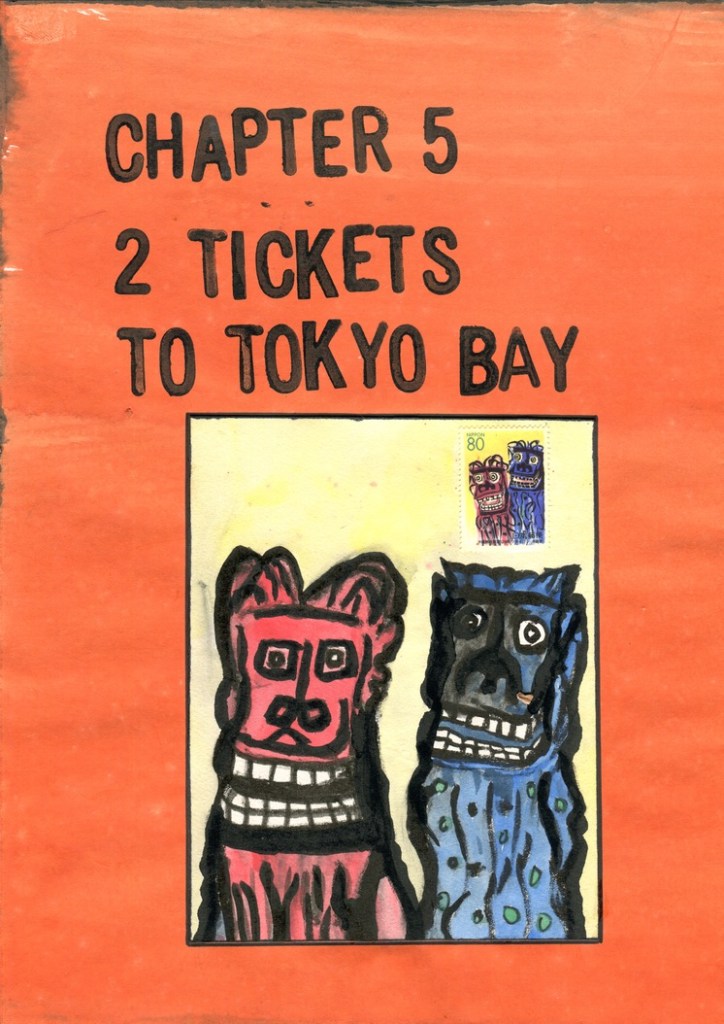
Title page of Chapter 5 of my graphic novel BLOTTING PAPER showing manga influenced illustration.
Inspired by Mizuki and other mangakas is the title page, above, of a chapter of my graphic novel. It points to my visits to Japan…and the particular resonance that country has had on my comics art research and creation.This manga influence and my appreciation of it led me to reference it in my graphic novel…here attempted in the graphic style of the illustration for the chapter’s title page.
Welcome to another visit to my little library collection of comics, books, journals and associated comics art paraphernalia. These are related to my research, study and enjoyment of comics art. In this series of posts I intend to focus on a particular creator, series, book, art or event.
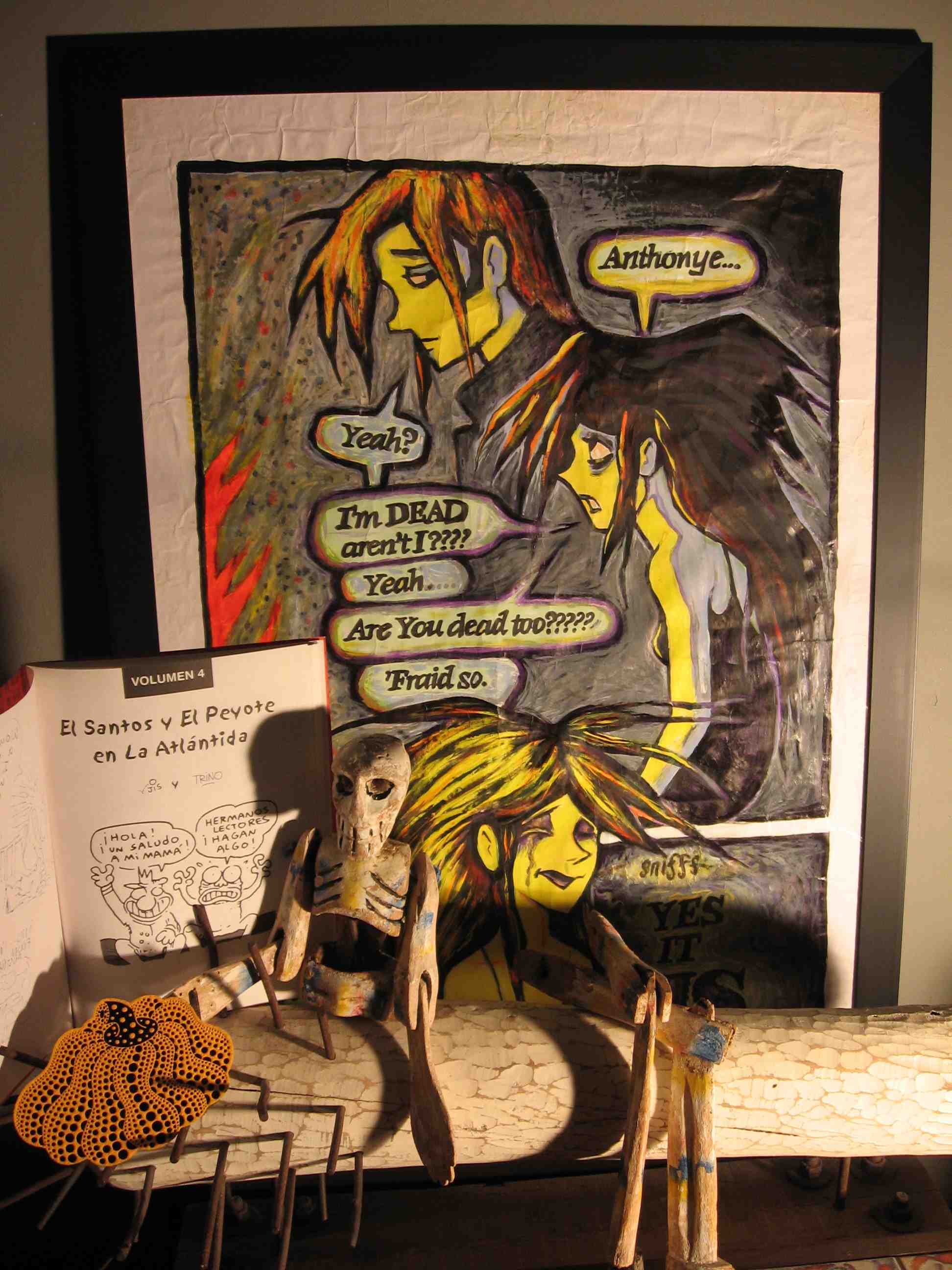
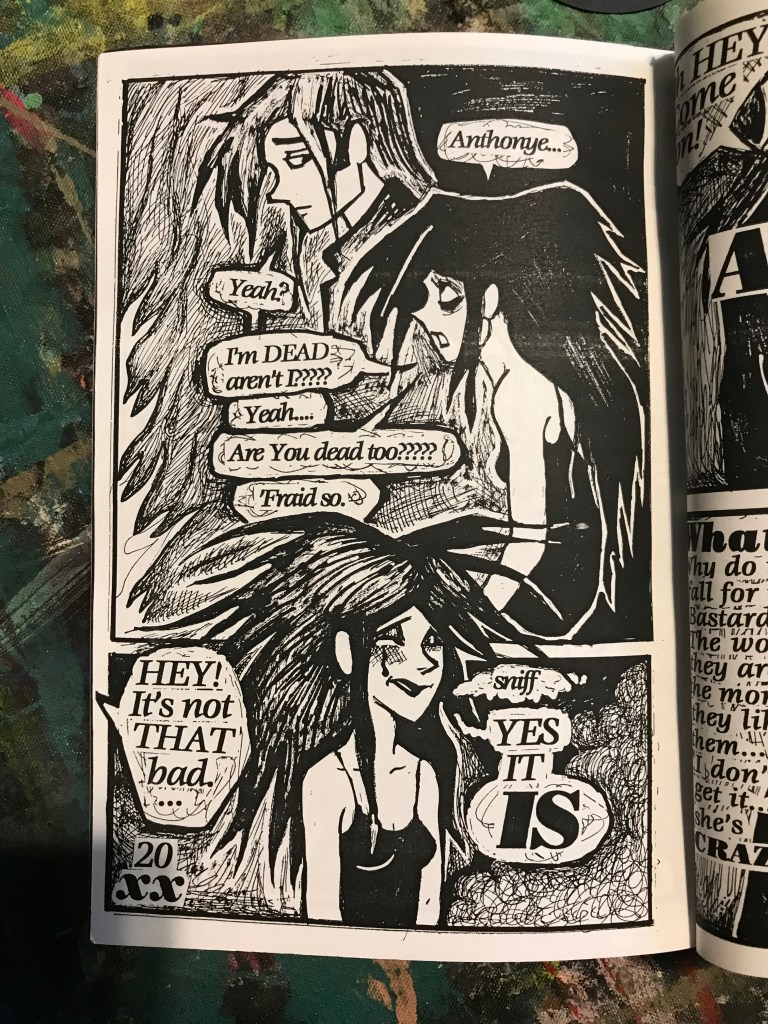
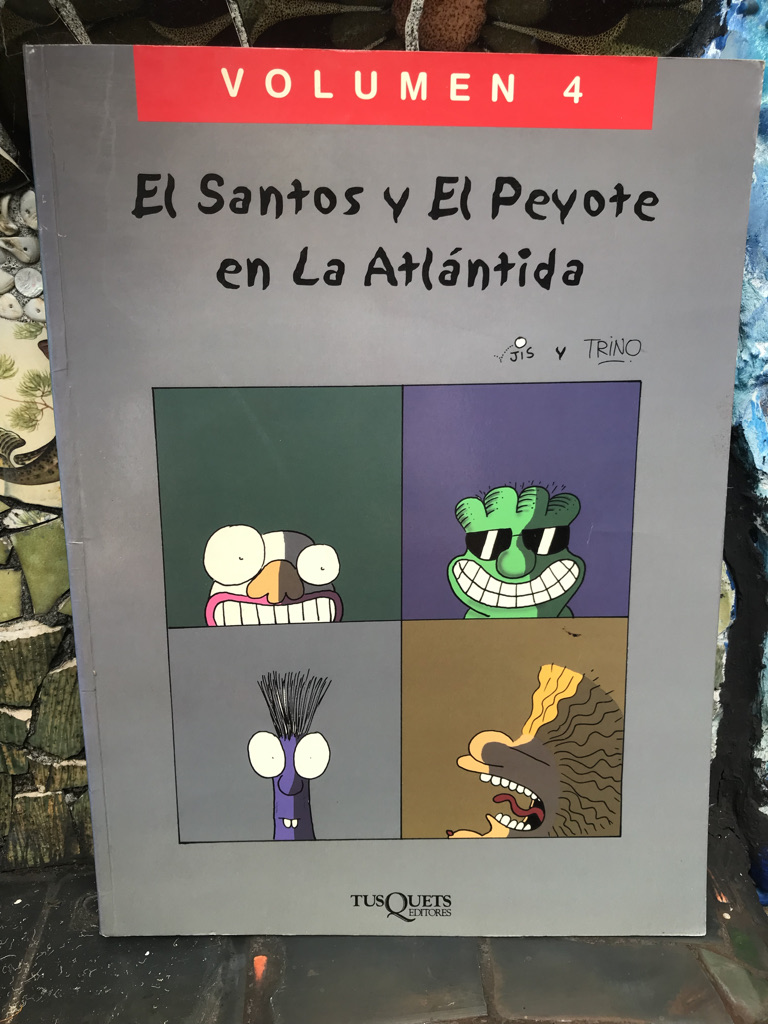
A painting by Louise Graber of a page from her comic Black Light Angels…a comic by Jis & Trino…a Halloween pumpkin card by Yayoi Kusama…skeleton doll and sculpture The Cloud by Richard Black are grouped for Halloween and Day of the Dead!
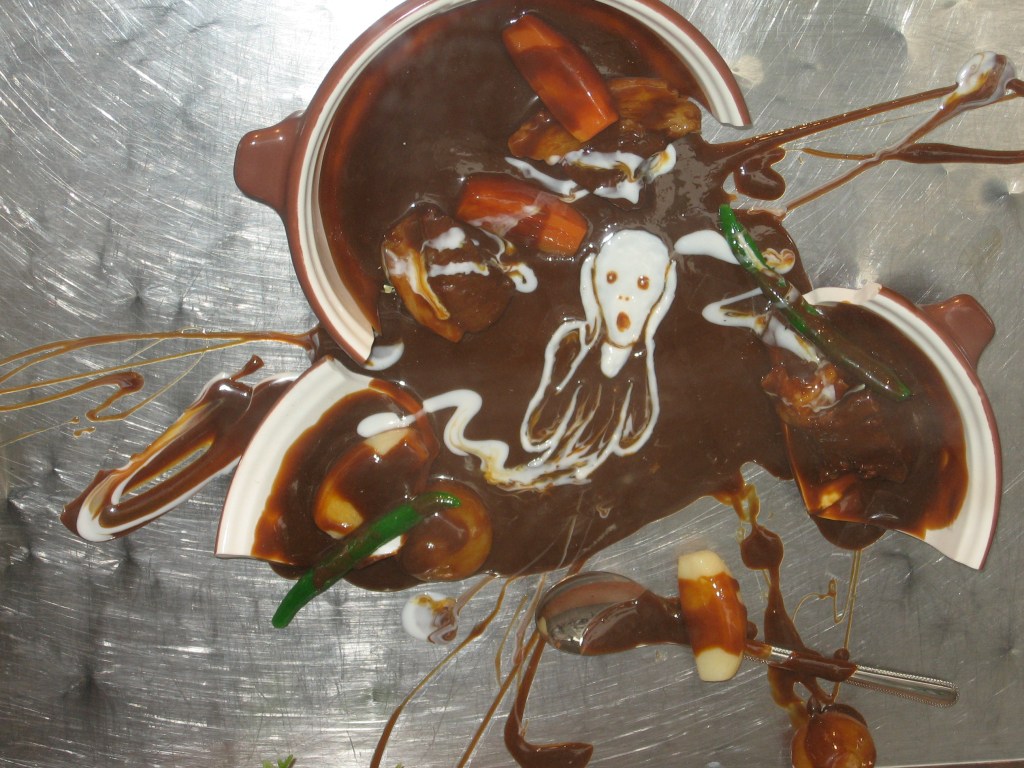
This photo of an interpretation of Edvard Munch’s “Scream” painting…as a decorated, demolished cake in a shop window in Tokyo somehow comes to mind at this time. Perhaps it is picking up on the cheeky attitude apparent in the work of those two Mexican artists.
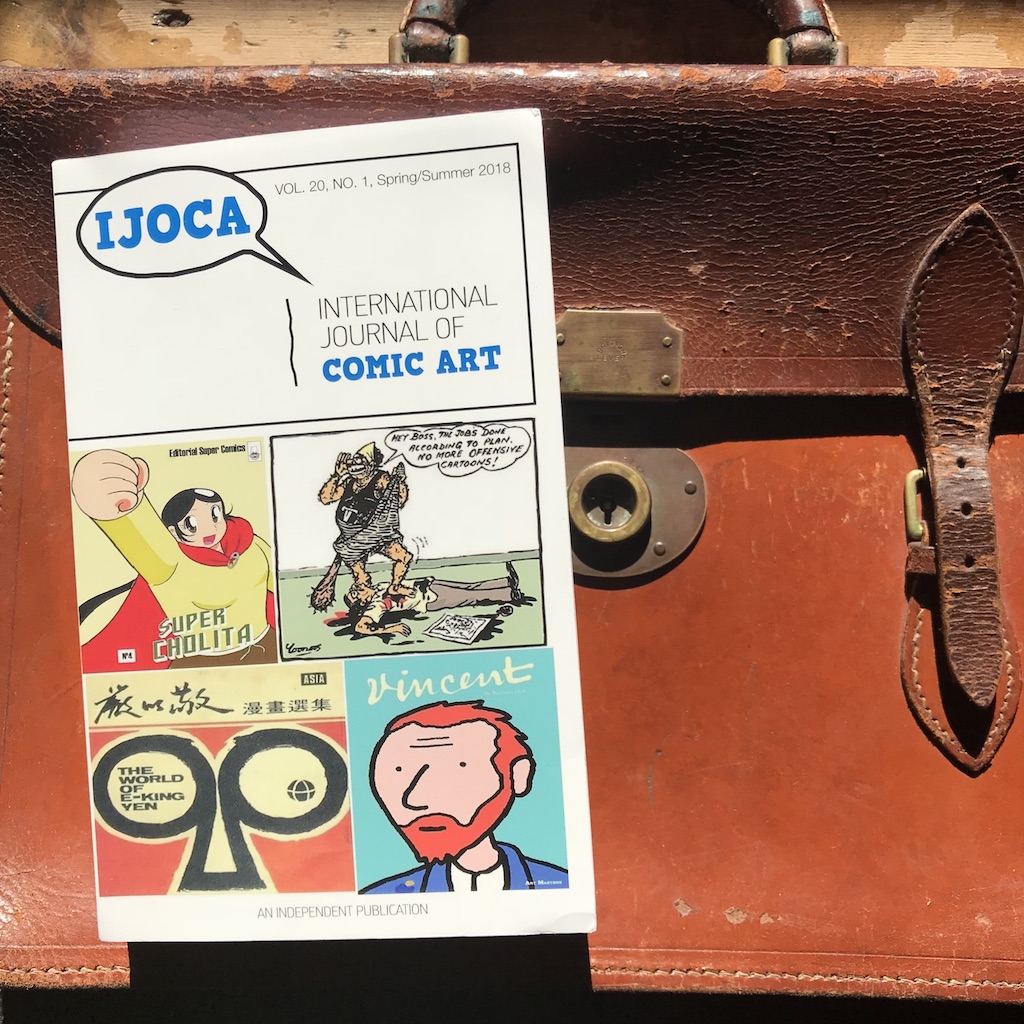
I reiterate the importance of my attendance at ICAF (Fifth Annual International Comic Arts Festival: “Culture, Industry, Discourse,”). It assisted the development of my research into comics art. I was fortunate in being introduced to, and seeing the presentations of, a group of international researchers into comics art. I also obtained the first ever issue of the International Journal Of Comic Art from 1999. I eventually became the Australian representative on the International Editorial Board of the journal. The journal enabled me to read a plethora of research articles on comics art by international scholars. I also had my own articles on research into Australian comics published. Along with my acquisition of it at the conference, it has proved an inspiring and motivating experience.
My LIBRARY posts form part of my graphic based material. This includes painting, printmaking and cartooning…including artwork for my comic and graphic novel BLOTTING PAPER: The Recollected Graphical Impressions of Doctor Comics.
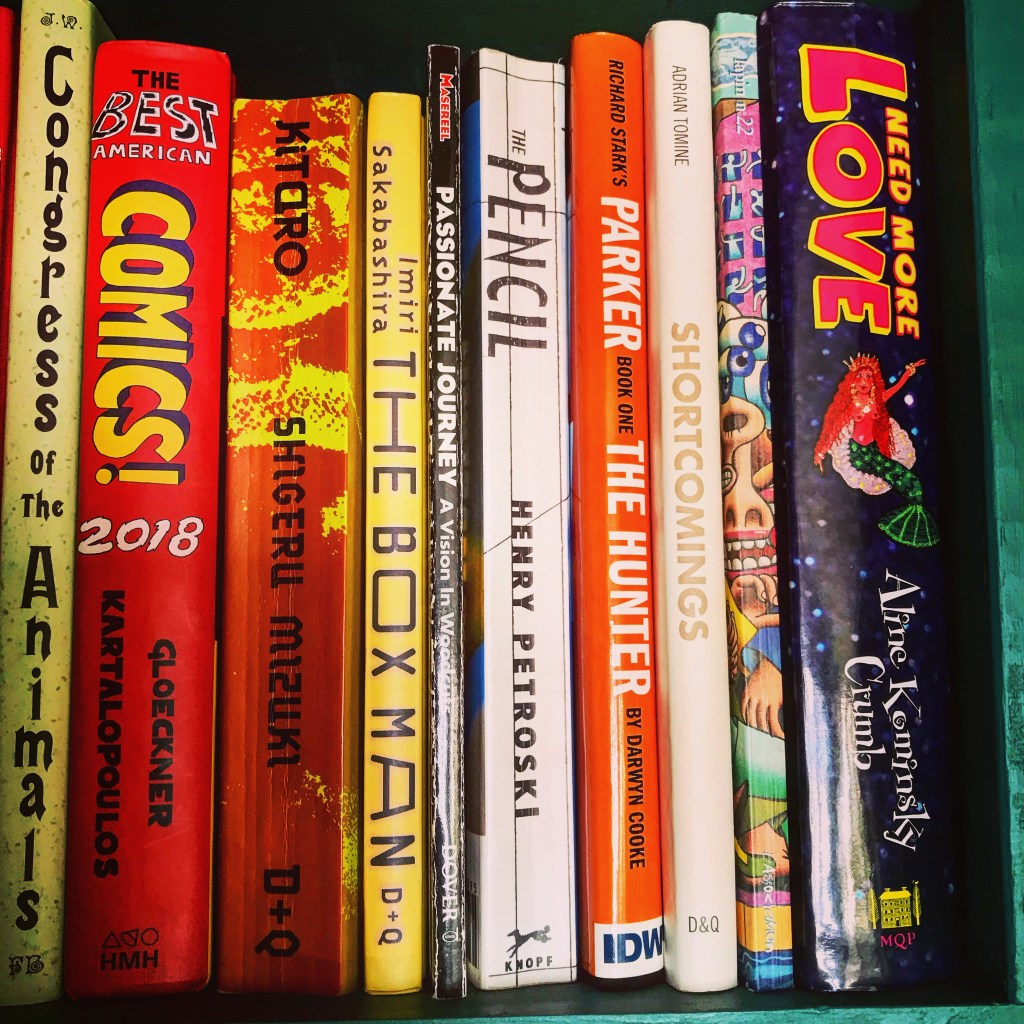
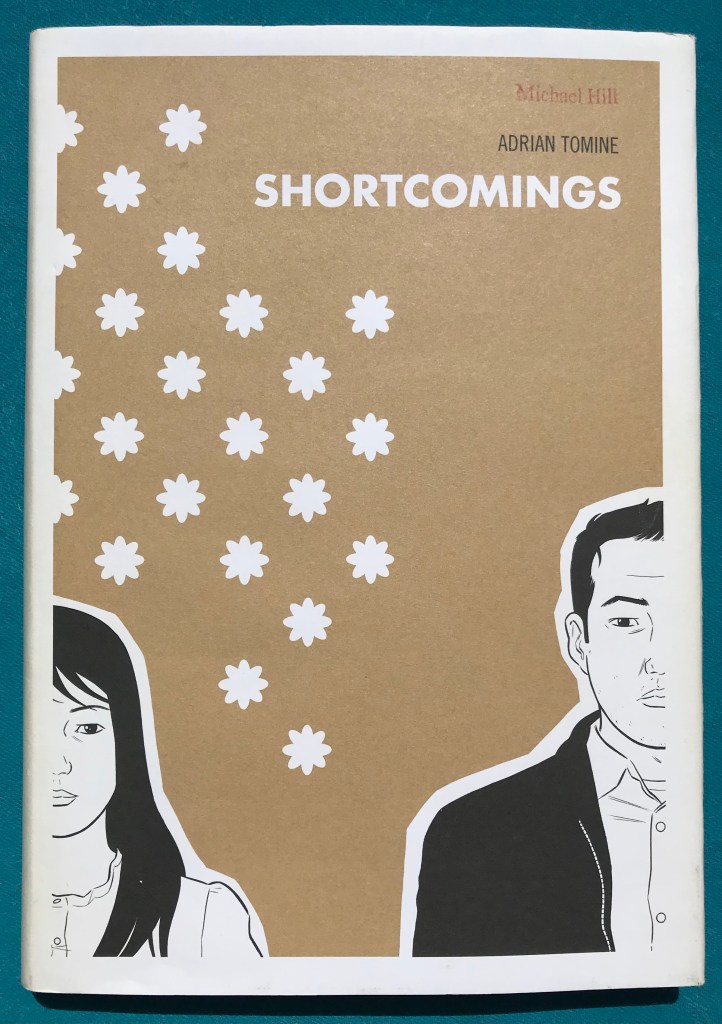
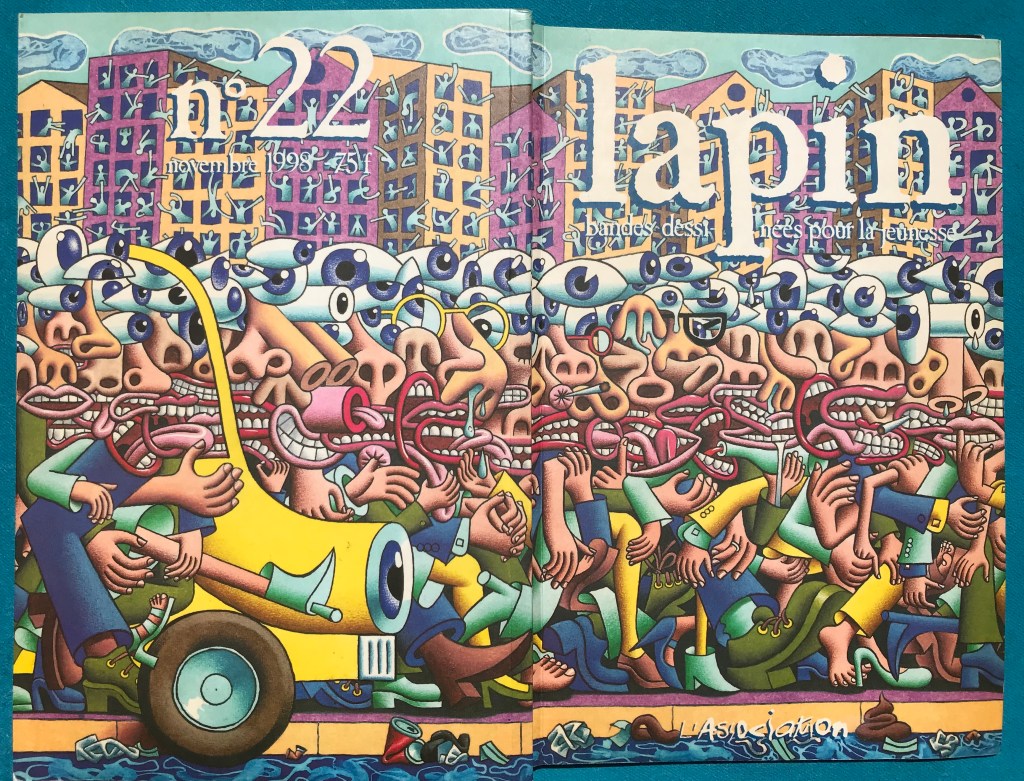
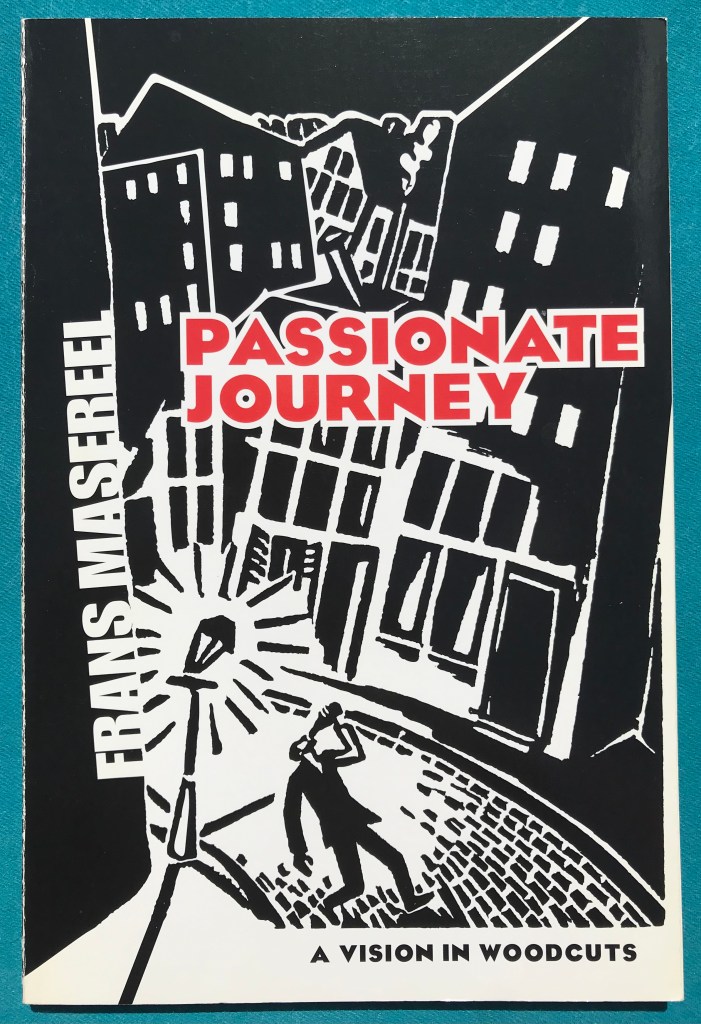
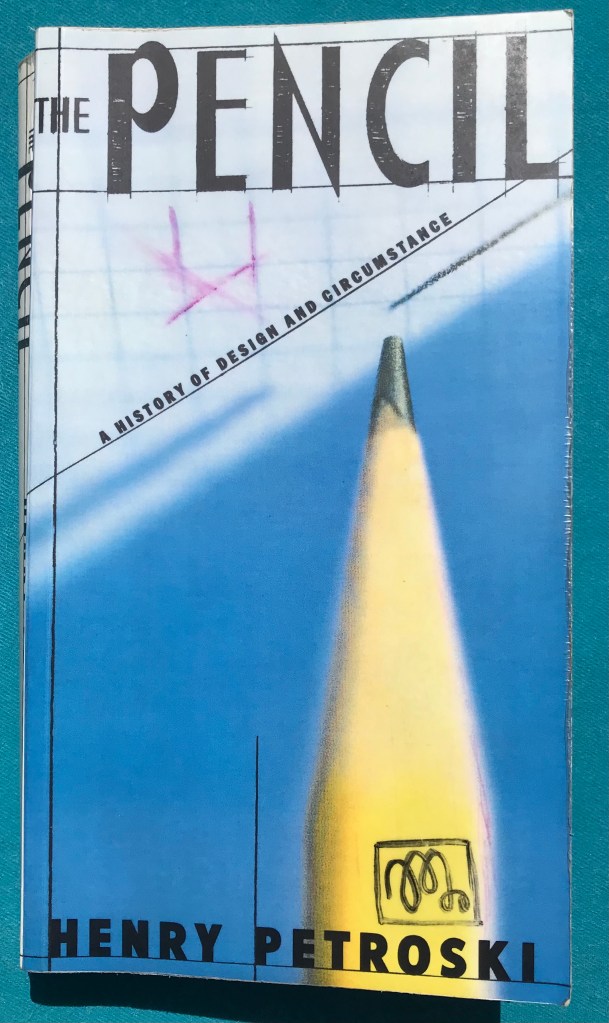
Welcome to another visit to my modest library collection of comics and books about comics. These are related to my research, study and enjoyment of the comics medium. In this series I focus on a small selection of books from my shelves and take a closer look. This time I shall be pushing that total to ten as every book in the photo will get a mention! The books are not shelved following normal library rules i.e. detailed categorisation…they are stacked by size…what a surprise!…however, they all have something to do with the rubrics of comics…being comics, collections of comics or histories, studies and critiques of comics.
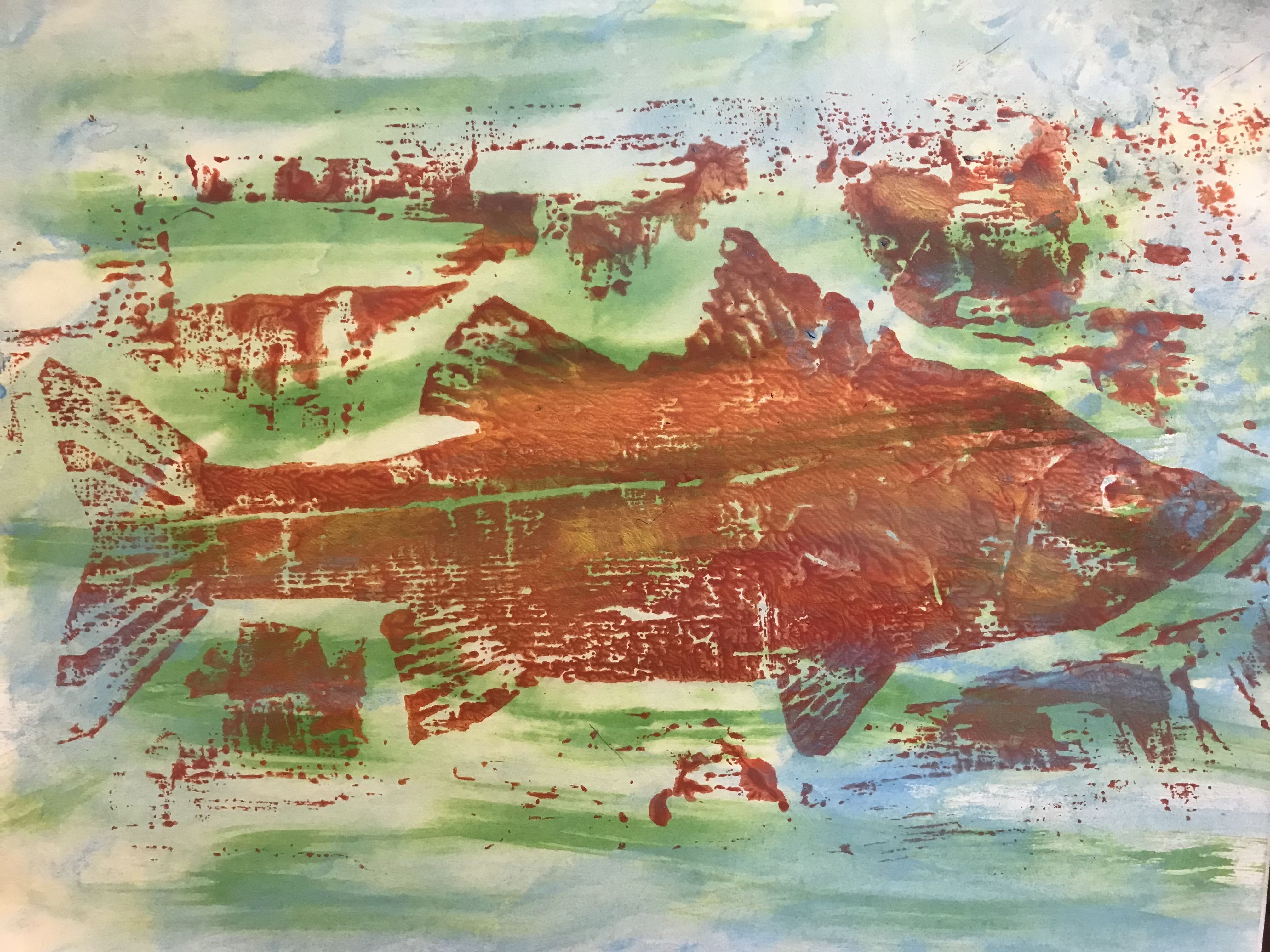
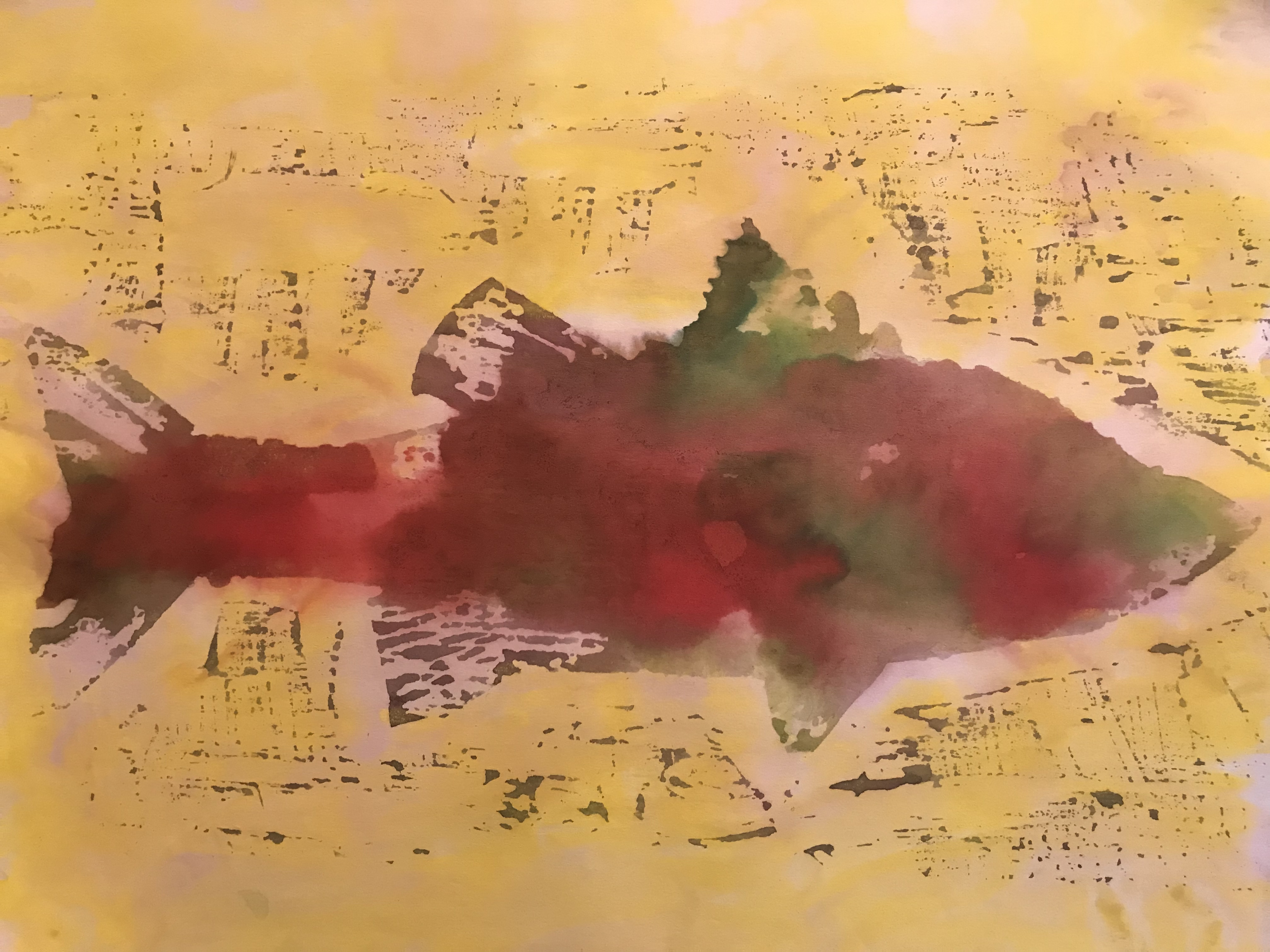
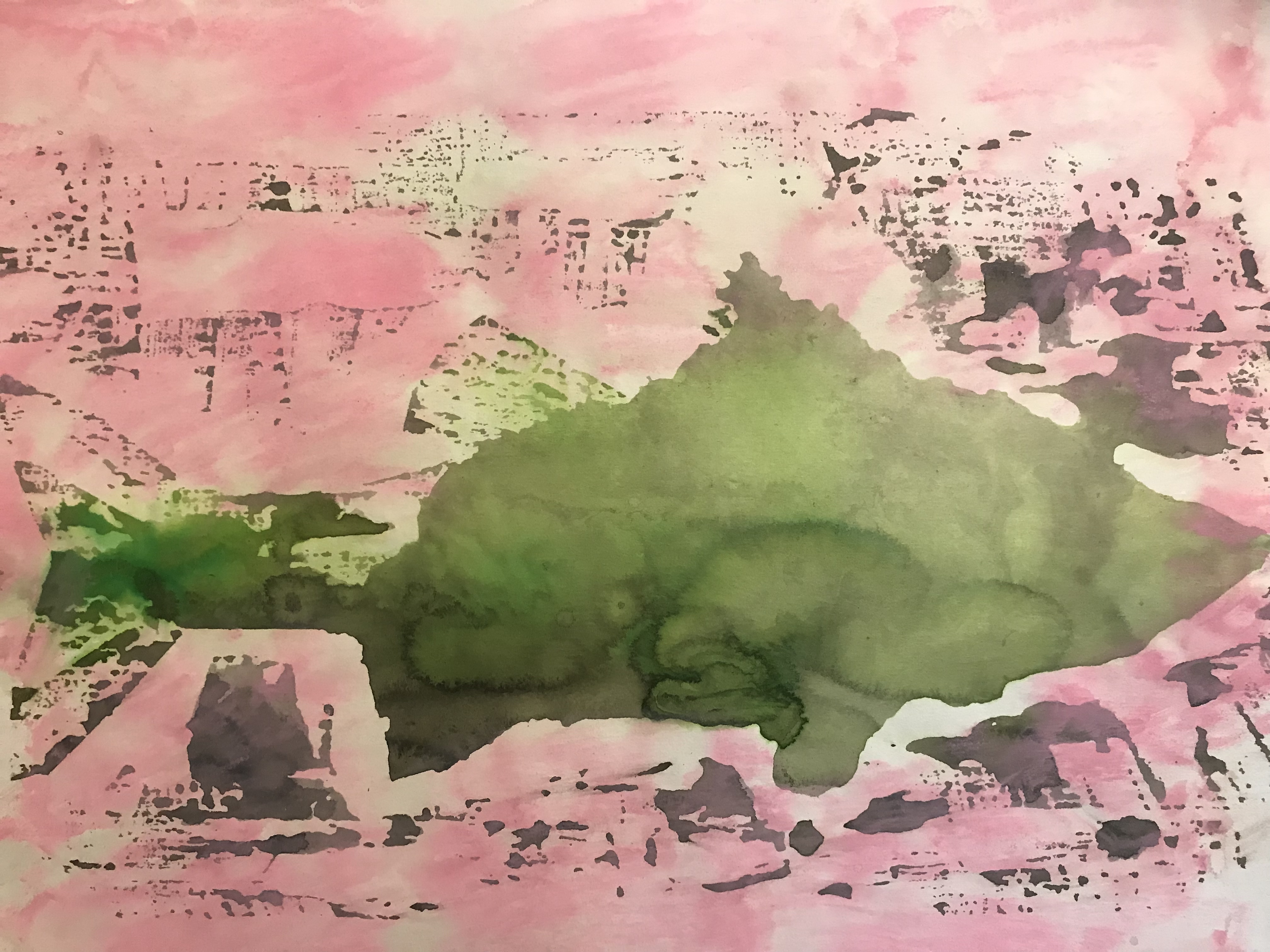
This is the final of six posts on the creation of experimental fish prints using woodblock printmaking techniques. These were exhibited as art prints. They were also used as animation frames in my experimental animated film Toxic Fish (see the photos below).The fish in this post is the kohada. It has a static shape on the woodblock and in the film frame. This contrasts with the surrounding coloured toxins from commercial pollution. These eventually poison the fish. Variations in the volume of ink applied to the block produced a range of similar but different outcomes. Once edited in sequence, these contributed to the creation of the illusion of movement. The associated movement of both fish and toxins frantically appear to twitch and jump all over the frame. The action looks frenetic. That effect is reinforced by the percussive soundtrack. The film was selected and screened at CINANIMA, the Animation Festival in Esphino, Portugal. It was also screened at the Art Gallery of NSW. Later it was shown at the Big Day Out rock festival in Sydney. There is a certificate and photo on a previous post: PRINTMAKING: Fish Four).
Sitting at the Oxberry animation film rostrum stand back in 1990. I was shooting my film, frame by frame, from the individual woodblock prints I had made. It took a really long time. I appear both happy and calm and pleased with the process despite the frantic impact that the film makes. I do listen to music while I work. I don’t recall what I was that day but it looks like I was enjoying it.
A later grouping of one species of the fish for art gallery exhibition. This composition had torn and collaged prints assembled in a school formation. It completed the process from design to printmaking to animation to film.
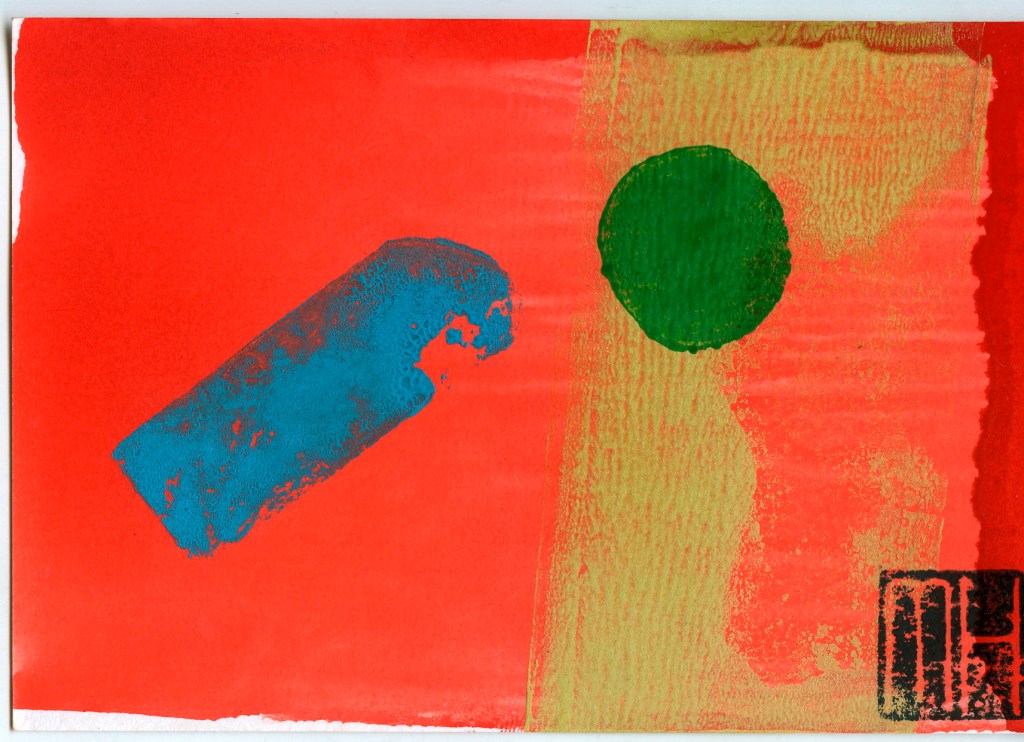
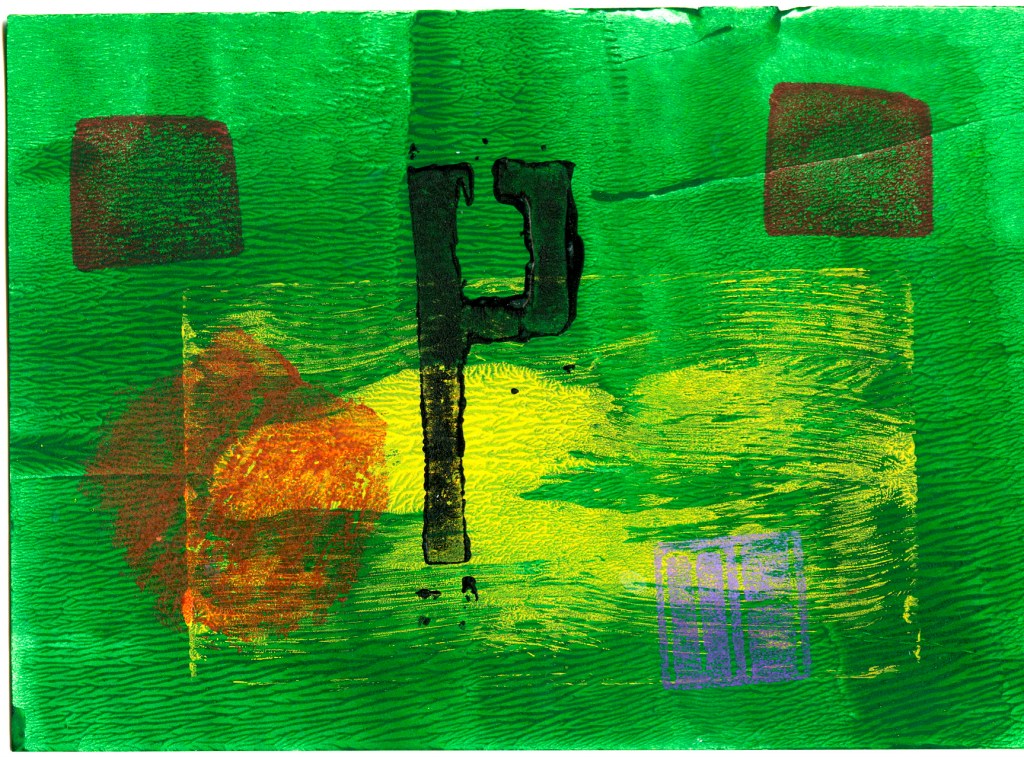
Continuing my POSTCARD ART blogs with another post profiling the design and production of my art postcards. I have been creating and printing these for more than a decade. This post looks back to cards I back when I started in 2006 and 2007. There are also cards from subsequent years. My art postcard project was inspired by a study trip to Japan. I looked at Modernist printmaking approaches that had taken place there. My cards were produced by hand in limited edition batches. Each card produced was unique…similar but not identical, part of a batch with an approximate match.
This is one of the earliest examples, from the series of Abstract Art Postcards made in 2007.
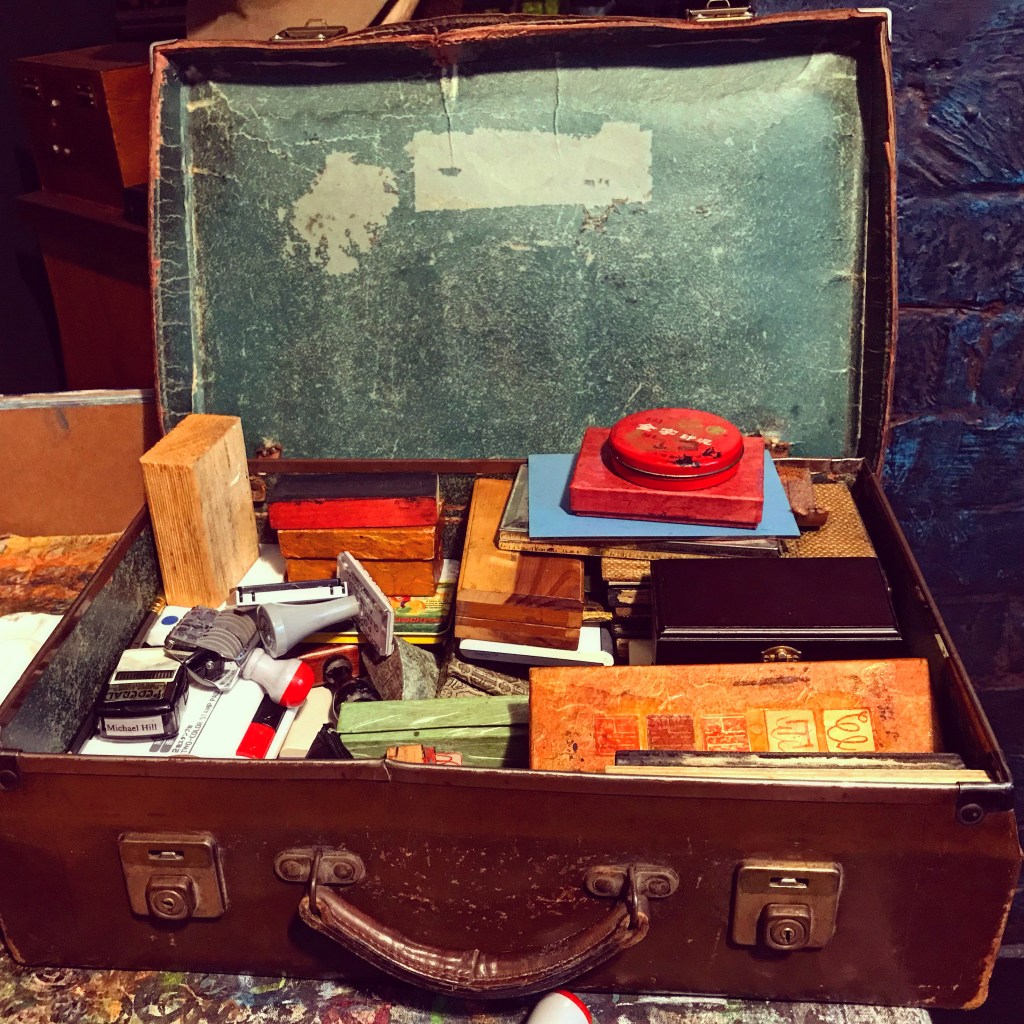
These graphic production stage series of posts were made over several years. They show selected, shots of the “making” stage and my methodology…whether for animation, comics, postcards, prints or paintings, in a small studio setting, with music playing in the background. I always work to music. Sometimes I include an image or thought about the music I was listening to in the studio that day. Some photos show the music equipment and/or the selected CD I was listening to at that session.
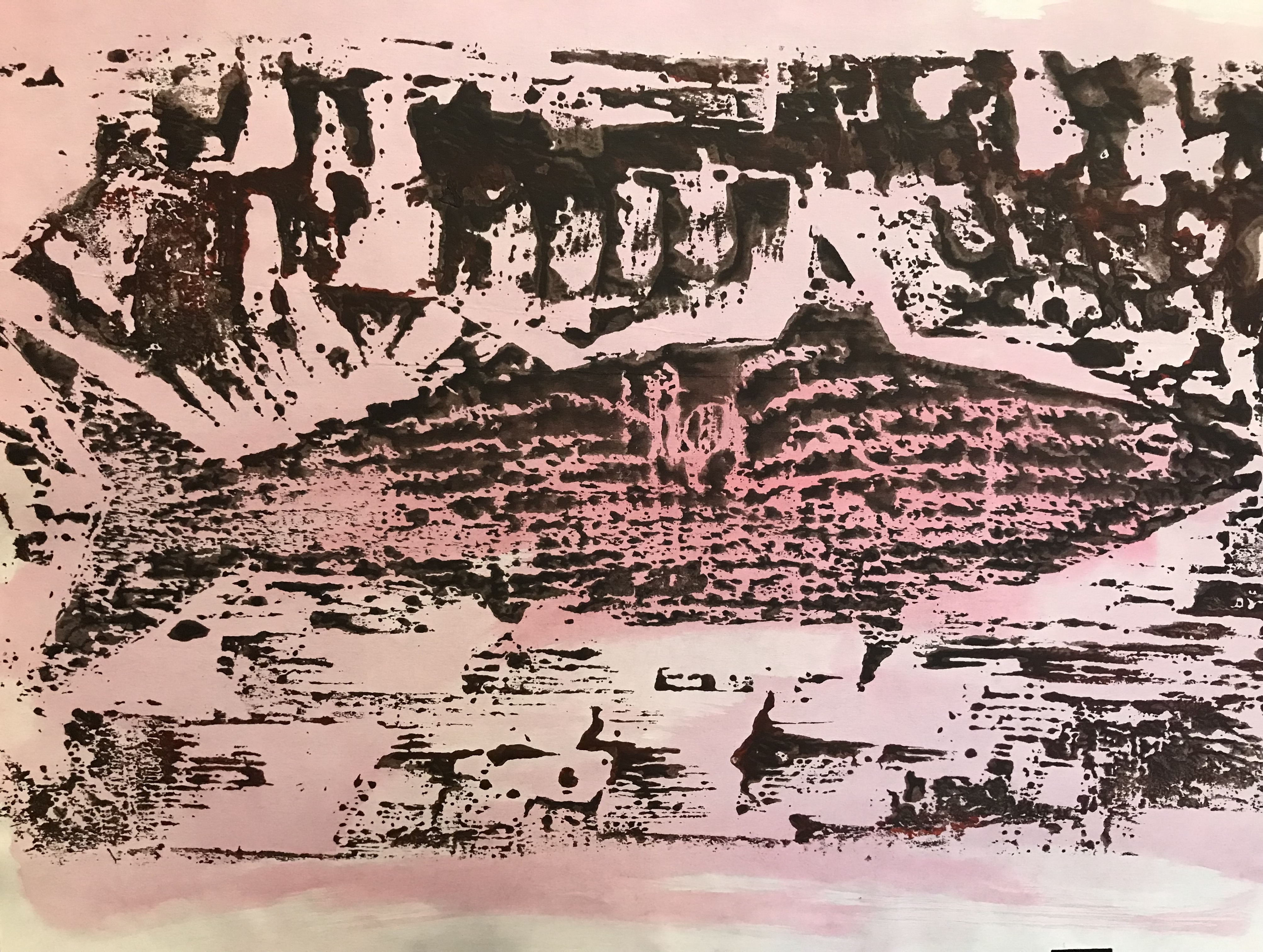
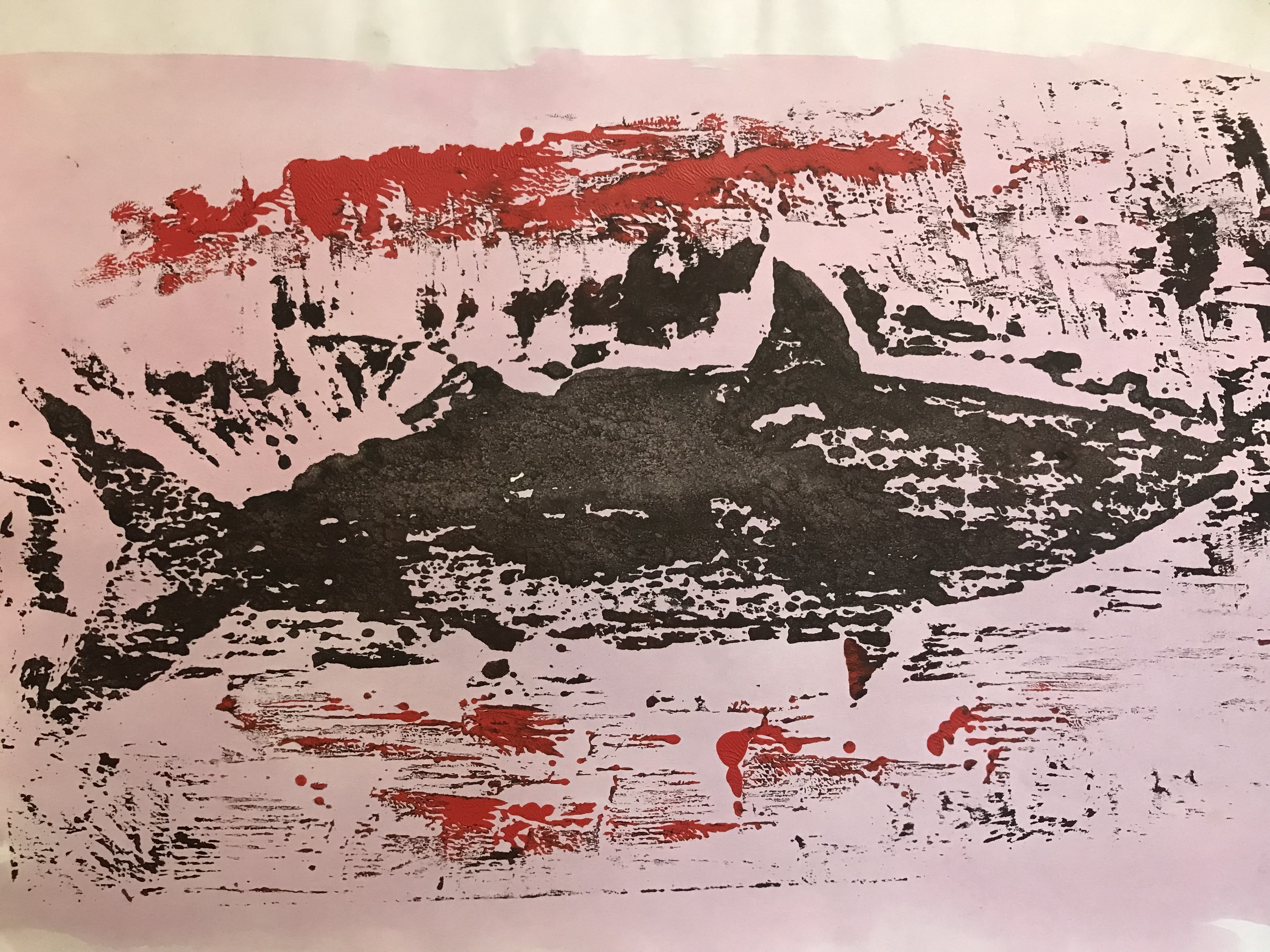
This is the fifth post documenting the production of the experimental prints that I made with woodblock printmaking techniques…for both gallery exhibition and also as frames in my experimental animated film Toxic Fish (see photos below).The fish in this sequence is the gizzard shad. It has static shape on the woodblock…this contrasts with the flooding of toxins from commercial pollution which are overlaid around it which eventually poison the fish. Variations in the volume of ink and the choice of hue produced a range of similar but different outcomes. When edited in sequence these contributed to the creation of the illusion of movement. The film was screened at CINANIMA, the Animation Festival in Esphino, Portugal…and at the Art Gallery of NSW in Sydney…and also at the Big Day Out rock festival. also in Sydney. (See certificate and photo on previous post: PRINTMAKING: Fish Four).
These and other examples of the art from the animation have been posted on the Doctor Comics website (doctorcomics.com) under the post heading PRINTMAKING: Fish 1, 2, 3 etc.
These production posts document the “making” stage, whether animation, comics, postcards, prints or paintings, in a small studio. I always work to music and some photos in my blog posts show the equipment and the CD…not these, unfortunately.


































 Doctor Comics