Tag: Dillon Naylor

Archive of Australian Alternative Comics: COMIC-FEST

Archive of Australian Alternative Comics, Comics July 18, 2013

Prior to the emergence of one of the larger comics and entertainment media conventions in Australia Supanova Pop Culture Expo the same management team, led by Daniel Zachariou, staged an event called Comic-Fest. This had a mostly comics oriented focus compared with the subsequent broader span of Supanova in which comics represents just one of several entertainment media that included films, television series, toys, trading cards, computer games and the internet. There were two stagings in 2001, at Fox Studios in February then followed in September by Comi-Fest 2 at the Sydney Centrepont Convention Centre.
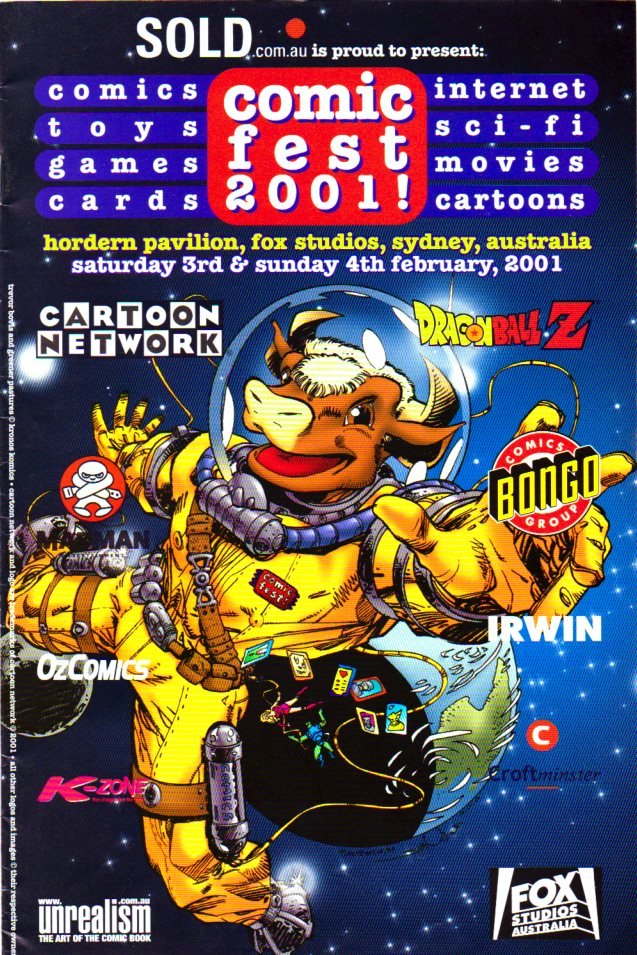
Trevor Bovis in space, the Greener Pastures program cover.

Trevor Bovis in space, the Greener Pastures program cover, designed by Tim McEwen.


Saturday seminar details with my involvement  in the superheroes panel.
Saturday seminar details with my involvement in the superheroes panel.


The Comic-Fest panel line-up, L to R, Dillon Naylor, Daniel Gloag, Amber Carvan and Ben Hutchings.

The Comic-Fest panel line-up, L to R, Dillon Naylor, Daniel Gloag, Amber Carvan and Ben Hutchings (Photo-©2001 Dr. Michael Hill a.k.a. Doctor Comics).

For the September event, withsupport from the event director, Daniel Zachariou, I organised a panel discussion on Australian alternative comics by local creators Dillon Naylor, Daniel Gloag, Amber Carvan and Ben Hutchings who each talked about their own comics and answered my questions. A general discussion of the Australian comics scene followed.
Another shot of the panel, L to R, Gloag, Carvan and Hutchings.

Another shot of the panel, L to R, Gloag, Carvan and Hutchings (Photo-©2001 Dr. Michael Hill a.k.a. Doctor Comics).

Aside from the panel discussion the big attraction for the local small press was the opportunity to set up shop and trade their work on the commercial floor along with the imported comics. There was also the opportunity to meet fellow local creators and exchange comics, contact details and curry recipes.

On the trading floor, Louise Graber and Alex Major.

On the trading floor, Louise Graber and Alex Major (Photo-©2001 Dr. Michael Hill a.k.a. Doctor Comics).
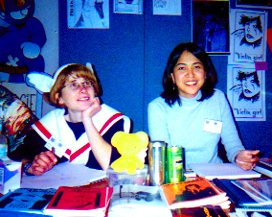

Also trading, Komala Singh.

Also trading, Komala Singh, on the right (Photo-©2001 Dr. Michael Hill a.k.a. Doctor Comics).


Also trading, Daniel McKeown with Alex Major.

Also trading, Daniel McKeown with Alex Major (Photo-©2001 Dr. Michael Hill a.k.a. Doctor Comics).

Along with the commercial trading there was the social attraction of meeting and chatting with fellow comics creators and sharing ideas and production experiences.

Lewis Morley and Louise Graber.

Lewis Morley and Louise Graber (Photo-©2001 Dr. Michael Hill a.k.a. Doctor Comics).


Two funny blokes and cartoonists, Ross Tesoriero and Ben Hutchings.

Two funny blokes and even funnier cartoonists, Ross Tesoriero and Ben Hutchings (Photo-©2001 Dr. Michael Hill a.k.a. Doctor Comics).


Ross Tesoriero and Louise Graber.

Big Ross Tesoriero with little Louise Graber (Photo-©2001 Dr. Michael Hill a.k.a. Doctor Comics).

Did you go to COMIC-FEST? What did you think? Would you like to add a comment about your impression of that event on this Blog post? I would be happy to hear, Michael.

This is the eleventh in a series of posts called Archives of Australian Comics History that document moments in the recent history of Australian comics, particularly alternative comics and the Australian Small Press. I started researching this subject in the late 1990s and it eventually led to my PhD thesis: Ph.D. Macquarie University, Division of Society, Culture, Media and Philosophy,  A Study Of Contemporary Australian Alternative Comics 1992-2000 With Particular Reference To The Work Of Naylor, Smith, Danko And Ord, 2003. On completion of the research I donated the materials and comics I had collected to the National Library of Australia: Michael Hill Collection of Australian Comics.

(All text, photos and artwork(except for Comic-Fest 2001 poster)-©2013 Dr. Michael Hill a.k.a. Doctor Comics).
Archive of Australian Comics History: DOWN UNDER GROUND

Archive of Australian Alternative Comics, Art, Comics February 13, 2013

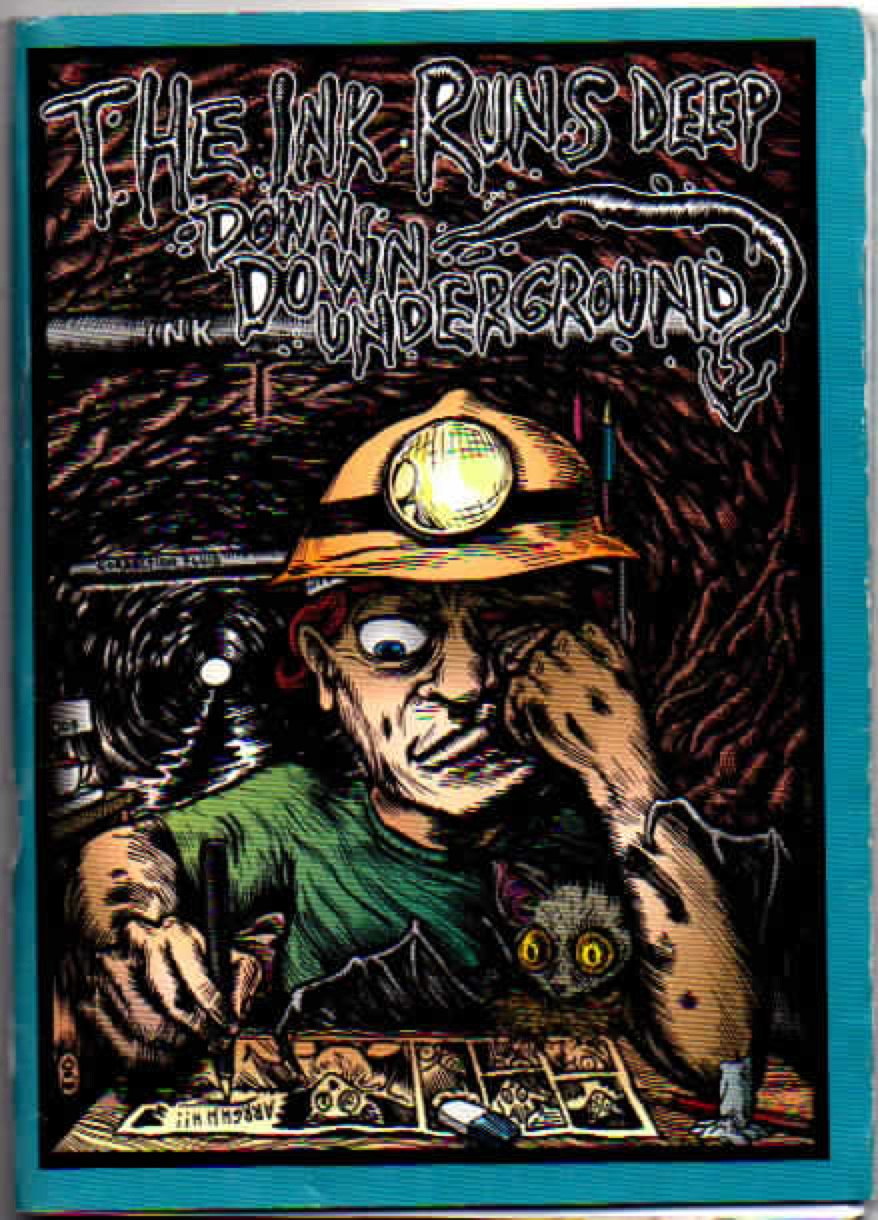
Underground comics are the subject of this post…in particular Australian alternative comics. I start with a review of an exhibition that Glenn Smith curated at the Orange Regional Gallery, in N.S.W. in 2005. The exhibition was titled The Ink Runs Deep Down, Down Underground. I wrote an essay titled “Art From The Inkubator” for inclusion in the exhibition catalogue.

The Ink Runs Deep...exhibition catalogue. (Design by Glenn Smith)
The Ink Runs Deep...exhibition catalogue. (Art & Design by Glenn Smith)

The successive waves of Australian alternative comics produced since the 1980s often feature a raw, spontaneous graphic style. This is accompanied by an irreverent attitude and a D.I.Y. Punk influenced approach to production. It is notably different from mainstream approaches to comics production. These alternative comics can be pluralistic, wide-ranging, antagonistic, mocking and containing taboo themes. The exhibition in Orange celebrated the creative expression behind these comics. Comics art…this much maligned art form…usually consigned to the pop culture trash bin…was hung for exhibition on the gallery wall.

Back cover of the exhibition catalogue. (Design by Glenn Smith)

Creators featured in the exhibition, all 27 of them, are listed on the back cover of the exhibition catalogue, above. They exhibited applications of comics art in a range of mediums from pen and ink to digital imaging. These were applied in animation, painting, posters, book covers and skate boards.

Display of Anton Emdin comics in the exhibition.
Exhibit of Cruel World minicomics by Anton Emdin.
Display of Black Light Angels minicomics by Louise Graber in the exhibition.
Exhibit of Black Light Angels minicomics by Louise Graber.

Noting the emergence of underground comix in Australia in his book Panel By Panel…John Ryan pointed to the social context of the 1970’s. This was a period in which a sense of national pride emerged. This led to a consequent interest in locally made art. That first wave of Australian alternative comics also seems to have been influenced by the North American Underground Comix movement. As in the Abstract Expressionist art movement of the 1950s, Australia seemed to have imported rather than grown, the art. Initially appearing somewhat derivative an Australian style later developed .

Louise Graber with a painting of a panel from her comic Black Light Angels in the exhibition.
Louise Graber with her painting of a panel from her comic Black Light Angels from the exhibition.

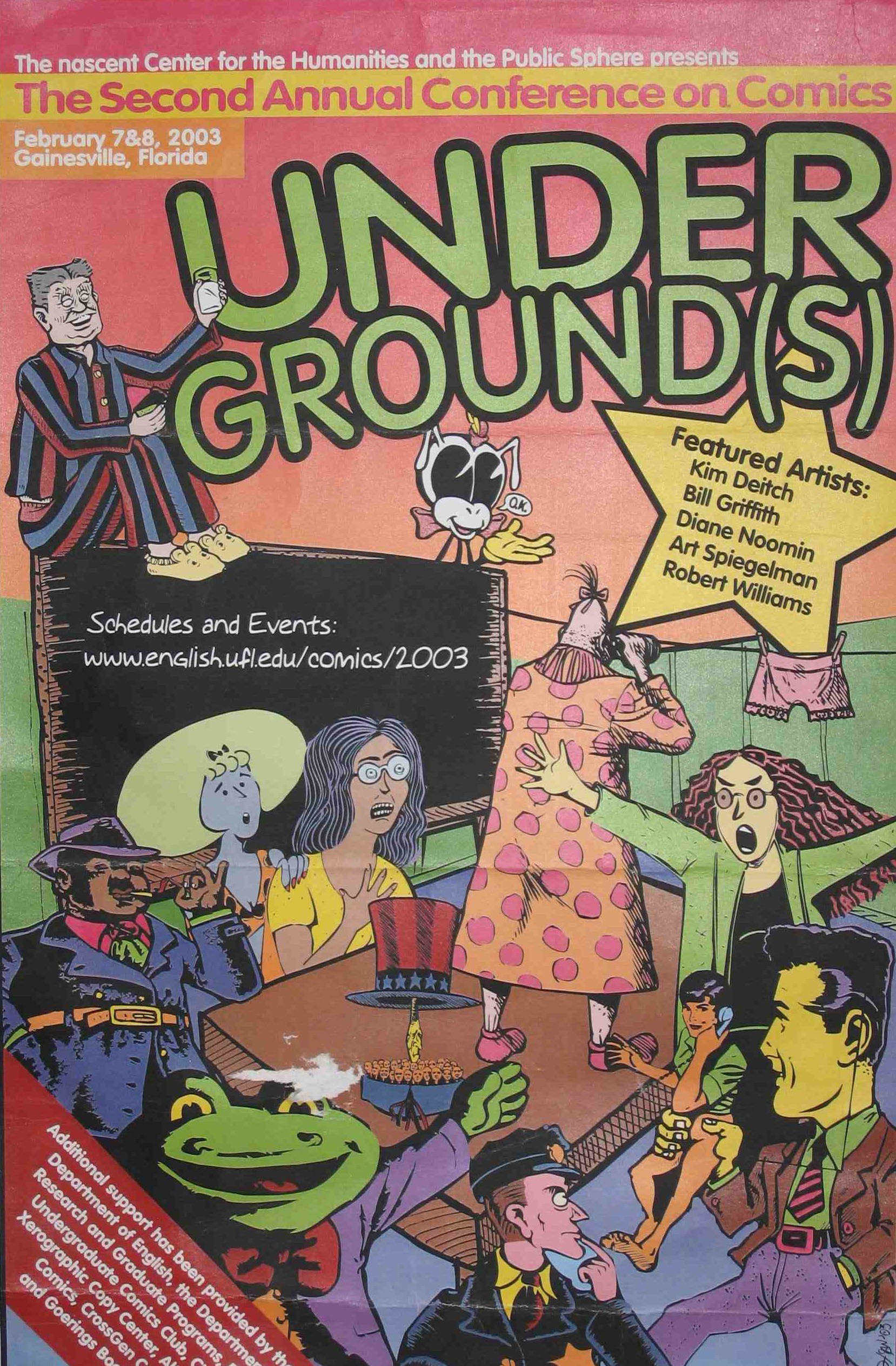
I had attended the Underground(s) conference on Comics and Graphic Novels at the University of Florida in 2003. It was organised by Donald Ault. At that conference I presented a research paper…titled “Down Under Ground: Emotional and Oppositional Outpourings from Sydney’s Subculture in the Comics of Glenn Smith”. Smith’s comics seemed to be an echo of the Underground comix of the late 1960s that began in San Francisco. They were different in style and content to the mainstream North American super-hero themed comics. They opened up the way for autobiographical and artform approaches. At that conference I heard from some of the creative figures from the original Underground(see back cover of program below). It was pleasing to describe Glenno’s work, and argue that it had some resonance with what they had done.

Front cover of Underground(s) conference program. (Design by William S. Kartalopoulos)


Back cover of Underground(s) conference program. (Design by William S. Kartalopoulos)


Underground(s) poster (detail).
Underground(s) conference poster (detail).

Have you read any Underground comics? I’d love to hear your thoughts about them as well as reactions to this post. 

This is the twelth in a series of posts titled Archives of Australian Comics History. They document moments in the recent history of Australian comics, particularly alternative comics and the Australian Small Press. I started researching this subject in the late 1990s. It eventually led to the writing of my doctoral thesis.  Details: Ph.D., Macquarie University, Division of Society, Culture, Media and Philosophy, for the thesis…A Study Of Contemporary Australian Alternative Comics 1992-2000…With Particular Reference To The Work Of Naylor, Smith, Danko And Ord, 2003. On completion of the research I donated the large number of comics I had collected…to the National Library of Australia: Michael Hill Collection of Australian Comics.

(All text, photos and artwork except where otherwise stated-©2013 Dr. Michael Hill a.k.a. Doctor Comics).