An awesome aspect of the recent Internationaler Comic-Salon Erlangen that I attended…in the old university town of Erlangen, Germany, near Nuremberg…was the staging of two contrastingly presented and equally impressive exhibitions of comics art on World War I…by Joe Sacco and Jacques Tardi.

Joe Sacco’s The Great War was displayed as an open-air exhibit in Schlossplatz. It was enlarged on display boards arranged in a long series of folds. Seeing it spread across the square magnified the herculean task that Sacco undertook in drawing this epic, concertina work. It represented one day of the Battle of the Somme fitted into one panel.

His wordless comic is structured around this single seemingly endless panel. It had been folded into 24 segments that unfolds to form a single piece. It depicts events in a continuous, cinema-pan like take. That is spread across time and space with soldiers assembling, attacking, engaging in crossfire and then returning to their lines. The unfolded published comic is too long for a table. Consequently, for exhibition, it has to be spread across the floor of two adjoining rooms or a long corridor. In Schlossplatz it ran right across the square necessitating a reading whilst walking approach. With so much detail it required several passes to take it all in.


The panels above show the trenches and the movement of the soldiers into the hostilities of ‘No Man’s Land’. This includes their exposure to artillery attacks and its associated schrapnel, plus machine gun and rifle fire.

By comparison, the war comics art of Jacques Tardi were exhibited indoors. Low level lighting created a sombre mood appropriate to the theme. It also perhaps protected the original art work from exposure. Corrections such as the whiting-out of errant black border lines and some alignment and registration marks were visible. This was the original art on display! It was not it’s cleaned up and reduced size reproduction as seen in the published comics.
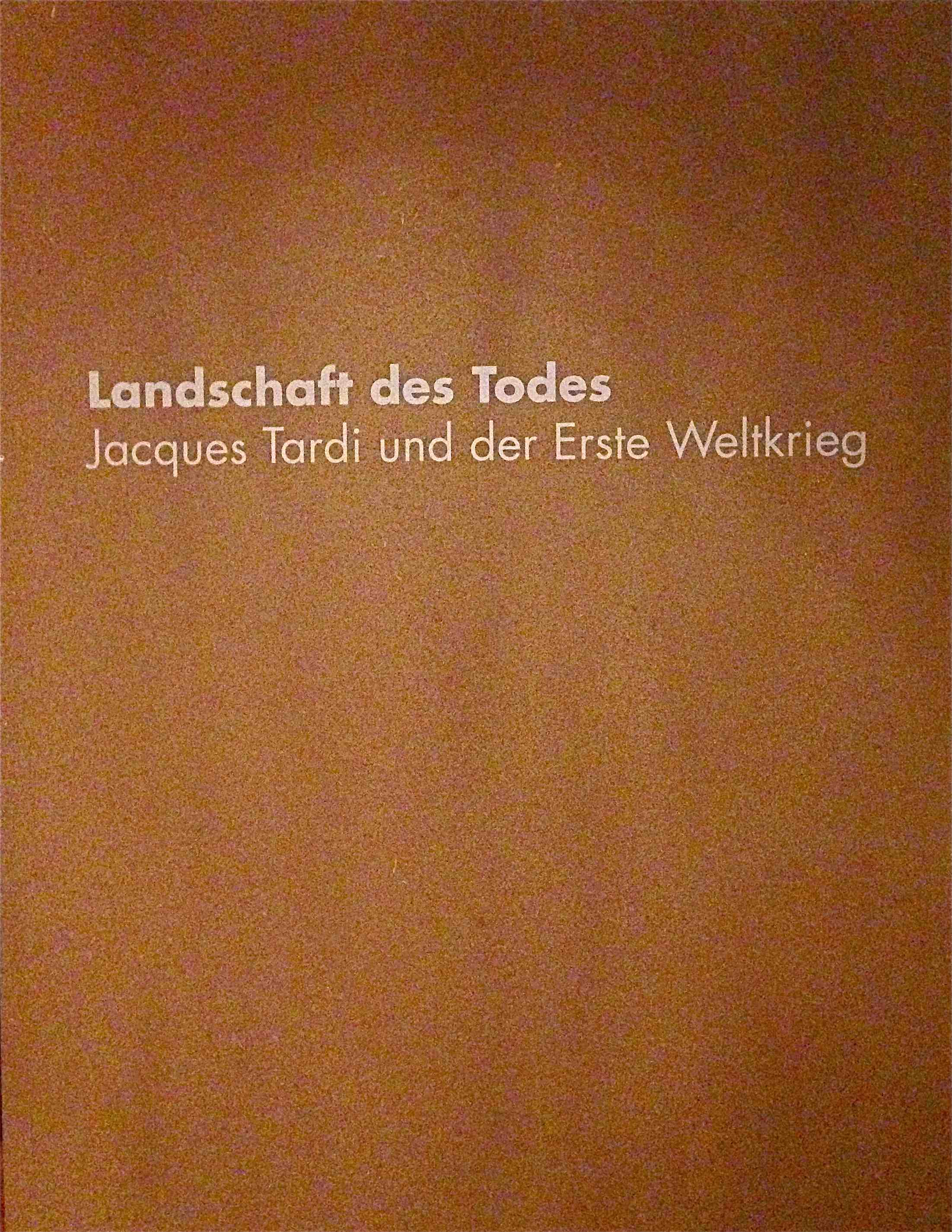

The work, titled Landscape of Death, was bleak, expressing the agony of those who fought in World War I. Many of the images were painful to view. These included soldiers’ bodies torn apart by flying pieces of shredded metal. They were lacerated, disfigured or rendered limbless, with some surviving in this state.
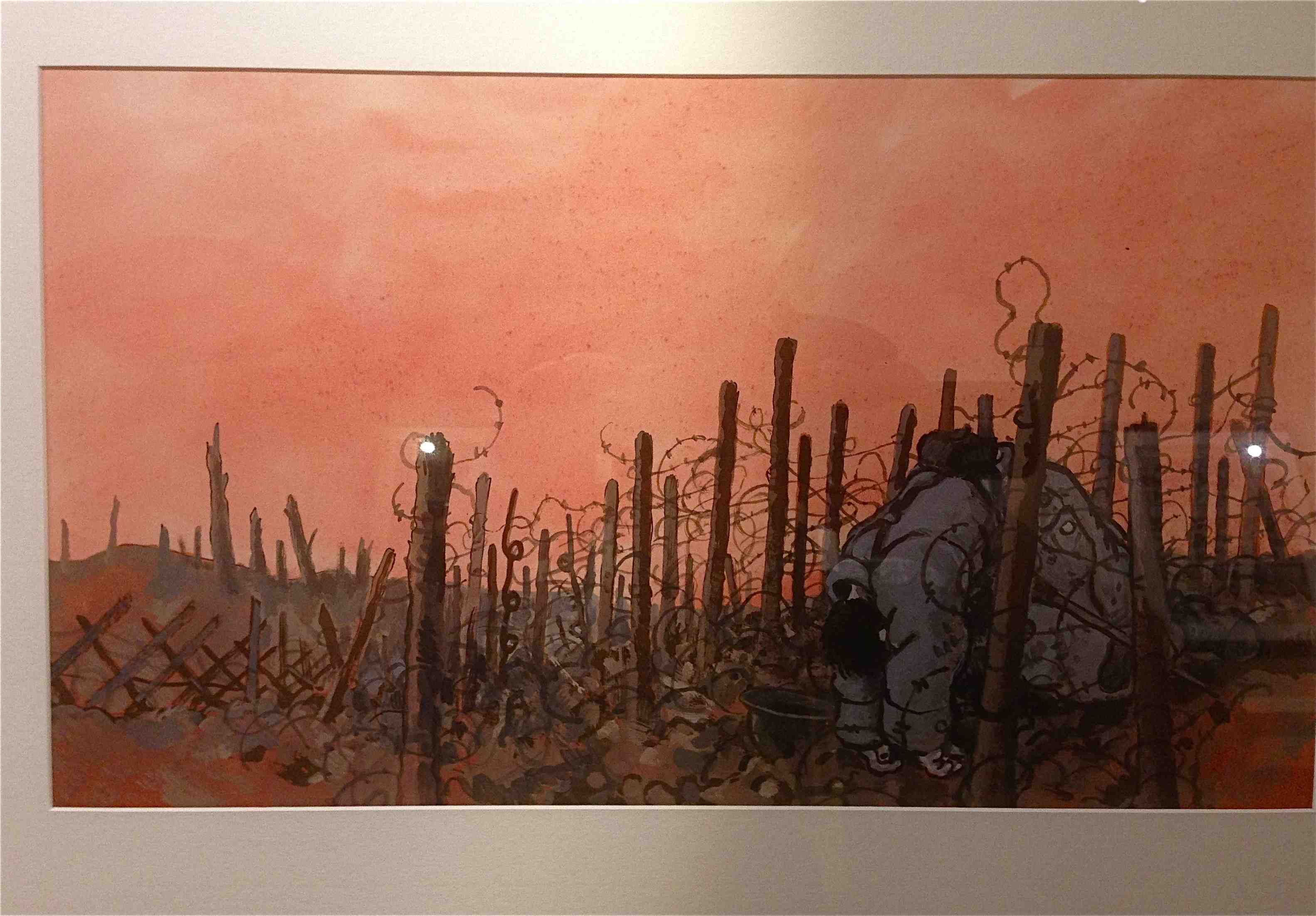
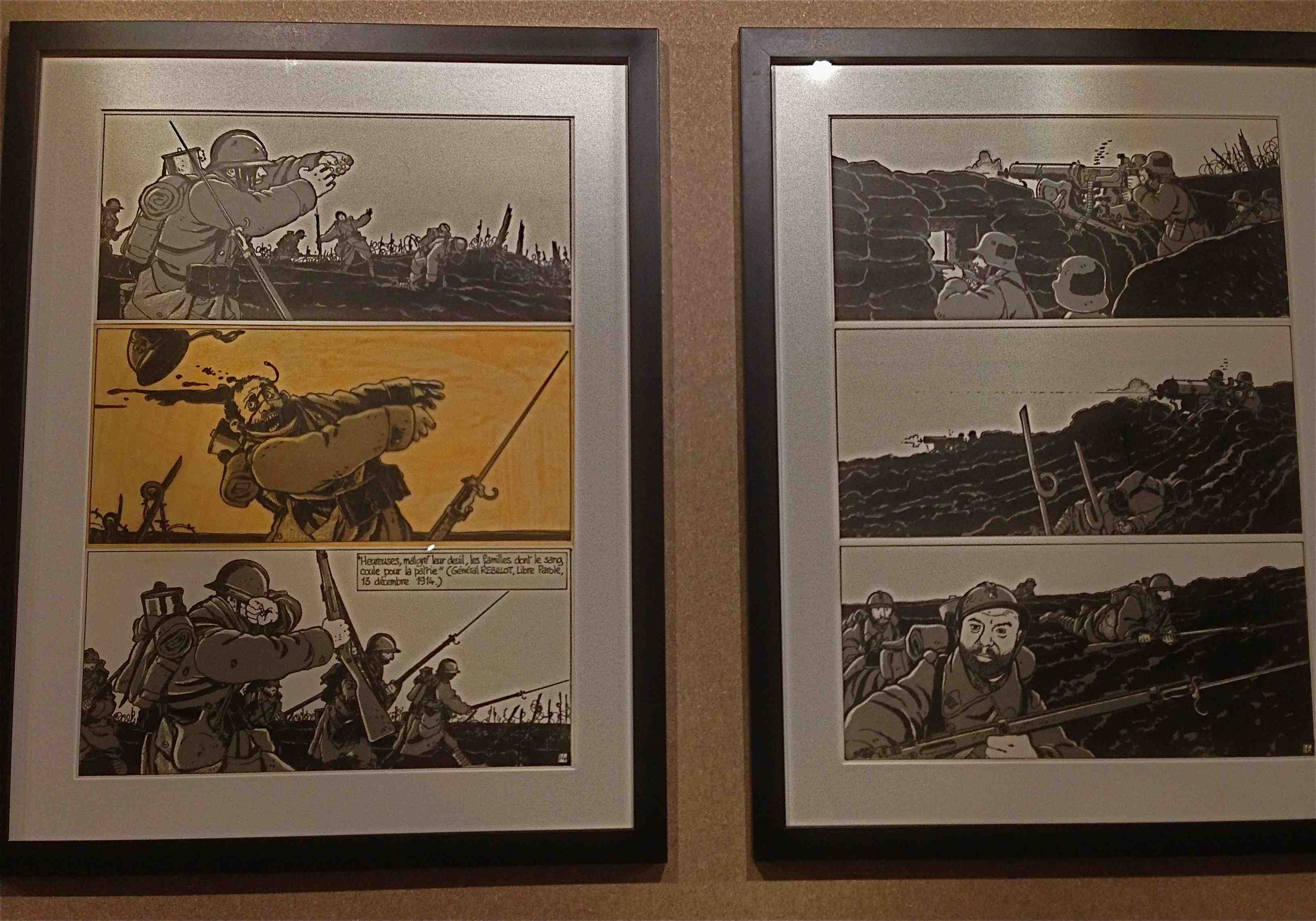
Exhibited in a darkened theatre, the low level of the light created a reverent atmosphere for the images. It also acted as a canopy of protection, from fading, for the original art work. The work was housed in a series of narrow wooden walled and roofed walk-throughs. Some shapes were cut into the walls so that one could see out to lessen the confined effect. Tardi’s use of colour was impressive. His delicate watercolour brushwork added a poignant hue to his poppies, pools of blood and rising smoke.

These two exhibitions, Sacco and Tardi respectively, had contrasting presentations:…open-air/indoor; …spacious/confined;…sunlight/low level artificial illumination;…expansive/confined;…complete/edited; …served to express and communicate aspects of the texts/open…the vulnerability of soldiers both out of the trenches and restricted by the narrow confines of the trenches;…time-one day or six years of living with gas masks, flame throwers, helmets, barbed wire…and the dampness, misery, the stench of rotting bodies, despair and the ongoing expectation of death. This all made a memorable imprint on me, Michael.
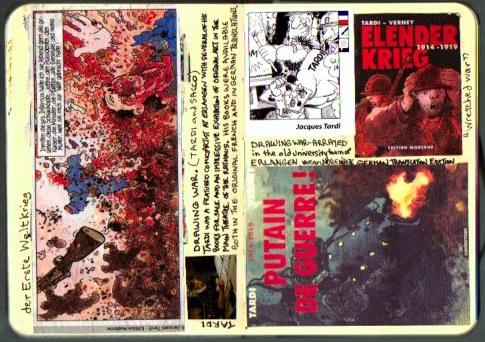
UPDATE 2017: I found this discarded Jacques Tardi sticker (below) from the set that the Erlangen organisers were disseminating…and decided to add it to this post, Michael.

(All text, photos and artwork-©2014 Dr. Michael Hill a.k.a. Doctor Comics).
 Doctor Comics