Month: August 2012

BLOTTING PAPER The Comic: Production Report No.9

Art, Blotting Paper, Comics August 21, 2012

Work continues on the production of the second chapter of my artist book/comic…Blotting Paper: The Recollected Graphical Impressions Of Doctor Comics. This report looks back at two of the main characters from the first chapter, the feline characters Cohl and Busch. These are funny animal characters that belong to Doctor Comics.

The cats in my Blotting Paper comic. (Felt pen drawing-©2012 Dr. Michael Hill a.k.a. Doctor Comics)

These feline characters Cohl and Busch are named after famous cartoonists of mine Émile Cohl and Wilhelm Busch. They live in the apartment with Doctor Comics as his companions. They l-o-v-e fish! They also know about comics, as much and possibly more than their owner, the so called Doctor Comics. In lecturing mode Doctor Comics has been known to channel Cohl! That cat is incredibly well read but with a distinct bias toward bandes dessinées.
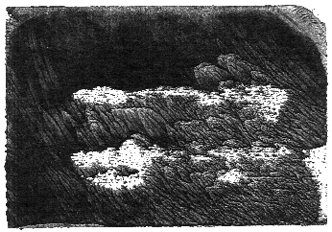
The subconscious landscape. (Monotype print-©2012 Dr. Michael Hill a.k.a. Doctor Comics)

Printmaking is playing a formidable role in the design of the spirits, ghosts and apparitions in this chapter. I am experimenting with sequential prints. This is a hangover from my animation days when I utilised the technique to generate large volumes of artwork.

Dreaming time. (Monotype print-©2012 Dr. Michael Hill a.k.a. Doctor Comics)
Monotype print in sumi ink of etheric body. (© 2012 Michael Hill)

Monotype print in sumi ink of etheric body. (© 2012 Dr. Michael Hill a.k.a. Doctor Comics)

In this chapter the Doctor Comics character is teleported into the supernatural world via a dream experience. To obtain a shadowy landscape for some ethereal figures he encounters, sumi-ink blots have been soaked on soft paper. Over and under-inking the blocks has resulted in intense black or under-inked white patches on the printed paper.

Monotype print in sumi ink of etheric body. (© 2012 Dr. Michael Hill a.k.a. Doctor Comics)

This dream sequence occurs toward the end of the chapter. There Doctor Comics confronts fearful looking ghostly figures that step out from the background. The monotype printing method and the use of sumi ink enabled the making of experimental images with a restricted palette. The incorporeal characters were manifested and embodied in this manner. Examples of these are in the monoprints of the etheric body and the shadowy phantoms above and below this paragraph.

Monotype print in sumi ink of shadowy phantom. (© 2012 Dr. Michael Hill a.k.a. Doctor Comics)

And it’s not all ghostly material. There are also some amusing moments of Doctor Comics buying graphic novels, interacting with his cats and cooking.
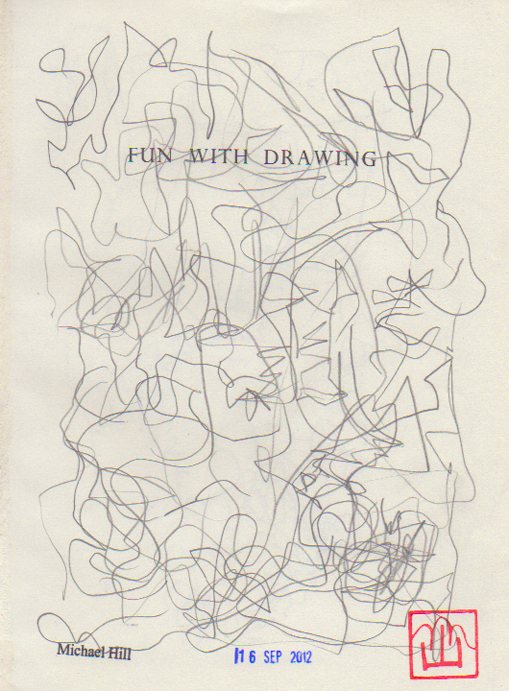
Abstract drawing. (© 2012 Dr. Michael Hill a.k.a. Doctor Comics)

This new chapter also includes experimental approaches to drawing including abstract, contour and blind contour. It’s creative fun time with this drawing process.
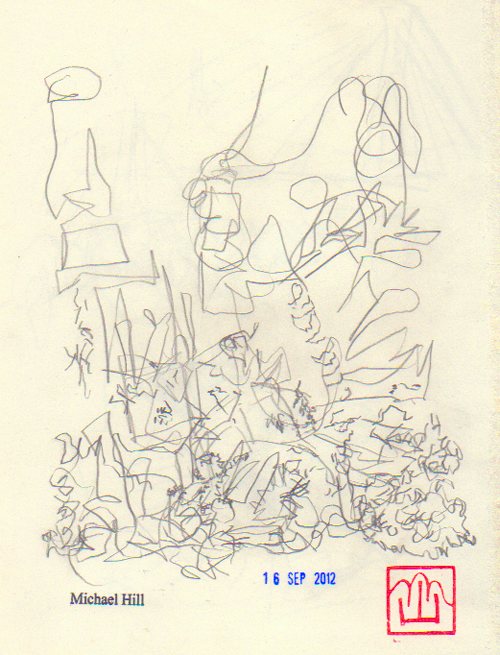
Abstract contour drawing.(© 2012 Dr. Michael Hill a.k.a. Doctor Comics)

Using line as an element of construction and expression, drawn, printed or written, although restrictive, is quite expressive. I find that drawing details very carefully of constantly changing scenes with accompanying alterations in point-of-view leads easily into abstraction.
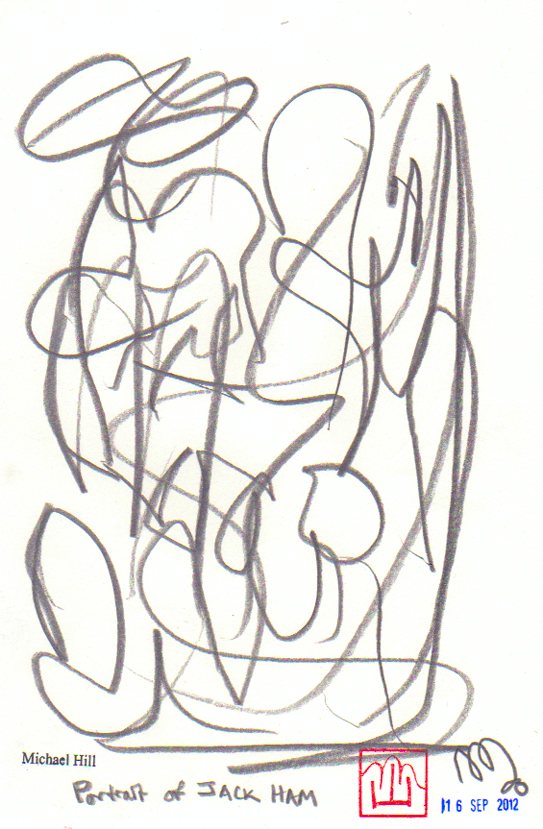
Abstract drawing to music.
(© 2012 Dr. Michael Hill a.k.a. Doctor Comics)

Drawing anything whilst listening to music invariably produces a pattern of abstract lines on paper that is most expressive. I follow the lines whilst I am making them and try to keep up with the tempo of the music. No erasers! A quicker tempo produces less inhibited lines and surprising shapes.
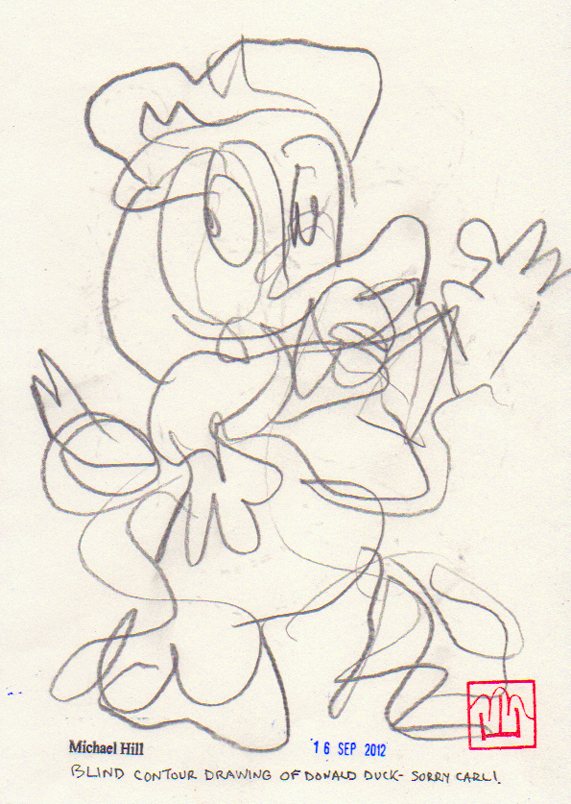
Blind contour drawing of Donald Duck.
(© 2012 Dr. Michael Hill a.k.a. Doctor Comics)

Another fun drawing exercise I have utilised is copying a character or object without looking at my drawing. I try to follow the outlines of the object but don’t look down to see how the drawing looks. Without the constant checking things can drift and shift out of perspective and registration. The contours can be accurate but out of place. How about you? Do you draw? Have you ever created images using printmaking methods? I would love to hear. Feel free to post a comment about your image-making approach on this blog and I shall respond. Till next post, Michael.

(All text, photos and artwork. (©2012 Dr. Michael Hill a.k.a. Doctor Comics)

Archive of Australian Alternative Comics: COMICS IN RECORD SHOPS

Archive of Australian Alternative Comics, Art, Comics August 8, 2012

In the 1990s it was not unusual to find alternative comics in record shops in Sydney. Examples were Phantom Records, Red Eye Records and Waterfront Records. Customers could find an assortment of locally made comics…in a corner on the floor or on a shelf or display rack. Odd sized comics which did not fit the display racks were laid on the floor. A similar layout could be found in Brisbane at Rocking Horse Records…in Canberra at Impact Records and in Adelaide at Big Star Records and Dominator Records. It was in these record shops that I first found some Australian alternative comics. These became the subject of my research into comics. There were also specialist bookshops that stocked comics as well as fantasy, science-fiction and movie material. In Sydney such shops were Land Beyond Beyond, Comic Kingdom, Kings Comics, and Half A Cow. The latter was a really wonderful shop to browse in with its carefully selected subcultural range of goods. It also had that strange logo of a cow cut in half…across not along like the Damien Hirst version and in cartoon rather than realistic style. There were also mail order distros such as Chewing Gravel that sold Australian comics.

The shop in Glebe. (Photo by Louise Graber)


Half A Cow business card with it’s eye catching sliced cow illustration.

The reason why independent record shops were selling alternative comics…was perhaps due to the perceived affinity of both medium’s independent approach to production and distribution. This positioning of the small press in the independent landscape…created parallels with the independent music industry that had flowed on from the Punk Rock movement. The term ‘Xerox music’ referred to the independent production of Punk records where the distribution system also employed a D.I.Y. approach with product being delivered to interested shops by hand. Alternatively it could be distributed by mail order. There were similarities in the way alternative comics were produced and distributed. These comics of the 1980s and 1990s…with their small print runs (usually less than 500), were commonly printed on photocopy machines by their creators. This was instead of the more costly offset process or digital printing used by professional print technicians for commercial clients. After printing their comics the creators, like their musical colleagues, would distribute their work themselves. Visiting comics, books and record shops…on foot, bus, train or bicycle…were creators carrying small amounts of stock in their bags. Then they would return a week later to check on sales. Eventually most of the more mainstream comics shops carried some alternative comics. There were even some musicians who made comics. Ray Ahn, Ryan Vella and Glenn Smith are examples. Half A Cow’s affinities with independent music ended up morphing them from a bookshop into an independent record label. Have you ever bought a comic from a record shop? I would love to hear!

Louise Graber's Black Light Angels comic-first sold at Half A Cow in Glebe.
Louise Graber’s Black Light Angels Gothic comic-first sold at Half A Cow in Glebe.

This is the ninth in a series of posts called Archives of Australian Comics History…that document moments in the recent history of Australian comics, particularly alternative comics and the Australian Small Press. I started researching this subject in the late 1990s and it eventually led to my PhD thesis: …Ph.D. Macquarie University, Division of Society, Culture, Media and Philosophy…A Study Of Contemporary Australian Alternative Comics 1992-2000…With Particular Reference To The Work Of Naylor, Smith, Danko And Ord, 2003. On completion of the research I donated the materials and comics I had collected to the National Library of Australia:…Michael Hill Collection of Australian Comics.

(All text, photos and artwork except where otherwise stated-©2012 Dr. Michael Hill).