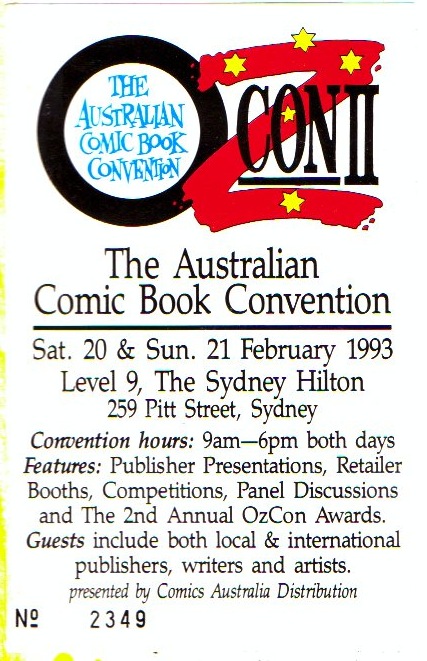
In terms of the large comics conventions in Australia prior to the current events Supanova, Animania, SMASH!, Armageddon and the earlier Comic-Fest, there was OZCON. Before that there was one event called ComicCon back in 1979. OZCON was the big, annual comics convention at the time I began researching Australian alternative comics in the late 1990s. The promotion of the more mainstream imported comics seemed to be the raison d’être for the event…although there was some minor presence by independent creators and their publications despite the cost of their participation. Some comics discussion panels also took place. I recall one between Eddie Campbell and Dave Sim about the distribution of independent comics. That was both informative and entertaining. Campbell was most amusing. This event provided a sense of community for local creators to meet…discuss their self-published comics…and compare their work to the imported product.
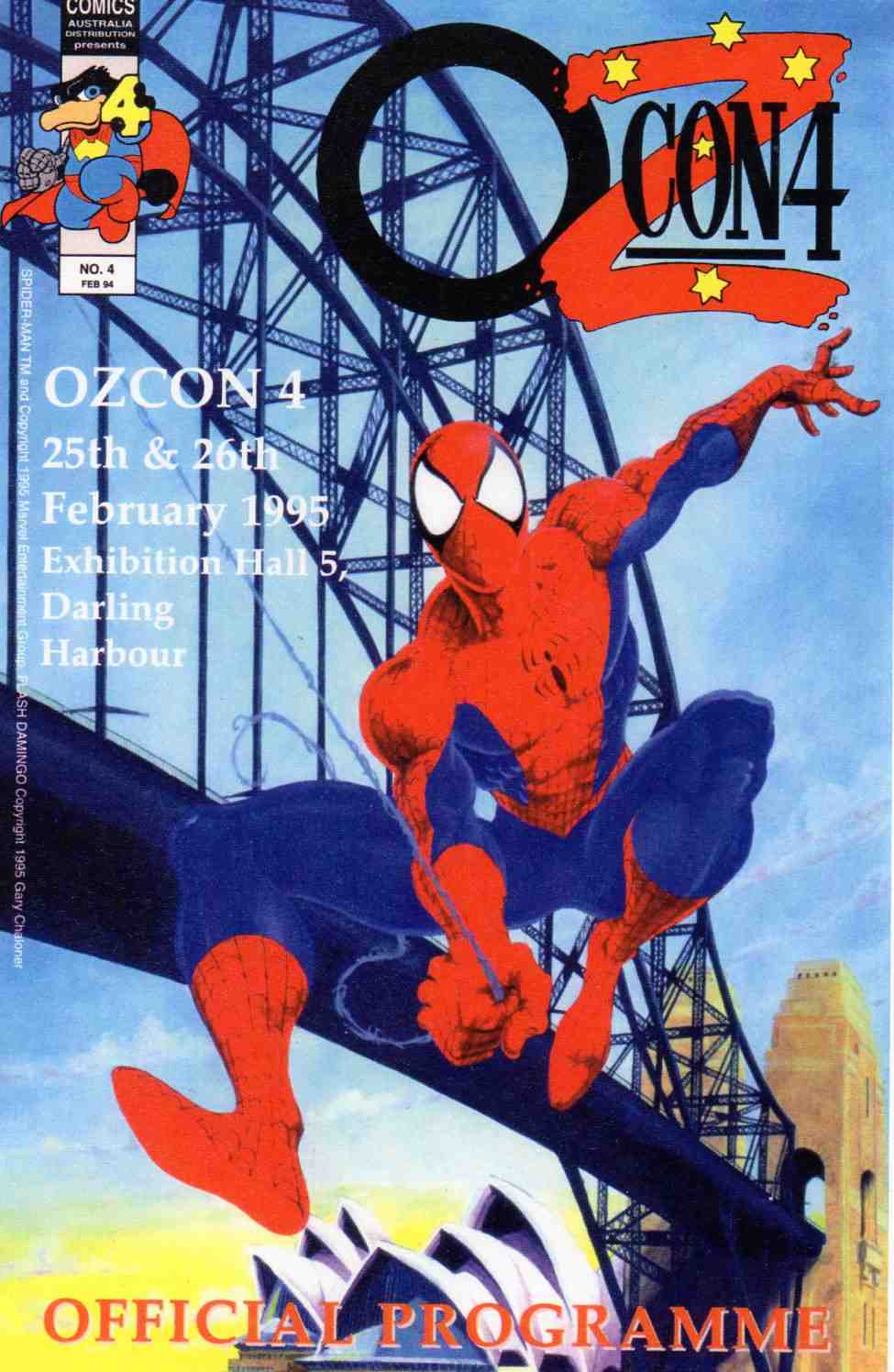
(Poster design by Ant Larcombe)
The poster for OZCON in 1995. Australian comics creators and fans back then had the spectre of the US super-hero genre hanging over them. It was a wonderful poster! It was designed by local comics creator and former student of mine Ant Larcombe…a graduate of Sydney College of the Arts. I had worked there as an academic staff member of the Visual Communication Design Department. The cover had an inset of the super-hero dressed avatar and character Flash Domingo by another Australian creator, Gary Chaloner.
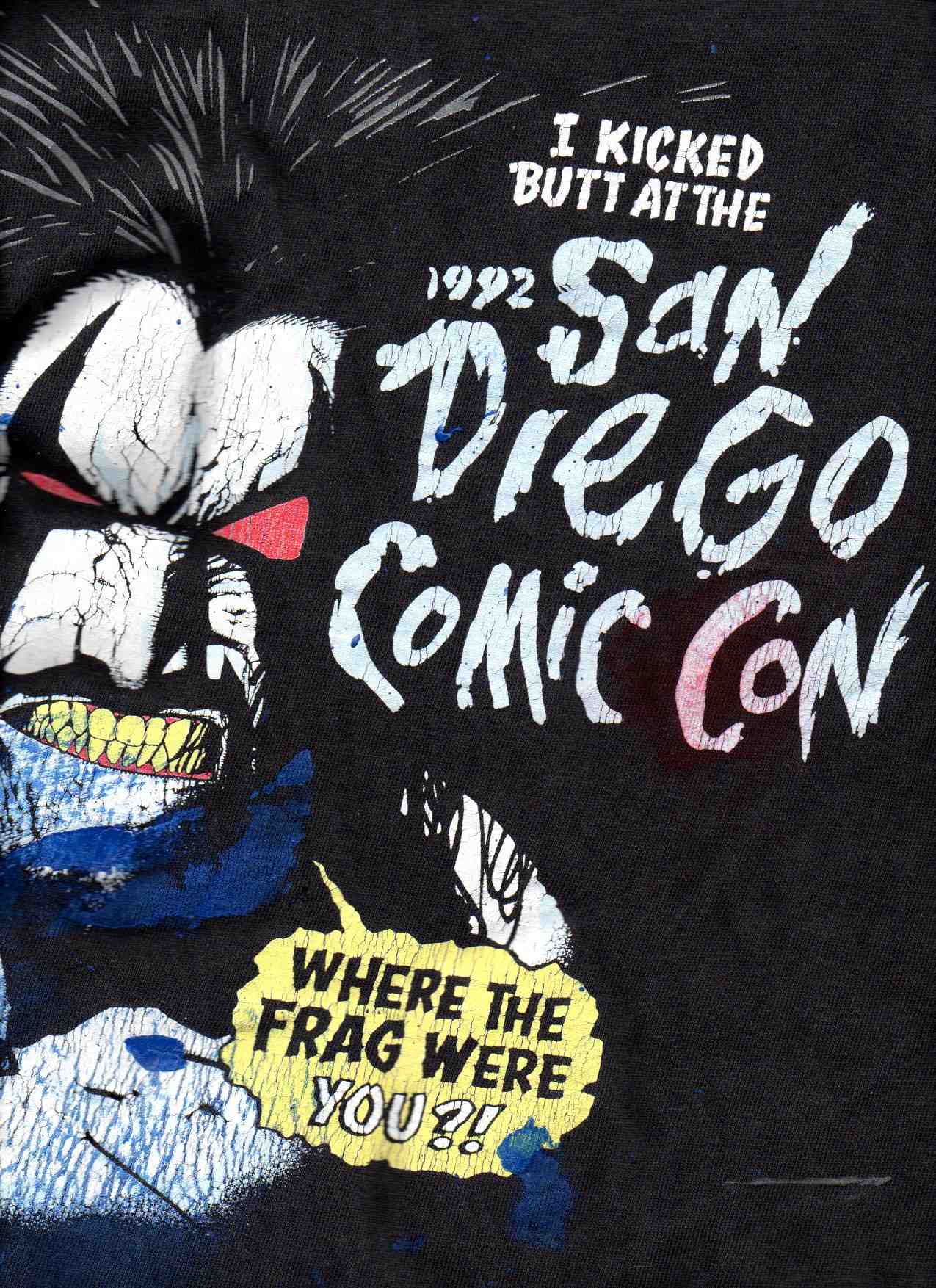
Reflecting on OZCON made me think of an American comics convention that I attended. “BIG” is a key descriptor. Above is a scan of the T-shirt I bought at what is considered the largest comics convention in the USA…San Diego Comic Con. It was from an earlier staging of that event, had been discounted as a remainder but caught my eye. The in-your-face aggression, confidence, swagger and speech balloon seemed to say what that convention was all about. The blue paint stains are a subsequent addition from my having worn it whilst doing one of my printmaking sessions. There were fewer than 50,000 attendees at the San Diego Con back in 2000. Over the past decade, however, this convention has grown in size to around three times that number. It remains considerably less than the 500,000 that go to Comiket in Tokyo, twice a year!…which makes a million of them, anually! Anyway, I was very impressed by the U.S.A. event. On the research front, in addition to presenting a paper on “Australian Gothic comics” at the conference…(shout out to my U.S.colleagues Randy Duncan and Peter Coogan)…I got to meet and chat with comics art figures: Will Eisner…Scott McCloud…Gahan Wilson…James Kochalka…Roman Dirge…Jhonen Vasquez…Los Bros Hernandez…Rumiko Takahashi and Jim Woodring. Oh joy! That was a very special and memorable experience for me.
Have you ever been to comics conventions? Which one? If you would like to post a comment about your experience, I would be happy to respond, Michael.
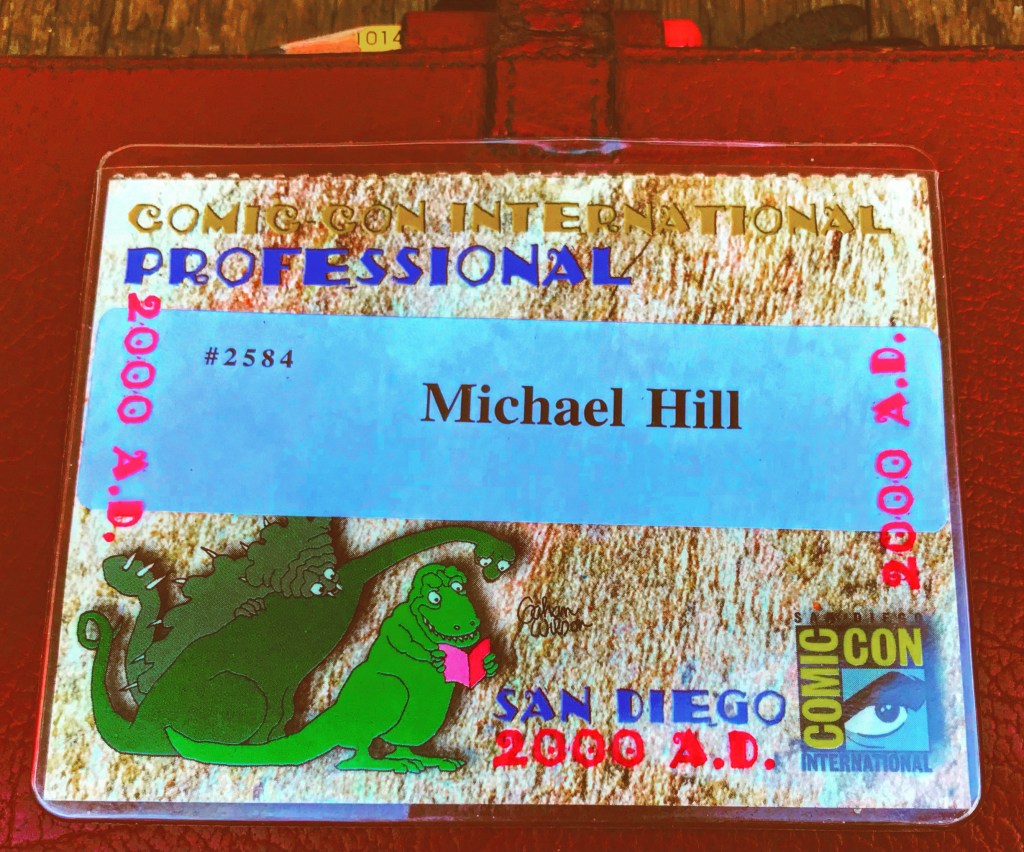
My ComicCon pass designed by Gahan Wilson whom I got to meet at this event.
MIND ROT AND OTHER COMICS ART SEMINARS AND WORKSHOPS AT UTS.
Besides the big comics conventions in Australia and overseas there were smaller Sydney based seminars and workshops. I organised for students of the Visual Communication Design Program at the University of Technology, Sydney. These included MIND ROT, a seminar and accompanying workshop in 1998, poster design by Neil Heymann…plus BIO-HAZARD, and BASICK-INKSTINCT both held in 1996(see posters and post following below).
Whist researching my collection of comics art research materials for my PhD thesis I came across this poster (below). It was for an event that I had conceived and organised at the University of Technology, Sydney, back in 1998. As a lecturer in the Visual Communication Department I was endeavoring to incorporate comics based projects into the course curriculum. It seemed to be an ideal medium in which to apply techniques of visual communication design. I found that students undertaking Word & Image projects were generally enthusiastic about comics. They enjoyed the combination of writing and drawing. To increase the students’ understanding of the professional practice of making comics I decided to involve some practitioners. The event poster(below) was designed by one of my students, Neil Heymann. His modestly carved signature can be discerned on the neck of the shouting head in the poster (below).

With funding from the student group Stop Motion Sickness I enlisted a trio of professional Australian comics creators. These were Mandy Ord from Canberra, Dillon Naylor from Melbourne and Glenn Smith from Sydney. They visited and displayed their comics art work to my Visual Communication Design students. They also described how they went about researching and designing their comics. Mindful of possible regional differences I selected these creators from three different Australian cities. Each comics creator made a 45-60 minute presentation of their work…showing visual examples to the whole class of students. This was followed by a Q&A session. Naylor profiled his comic about Melbourne share-household shenanigans Pop Culture & 2 Minute Noodles. Ord spoke about her intensely inky, autobiographical tales of life in Canberra, Wilnot. Smith described making his painstakingly, linear drawn, slice-of-life The Sydney Morning Hell. Each guest also led a practical, comics art workshop with a small group of students. Experienced comics creator Gerard Ashworth, also from Sydney, attended the seminar and kindly assisted with the workshop proceedings. The event was a small but significant moment in terms of the formal study of the medium.
The seminar’s title? Attempted irony with little bit of cheek, perhaps? I think I was put in a defensive position by the dim view of the medium in the community. There were one or two doubts from some of my colleagues. This was in relation to the presumption that comics be considered a valid form of design. Most of the academic staff supported the study of comics, especially the staff of the Visual Communication Design Department. Back in those days, thirteen years ago, photography was the most popular subject. This was followed by graphic design and illustration. Comics, animation and video were perceived as lesser, although emerging, forms…especially video with the then growing interest in music video. I was taking the study of comics seriously by undertaking academic research into comics art for my PhD degree. I saw this event as a stepping stone to the staging of a conference on comics for researchers and students. The poster was designed by one of students, Neil Heymann, who is now a New York based advertising designer. The notion of comics being a suitable medium of scholarly study and research had already been accepted. The teaching of comics as professional practice, however, remained a hurdle.


These posts form part of the series of posts titled Archives of Australian Comics that document events in the recent history of Australian comics, particularly alternative comics and the Australian Small Press. I started researching this subject in the late 1990s and it eventually led to my PhD thesis: Ph.D. Macquarie University, Division of Society, Culture, Media and Philosophy, A Study Of Contemporary Australian Alternative Comics 1992-2000 With Particular Reference To The Work Of Naylor, Smith, Danko And Ord, 2003. On completion of the research I donated the materials and comics I had collected to the National Library of Australia: Michael Hill Collection of Australian Comics.
All comments welcome, Michael.
(All text-©2011 Dr. Michael Hill a.k.a. Doctor Comics).
 Doctor Comics